This book addresses the topic of integrated digitization of plants on an objective basis and in a holistic manner by sharing data, applying analytics tools and integrating workflows via pertinent examples from industry. It begins with an evaluation of current performance management practices and an overview of the need for a "Connected Plant" via digitalization followed by sections on "Connected Assets: Improve Reliability and Utilization," "Connected Processes: Optimize Performance and Economic Margin " and "Connected People: Digitalizing the Workforce and Workflows and Developing Ownership and Digital Culture," then culminating in a final section entitled "Putting All Together Into an Intelligent Digital Twin Platform for Smart Operations and Demonstrated by Application cases."
eBook - ePub
Digitalization and Analytics for Smart Plant Performance
Theory and Applications
- English
- ePUB (mobile friendly)
- Available on iOS & Android
eBook - ePub
About this book
Information
PART 1
CHALLENGES AND OPPORTUNITIES FOR DIGITALIZATION
This part consists of three chapters. Chapter 1 provides the challenges that industries are facing, which defines the needs for digitalization, while Chapter 2 introduces the concept of Connected Plant, which can overcome the challenges. Furthermore, Chapter 3 provides an overview of big data and data analytics for industrial applications.
The industry is at a turning point. On one side, environmental, quality, and safety regulations are becoming ever stricter, and meeting the regulations is the license to operate manufacturing plants. On the other hand, the workforce is evolving, as an information technology (IT) savvy, but less experienced generation moves into roles once held by industry veterans, who have retired or are looking to retire. These trends are making the industrial norms to be rewritten, negatively affecting profitability, reliability, and safety.
The answer lies in the digital transformation. To overcome the challenges, pacesetting companies have already applied digitalization. The experience demonstrates that digitalization can turn a distracted organization—that is bogged down in reacting to day‐to‐day issues—into an agile, well‐oiled machine that proactively anticipates issues and organizes to prioritize and solve them before they occur and escalate. Thus, industrial companies need digital solutions to integrate different data sources and advanced analytics incorporating with organization culture and day‐to‐day processes to make more informed decisions in real time to run their production processes more efficiently. Done right, it can empower personnel and makes the decision and implementation process more effective and can solve problems that could not be solved before. It can build a culture with digital information at the core. In short, digitalization seeks to achieve all that we sought from digitization in the past, albeit more effectively and efficiently. More importantly, digitalization aims to create new value beyond digitization by enhancing companies' business capabilities and achieving operation excellence across the entire operation value chains.
The best outcome for digitalization is achieved by the proper integration of IT (data centric), OT (Operation Technology; control centric), and ET (Engineering Technology; model centric), which is designed to monitor current events and predict new events, detect early warning signs of failure, and make changes to process operations and enterprise business for better profit, efficiency, reliability, and safety. The most representative of digitalization is digital twin. By taking advantage of advanced “digital twin” technology, process engineers can implement around‐the‐clock monitoring of plant performance, and ongoing operational health checks and optimization to maintain the best plant performance every day.
1
CHALLENGES FOR OPERATION EXCELLENCE
1.1 INTRODUCTION
Environmental, quality, and safety regulations are becoming ever stricter, and meeting the regulations is the license to operate manufacturing plants. In today's competitive environment, process plants are under more pressure than ever to deliver improved operating performance. Making the things even more challenging, the workforce is evolving, as an information technology (IT) savvy, but less experienced generation moves into roles once held by industry veterans, who have retired or are looking to retire. These trends are making the industrial norms to be rewritten, affecting profitability, reliability, and safety.
Thus, the industry is at a turning point. The answer lies in the digital transformation. To overcome the challenges, pace‐setting companies have already applied digital transformation. The experience demonstrates that digitalization can turn a distracted organization—which is bogged down in reacting to day‐to‐day issues—into an agile, well‐oiled machine that proactively anticipates issues and organizes to prioritize and solve them before they escalate. Thus, industrial companies need digital solutions to integrate different data sources with advanced analytics to make decisions in near real time to run their production processes more efficiently. Done right, it can empower personnel and makes the decision and implementation process more effective and can solve problems that could not be solved before. It can build a culture with digital information at the core. In short, digitalization seeks to achieve all that we sought from digitization in the past, albeit more effectively and efficiently. More importantly, digitalization aims to create new value beyond digitization by enhancing companies' business capabilities and achieving operation excellence across the entire operation value chains.
For most industrial plants, mere Industrial Internet of Things (IIoT) deployment is no longer a competitive advantage without understanding the implications of these insights. These advantages could be anything from improving safety to productivity to operational efficiency to workflow integration and automation. This is the part where true business outcome is delivered. To achieve the best digitalization outcome, it requires optimal integration of IT, operation technology (OT), engineering technology (ET), and data technology (DT). IT consists of computers, networking devices, and other devices to generate, process, store, secure, and exchange all forms of electronic data. OT mainly includes industrial sensors and control systems, while ET comprises process models simulation and optimization and best practices for operation. DT consists of data analytics and machine learning (ML) technology.
This integration of IT/OT/ET/DT creates significant value for companies and will lead to new business opportunities and growth. A properly designed digital twin is the best representation of this integration. The book will focus on the methodology of Connected Plant, which is designed to achieve the optimal integration of IT, OT, ET, and DT for operation excellence in the form of digital twins.
1.2 OPERATION ACTIVITIES IN A PROCESS PLANT
Process operation activities can be represented as a hierarchy (Figure 1.1). The foundation of the structure is composed of field devices (Level 1) such as sensors, transmitters, actuators, and valves that measure process variables such as flows, compositions, temperatures, and pressures, which are required for any industrial control system.
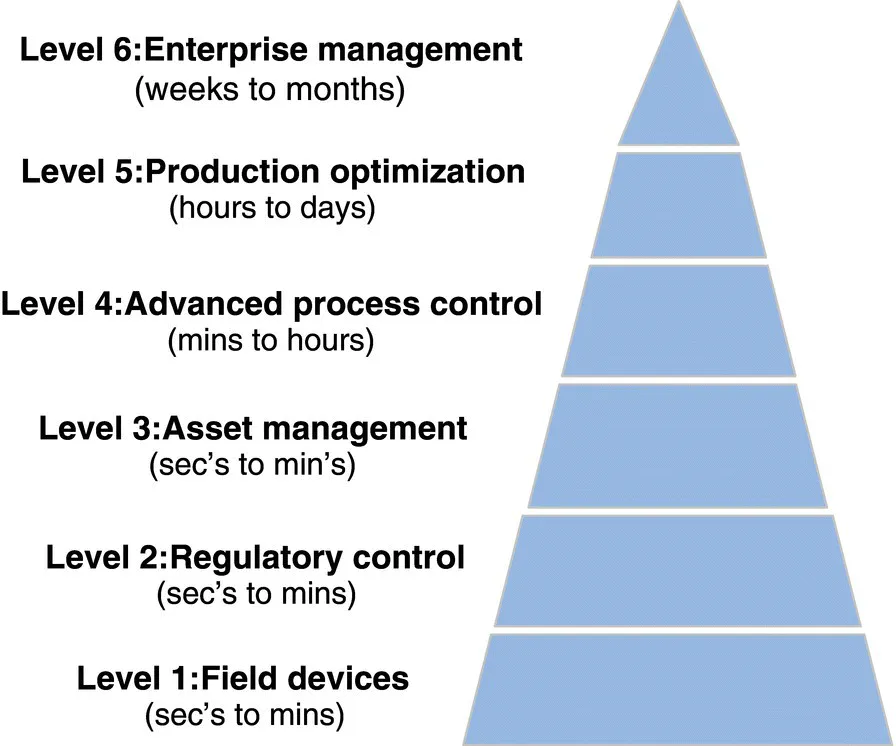
FIGURE 1.1. Six‐level hierarchy for process control and optimization.
The next level (Level 2) consists of regulatory controllers, which maintain measured values within specified limits. Process control plays a key role in ensuring process safety and protecting personnel, equipment, and the environment (Level 3).
While regulatory controllers tackle each variable individually, the advanced process control such as multivariable and constraint controllers (Level 4) evaluates multiple variables simultaneously and enables an entire process unit close to a set of limiting constraints. To determine the optimum set points for a set of controllers, real‐time optimization (Level 5) is employed, which also consider advanced control strategies beyond control modules, process supervision and coordination, shutdowns and start‐ups, reliability and safety management, maintenance scheduling, etc.
At Level...
Table of contents
- COVER
- TABLE OF CONTENTS
- TITLE PAGE
- COPYRIGHT PAGE
- DEDICATION
- PREFACE
- ACKNOWLEDGMENTS
- PART 1: CHALLENGES AND OPPORTUNITIES FOR DIGITALIZATION
- PART 2: MODEL THINKING FOR SMART OPERATIONS
- PART 3: CONNECTED PLANT FOR SMART OPERATIONS
- PART 4: DIGITAL SOLUTIONS FOR SMART OPERATIONS
- INDEX
- END USER LICENSE AGREEMENT
Trusted by 375,005 students
Access to over 1.5 million titles for a fair monthly price.
Study more efficiently using our study tools.
Frequently asked questions
Yes, you can cancel anytime from the Subscription tab in your account settings on the Perlego website. Your subscription will stay active until the end of your current billing period. Learn how to cancel your subscription
No, books cannot be downloaded as external files, such as PDFs, for use outside of Perlego. However, you can download books within the Perlego app for offline reading on mobile or tablet. Learn how to download books offline
Perlego offers two plans: Essential and Complete
- Essential is ideal for learners and professionals who enjoy exploring a wide range of subjects. Access the Essential Library with 800,000+ trusted titles and best-sellers across business, personal growth, and the humanities. Includes unlimited reading time and Standard Read Aloud voice.
- Complete: Perfect for advanced learners and researchers needing full, unrestricted access. Unlock 1.5M+ books across hundreds of subjects, including academic and specialized titles. The Complete Plan also includes advanced features like Premium Read Aloud and Research Assistant.
We are an online textbook subscription service, where you can get access to an entire online library for less than the price of a single book per month. With over 1.5 million books across 990+ topics, we’ve got you covered! Learn about our mission
Look out for the read-aloud symbol on your next book to see if you can listen to it. The read-aloud tool reads text aloud for you, highlighting the text as it is being read. You can pause it, speed it up and slow it down. Learn more about Read Aloud
Yes! You can use the Perlego app on both iOS and Android devices to read anytime, anywhere — even offline. Perfect for commutes or when you’re on the go.
Please note we cannot support devices running on iOS 13 and Android 7 or earlier. Learn more about using the app
Please note we cannot support devices running on iOS 13 and Android 7 or earlier. Learn more about using the app
Yes, you can access Digitalization and Analytics for Smart Plant Performance by Frank (Xin X.) Zhu in PDF and/or ePUB format, as well as other popular books in Technology & Engineering & Chemical & Biochemical Engineering. We have over 1.5 million books available in our catalogue for you to explore.