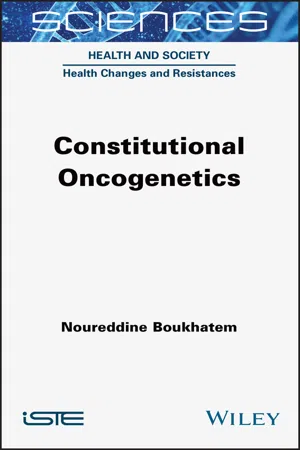
Constitutional Oncogenetics gives precise descriptions of the main syndromes that cause a predisposition for cancer. The first part examines the most common syndromes in the majority of the world, including the heightened hereditary risk of breast and ovarian cancer and Lynch syndrome. The second part introduces less common infracentesimal syndromes, such as Bloom syndrome and Fanconi syndrome. This book is intended for oncogenetic practitioners and other specialists, as well as medical students.
- English
- ePUB (mobile friendly)
- Available on iOS & Android
eBook - ePub
Constitutional Oncogenetics
About this book
In the age of genomics, oncogenetics is a growing discipline. It is defined as the identification and management of families where there is a suspected hereditary risk of cancer. This relatively new discipline is part of a modern medicine that aims to be both preventive and predictive.
Information
PART 1
Major Syndromes
1
Hereditary Breast and Ovarian Cancer Syndrome Including Isolated Ovarian Cancers
In this chapter, we will describe the genetic predisposition to breast and ovarian cancers, including situations where the only cancers encountered are ovarian cancers.
1.1. Introduction
Inherited cancer syndromes are characterized by germline genetic mutations, which are associated with a high risk of cancer development. These mutations are usually inherited in an autosomal dominant manner and often induce cancers at a relatively early age. Hereditary cancer syndromes are rare, accounting for only about 5–10% of all breast cancers.
In addition to hereditary breast and ovarian cancer (HBOC, BRCA1/BRCA2) syndrome, breast and ovarian cancers are components of several autosomal dominant cancer syndromes: Li–Fraumeni syndrome (TP53), Cowden syndrome (PTEN) and hereditary diffuse gastric cancer syndrome (CDH1). The risk of breast cancer is higher in people diagnosed with these syndromes and there is a risk of developing tumors in other organs.
Other genetic syndromes may include breast cancer as an associated trait: the heterozygous carriers of the deleterious mutations of the ATM gene (ataxia-telangiectasia) and the STK11 gene (Peutz–Jeghers syndrome).
Lynch syndrome (LS) is primarily associated with colorectal and endometrial cancer, although several studies have shown that patients with LS have a higher risk of developing breast cancer.
Ovarian cancer is also associated with LS and Gorlin syndrome.
Mutations in other genes are also associated with an increased risk of developing breast cancer (checkpoint kinase 2 [CHEK2], PALB2, NBN and BARD1) or ovarian cancer (BRCA1 interacting protein 1 [BRIP1], RAD51C and RAD51D).
Recent studies have shown that half of the pathogenic mutations identified in individuals who meet only the HBOC test criteria were in genes other than BRCA1/2. Similarly, half of the pathogenic mutations identified in individuals who meet only the criteria for LS testing were in genes that are not part of the LS predisposition genes.
These same studies have shown the usefulness of testing people suspected of developing or who have developed HBOC for a list of 25 genes (BRCA1, BRCA2, ATM, CHEK2, PALB2, NBN, BARD1, BRIP1, RAD51C, RAD51D, MLH1, MSH2, EPCAM, MSH6, PMS2, APC, MUTYH (biallelic), BMPR1A, SMAD4, TP53, PTEN, STK11, CDH1, CDKN2A and CDK4).
While MUTYH biallelic mutations are known to cause MYH polyposis-associated syndrome with a 28-fold increased risk of colorectal adenocarcinoma, monoallelic carriers have been reported to have only a slight increase in colorectal cancer risk (odds ratio of ~1.34), but together with an increased risk of breast cancer.
The most recent studies have confirmed the association of 15 genes with an increased risk (>2.0 times) of breast cancer (ATM, BARD1, BRCA1, BRCA2, CDH1, CDKN2A, CHEK2 (except p.I157T), MLH1, MSH2, MSH6, NF1, PALB2, PTEN, RAD51D and TP53). Eleven genes were associated with an increased risk (>2.0 times) of ovarian cancer (ATM, BRCA1, BRCA2, BRIP1, MSH2, MSH6, NBN, PMS2, RAD51C, RAD51D and TP53).
In this section, we will discuss the roles of BRCA1 and BRCA2 genes in predisposition to both breast and ovarian cancers; CHEK2, PALB2, NBN and BARD1 in predisposition to breast cancer; and BRIP1, RAD51C and RAD51D in predisposition to ovarian cancer.
1.2. Prevalence
Approximately one in 300–400 people in the general population is born with an inherited mutation in the BRCA1 or BRCA2 gene. The frequency of BRCA1 or BRCA2 mutation is approximately one in 40 in the Ashkenazi Jewish population.
PALB2 pathogenic variants have been examined in multiple small studies of familial and early breast cancer in multiple populations. The prevalence of pathogenic variants ranged from 0.4% to 3.9%. Similar to BRIP1 and CHEK2, there was incomplete segregation of PALB2 pathogenic variants in families with hereditary breast cancer.
It is estimated that mutations in RAD51C increase the risk of ovarian cancer by 9% and occur in approximately 1–5.7% of women with ovarian cancer (without considering any selection criteria).
It is estimated that one in 200 people with ovarian cancer will have a constitutional mutation in the RAD51D gene.
When should one suspect a genetic predisposition? The following section outlines the criteria for referral for an oncogenetic consultation, according to the National Comprehensive Cancer Network (NCCN).
1.2.1. Genetic risk assessment criteria1
1.2.1.1. A person with cancer
For a diagnosed patient, the reasons for referral for an oncogenetic consultation, according to the NCCN, are as follows:
- 1) a person with ovarian cancer2;
- 2) a person diagnosed with breast cancer who meets one of the following criteria:
- – a mutation known in the family in a cancer predispositi...
Table of contents
- Cover
- Table of Contents
- Copyright
- Foreword
- Introduction
- PART 1: Major Syndromes
- PART 2: Infracentesimal Syndromes
- Appendix: Summary of the Book
- References
- Index
- End User License Agreement
Trusted by 375,005 students
Access to over 1.5 million titles for a fair monthly price.
Study more efficiently using our study tools.
Frequently asked questions
Yes, you can cancel anytime from the Subscription tab in your account settings on the Perlego website. Your subscription will stay active until the end of your current billing period. Learn how to cancel your subscription
No, books cannot be downloaded as external files, such as PDFs, for use outside of Perlego. However, you can download books within the Perlego app for offline reading on mobile or tablet. Learn how to download books offline
Perlego offers two plans: Essential and Complete
- Essential is ideal for learners and professionals who enjoy exploring a wide range of subjects. Access the Essential Library with 800,000+ trusted titles and best-sellers across business, personal growth, and the humanities. Includes unlimited reading time and Standard Read Aloud voice.
- Complete: Perfect for advanced learners and researchers needing full, unrestricted access. Unlock 1.5M+ books across hundreds of subjects, including academic and specialized titles. The Complete Plan also includes advanced features like Premium Read Aloud and Research Assistant.
We are an online textbook subscription service, where you can get access to an entire online library for less than the price of a single book per month. With over 1.5 million books across 990+ topics, we’ve got you covered! Learn about our mission
Look out for the read-aloud symbol on your next book to see if you can listen to it. The read-aloud tool reads text aloud for you, highlighting the text as it is being read. You can pause it, speed it up and slow it down. Learn more about Read Aloud
Yes! You can use the Perlego app on both iOS and Android devices to read anytime, anywhere — even offline. Perfect for commutes or when you’re on the go.
Please note we cannot support devices running on iOS 13 and Android 7 or earlier. Learn more about using the app
Please note we cannot support devices running on iOS 13 and Android 7 or earlier. Learn more about using the app
Yes, you can access Constitutional Oncogenetics by Noureddine Boukhatem in PDF and/or ePUB format, as well as other popular books in Medicine & Medical Theory, Practice & Reference. We have over 1.5 million books available in our catalogue for you to explore.