This book is available to read until 23rd December, 2025
- 248 pages
- English
- ePUB (mobile friendly)
- Available on iOS & Android
eBook - ePub
Available until 23 Dec |Learn more
About this book
Discover a fresh new offering for your farm or orchard business
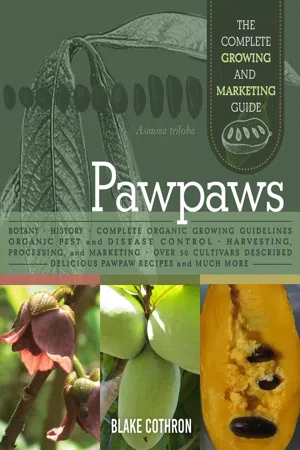
Pawpaws is the first in-depth guide to small-scale commercial cultivation of pawpaws. Also known as Indiana bananas or hipster bananas, this almost forgotten fruit, native to North America, is making a huge comeback with foodies, chefs, craft brewers, and discerning fruit-lovers.
Written by, and for, the organic grower, coverage includes:
- Botany and the cultural history of pawpaws
- Orchard siting and planning
- Choosing the best-quality nursery trees
- Descriptions of over 50 cultivars
- Propagation and organic growing tips
- Pests and disease management
- Marketing and selling fresh pawpaws, seeds, and starts
- Processing and producing value-added products.
Get ahead of the farming curve, diversify your orchard or food forest, and discover the commercial potential of America's almost forgotten native fruit with this comprehensive manual to small-scale commercial pawpaw production.
Frequently asked questions
Yes, you can cancel anytime from the Subscription tab in your account settings on the Perlego website. Your subscription will stay active until the end of your current billing period. Learn how to cancel your subscription.
No, books cannot be downloaded as external files, such as PDFs, for use outside of Perlego. However, you can download books within the Perlego app for offline reading on mobile or tablet. Learn more here.
Perlego offers two plans: Essential and Complete
- Essential is ideal for learners and professionals who enjoy exploring a wide range of subjects. Access the Essential Library with 800,000+ trusted titles and best-sellers across business, personal growth, and the humanities. Includes unlimited reading time and Standard Read Aloud voice.
- Complete: Perfect for advanced learners and researchers needing full, unrestricted access. Unlock 1.4M+ books across hundreds of subjects, including academic and specialized titles. The Complete Plan also includes advanced features like Premium Read Aloud and Research Assistant.
We are an online textbook subscription service, where you can get access to an entire online library for less than the price of a single book per month. With over 1 million books across 1000+ topics, we’ve got you covered! Learn more here.
Look out for the read-aloud symbol on your next book to see if you can listen to it. The read-aloud tool reads text aloud for you, highlighting the text as it is being read. You can pause it, speed it up and slow it down. Learn more here.
Yes! You can use the Perlego app on both iOS or Android devices to read anytime, anywhere — even offline. Perfect for commutes or when you’re on the go.
Please note we cannot support devices running on iOS 13 and Android 7 or earlier. Learn more about using the app.
Please note we cannot support devices running on iOS 13 and Android 7 or earlier. Learn more about using the app.
Yes, you can access Pawpaws by Blake Cothron in PDF and/or ePUB format, as well as other popular books in Business & Agribusiness. We have over one million books available in our catalogue for you to explore.
Information
1 Foraging for Wild Pawpaws
We’ll start off this pawpaw journey the same way I began my relationship with this most curious, elusive, and desirable of trees...searching for them in the wild. That search has not been a disappointment in any way. It has been extremely enjoyable and complex, owing to the species’ very diverse and colorful past and promising future as an important multi-purpose temperate fruit tree.
Why would one want to forage for wild pawpaws? There are a number of reasons. First, it’s often fun and educational, and you can see how these trees grow naturally. Second, many wild trees produce good-quality fruit that can be harvested. Third, there is much genetic potential in the wild pawpaws within their native range, and trees worthy of propagation and introduction definitely exist out there. They can also provide seed for growing trees or rootstock.
It’s worth noting the eight other species of Asimina that grow in eastern North America. These similar but much less desirable (for fruit production) cousins of Asimina triloba typically do not produce desirable or even edible fruit, yet they may have characteristics to contribute to breeding experiments and are worthy of protection. Others are possible future native landscaping trees and are quite beautiful. For instance, Asimina pygmaea, found in South Georgia and Florida, is very dwarf1 in stature (around 12 to 24 inches tall at maturity) but produces small fruit with little to no eating value. Breeding Asimina pygmaea with a large-fruited Asimina triloba cultivar could possibly produce a dwarf-sized tree that produces good large fruit. I came across Asimina pygmaea or possibly Asimina parviflora many years ago in a forested area near Savannah, Georgia, and thought they were Asimina triloba. I could not figure out why they were so small (around 2 feet tall), until later when I learned they were a different species altogether. So, we have to first make sure we are searching in the correct areas and for the correct species. There are other native subspecies that produce bigger blooms and other characteristics, but none come close to the quality and size of the delicious edible fruit produced by Asimina triloba. Neal Peterson has successfully hybridized different Asimina species with novel results (larger flowers, etc.).2
Unknowingly, I grew up right in the heart of the pawpaw’s native range. Kentucky is known by researchers to be a prime area for locating, researching, and growing premium-quality pawpaws. Most native forested environments in Kentucky contain sizable populations of wild pawpaws. The very best habitat to find them is in moist lowland, riparian zones: the river bottom areas and muddy shores and slopes of small rivers and streams. Often they are on the sunnier east, west, and southern slopes of hills, especially in well-draining areas above waterways. They can also be found growing thick among the sunnier stretches of cleared trails and roads in parklands. Edges where moist meadows meet the forest are also suitable habitats. Contrary to what some people think, pawpaws do not grow in mucky, poor-draining, swampy, or wetland areas! They must have good drainage and soil aeration. You’ll never find pawpaws growing in a swamp, although possibly nearby, uphill a bit on better draining land, no doubt. They cannot handle continual wet feet, meaning, having the roots immersed in water like a cypress tree. Being a species of riparian zones, they are adapted to occasionally having their roots submerged for a few days or a week with no negative repercussions. See the color photos section for a nice shot of an older wild grove in Louisville, Kentucky, growing in a riparian zone that occasionally floods.
Nowadays pawpaw trees are becoming more common in native plant gardens, urban settings, edible landscaping, and some reforestation projects. Make sure to ask permission before foraging for pawpaw fruit growing on someone else’s property! Although pawpaw trees are commonly and sometimes abundantly found in natural areas within their native range, the tricky part is finding the elusive fruit. You will often find lush stands of trees but nothing more than green leaves and branches, with zero to very little fruit yield. Why is that?
To answer, pawpaw trees in the wild (and those left unchecked in your garden) do not grow into a single-trunk form akin to trees such as most pines, oaks, and maple. Their growth habit is more colonial and expansive, forming the proverbial pawpaw patch. First, pawpaw seeds inside fruit dropped in autumn overwinter in forest litter and then germinate in spring, quickly sending down a deep 12+” taproot that soon expands into a full root system. About 6 to 12 weeks later, the plant sprouts a single stem that eventually becomes a single trunk and a year later forms branches, etc., much like any tree. However, like wild plum trees (Prunus americana), pawpaw roots soon sprout forth many shoots, called suckers, from their horizontally growing roots, on trees between about 5 to 7 years old. These emerge from underground to eventually form a clonal stand of genetically identical tree-like suckers, all joined underground by a single root system. All of these suckers can grow to tree size (15 to 20 feet tall, 6 to 12 inches in diameter). Thus, the pawpaw tree becomes a thicket of its own that appears to be many trees closely spaced together (3 to 6 feet apart usually) but is actually only one—an original “mother tree” surrounded by a thicket of tree-size sucker “trees” of various ages and sizes. A pawpaw thicket of one specimen can sometimes span a large area, with suckers forming 10 to 20 feet or more away from the original mother tree, with dozens of tree-like shoots, creating the impression of a stand of many trees growing together. However, being that pawpaw trees are rarely self-fertile, meaning that without the nearby presence of another genetically different specimen in flower at the same time, there will be almost no cross-pollination, and thus zero to scarce fruit set. Add that to the fact that shaded trees produce few flowers each spring, that also happen to utilize an unusual pollination strategy, and you will often find yourself disappointed with the lack of fruit to be harvested from even large pawpaw stands found in the wild. Adding further uncertainty to the situation, the fruit quality in the wild varies greatly from amazing to “spitters” (fruit so bad, you just gotta spit ’em out!). In my foraging trips, I have found about 25% of the wild fruit in Kentucky to be of decent good-eating quality, 50% to be marginally edible, and the other 25% to be spitters.
You can also identify pawpaws by the bark which is very smooth, silver-gray and may often be spotted with holes left by sapsuckers. The twigs and leaves when crushed release an acrid odor I liken to the sulfurous smell of common Fourth of July fireworks.
When you do find good wild pawpaw fruit it is often really good and worth the effort. Foragers that take to the waterways via canoe in rich pawpaw territory tend to come back loaded with buckets of fruit and the least tired. Just keep in mind that pawpaws are only in season for about 4 to 6 weeks, from late August to late September within their main range and September to October in the northern fringe (Michigan, New York, Pennsylvania, Northern Ohio, etc.). Old-timers in Kentucky say that they used to follow the fluttering zebra swallowtail butterflies all the way to the wild pawpaw patches. Whether they are speaking poetically or factually, this might actually be useful, as will be explained later.
Wild pawpaws are easiest to identify when blooming around mid-late April. With no leaves on the trees, the purple-black bell-shaped blooms, an inch or two across, are very conspicuous against the somewhat sparse vegetation around them. Insects will also often be abuzz around the trees. No, you will not smell anything objectionable!
When you do find a good pawpaw patch, rejoice in the abundance and goodness of the pawpaw. Tread lightly, leave no trace, and do not damage the trees or attempt to climb their weak, brittle branches, as this can severely damage the trees. Shaking the branches violently will dislodge many underripe fruit that will never ripen properly. Just check underneath the trees for fruit or give them the slightest gentle shake to dislodge them. Consider helping the patch by planting some genetically different pawpaws nearby, planting pawpaw seeds, maybe cutting down a few invasive trees nearby, or removing some litter. Excellent wild specimens can be propagated via sucker removal or grafting, as will be explained in the propagation section of this book.
2 Description of North American Pawpaw Fruit
By now you know the botany and how to identify wild pawpaws. Worth mentioning is that the North American Pawpaw Growers Association has decided to start using the term “North American pawpaw” when describing Asimina triloba. This may be appropriate sometimes because, as explained earlier, in many tropical regions the unrelated papaya (Carica papaya) is also called “pawpaw,” resulting in a fair amount of confusion. However, for simplicity’s sake, we will assume by now you know this book is about Asimina triloba and not something else, and the term “pawpaw” is what we will call the fruits and trees of the species.
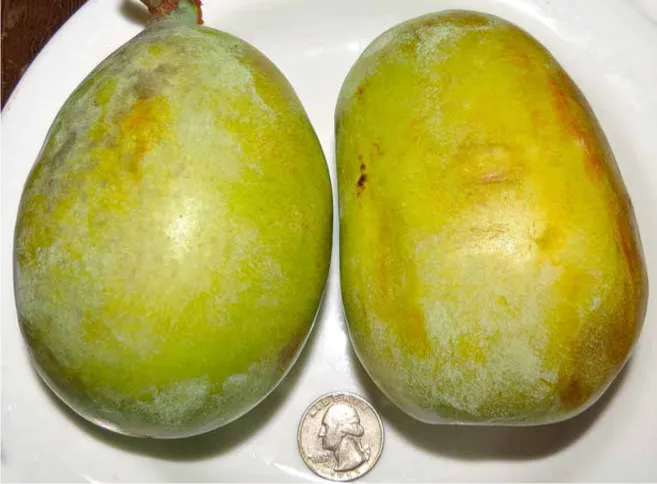
It can be challenging to describe what a pawpaw fruit tastes like unless you are a gourmet cook or unusual fruit enthusiast. It’s fair to say “a pawpaw tastes like a pawpaw.” That’s true. After all, how would one effectively convey the unique flavor of a banana, watermelon, or peach? Like these, pawpaw is unique in and of itself. Most people tend to say they taste like banana, and that is a fair enough ballpark description, but we can get more much in-depth and descriptive. The fact is, many pawpaws don’t taste at all of banana. Pawpaw has many possible flavor combinations, and the nuances are rich and plentiful. However, unlike most fruits, the flavor changes dramatically at the stage of soft ripe to the still edible but quite different overripe stage, with black or brown skin color.
Common positive flavor descriptions of various cultivars include: banana, mango, strawberry, vanilla, persimmon, chocolate, cocoa butter, pumpkin, anise, coconut, Mexican flan, pineapple, citrus/orange, cantaloupe, cherimoya, caramel, honey, marshmallow, nutty...that’s quite a large range of variation! Few (if any!) fruit species in existence would generate such a varied and rich list of possible delicious flavors. In fact, that’s downright impressive. It’s possible that only Durian fruit (Durio zibethinus) would have such a long and varied comparable potential flavor list.
Common positive texture descriptions include: custard, marshmallow, creamy, thick, avocado-like, chewy, buttery, smooth, juicy, refreshing, moist, melting, pudding-like, soft, and silky.
Common negative flavor descriptions include: bitter skin or seeds, bland, nasty, cloyingly sweet, off-flavor, bad aftertaste, acrid, sulfurous, or just “too weird!”
Common negative texture descriptions include: watery, slimy, pasty, goopy, gelatinous, loose, hard, rubbery, gritty, unpleasant, and gross.
In my evaluations of pawpaw cultivars compiled at the end of this book, negative textures and off-flavors of different cultivars are listed and taken seriously as strong deterrents to growers looking to grow quality pawpaws. See chapter 11, Pawpaw Cultivars for many in-depth descriptions of all known pawpaw cultivars.
A challenge with marketing pawpaw in the US is that most 21st century Americans tend to prefer crunchy or firm fruit, even now...
Table of contents
- Cover
- Title Page
- Copyright Page
- Contents
- Dedication Page
- Preface
- Introduction
- 1. Foraging for Wild Pawpaws
- 2. Description of North American Pawpaw Fruit
- 3. Flowering and Pollination
- 4. Site Design and Planting
- 5. Choosing Your Trees
- 6. Maintaining the Orchard
- 7. Harvesting Pawpaw Fruit
- 8. Tree Propagation
- 9. Pests, Diseases, Disorders, and Their Management
- 10. Pawpaw Fruit Marketing Strategies
- 11. Pawpaw Cultivars
- 12. Troubleshooting, Cost Analysis, and Calendar
- 13. Conclusion
- Resources
- Notes
- Index
- About the Author
- About New Society Publishers