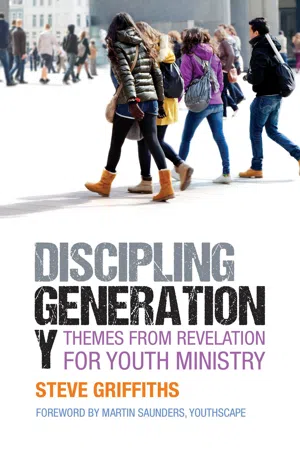
When it comes to discipling Generation Y - those born between 1980 and 2000 - we need to acknowledge that they speak a different cultural language from the rest of us. This is a generation on a passionate quest to find their identity amid a barrage of online information and entertainment, a generation at ease with an astonishing level of global connectivity. Even so, the process of discipleship remains essentially what it always was. Ultimately, we want our young people to be happy and fulfilled. We seek to introduce them into a way of living that takes seriously Jesus Christ as 'the way, the truth and the life' (John 14: 6). This book shows how Revelation offers one of the clearest biblical explorations of Kingdom values at work in highly challenging circumstances. Youth ministry trainer Steve Griffiths unpacks its message with an invaluable mix of theory, Bible study and practical application to show how we can use the themes of this often misunderstood book of the Bible to help us grow young people into mature followers of Jesus, ready to work and witness in a fast-changing world.
- English
- ePUB (mobile friendly)
- Available on iOS & Android
eBook - ePub
About this book
Information
Topic
Theology & ReligionSubtopic
ReligionChapter 1
Generation Y and the book of Revelation
Generation Y: the challenge of discipleship
When it comes to discipling young people, there has been an earthquake of epic proportions. The fault lines have ruptured, the landscape has been irrevocably changed and the old way of being in community together has gone for good. The map must be completely redrawn. This is deeply unsettling for those of us rooted in the values and behavioural patterns of previous generations. Trying to comprehend the worldview of Generation Y is, quite literally, akin to learning a new language. How can we possibly disciple a generation of young people who speak a different cultural language from the rest of us?
Despite the new language, though, the conversation remains the same. The purpose of discipleship is essentially what it always was. We are seeking to introduce young people into a way of living that takes seriously Jesus Christ as ‘the way, the truth and the life’ (John 14:6). We are mindful of Jesus’ proclamation that ‘I came that they may have life, and have it abundantly’ (John 10:10). Ultimately, we want our young people to be happy and fulfilled, and our young people themselves want to be happy and fulfilled. As Christians, we believe that the only way to ultimate fulfilment is to live in a relationship with Jesus Christ. Doing what we can to facilitate and encourage that relationship is the process of discipling. However, when it comes to mentoring Generation Y, we make life much harder for ourselves by misinterpreting the end result of the process of discipling. It is crucial for us to get a thorough understanding of this before we move into a consideration of Revelation and the role it can play in the discipling process.
In Ephesians 5:1, Paul exhorts us to ‘be imitators of God’. Furthermore, he tells us in Colossians 1:28 that his desire is to ‘present everyone mature in Christ’. In our discipling of young people, we have traditionally developed a rather static model on the basis of such biblical ideas. That is to say, we have held to an idea of what Christ is ‘like’, in terms of characteristics, ethical values and behavioural patterns, and have trained our young people to exemplify this likeness in their own lives. In so doing, we have assumed that they are fulfilling Paul’s command to ‘imitate God’. Such an approach, however, is less likely to work for Generation Y, which understands personal authenticity much more in terms of flow and change than static adherence to a preconceived frame of being. To be effective in our discipling of Generation Y, we need a new perspective on the end result; we need to understand afresh what it means to be ‘mature in Christ’.
We find help in the process of redefining discipleship from a rather unexpected source—Carl Jung. In 1932, he gave a paper at the Alsatian Pastoral Conference entitled ‘Psychotherapists or the Clergy’, in which he had this to say:
Are we to understand the ‘imitation of Christ’ in the sense that we should copy his life… or in the deeper sense that we are to live our own proper lives as truly as he lived his in all its implications? It is no easy matter to live a life that is modelled on Christ’s, but it is unspeakably harder to live one’s own life as truly as Christ lived his.
Jung’s point is that Christ was the fullness of humanity because he learned to live his life in true authenticity. He was absolutely authentic to who he was as the Son of God. To ‘imitate Christ’ does not mean that we must attempt to ‘replicate Christ’ in our own beings but that we must pursue our own authenticity as children of God. In essence, God has made me to be me, and he has made you to be you. We only achieve what Paul calls ‘maturity in Christ’ when I am authentically me and you are authentically you. The process of discipleship is helping young people to discover their own authenticity in God, not an attempt to create what Martin Luther called ‘little Christs’. Quite simply, ‘What would Jesus do?’ is the wrong question. The right question is, ‘What would God have me do, as me, in this situation?’
This causes us to reassess our discipling methodologies with regard to Generation Y. If we need to frame the discipling process in terms of the pursuit of authenticity, we must create opportunities not only to teach but also to help them explore. Generation Y discipling must be an intensely creative activity. Catechesis may have a part to play but it can no longer form the whole, as it did with the Silent Generation and perhaps even the Baby Boomers. There are two key ideas that can help us in this.
The power of symbols
The first is that Generation Y is growing up in a semiotic environment, which is to say that symbols hold immense power for them. To a large extent, this is driven by the consumer culture of Generation Y. It really does matter if a young person wears Nike trainers or Adidas. It really does matter if they use a Blackberry or an iPhone. This is not because the products themselves are of particular importance but because there is a meaning inherent within the product that has symbolic power in youth cultures. Young people express who they are through the products they consume and the symbols they wear. We might even say that Generation Y resides in a semiotic world. As we disciple young people, we must be aware of the power and meaning that reside in the symbols they use. We must be careful to interact with their symbols with deep respect, knowing that if we disrespect the symbols, we disrespect them.
With regard to our current study, it is deeply encouraging that young people understand the power of symbols and are content to express themselves in symbolic ways, because the book of Revelation is utterly reliant on symbolic language to express its teaching. Many people fear the book of Revelation because they take the contents as literal. They believe that all the events will take place as described by John. However, understanding these events as literal goes against the grain of scripture. Revelation is part of a writing genre known as ‘apocalyptic’, which uses symbolic language to describe spiritual realities that are too deep and profound for description. There is a great deal of apocalyptic genre in the Bible (for example, Ezekiel, parts of Daniel, parts of Isaiah, Mark 13 and sections of Paul’s letters to the Thessalonians) and it was a widespread tradition of writing in Judaism and in other Middle Eastern religions. We shall see that many of the symbols in Revelation are used in other apocalyptic writings, which makes interpretation all the easier for us. By contextualising Revelation within the apocalyptic tradition, we are encouraged to understand its teachings as ‘true’ but not ‘literal’. That is to say, the ‘events’ of Revelation will happen but not necessarily in the way that John describes them, because he is working within the limitation of human language to describe spiritual ‘truths’ that, by definition, are indescribable. Like Generation Y, John was content to create a semiotic world; he used symbols to speak of truths too deep for ordinary language.
The symbolic nature of John’s vision is apparent to us from the very beginning of Revelation. In 1:10, he writes, ‘I heard behind me a loud voice like a trumpet’ (NIV). The Greek word used here for ‘loud’ is megalein (like ‘megaphone’). However, this word does not refer to volume so much as grandeur: John heard a ‘grand’ voice like a trumpet. In those days, as in ours, trumpets were used when royalty was about to enter the room, and that is what is about to happen here: John is saying his prayers and a grand voice, like a trumpet, announces to him that something special is about to happen. Royalty is about to appear: John is about to be given a vision from the King of kings and Lord of lords.
John continues in verse 12, ‘I turned round to see the voice that was speaking to me’ (NIV). This is a strange phrase because we cannot see a voice; we can only hear it. But the word John uses for ‘see’, blepein, can have more to do with understanding than physical sight. The equivalent in English may be when someone explains a problem that you have struggled to understand and you say, ‘Oh, I see!’ So when he says, ‘I turned round to see the voice’, John means that he gave the voice full attention in order to understand the message. His use of the word blepein contrasts with the next part of this verse, where he says, ‘And when I turned, I saw seven lampstands.’ The word for ‘saw’ used here is different: it is eidon. Although not exclusively, this word often carries an even deeper meaning of sense perception. The English equivalent might be, ‘I saw the wind blowing’ or ‘I saw fear in her eyes.’
It seems, therefore, that John did not see the vision he records in a literal and physical sense. Rather, it was a matter of spiritual perception in his mind’s eye, as the Holy Spirit inspired him to ‘see’. The understanding of this style of writing should take something of the fear out of our study of Revelation. The events described are not so much actual ‘events’ to happen but spiritual ‘realities’ described in symbolic language. As we move through our study together, we shall see that all the key themes of the Christian faith are revealed to John, and to us, so that we can gain assurance and comfort from God in our times of struggle and anxiety. It is incumbent on us, then, to teach Revelation to young people in such a way that God’s original intent is honoured and their faith is deepened accordingly. The fact that Generation Y readily accepts symbolism as a method of transmitting truth should be a real encouragement to us.
Finding our authentic identity
The second helpful key idea is that young people are on a passionate quest to find their identity. The truth is that young people today are dissatisfied with the world, and, as a result, many are dissatisfied with life. Even if they do not vocalise it as such, young people are on a spiritual search. They are growing increasingly distrustful of the machinery of society as the provider of meaning and increasingly reliant on their friendship groups, whether physical or virtual, to discover identity and purpose. Paradoxically, the search for meaning, the spiritual quest, is becoming more and more individualised, yet it is still thoroughly worked out in community. As we shall see in a later chapter, the notion of ‘belonging’ is a core value for Generation Y. It is by ‘belonging’ that many young people discover their authentic identity.
Those of us who are observers of Generation Y often interpret their approach to life as deeply fragmented. From the outside, it seems that young people today labour under the weight of many ‘identities’—one within the home, one at college, one at church, one or more online, one with the extended family and so on. Some young people are forced into this situation, particularly those from ethnic backgrounds who struggle to work out what it means to be, for example, a British Asian. Even for those young people who do not have these pressures, however, the creation of different personas according to context is an habitual way of being. Furthermore, they do not recognise this as fragmentation at all. Rather, their understanding of ‘self’ is not as one static unit but the sum total of what we might recognise as ‘multiple identities’.
Rather than creating a problem, this can have profoundly positive implications for our discipling of young people. Through Revelation, we become convinced that authentic identity is, as Generation Y has discovered, a matter of multiplicity rather than one static concept. This is not least because of our dual location: we reside in two quite different places. John writes in 1:9 that he is ‘in Christ’ but also that he is ‘on Patmos’. He recognises that he has a spiritual location (in Christ) and a physical location (on Patmos). He reiterates this dual location in verse 10 by stating, ‘On the Lord’s Day I was in the Spirit’ (NIV). Again, we see two separate locations, one of physicality (on the Lord’s Day) and one of spirituality (in the Spirit). So John gives us two locations for existence through four phrases—‘in Christ/in the Spirit’ (spiritual) and ‘on Patmos/on the Lord’s Day’ (physical). He recognises a dual identity: we are citizens of heaven but also citizens of earth.
It would be true to say that many of the difficulties young Christians face are primarily a result of working out the tensions felt between their heavenly location and their earthly location. The temptations they face, the sins they fall into, are a result of the fact that they know Christians should behave in one way (spiritual location), but the pull of the body is too great to resist (earthly location). Engagement with Revelation c...
Table of contents
- IMPORTANT COPYRIGHT INFORMATION
- Contents
- Foreword
- Introduction
- Chapter 1
- Chapter 2
- Chapter 3
- Chapter 4
- Chapter 5
- Chapter 6
- Chapter 7
- Chapter 8
- Chapter 9
- Chapter 10
- Bibliography
- About the author
Trusted by 375,005 students
Access to over 1.5 million titles for a fair monthly price.
Study more efficiently using our study tools.
Frequently asked questions
Yes, you can cancel anytime from the Subscription tab in your account settings on the Perlego website. Your subscription will stay active until the end of your current billing period. Learn how to cancel your subscription
No, books cannot be downloaded as external files, such as PDFs, for use outside of Perlego. However, you can download books within the Perlego app for offline reading on mobile or tablet. Learn how to download books offline
Perlego offers two plans: Essential and Complete
- Essential is ideal for learners and professionals who enjoy exploring a wide range of subjects. Access the Essential Library with 800,000+ trusted titles and best-sellers across business, personal growth, and the humanities. Includes unlimited reading time and Standard Read Aloud voice.
- Complete: Perfect for advanced learners and researchers needing full, unrestricted access. Unlock 1.5M+ books across hundreds of subjects, including academic and specialized titles. The Complete Plan also includes advanced features like Premium Read Aloud and Research Assistant.
We are an online textbook subscription service, where you can get access to an entire online library for less than the price of a single book per month. With over 1.5 million books across 990+ topics, we’ve got you covered! Learn about our mission
Look out for the read-aloud symbol on your next book to see if you can listen to it. The read-aloud tool reads text aloud for you, highlighting the text as it is being read. You can pause it, speed it up and slow it down. Learn more about Read Aloud
Yes! You can use the Perlego app on both iOS and Android devices to read anytime, anywhere — even offline. Perfect for commutes or when you’re on the go.
Please note we cannot support devices running on iOS 13 and Android 7 or earlier. Learn more about using the app
Please note we cannot support devices running on iOS 13 and Android 7 or earlier. Learn more about using the app
Yes, you can access Discipling Generation Y by Steve Griffiths in PDF and/or ePUB format, as well as other popular books in Theology & Religion & Religion. We have over 1.5 million books available in our catalogue for you to explore.