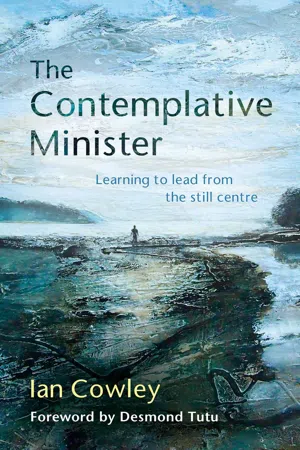
There was a time where Christian ministry offered the opportunity to spend your life in the study of God's word, in reading and reflection, in prayer and sermon preparation, and in the quiet and faithful pastoral care of a community. The world has changed, and with it most of the expectations that govern church appointments. These days there are very few jobs in full time ministry which do not require a heroic combination of stamina, multi-tasking and change management. This book gives practical advice on how to nurture faith and a sense of calling amid the hectic life that is ministry today. Drawing on his experience of developing and leading training programmes in this area, Ian Cowley assesses the stresses and pressures of the job and shows how to grow into being a 'contemplative minister', prioritising a relationship of deepening love with God. He also offers guidance on leading others into that same relationship, without your own spiritual life running dry.
- English
- ePUB (mobile friendly)
- Available on iOS & Android
eBook - ePub
About this book
Information
Topic
Theology & ReligionSubtopic
ReligionChapter 1
Being and doing
‘I will not give you counsel, saying do this or do that. For not in doing or contriving, nor in choosing between this course and another can I avail; but only in knowing what was and what is and in part also what shall be.’
J.R.R. Tolkien, The Lord of the Rings3
In the mid-1970s, when I was a student in South Africa, I first began to explore a call to full-time ordained ministry in the Anglican Church. This was not something that I had ever envisaged as a possible career choice. It was not a possibility that had seemed even remotely attractive to me as a young person leaving school. During my student days at the University of Natal I was drawn into the life and work of a number of university Christian organisations, and I began to encounter something which was profoundly attractive and life-changing. I saw a new community, an alternative society that at its centre was radically different from the established order of apartheid South Africa. I increasingly knew that this was what I wanted to do with my life: to be part of a Church which would be the hope of the nation, the salt and light in a land that desperately needed justice and transformation.
I made an appointment to see the local bishop, Kenneth Hallowes, at his office in Pietermaritzburg, Natal. Bishop Ken already knew me well, and he knew that God was calling me. He made the decision to accept me as an ordination candidate of the diocese, and agreed that I should travel to England to train at one of the theological colleges there. Shortly before I left for England I went to see Bishop Ken again. I suspect he knew that I was a serious minded-young man, determined to make a difference by offering my life in the service of Christ. So he said to me before I left his office that day, ‘Remember, Ian, being comes before doing.’
Those words have stayed with me and have been increasingly important to me over the years: ‘Being comes before doing.’ I have wrestled often, in different times and situations, with the balance between being and doing. My natural instinct is to be doing, to be making things happen, getting things done. I quickly discovered, though, that unless I made time for being, I began to run into difficulty. I would find a weariness and a frustration rising up in me to the point that it threatened to overwhelm me. I found myself like a swimmer in the open sea, only just keeping my head above the waves and the deep water. Surely this was not how it was meant to be.
In the years leading up to the birth of a democratic South Africa in 1994, we went through some exceptionally testing and traumatic times. During those days many of us who were part of the Church in South Africa found ourselves on the frontline of working for justice and reconciliation, in prophetic witness and in care for the poor and the suffering. No one can live through times such as those without experiencing a lot of stress and pain. Following Christ was never going to be easy or comfortable. How do we survive in ministry when the going gets really tough? I knew that my greatest need was to be more and more deeply rooted in the unfailing and unconditional love of God which is offered to us in Christ.
Gradually my understanding of God’s call to me as a priest and minister in the Anglican Church has changed. During the 1980s, when I was rector of a church in a suburban setting on the edge of Pietermaritzburg, I came to realise very clearly that I could not do the work of ministry unless I was, first and foremost, a person of prayer. Prayer had to become the priority of my life. To know God, and to live in relationship with God, was my first call. This had to come first, even before growing the Church or serving the poor or standing for justice. I would only be able to sustain the work to which I knew I had been called if I lived each day in active dependence and trust in God.
Indeed, I could see from those around me that the cost of taking on the work of being an activist in the service of the Lord and of justice and the poor could be very high. In such demanding contexts, unless we are deeply sustained by the resources which only Christ can give us, we are all too likely to lose our way, and perhaps even lose our vocation. Joan Chittister wrote, ‘We have to remember that work is not prayer. It is at best an extension of prayer. We fool ourselves if we argue that we don’t have to pray because we work so hard or our work is so good. Those who work without prayer—no matter how good the work, no matter how sincere the minister—soon dry up inside. They have nothing left to give. Or, the work fails and they have no faith to sustain them, no perspective to encourage them.’4
In the Diocese of Salisbury I help to lead regular days for those in ministry entitled ‘The Contemplative Minister’. The starting point for all that I teach on these days is this: the heart of priestly ministry is the call to an ever deepening relationship of love for God, to lead others into that relationship and to enable them to respond to God in loving service and mission. The heart of our call, very simply, is to know God and to teach our people to pray and to respond to God’s call. Being comes before doing. Ministry is primarily about who you are, not about what you do.
The question that many of us are struggling with is this: how do we live this out? The demands of our role and the expectations placed upon us by others and by ourselves drive us on until we cry out to find a better way of being in ministry. Many times, in the midst of these pressures and demands, I have tried somehow to hold to the promise of Jesus in Matthew 11:28: ‘Come to me all you that are weary and are carrying heavy burdens, and I will give you rest.’
In working this out, it has been important for me to be reminded that Jesus says in Luke 9:25, ‘What does it profit someone if they gain the whole world and lose or forfeit their true self?’ My experience of seeking to live a life of following Jesus is that Jesus is calling me to discover and to become my true self. It is only in becoming my true self that I will find the rest that Jesus promises. Yet the responsibilities of public ministry can make this very difficult. Thomas Merton, the great contemplative writer and thinker, wrote about the tension between the true self and the false self. Merton also wrote a chapter entitled ‘Being and Doing’,5 and he points to the connection between finding my true self and finding the right balance for each of us in our being and our doing.
What is the false self? Merton identifies the false self as the person we wish to present to the world, and the person we want the world to revolve around.6 Richard Rohr, in his book Adam’s Return, says, ‘Our false self is who we think we are. It is our mental self-image and social agreement, which most people spend their whole lives living up to—or down to. It is all a fictional creation. It will die when we die. It is endlessly fragile, needy, and insecure, and it is what we are largely dealing with in the secular West.’7
The false self is the part of us that is most concerned with outward appearances, with appearing strong, or self-confident or successful or busy.
If my main concern in any situation is ‘What are people thinking of me? How do I appear to them?’ then it is likely that my false self is playing a major role. In parish ministry we can easily find ourselves constantly responding to the pressures of meeting other peoples’ expectations. Inevitably some people want to see their minister keeping busy, working hard, growing the church, visiting the church members, producing results. These are some of the expectations that constantly attend the lives of those in public ministry.
We also have to deal with the pressure of our own expectations of ourselves. Many of us are in full-time ministry at least partly because of our own personal history. This may well include a need to be needed or to be seen to ‘be good’. It is important that we become familiar with the inner expectations which drive us and make us who we are. These may well be inherited from important figures in our childhood and youth, our parents, our teachers, even our friends and siblings.
Finding our true selves means moving away from those parts of ourselves that are mainly concerned with proving ourselves to others, whether they be our parishioners and colleagues or figures from our past who may even no longer be alive. Christ calls us to freedom. ‘You will know the truth, and the truth will make you free,’ says Jesus (John 8:32). In becoming my true self I am set free in Christ to be the person I truly am, the real Ian. I am set free from all that hinders me in being close to God who loves me unconditionally and accepts me as the person that he made me to be.
In his book New Seeds of Contemplation, Thomas Merton describes how so much of our energy can be used up in trying to maintain the agenda and the demands of the false self. Merton writes, ‘Thus I use up my life in the desire for pleasures and the thirst for experiences, for power, honour, knowledge and love, to clothe this false self and construct its nothingness into something objectively real. And I wind experiences around myself and cover myself with pleasures and glory like bandages in order to make myself perceptible to myself and to the world, as if I were an invisible body that could only become visible when something visible covered its surface.’8 Merton’s life as a Trappist monk and hermit points us to our own need to look beyond the incessant demands and expectations of others and of our society, and to seek the depths that lie within. However, Merton is also clear that we find our true selves only through love and selflessness, and in relationship and in communion with others.
A better way
The false self is preoccupied with outward appearance, with what other people think about us and about what we are doing. Success and achievement become important because they seem to define our identity and give us a sense of significance. Gradually many of us discover how much of this is hollow, and increasingly we see it for the illusion that it is. No matter how hard we try to fill our lives with more experiences, more achievements, more power and influence, somehow we are no closer to finding real and lasting value or significance. Prestige and influence in society are fleeting, and their pursuit pits us against one another and makes us compare and compete, to very little real and lasting effect.
Surely there is a better way, especially for those set aside by the Church to live the example of Christ. A few years ago the Bishop of Salisbury invited Timothy Radcliffe, the Dominican priest, writer and teacher, to spend Lent in the diocese, and to meet with small groups of clergy to reflect on important issues in our vocation and ministry. Timothy Radcliffe asked us, ‘How did we get from sabbath to the Protestant work ethic?’ He spoke to us about the violence of busyness and rush, and said that it is important for us to be seen to rest with God. ‘We are those who believe that salvation is through grace, not works,’ he said. He reminded us of the importance of ‘divine leisure’: hanging around with God. Timothy said that we need to remember who we are in Christ and refuse to be workaholics.
David Stancliffe, at that time the Bishop of Salisbury, reminded us of the words of St Irenaeus (c.112–c.202), ‘The glory of God is a human being fully alive.’ David Stancliffe then said to the gathering of clergy, ‘Our words will only have authority if we are alive. The question is, “How may you have a life?”’
Becoming a contemplative minister is about taking this question seriously. At the heart of this vision of ministry is the call to become human beings who have discovered what it is to be fully alive in Christ. Our priority will become finding that which is life-giving for us and for those whom we serve. It is also about turning away from all that is life-draining and life-destroying for us and for those around us. We will have to face the insidious demands of the false self, and be willing to choose life and freedom instead of choosing the pursuit of success, pleasure and significance. We will need to be willing to get to grips with the deeper realities of personal transformation, so that we may find our true selves in Christ. Then, by our being in Christ, our doing will speak to those around us of life and peace.
Chapter 2
Knowing our vocation
As Jesus passed along the Sea of Galilee, he saw Simon and his brother Andrew casting a net into the sea—for they were fishermen. And Jesus said to them, ‘Follow me and I will make you fish for people.’ And immediately they left their nets and followed him. As he went a little farther, he saw James son of Zebedee and his brother John, who were in their boat mending the nets. Immediately he called them; and they left their father Zebedee in the boat with the hired men, and followed him.
Mark 1:16–20
The reason to wake up
The word ‘vocation’ literally means ‘calling’. Finding one’s vocation is not only something that is important for Christians and for the work of ministry; vocation is for everyone. We all have a vocation,...
Table of contents
- Foreword
- Introduction
- Chapter 1
- Chapter 2
- Chapter 3
- Chapter 4
- Chapter 5
- Chapter 6
- Chapter 7
- Chapter 8
- Chapter 9
- Chapter 10
- Chapter 11
- Chapter 12
- Chapter 13
- Chapter 14
- Chapter 15
- Conclusion: Returning to the beginning
- Notes
- Acknowledgements
Trusted by 375,005 students
Access to over 1.5 million titles for a fair monthly price.
Study more efficiently using our study tools.
Frequently asked questions
Yes, you can cancel anytime from the Subscription tab in your account settings on the Perlego website. Your subscription will stay active until the end of your current billing period. Learn how to cancel your subscription
No, books cannot be downloaded as external files, such as PDFs, for use outside of Perlego. However, you can download books within the Perlego app for offline reading on mobile or tablet. Learn how to download books offline
Perlego offers two plans: Essential and Complete
- Essential is ideal for learners and professionals who enjoy exploring a wide range of subjects. Access the Essential Library with 800,000+ trusted titles and best-sellers across business, personal growth, and the humanities. Includes unlimited reading time and Standard Read Aloud voice.
- Complete: Perfect for advanced learners and researchers needing full, unrestricted access. Unlock 1.5M+ books across hundreds of subjects, including academic and specialized titles. The Complete Plan also includes advanced features like Premium Read Aloud and Research Assistant.
We are an online textbook subscription service, where you can get access to an entire online library for less than the price of a single book per month. With over 1.5 million books across 990+ topics, we’ve got you covered! Learn about our mission
Look out for the read-aloud symbol on your next book to see if you can listen to it. The read-aloud tool reads text aloud for you, highlighting the text as it is being read. You can pause it, speed it up and slow it down. Learn more about Read Aloud
Yes! You can use the Perlego app on both iOS and Android devices to read anytime, anywhere — even offline. Perfect for commutes or when you’re on the go.
Please note we cannot support devices running on iOS 13 and Android 7 or earlier. Learn more about using the app
Please note we cannot support devices running on iOS 13 and Android 7 or earlier. Learn more about using the app
Yes, you can access The Contemplative Minister by Ian Cowley in PDF and/or ePUB format, as well as other popular books in Theology & Religion & Religion. We have over 1.5 million books available in our catalogue for you to explore.