Resourcing Rural Ministry offers an in-depth exploration of the key aspects, challenges and opportunities of mission in a rural church. Relevant for ordained and lay leaders alike, the book covers subjects ranging from encouraging evangelism in a multi-church group to making best use of church buildings. Containing a wealth of real-life case studies and suggestions for follow-up, this ecumenical publication draws on the expertise and resources of the Arthur Rank Centre (ARC), which has served the spiritual and practical needs of the rural Christian community for over 40 years. This book contributes to ARC's Germinate programme of training, development and support for rural multi-church groups of all denominations. Resourcing Rural Ministry was first developed by Simon Martin as Training and Resources Officer at the ARC. Additional chapters have been contributed by the Revd Caroline Hewlett, Rona Orme and Becky Payne and the final text has been prepared and edited by Jill Hopkinson. 'This book is packed with helpful resources and background theology that will aid the rural church to be a vibrant and relevant presence in today's society.' Revd Peter Ball, Mission and Training Officer, Eastern Synod of the URC 'Read these contributions and you'll be excited by a wealth of experience, insight and resource.' Rt Revd James Bell, Bishop of Ripon
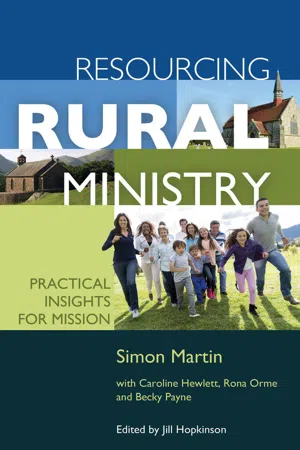
eBook - ePub
Resourcing Rural Ministry
Practical insights for mission
- 208 pages
- English
- ePUB (mobile friendly)
- Available on iOS & Android
eBook - ePub
Resourcing Rural Ministry
Practical insights for mission
About this book
Information
Topic
Theology & ReligionSubtopic
ReligionChurch buildings: serving the community and ministry to visitors
Our church buildings need to offer a SPACE for God, a PLACE for people and a BASE for mission.1
The relationship between a congregation and its building can be both positive and negative. The care of a building is not the primary reason why people join a church, yet congregations find themselves responsible for a place that (they may feel) drains their resources and prevents them from doing certain things, and a place over which other organisations have a say. Many of our churches are under-utilised and, for many congregations, the burden of looking after historic buildings falls on a small group of volunteers.
Many outside the church view our buildings, often the oldest and most prominent in the area, as powerful symbols of stability. The building is seen as a keeper of community stories and traditions, and as providing a sense of the spiritual. Increasingly, congregations are rediscovering the role that church buildings can play in their mission, working with others in their communities to develop new uses, recreating them as assets for the whole community. Buildings are then used for up to seven days a week rather than one in seven. This can often provide a more secure future for the building and reconnect the church with the wider community.
The key is to start with mission. What is God calling you to do? Decide what it is you want to achieve and then look at how your resources—building, people and finances—can help you achieve your objectives. A building project on its own is not going to build a congregation, provide a service to the wider community or help you engage with your wider community.
Ministry to visitors
The Churches Visitor and Tourism Association says, ‘We believe that church buildings are at the forefront of the Church’s mission. Our buildings proclaim—in wood, stone, glass and metal—that “God is in the midst” of every community.’2
Tens of millions of people visit our cathedrals and churches every year. Keeping the building open and extending a welcome is the simplest way for the church to be a living presence for community and visitors alike. Church buildings belong to the whole community, so, to keep them closed to all but a few, on restricted occasions, gives the message that they belong only to the chosen few. An open church is a simple act of hospitality to everyone, whether worshippers, pilgrims or tourists.
There are many reasons why people visit churches.
- • Church buildings bear witness to the Christian faith and offer a celebration of the presence of God in a community. An open church speaks of a welcoming Christian community and a welcoming God.
- • An open church offers a sacred space at the heart of every community where local people and tourists can come and meet with God and find a place for quiet contemplation.
- • Churches are treasure houses of history, from which people of all ages can learn about architecture, history, craftsmanship and ancestry. Their stunningly beautiful interiors provide inspiration and succour to those leading busy, perhaps stressful lives.
- • Churches are key keepers of community heritage, traditions and stories.
- • Other faith groups and people from ethnic minority backgrounds have a genuine interest in finding out more about churches. Open churches can contribute to inter-faith understanding.
The many benefits of opening your doors include:
- • opportunities to share faith and reach new audiences
- • helping people to see that it is a living space
- • the fact that public access is often a requirement of funders such as the Heritage Lottery Fund or other charities
When opening your church for visitors (tourists or pilgrims), the vision for hospitality should form part of all other policies and initiatives and inform all future plans, including developments to the building. Consider setting up an ‘Open Church’ group, which can develop the vision and work through the practical implications. Everyone in your church should be part of the discussion and should understand the implications of opening and what it means to be welcoming.
Barriers
Many rural churches are already open regularly, but for others this can be a challenge. Fears about theft, antisocial behaviour and personal safety are the three main reasons why churches are not open. These are genuine concerns. If you open and leave the building unattended, items may be taken. You may also be in an area where there are particular social problems, raising issues of personal safety and property damage. There may be a subconscious fear that people will come in who do not respect the building or the Christian faith.
However, without wanting to minimise the risks, many of these fears may only apply in very specific circumstances. It is sometimes assumed that insurance policies require churches to be locked but, in fact, an open church is less likely to suffer a theft. The advice of insurance company Ecclesiastical is that, provided the right precautions have been taken, ‘where appropriate, churches are kept open because of the positive effect that has on security. The presence of legitimate visitors will help to deter those with a criminal intent.’3
Both Ecclesiastical and Methodist Insurance provide detailed advice on the practical measures you can put in place to mitigate risk. As long as you implement that advice, you will be covered for the cost of any theft or damage (and your premiums should not go up). It is often less expensive to replace items than to repair damage caused by break-ins.4 There is also guidance available on good practice for personal safety.5
An opening strategy
When opening your church, the following questions need to be considered.
- • What are the best times for the building to be open and what is realistically achievable?
- • Will the building be unattended or will someone be present to welcome visitors and offer a discreet security presence?
- • How does your building look to a stranger coming to it for the first time?
The small Methodist church of Cullen, Moray, in Scotland, has ‘Open Door’ every Wednesday between February and December, from 10.00 am to 11.30 am, for a ‘cuppa and fellowship’.6
Providing a welcome
Visitors will appreciate it if they feel that they have been expected and that thought has been given to making them feel welcome. Many people are reluctant to open a closed church door because, for those who are not regular ...
Table of contents
- IMPORTANT COPYRIGHT INFORMATION
- Foreword
- Introduction
- Mission in rural contexts
- Multi-church ministry
- Discipleship, nurture and training
- Worship
- Encouraging evangelism
- Fresh expressions of church
- Children and young people
- Developing Messy Church
- Church buildings: serving the community and ministry to visitors
- Bibliography
- Acknowledgements
- About the authors
Trusted by 375,005 students
Access to over 1.5 million titles for a fair monthly price.
Study more efficiently using our study tools.
Frequently asked questions
Yes, you can cancel anytime from the Subscription tab in your account settings on the Perlego website. Your subscription will stay active until the end of your current billing period. Learn how to cancel your subscription
No, books cannot be downloaded as external files, such as PDFs, for use outside of Perlego. However, you can download books within the Perlego app for offline reading on mobile or tablet. Learn how to download books offline
Perlego offers two plans: Essential and Complete
- Essential is ideal for learners and professionals who enjoy exploring a wide range of subjects. Access the Essential Library with 800,000+ trusted titles and best-sellers across business, personal growth, and the humanities. Includes unlimited reading time and Standard Read Aloud voice.
- Complete: Perfect for advanced learners and researchers needing full, unrestricted access. Unlock 1.5M+ books across hundreds of subjects, including academic and specialized titles. The Complete Plan also includes advanced features like Premium Read Aloud and Research Assistant.
We are an online textbook subscription service, where you can get access to an entire online library for less than the price of a single book per month. With over 1.5 million books across 990+ topics, we’ve got you covered! Learn about our mission
Look out for the read-aloud symbol on your next book to see if you can listen to it. The read-aloud tool reads text aloud for you, highlighting the text as it is being read. You can pause it, speed it up and slow it down. Learn more about Read Aloud
Yes! You can use the Perlego app on both iOS and Android devices to read anytime, anywhere — even offline. Perfect for commutes or when you’re on the go.
Please note we cannot support devices running on iOS 13 and Android 7 or earlier. Learn more about using the app
Please note we cannot support devices running on iOS 13 and Android 7 or earlier. Learn more about using the app
Yes, you can access Resourcing Rural Ministry by Simon Martin, Caroline Hewlett, Rona Orme, Becky Payne, Jill Hopkinson in PDF and/or ePUB format, as well as other popular books in Theology & Religion & Religion. We have over 1.5 million books available in our catalogue for you to explore.