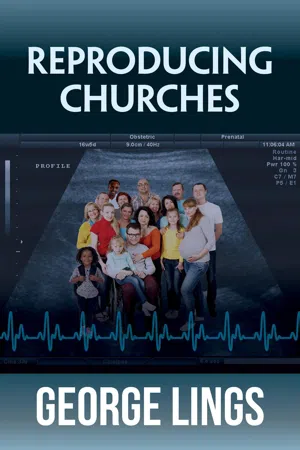
In an original and exciting theological move, senior authority on fresh expressions of Church and church planting, Canon Dr George Lings, suggests that we look at Church differently. Based on extensive research, Lings argues that the Church has a calling and the capacity to reproduce which is inherent in what Church is, rather than as its function. The Church reproduces, albeit nonidentically, because it is the Church; that's how it fulfils its mission. This seminal and inspiring work will inform and re-energise Church leaders for the task in hand in this generation and beyond.
- English
- ePUB (mobile friendly)
- Available on iOS & Android
eBook - ePub
Reproducing Churches
About this book
Information
Topic
Theology & ReligionSubtopic
Religion1
Different lenses, different views of the Church
When I was 30 I had to go to the optician for the first time. It was annoying, but I could no longer read a book easily, though driving and playing sport were fine. So I got my first bifocals, and I sharply noticed that what you look through affects what you see. Something similar happens when you put on sunglasses. Some kinds highlight the colours in the world around. They make you think that what you are seeing is warmer and more vibrant.
Our assumptions are similar to spectacles. Both affect the way we are looking at things and, therefore, what we think we are seeing. The Introduction introduced this idea through some related terms—models, images and paradigms—and noted how powerful they are.
As I reflect on my varied church leadership experience since 1974, and how I was supposed to understand the Church, I have come to realise that my theological spectacles have been altered several times. At each stage I saw something different or differently. My underlying paradigm, or worldview, was quite profoundly changed. I have found also that, with each change, it becomes harder to go back. I can remember when colour television came in. You could still opt for black and white, but why would you? Surely watching in colour was more like the real world.
Four successive lenses
Let me trace for you four successive paradigms, or ways of understanding, that I think have operated in my lifetime. Most of them are not drawn from Dulles and his famous book, or from Minear’s book about 96 images of the Church found in the New Testament. What I am talking about lies behind and beneath those sorts of categories. In each one, I will headline what the key term suggests and how growth is understood within that way of seeing.
Tracking this movement may be important because, in many denominations, including the Church of England, a high value is put on stability and being settled. Perhaps that is partly why fresh expressions of Church unsettle a number of people. We all know what it is to value cherished traditions, and we prefer known ways of operating. A mythology can grow up around both, such that people say, ‘It has always been like that and so shouldn’t change.’ A trivial classic example is the belief that churches have always had pews. In reality, they only became popular a couple of hundred years ago. Here I want to show that there have been significant changes in much bigger assumptions about the Church.
The institutional paradigm
This view is venerable, longstanding and still around. Its advocates might well argue that it keeps the show on the road. Unexciting things like committees, stewardship schemes, rules and regulations are like a flywheel that keeps the Church engine turning over. I don’t think that institutions are necessarily bad. Economic and legal considerations have a part to play, and we can’t live totally without them. But, since the writings of Max Weber, we are aware that there is a well-known tendency for all adventures to drift slowly towards bureaucracy. Institutions can be deadening.
The nature of institutional thinking is monopolistic and unitary: it thinks it is the only show on the road and the only way things can be done. Therefore, I have noticed that, in this way of seeing, any new people wanting to join the Church as institution do so by being incorporated into exactly its style, under its rule. Star Trek fans might think of the malign force, the Borg, who assimilate anyone they come into contact with. The message is ‘You join us on our terms.’ The notion that new people coming in might change us is considered ridiculous. You may even have heard that said explicitly, by longstanding church members. The institutional Roman Church, in particular, understood itself as the perfect society, the only one true Church. Any departure from it was thought to be, at best, divisive and probably heretical. But other denominations have taken such an approach, too. The Anglican description of those outside the Church of England as ‘Dissenters’ is evidence of this attitude, and these sorts of views have not disappeared.
It will be immediately obvious that the following set of ideas just don’t fit with this way of thinking. By the institutional paradigm, churches don’t ‘reproduce’ or get ‘born’; all that might happen is that a further local branch of the institution might be opened. Any new branch—say, for an area of new housing—should not be different in any significant way from its parish church. If ‘reproduction’ is fanciful, then non-identical reproduction is impossible and undesirable.
As I mentioned in the Introduction, Dulles teaches that this model lost its dominance around 1940. He holds that Vatican II, 20 years later, completed its relegation to a secondary place and was the death knell for that image as primary or adequate by itself.1 But Catholic critics from within, like the consultant Gerald Arbuckle, counter that the institutional is fighting back. He argues that ‘renewal’ will be an inadequate term for what is needed. Twenty years ago, he even said, ‘A fresh expression is necessary.’2 Dulles’ more optimistic book charted the rise of five other models in the 30 years after World War II. This is a serious admission that we live in times when the reimagination of the Church is going on. Notice that the words ‘image’ and ‘imagination’ are related.
The managerial or mechanical paradigm (Church Growth)
I recall the arrival in Britain in 1975, in the same decade as when Dulles was writing, of ‘Church Growth’ thinking. It was brought in by the Bible Society, in the humorous and persuasive style of Revd Eddie Gibbs. Although he is English, Gibbs brought the idea from the USA. The controlling image was an American one, in a period when plans dictated outcomes. Looking back now, perhaps unsurprisingly, it was managerial and rather mechanical.
I remember well that the Church Growth view was shocking to traditional church leaders in several ways. It suggested that the Church could be improved and, indeed, that it should be, because it was far from perfect. That was naked criticism and leaders were offended. Just as bizarrely at the time, it held that growth should occur. It taught that growth was normal for churches—a controversial thought. I remember other Anglicans disapproving. Growth was thought of as rather crass. It was a dirty word, rather like talking about how much you earned. Others simply dismissed the idea as not worthy of consideration because it came from America.
This was very different from the institutional view, which didn’t do change and simply sucked others into what already existed. Church Growth was done in two related ways. One was by making internal improvements to the existing local church community and its building, in order to make both more attractive to others. The other way was to seek numerical growth by the addition of new members. This raised the spectre of the three ‘E’ words that the Church of England doesn’t like: evangelism, enthusiasm and earnestness.
However, this paradigm was the same as the institutional in its assumption that others would come to us. In the institutional view, that was because the institution was all that existed, but in the Church Growth view, it was because the improved Church was worth joining. Both practised inward attraction. A mathematical symbol to write alongside the Church Growth view would be the plus sign, standing for the desire to add, together with an inward facing arrow. Mission and evangelism were a matter of going out from the Church in order to bring others back to it, having introduced them to Jesus along the way.
Church Growth thought of change in modernist terms: growth was analysed, planned, timed and costed. It was as though a church was a machine to be tinkered with and tuned up. There were critiques then that its thinking was too close to the consumerist language of customers. It was criticised, perhaps unfairly, for its lack of holistic mission. Rage even came from others about the view that it encouraged Homogeneous Unit Practice or its principle—an idea spotted by another American, Donald McGavran. He taught that people like to become Christians without changing their cultural background.
Church Growth’s overall way of operating is now castigated by writers such as Frost and Hirsch, as being merely attractional.3 Moreover, Eddie Gibbs himself and his English colleague, Ian Coffey, later listed many features relating to available space, resources, serving niches and the pursuit of excellence, which mean that models from the USA do not translate easily to the UK context.4
Despite some criticisms, Church Growth thinking is still alive and well. It informs a number of churches, larger and smaller, as well as particular strategies like Back to Church Sunday and the much wider programme that many find helpful, ‘Leading your Church into Growth’. The books of Bob Jackson spell out researched findings about what helps to reduce decline and what is likely to assist numerical growth as well as growth in depth.5 It would have been astonishing, if not shocking, to the Church of England in 1975 to know that, 40 years later, the same national Church would make numerical growth one of its goals for the next five years. Whether that derives more from Church Growth thinking or from alarm at a 40-year decline is a good question.
Because the focus was on improving the attractiveness of what already existed, this second paradigm did not so much reject creating further churches as fail to consider that it could be important. Because it came after the institutional paradigm, the emphasis fell on the churches we already had, and on making them fit for purpose. The energy was inwards, in order to improve current churches, as well as outwards, to bring people back to what had been improved. During that period, my own limited research across the country found but a handful of further new Church of England churches,6 other than the so-called house churches. The latter began mainly through people leaving existing denominations. Yet, even during the 1980s, the sufficiency of this paradigm began to be challenged and, in my view, it was eventually subverted to some extent by its successor.
The horticultural paradigm (Church Planting)
Monica Hill was the editor of the first English church planting book, in 1984.7 A few years later, Bob Hopkins wrote a pair of Grove booklets: the first in 1988, followed closely by a second in ...
Table of contents
- Foreword
- Introduction: why this book?
- 1 Different lenses, different views of the Church
- 2 Creation and covenant’s mandate to reproduce
- 3 The reproductive strand in the kingdom and the Gospels
- 4 The Trinity and the Church seen as community-in-mission
- 5 Looking to Jesus the pioneer
- 6 Following Jesus in dying to live
- 7 The Holy Spirit and the surprises in reproduction
- 8 Christendom’s eclipse of a reproducing Church
- 9 Reproduction and the classic ‘four marks’ of the Church
- 10 The useful outworking of the reproductive strand
- 11 Rehabilitating the Church
- Acknowledgements
- About the author
- IMPORTANT COPYRIGHT INFORMATION
Trusted by 375,005 students
Access to over 1.5 million titles for a fair monthly price.
Study more efficiently using our study tools.
Frequently asked questions
Yes, you can cancel anytime from the Subscription tab in your account settings on the Perlego website. Your subscription will stay active until the end of your current billing period. Learn how to cancel your subscription
No, books cannot be downloaded as external files, such as PDFs, for use outside of Perlego. However, you can download books within the Perlego app for offline reading on mobile or tablet. Learn how to download books offline
Perlego offers two plans: Essential and Complete
- Essential is ideal for learners and professionals who enjoy exploring a wide range of subjects. Access the Essential Library with 800,000+ trusted titles and best-sellers across business, personal growth, and the humanities. Includes unlimited reading time and Standard Read Aloud voice.
- Complete: Perfect for advanced learners and researchers needing full, unrestricted access. Unlock 1.5M+ books across hundreds of subjects, including academic and specialized titles. The Complete Plan also includes advanced features like Premium Read Aloud and Research Assistant.
We are an online textbook subscription service, where you can get access to an entire online library for less than the price of a single book per month. With over 1.5 million books across 990+ topics, we’ve got you covered! Learn about our mission
Look out for the read-aloud symbol on your next book to see if you can listen to it. The read-aloud tool reads text aloud for you, highlighting the text as it is being read. You can pause it, speed it up and slow it down. Learn more about Read Aloud
Yes! You can use the Perlego app on both iOS and Android devices to read anytime, anywhere — even offline. Perfect for commutes or when you’re on the go.
Please note we cannot support devices running on iOS 13 and Android 7 or earlier. Learn more about using the app
Please note we cannot support devices running on iOS 13 and Android 7 or earlier. Learn more about using the app
Yes, you can access Reproducing Churches by George Lings in PDF and/or ePUB format, as well as other popular books in Theology & Religion & Religion. We have over 1.5 million books available in our catalogue for you to explore.