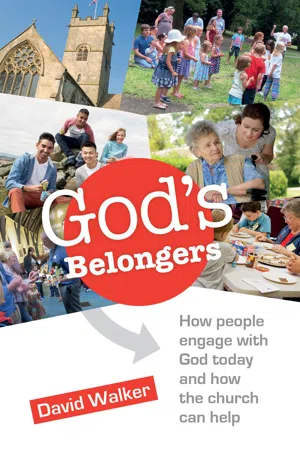
God's Belongers should transform our thinking about what it means to belong to church. Uniquely, David Walker replaces the old and worn division between 'members' and 'nonmembers' with a fourfold model of belonging: through relationship, through place, through events, and through activities. From his extensive practical research, the author shows how 'belonging' can encompass a far wider group of people than those who attend weekly services. This opens up creative opportunities for mission in today's world. 'In this excellent book David Walker brings together his considerable gifts as a first-rate mathematician and theologian in a highly accessible manner. The result is not only fascinating and thought-provoking: its insights have the potential significantly to renew the mission of the church in its efforts to make the love of God in Jesus known. I hope it will be very widely read.' The Right Revd Dr John Inge, Bishop of Worcester
eBook - ePub
God's Belongers
The four ways people engage with church and how we encourage them
- English
- ePUB (mobile friendly)
- Available on iOS & Android
eBook - ePub
About this book
Information
Topic
Theology & ReligionSubtopic
Christian MinistryPart One
How we belong
Chapter 1
Belonging: a theological concept
Belonging and the scriptures
From a Christian perspective our prime ‘belonging’ relationship is with God. And our Bibles would suggest that’s a pretty wide and comprehensive idea.
The Old Testament notion of the ‘People of God’ is the best developed corporate understanding of what it is to belong. Without, at that stage in Israel’s journey, a consistent and developed sense of an afterlife, it is the present belonging with God rather than the promise of a future destiny that lies to the fore of much of the Hebrew scriptures. It’s a belonging that is expressed in many ways. We first come across it strongly in a series of covenants between God and humanity, set in the times of figures such as Noah, Abraham and Moses. This belonging is often sealed with a visible sign: in Noah’s case it is to be the rainbow; for Abraham it lies in the ritual of circumcision. Alongside this belonging with the whole of humanity, or with a race or nation, the Old Testament stories are full of examples of how God belongs with particular individuals. In two cases, Enoch and Elijah, they are taken directly into God’s presence without experiencing death. Key to all these examples is the idea that belonging is not unidirectional but mutual. ‘We are your people and you are our God.’ It rises through the Old Testament and reaches a crescendo in the poetic and erotic language of the Song of Songs, where the lover and the beloved express the depth of the passion of a belonging summed up briefly in the phrase, ‘My beloved is mine and I am his’ (Song of Solomon 2:16).
When we move on to look at the New Testament, we find that both the individual and corporate aspects of belonging with God are developed further. The role of Jesus, as the one who mediates belonging between human beings and the Father, stands particularly prominent in the Gospel stories set around the events of the first Easter. Matthew, Mark and Luke all emphasise the significance of Jesus inviting his followers to partake of his body and his blood, a theme that St Paul picks up in his first letter to Corinth. Those who eat and drink in this way are joined to one another and to Christ. St John takes a slightly different tack, though again he is focused on the events of the night in which Jesus was to be arrested. In his case, it is the mutual indwelling of the Father and the Son in love, into which the disciples are invited to join, that is the key message. In the Acts of the Apostles, as well as in Paul’s epistles, we gain a sense of how baptism is becoming a crucial rite, both creating and expressing belonging with God, and is as unrepeatable as circumcision. Meanwhile, the complex relationship between Jesus, the earliest Christian community and the Jerusalem temple is played out across the pages of the four Gospels and Acts.
There is much in the scriptures, then, which speaks of human belonging with God, and which sees this as expressed in a far richer set of ways than simply in the sort of frequent and regular cultic activities that individuals and communities may participate in. But if we are to look beyond regular churchgoers, how wide can we cast our net?
It’s a question to which there are two standard but very different answers. The subtitle of Grace Davie’s influential book Believing without Belonging1 suggests that we might be interested in those people who hold to a doctrinal faith, but choose not to translate it into participating membership. The problem lies in coming to any clear position on what comprises a sufficient level of belief in order to qualify. The survey forms I’ve produced and analysed invite respondents to signify agreement or otherwise with statements on the one hand as broad as, ‘I believe in God’ and, ‘I believe in Jesus Christ’, and on the other as specific as, ‘I believe that God made the world in six days and rested on the seventh’ and, ‘I believe that Jesus really turned water into wine’. They are important questions to ask, and I’ll come back to them later on, but they have two major drawbacks. One problem is that the relationship between the answers that people give to these questions and their actual involvement in church life is more complex than we might at first imagine. However, my greater concern is that doctrinally based criteria are by their very nature imposed on those who we are studying, and seeking to engage with, from the outside. The alternative, and the route I much prefer, is to put the ball back in the court of the individuals themselves and invite them simply to define themselves as Christian if they so wish.
There are some who see such ‘self-defined Christian affiliation’ as at best a potential for being drawn into a ‘proper’ faith, and others who consider it as a hindrance to or vaccination against evangelism. Against these views Thomas, in his book Counting People In,2 distinguishes between ‘participant’ and ‘associate’ membership and warns the Church against a policy of working solely to maintain the former whilst ignoring the latter. He remarks on how people choose to identify with ‘brands and ideas’ rather than ‘groups and meetings’ and notes that successful organisations are often those that ‘enable us to support them without requiring our participation in the organisations themselves’.
My stance is that belonging is sufficiently powerful as a theological concept to demand the Church pays full attention to it, both responding appropriately to its manifestations and promoting it at various levels of its work. By doing so, the Christian belonging of far more people than the small percentage of the population who attend a church on Sundays, or even that wider group who subscribe to somebody else’s definition of an adequate doctrinal framework, can be both described and nurtured.
Reflecting on this wider concept of how human beings and communities belong with God has led me to identify four different aspects of Christian belonging: belonging with people, activities, events and places. It is this model that flows through this book. In the following four chapters I will be looking to explain and illustrate these four more fully; before that, it may be helpful to describe each of them as briefly as possible, as they emerged via the scriptures, into the life of the early Church, and on to our present generation.
Belonging with people
The children of Israel belong, in the Old Testament, not only with God but with each other. The Jewish Law seeks to manage this belonging, and the prophets repeatedly call the people to repentance for failing to maintain the standards of justice that such belonging requires. Several of the later epistles in the New Testament pick up the secular model, in Roman-influenced society, of a ‘household’, built around a network of interpersonal relationships. They adapt and adopt it in order to construct the emerging notion of a church, with bishops, presbyters and deacons who both lead the community and model the Christian life for others. Several major denominations still define themselves as being those in communion with a particular senior bishop.
Within the Christian community, the church has its lay and ordained ministers and officers. These are individuals who are associated in the minds of those they meet with the church. What they do is seen, to a greater or lesser extent, as the church doing it. Some hold formal office, as clergy, churchwardens, readers or members of a local ministry team. Others are simply recognised for what they do: visiting, flower-arranging, organising events or by virtue of their having previously occupied some such role.
Belonging with people offers a route in for those who for reasons of time or distance are not taking part in regular activities. For some, the most significant way of sustaining their belonging as part of the church is through key people visiting them, or inviting them to visit in turn. Regular letters, parish magazines or telephone conversations can also have a part to play. For some individuals with complex working patterns, it may be more practicable to retain relationships with significant individuals than to fit in with the relatively less flexible diary demands of attending a regular activity.
Belonging through relationship does, of course, give rise to the potential for conflict. My belonging may be at the expense of yours. Conflicts may arise through personality clashes or may be the consequences of competition between individuals for recognition, authority and status. One commonly cited example is of tension when new arrivals in a parish bring with them skills and enthusiasm to run things. Those who have been previously accustomed to being seen at the heart of the church community may express genuine gratitude for the new energy of the incomers whilst at the same time feeling marginalised by them.
Belonging with activities
Activity, as it is understood today, is much less to the fore in the Bible. The Old Testament has its daily temple rituals performed by priests, but there is little that speaks of demands on individual Israelites for frequent and regular participation. However, by the time of Jesus the synagogue is a significant locus for activity, and the early disciples quickly pick up the pattern of weekly observance that remains familiar today. Paul’s various lists of spiritual gifts attest to a range of individuals regularly applying their skills to further the regular life of the church.
Activities are those things that take place on a regular and frequent basis, and where individuals are expected to engage not just on a specific occasion but with the series. So, for example, Sunday services, youth groups, home fellowships, Mothers’ Union, toddler groups and the Parochial Church Council meetings are examples of church-run activities; by contrast, Christmas services, baptisms, funerals, garden fetes and concerts are categorised here as events.
Taking part in activities requires a significant investment of time and energy. It is not unusual in a parish to find the same individuals maintaining a variety of them, both within the church and in the wider community. It is often those who like activities who run the events, maintain the buildings and act as the significant individuals in the community. Some activity-led people grumble that others don’t join in as much as they should, and may even doubt the genuineness of a belonging that isn’t activity based. Many church activities are not contested, since those who don’t wish to involve themselves don’t have to take part. However, when it comes to the timings and style of Sunday worship, where there is a sense of the broadest range of the Christian community gathering for a shared act, then there is always the potential for what best sustains my sense of belonging being what is least helpful for you.
Belonging with events
The notion of expressing religious belonging through events is evident in the various covenant makings of ancient Israel as well as in the rites for circumcision, purification of women and cleansing of lepers. In the early Church these are superseded by baptism as the main event-based expression of religious affiliation. The notion of affirming religious identity at a variety of rites of passage, such as confirmation and first communion, builds on this over successive centuries.
Most churches undertake a range of events that engender belonging. The occasional offices of baptisms, marriages and funerals are a crucial part of them. They express a belonging with the Church and with God at key moments in the lives of the individuals directly concerned. They place the church at the centre of how a network of friends, relatives and neighbours expresses its belonging together. Along with these, major festivals such as Christmas and Harvest allow a belonging with the Christian story to be expressed and enacted. Concerts, fetes, garden parties and social events offer a belonging together in the community, with the church acknowledged as having an explicit part in that belonging.
Some communities engender a significant amount of belonging through secular events that are not part of an organisation with wider aims. The well dressings of rural Derbyshire and the Open Garden weekends of Worcestershire are examples. Often the church or its core membership plays a central role in arranging and promoting such events. They illustrate that there can be two levels of belonging going on at the same time. There is a basic level of belonging, with both the local community and the place, which is offered to those who visit the events. At the same time, there is a deeper sense of belonging engendered in many of...
Table of contents
- IMPORTANT COPYRIGHT INFORMATION
- Foreword
- Introduction: an aid for mission
- Part One How we belong
- Chapter 1 Belonging: a theological concept
- Chapter 2 Reliably regular: belonging through church activities
- Chapter 3 People power: belonging through relationships
- Chapter 4 Only the once: belonging through events
- Chapter 5 Location, location: belonging through place
- Chapter 6 The mystery of the missing vicar: an example of belonging
- Part Two Belonging for mission
- Introduction
- Chapter 7 What’s the difference? Understanding occasional churchgoers
- Chapter 8 Together in mission: the Five Marks of Mission
- Chapter 9 Paying the piper: what has become of Anglican governance and finance?
- Part Three Who else is missing?
- Introduction
- Chapter 10 Types and temperaments: what is Psychological Type?
- Chapter 11 Models for motivation: exploring the world of Religious Orientation
- Chapter 12 Never on Sunday: the opportunities and challenges of Sunday worship
- Concluding remarks
- Bibliography
- Notes
- About the author
Trusted by 375,005 students
Access to over 1.5 million titles for a fair monthly price.
Study more efficiently using our study tools.
Frequently asked questions
Yes, you can cancel anytime from the Subscription tab in your account settings on the Perlego website. Your subscription will stay active until the end of your current billing period. Learn how to cancel your subscription
No, books cannot be downloaded as external files, such as PDFs, for use outside of Perlego. However, you can download books within the Perlego app for offline reading on mobile or tablet. Learn how to download books offline
Perlego offers two plans: Essential and Complete
- Essential is ideal for learners and professionals who enjoy exploring a wide range of subjects. Access the Essential Library with 800,000+ trusted titles and best-sellers across business, personal growth, and the humanities. Includes unlimited reading time and Standard Read Aloud voice.
- Complete: Perfect for advanced learners and researchers needing full, unrestricted access. Unlock 1.5M+ books across hundreds of subjects, including academic and specialized titles. The Complete Plan also includes advanced features like Premium Read Aloud and Research Assistant.
We are an online textbook subscription service, where you can get access to an entire online library for less than the price of a single book per month. With over 1.5 million books across 990+ topics, we’ve got you covered! Learn about our mission
Look out for the read-aloud symbol on your next book to see if you can listen to it. The read-aloud tool reads text aloud for you, highlighting the text as it is being read. You can pause it, speed it up and slow it down. Learn more about Read Aloud
Yes! You can use the Perlego app on both iOS and Android devices to read anytime, anywhere — even offline. Perfect for commutes or when you’re on the go.
Please note we cannot support devices running on iOS 13 and Android 7 or earlier. Learn more about using the app
Please note we cannot support devices running on iOS 13 and Android 7 or earlier. Learn more about using the app
Yes, you can access God's Belongers by David Walker in PDF and/or ePUB format, as well as other popular books in Theology & Religion & Christian Ministry. We have over 1.5 million books available in our catalogue for you to explore.