This challenging book sets out what is involved in being a Christian minister - its joys and difficulties, its responsibilities and privilege. It discusses the call to and the work of ministry; the breadth and nature of the task. How to be a Minister will prove to be immensely useful across a wide spectrum of church traditions, both to those already in ministry and to those contemplating the vocation.
- English
- ePUB (mobile friendly)
- Available on iOS & Android
eBook - ePub
How to Be a Church Minister
About this book
Information
Topic
Teologia e religioneSubtopic
Ministro del culto cristianoThe Bible Reading Fellowship
15 The Chambers, Vineyard
Abingdon OX14 3FE
brf.org.uk
The Bible Reading Fellowship (BRF) is a Registered Charity (233280)
ISBN (ePub) 978 0 85746 793 5
ISBN (Mobi) 978 0 85746 690 7
First published 2018
All rights reserved
Text © Nigel G. Wright 2018
This edition © The Bible Reading Fellowship 2018
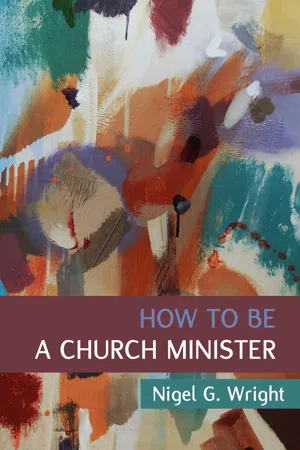
Cover image: Father, Son and Holy Spirit (Trinity), © Jenny Meehan. All rights reserved, DACS 2017
The author asserts the moral right to be identified as the author of this work
Acknowledgements
Unless otherwise stated, scripture quotations are taken from The Holy Bible, New International Version (Anglicised edition) copyright © 1979, 1984, 2011 by Biblica. Used by permission of Hodder & Stoughton Publishers, an Hachette UK company. All rights reserved. ‘NIV’ is a registered trademark of Biblica. UK trademark number 1448790
Extracts marked KJV are taken from the Authorised Version of the Bible (The King James Bible), the rights in which are vested in the Crown, are reproduced by permission of the Crown’s Patentee, Cambridge University Press.
Scripture quotations marked ESV are taken from the Holy Bible, English Standard Version, published by HarperCollins Publishers, © 2001 Crossway Bibles, a division of Good News Publishers. Used by permission. All rights reserved.
Every effort has been made to trace and contact copyright owners for material used in this resource. We apologise for any inadvertent omissions or errors, and would ask those concerned to contact us so that full acknowledgement can be made in the future.
A catalogue record for this book is available from the British Library
Contents
Introduction: Viewing the territory
1 Be clear about God’s call
2 Lay firm theological foundations
3 Appreciate the need for recognition
4 Bear the word of God
5 Construct a supportive base for ministry
6 Build the congregation
7 Pastor the people
8 Conduct worship well
9 Have the courage to lead
10 Seek the lost, heal the sick, overcome evil
11 Value the occasional offices
12 Stay on the boil
13 Commit to lifelong development
14 Endure and prevail
Epilogue: Ending well
Recommended reading
About the author
Dedicated with love to Joel
Introduction
Viewing the territory
This book has its immediate origins in a visit to the Houses of Parliament Shop in Parliament Square, London. While browsing there, I noticed two books with the title How to Be a Minister, one by the late Sir Gerald Kaufman and the other (with the subtitle A 21st-century guide) by John Hutton. The ministers in question, of course, were entirely different from the ones described in this particular volume. They were concerned with the skills and understanding required in being a minister of the Crown, a role into which many Members of Parliament are pitched with little preparation and that represents the height of their political career. Without denying the fact that a Christian minister will also be confronted with the need for some political skills – churches after all being composed of people of all shapes, sizes and dispositions – the exercise of governmental power is not primarily what is at stake here. Christian ministers are servants of God and of God’s church, entrusted with the ‘cure of souls’ (to use a helpful, if now old-fashioned, term). Their concern is with the spiritual life, with the relation of persons to their creator and redeemer, and consequently with the health and well-being of congregations as the corporate expression of such life. Although in the eyes of many this will be seen as a marginal and irrelevant occupation, for those who believe in the Christian gospel it will be the highest calling that may be given, requiring the best that can be brought to it.
Having noted the two above-mentioned books, it soon occurred to me that the title might just as well be employed in setting out something of what is involved in becoming and being a minister of Christ. Granted, there is a diversity of terms in use at this point, including ‘priest’, ‘pastor’, ‘clergy’, ‘deacon’, ‘presbyter’, ‘bishop’ and ‘elder’, according to the differing traditions within the Christian churches (all of which terms we may have cause to explore below), But there is also a commonality of tasks and responsibilities in ministry, though with differing emphases.
And there is no shortage of literature attempting to do what this book attempts; this is well-trodden territory. We might recall here classics such as Pope Gregory the Great’s Pastoral Care, George Herbert’s The Country Parson or Richard Baxter’s The Reformed Pastor. A glance at my bookshelves brings to mind more recent and representative titles, such as The Work of a Pastor, The Protestant Ministry, The Art of Pastoring, First Among Equals, Understanding Ministerial Leadership, Moral Leadership, Transforming Priesthood, Ministry: A case for change, Creative Church Leadership, Ministry and Priesthood, The Shape of the Ministry, Making God Possible and, simply, Pastor. This is to say nothing of the available literature on leadership in general or concerning pastoral theology, a term that, however broadly it might now be applied, originally dealt with the office, duties and tasks of those called to minister. Well-worn the path may be, but the need for any ‘reflective practitioner’ to think carefully about what he or she is called to do is constant and ongoing. It is this that provides the rationale for another contribution to an admittedly well-populated field.
In this book, therefore, I set out a particular perspective (as all perspectives must be) on what is involved first of all in becoming a minister and then in fulfilling that calling in a responsible and consistent way. It draws on a broad understanding of the biblical origins of ministry and churches’ long reflections on their practice, and also necessarily from extensive experience of both working as a minister and training and forming others for their work. It will become obvious that I write as a minister in a free-church tradition. Although I hope not to come across as a Protestant ‘red in tooth and claw’, I certainly have a free-church bias. However, I trust there will also be evidence of understanding of the nature of ministry in more catholic and episcopal traditions. While I hope for the sake of greater mutual understanding to compare or contrast these differing approaches, and there will certainly be points at which I explore disagreements, I aim to do all this with an irenic and constructive attitude. In the spirit of corrective ecumenism, we all have much to learn from each other. I am also conscious that much of the energy in church life now exists in swathes of new or minority-ethnic churches whose conceptions of ministry can sometimes sit loose to the church’s traditions. While there is much to value in these new perspectives, I hope to show that there is much in the older traditions that can inform the practice of mission and ministry today, however much we tend towards a contemporary style.
Ministry in the New Testament and beyond
An introductory word offering a sketch of ministry in the New Testament is in place here. All developed understandings of ministry are elaborations of patterns we see emerging in the New Testament. Certainly, the mission and ministry of Jesus must serve as the basis and model for all subsequent ministry. If it is understood that the risen Christ continues to minister to his church today, then all forms of ministry are in fact manifestations of what Christ continues to do by the Spirit in building his church (Matthew 16:17–19). The ministries of apostle, prophet, evangelist, pastor and teacher, referred to as gifts of the risen Lord for the building up of his body (Ephesians 4:11–13), are but charismatic manifestations of the fullness that is in him who embodied all these gifts in his incarnation and, having ascended to the Father, continues to do so for the sake of the church. It is through these effective Spirit-filled ministries that the church at first sprang into life and continued in being. They may be thought of as ‘translocal’ in that their first objective was to spread the church throughout the ancient world.
Christianity was a missionary movement before it ever became an institution. In time the first bursts of charismatic energy that grounded the church began to require more regular, local forms of ministry to ensure that what had begun would endure. The New Testament gives evidence of varying forms of church life, reminding us to be respectful of a wide degree of flexibility. But in churches such as those founded by Paul and Barnabas, the apostles either appointed or caused to be elected (both meanings are possible) local elders who would oversee the work (Acts 14:23; 20:17). Overseers/elders and deacons are first mentioned by Paul in Philippians 1:1 and the qualifications for these roles are dealt with in more detail in 1 Timothy 3:1–13 and Titus 1:5–9 (and I return to these passages in chapter 14).
Although in this book I am hesitant to use the word ‘priest’, for reasons that I shall in due course explain, the relationship between elders and deacons appears to me to be similar to that between priests and Levites in the service of Israel’s tabernacle and then temple. The priests had the ‘upfront’ roles of leading and presiding; the Levites tended to the work of the tabernacle in the background, making sure all was in order. A pattern therefore emerges in the New Testament church of charismatic ministries energising the churches and in time establishing more structured forms of local leadership to ensure their work continued and was sustainable. There is a saying that without people nothing happens but without institutions nothing lasts. I would understand if many readers objected to the word ‘institution’, yet if that word can be detached from the idea of bureaucracy it does point to a necessary truth: movements need to stabilise around an orderly pattern of operation and relations in order to endure. It is unfortunate when institutions become devoid of charisma, but charisma without order tends either to explode or to dissipate. The key is for institutional order to accompany, support and be the vehicle of charisma just as the skeleton supports the life of the body. Ministry should live in this beneficial tension and thrive because of it.
The New Testament also makes provision for the development of future ministers: ‘And the things you have heard me say in the presence of many witnesses entrust to reliable people who will also be qualified to teach others’ (2 Timothy 2:2). The thread of succession proceeds here from the original apostles, to the elders they have appointed, to the further generations that they in turn will prepare and appoint to carry the witness into the future. Christian ministry therefore has the nature of a relay. Those in the present generation are raised up by God, but they also enter into the work of those who have gone before and should be preparing those who are to follow on. This can rightly be understood as a form of apostolic succession: a faithful handing on of the apostolic witness and an engagement in the ‘apostolate’, the active mission of God that is shared with the whole church. The apostolic ministry is therefore part of the whole church’s apostolic mandate to preserve and transmit the gospel of Christ.
After the New Testament era, a significant variation took place within the pattern of elders and deacons. As the churches expanded and the generation of the first apostles passed away, some elders took on wider responsibility for the churches in a locality. In the New Testament, two words are used interchangeably for elder: episkopos and presbyteros. The first means ‘overseer’ and the second connotes age, and therefore wisdom. The derived words ‘bishop’ and ‘episcopal’ came into use to refer to duly appointed overseers of an area or ‘diocese’ in which they would act to unify the separate churches, to care for ministers, to safeguard the church’s teaching and to facilitate its ongoing mission. This innovation gave rise to an understanding of ministry as three-fold in character: bishops, presbyters and deacons. The pressure to move in this direction also arose from the need, in an age when deviations and heresies were emerging, to have a reference figure who could guard the normative Christianity of the apostolic witness. This was a crucial step at a time when, although the New Testament writings were in circulation and regarded as authoritative, the canon of writings by which Christian truth could be judged had not yet been commonly agreed and finalised, pushing teaching authority in the direction of the bishops.
Not all present-day churches accept the need for a threefold order, many believing that a twofold pattern of elders and deacons is adequate. Not all those who accept a threefold order wish to endorse the flummery and trappings that go with some forms of episcopacy. Yet even those who endorse a twofold order often set some of their elders aside for translocal, bishop-like roles in support of the church’s leaders at large. These may go under names such as moderators, superintendents, regional ministers, apostles and chairs of district (and, as so often, Americans find a word for this generic species of ministry and call it ‘the judicatory’); but the fact that they are found to be necessary suggests that there is a practical wisdom to the idea of the threefold order. From the point of view of this book, it will become clear that there is a tension between episcopal and congregational ways of being church. In episcopal traditions authority is mediated largely through the bishops acting in communion with each other. In congregational traditions authority is understood to reside within the congregation, allowing them a high degree of freedom. Both traditions do, of course, acknowledge that all authority is to be exercised under Christ and by the Spirit.
Intended audiences
As I write, I have certain groups in mind who may find this book helpful. First, there are those who are experiencing and exploring a call or vocation to ministry. A short time ago those in this category were likely to have been both young and male and may well have seen themselves preparing for a lifetime’s career as ministers. Those days are now past, and this seems to be the case across the spectrum of denominations. The profile of tho...
Table of contents
- ebook_How To Be A Church Minister
Trusted by 375,005 students
Access to over 1.5 million titles for a fair monthly price.
Study more efficiently using our study tools.
Frequently asked questions
Yes, you can cancel anytime from the Subscription tab in your account settings on the Perlego website. Your subscription will stay active until the end of your current billing period. Learn how to cancel your subscription
No, books cannot be downloaded as external files, such as PDFs, for use outside of Perlego. However, you can download books within the Perlego app for offline reading on mobile or tablet. Learn how to download books offline
Perlego offers two plans: Essential and Complete
- Essential is ideal for learners and professionals who enjoy exploring a wide range of subjects. Access the Essential Library with 800,000+ trusted titles and best-sellers across business, personal growth, and the humanities. Includes unlimited reading time and Standard Read Aloud voice.
- Complete: Perfect for advanced learners and researchers needing full, unrestricted access. Unlock 1.5M+ books across hundreds of subjects, including academic and specialized titles. The Complete Plan also includes advanced features like Premium Read Aloud and Research Assistant.
We are an online textbook subscription service, where you can get access to an entire online library for less than the price of a single book per month. With over 1.5 million books across 990+ topics, we’ve got you covered! Learn about our mission
Look out for the read-aloud symbol on your next book to see if you can listen to it. The read-aloud tool reads text aloud for you, highlighting the text as it is being read. You can pause it, speed it up and slow it down. Learn more about Read Aloud
Yes! You can use the Perlego app on both iOS and Android devices to read anytime, anywhere — even offline. Perfect for commutes or when you’re on the go.
Please note we cannot support devices running on iOS 13 and Android 7 or earlier. Learn more about using the app
Please note we cannot support devices running on iOS 13 and Android 7 or earlier. Learn more about using the app
Yes, you can access How to Be a Church Minister by Nigel G. Wright in PDF and/or ePUB format, as well as other popular books in Teologia e religione & Ministro del culto cristiano. We have over 1.5 million books available in our catalogue for you to explore.