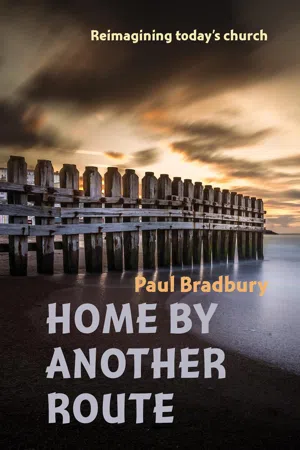
Paul Bradbury believes that a movement of the Holy Spirit is beginning to renew and reform today's church – a church marginalised and 'in exile'. Following on from Stepping into Grace, Bradbury takes the prophet's powerful image of dry skeletal human remains coming to life through the miraculous work of the Spirit of God to encourage and inspire the contemporary church to seek renewal through the Spirit. This is a compelling and prophetic book – a must-read for today's church.
- English
- ePUB (mobile friendly)
- Available on iOS & Android
eBook - ePub
About this book
Information
Topic
Theology & ReligionSubtopic
Christian ChurchContents
Introduction: ‘Crisis? What crisis?’
1 Exile: a story for our times
2 Picking over the bones
3 Entering a new story
4 Living to a different script
5 Home by another route
6 Beyond exile: a new story ‘from below’
Notes
Acknowledgements
About the author
The Bible Reading Fellowship
15 The Chambers, Vineyard
Abingdon OX14 3FE
brf.org.uk
The Bible Reading Fellowship (BRF) is a Registered Charity (233280)
ISBN (mobi) 978 0 85746 632 7
ISBN (epub) 978 0 85746 799 7
First published 2019
All rights reserved
Text © Paul Bradbury 2019
This edition © The Bible Reading Fellowship 2019
Cover image © harbourviewphotography.com
The author asserts the moral right to be identified as the author of this work
Acknowledgements
Unless otherwise acknowledged, scripture quotations are from The Holy Bible, New International Version copyright © 1979, 1984, 2011 by Biblica. Used by permission. All rights reserved worldwide. ‘NIV’ is a registered trademark of Biblica.
Extracts from the Authorised Version of the Bible (The King James Bible), the rights in which are vested in the Crown, are reproduced by permission of the Crown’s Patentee, Cambridge University Press.
Extract from ‘Journey of the Magi’ by T.S. Eliot in Collected Poems 1909–1962 (Faber and Faber Ltd, 2017). Used by permission.
Every effort has been made to trace and contact copyright owners for material used in this resource. We apologise for any inadvertent omissions or errors, and would ask those concerned to contact us so that full acknowledgement can be made in the future.
For Emily
Introduction: ‘Crisis? What crisis?’
Not far from where I live, on Dorset’s Jurassic coast, is the village and bay of Kimmeridge. Overlooking the bay is Clavell Tower, a striking eleven-metre-high building, which sits close to the edge of the dramatic cliff that forms one side of the entrance to the bay. Clavell Tower has had an interesting life. Built by the local vicar as an observatory and folly in 1830, it was later used as a lookout by the coastguard until the 1930s. Having been gutted by fire, it stood unattended for years, its desolate appearance and location the inspiration for a crime novel, The Black Tower by P.D. James, in 1975. More recently, however, its fortunes have improved. Threatened by accelerated erosion of the cliff on which it stands, the decision was made to move the entire tower inland. The tower was dismantled piece by piece, each of its nearly 16,000 stones was numbered and catalogued, and then the whole thing reconstructed and renovated 25 metres away from the cliff. The tower’s previous position is now remembered by a ring of foundation stones close to the encroaching cliff edge.
Clavell Tower is quite a feat of restoration. Returning the tower to its former glory, and raising the money for the work and materials, was one thing. But responding to the imminent crisis created by the power of the sea was another challenge entirely. It is a testimony to the value and importance we place on these historic buildings and landmarks that those involved had the vision and commitment to save such a beautiful building.
Yet – you can’t help wondering how many years 25 metres amounts to. There are large, global forces at work here. The cliff continues to crumble at an alarming rate; at times, whole slices, a metre deep or more, disappear during winter storms. The coast path in the area requires rerouting in various places to respond to the landslides that are occurring now with regularity. Clavell Tower may have been restored to its former glory, but the crisis has not been averted. As things stand, Clavell Tower has simply been given a stay of execution. There is no more cliff to play with. One day, the tower and all its 16,000 stones will fall into the sea.
The church in the west faces a crisis, one created by a force of increasing intensity, unleashed in the deep sea of the Enlightenment era, whose eroding forces are at work at the very foundation on which the church as we know it stands. We touch on the reality of this crisis with talk of church renewal, church reform, church growth, of which there is much debate, much advice, much time and money invested. Yet how much of this effort ignores, consciously or not, the deeper forces at work at the bottom of the cliff we find ourselves on? How much of our attention is spent on restoring the building at all costs, without fully embracing the true reality of the environment in which that project is taking place? And how much of the effort involved under these headlines is made in the cause of simply moving the church inland, restoring the historic structure of the building away from danger and giving it a new lease of life. Crisis? What crisis?
Crisis is the very real and unavoidable context of the exile and the literature inspired by it. Israel’s life had been destroyed, its structures and symbols literally burned by fire and its elite exported miles across the desert to Babylon. The Babylonian empire was now the pre-eminent force in the Near-Eastern world. It had been unleashing its power on the surrounding empires for decades, eating up territory, getting inevitably closer. It was surely only a matter of time until Jerusalem fell.
Yet, as the Babylonians withdrew from the charred wreck of Jerusalem, taking the ruling figures with them and leaving the poor to work the land under an appointed administrator, there were those who believed that all could be restored. There was a way back. The stones of Jerusalem could be numbered and catalogued and, one day, they would return and all would be back to the way things were. Crisis? What crisis?
One of the exilic writers in particular experienced almost all the horror of the exile first-hand. He grew up in Jerusalem and was a resident there when the first wave of exiles was taken to Babylon. He travelled as a captive across the desert to Babylon and, with his fellow exiles, began to learn how to live as an exiled people, while at the same time wondering what had happened to their home and whether they would ever see it again. That writer and prophet was Ezekiel. Among the vivid visions and prophetic actions of the book of Ezekiel is that of the valley of dry bones. The hand of the Lord takes Ezekiel and presents him with a vision of utter hopelessness and death. There is a valley ‘full of bones’ in which the Spirit leads Ezekiel ‘back and forth among them’ as though confronting him with the unyielding detail of his own despair. Having confronted Ezekiel with the pain and reality of the crisis of the exile, the Spirit asks Ezekiel a key question: ‘Son of man, can these bones live?’
That question appears to have a simple answer, for the ground beneath the valley of dry bones is the ground of a foreign power. It is the ground of a foreign empire, one that worships foreign gods and one that has triumphed over the God of Israel. Ezekiel lived and exercised his ministry through the anticipation and realisation of the catastrophe of the fall of Jerusalem. What Ezekiel saw in the vision of the dry bones is what he had experienced: a stark and potent vision of the reality of exile, an exile that was viewed as utter death and destruction to all that seemed to Israel as fundamental to its identity and purpose.
For the western church, the ground beneath our feet has shifted. We describe this movement in a variety of ways: post-modern, post-Christendom, post-Christian. And in these descriptions, we point to the seismic nature of the movement we experience. Something fundamental is taking place and has taken place. Old landmarks, symbols and structures that could once be used reliably to orient our lives, our institutions, our faith, seem to have shifted or gone altogether. In this sense, we experience what Ezekiel and the captives in Babylon experienced; we experience exile.
Metaphors are a way of interpreting and reflecting on our own story and situation by laying alongside it the images and stories of another. The world of the metaphor connects at different points with the world we experience. We see connections and illuminations, as well as differences and mismatches. The more connections, the better the metaphor. Yet all metaphors have limitations. They cannot fully describe our reality, but they can help us understand it and respond to it more confidently.
I believe exile is a powerful metaphor for the church, particularly the western church, and perhaps even more particularly the church in the UK. We have not suffered the geographical dislocation that was the experience of the Babylonian captives, or which is the painful experience of many political dissidents or asylum seekers. So, while we must recognise the dangers of associating too closely with the emotions of exile, nevertheless we may well connect with a ‘sense of the loss of a structured, reliable “world” where treasured symbols of meaning are mocked and dismissed’.1 Others have explored the richness of this metaphor and argued its merits and deficiencies. That is not the main aim of this book. But a summary of our own experience of exile might be offered under two broad headings: disestablishment and decentring.
Disestablishment, though not yet a constitutional reality in the UK, is nevertheless a description of an ongoing process whereby the Christian church is increasingly losing power and influence in society. Remnants of another era still remain – civic churches, the Lord Spiritual, families coming for baptism, a chaplain to the Houses of Parliament, prayers at the start of local council meetings – but these are remnants, often under threat or in decline. They are vestiges of the once-great edifice of Christendom, the constituted marriage between church and state which provided a place at the high table of power and influence for the church from Constantine in the fourth century onwards.
Christianity was the shaping story, the lingua franca, the DNA of social, cultural and political life for centuries. Now, it seems like an obscure myth in an old language that no one speaks any more. Many commentators and scholars will point to the Enlightenment and the philosophy of René Descartes, John Locke, Rousseau and others in the 17th century as opening the door to a fundamental undermining of the whole Christendom monolith. This ‘age of reason’ challenged the assumptions of Christendom at its very core with its assertion that knowledge can only be reliably attained by the reasoning individual. As this assertion worked its way into every area of life, the power and influence of the church as the arbiter of truth was subsequently diminished. Religion, not just Christianity, has been constantly re-evaluated since and seen its stock devalued. It has been told to retreat into the private sphere and stay out of public life. Its long and inauspicious association with political power and cultural hegemony has left it with a reputation it struggles to overcome. Consequently, religion in general, and the Christian church in particular, ‘must now function within a framework that precludes any kind of cultural authority’.2
Decentring is a word that more describes the consequences of disestablishment. At one time, the church and the Christian faith it represented could count on a recognition and reputation within the life of western societies that made it central to people’s lives whether they were believers or not. This is clearly no longer the case. Furthermore, it is precisely its perceived abuse of its position of power and authority, as part of the establishment, that puts it in a poor position now to provide any influence or make its voice heard. In that sense, many would say that the church is a church on the edge. That may well be our experience.
But while the church has been pushed from the centre, society has also lost any real sense of having a centre at all. It is not as straightforward as to say that the church has been thrust from the centre of cultural life and replaced with something else. In such a scenario, at least the church could come to terms with its new position and begin to reorient itself. Instead, there is no centre any more, or at least no communally agreed centre around which spiritual, cultural and political life can be oriented. Instead, ‘culture is now an organised diversity with little sense of a defining centre’.3
In this context, the search for new models, new paradigms in which to organise and plan might well be futile. These sorts of approaches reckon on the emergence of a new status quo, a new kind of place, a new set of established relationships which remain dependable and predictable. But the nature of our new context is one of continuous change. In fact, perhaps the one predictable thing we experience is change itself.
So how might the church go about even asking the questions of its place and identity in this bewildering, challenging, disorienting context? The very unpredictability of the world we now inhabit mitigates against the standard methods of analysis. We cannot see our evolving context as a new system to analyse and understand so that we can put it together again in our minds and work out our place within it. There is no system. There is no place. Exploring who we are, and how we are to be in this new world, will require a very different mode of reflection.
Narrative resources offer us such an alternative mode of thinking. Sociologists now speak of ‘flows’ of images, data and capital as a way of making sense of culture and of describing cultural change. Culture is no longer static and definable, but its constant change is a layering of narratives within an environment of ‘flows’. These flows are influences, pressures, incentives that shape and develop the stories of our lives and the lives of those around us. And so, when we are asked about ourselves, we invariably tell a story. We are telling our own particular narrative of identity within the multiple, layered narratives of those we live among. Of course, there are groups of narratives, networks of narratives, many ways in which narratives connect with one another. Where there is significant commonality, we might call this a culture. But even as we have placed the finger of definition on a story, the story starts to move on. Stories allow for change, for flow. They are, by their nature, averse to formulaism.
Perhaps, then, the most fruitful way to explore our place as the church in the maelstrom of our world is to play with story. What are the stories that connect best with the story we find ourselves in? A story is not like a map or a model. It will not lay itself over our half-formed version of events and tell us how things are, how things will be and therefore what we should do about it. But a good story will lie alongside the emerging story we find ourselves in and will act rather like a spiritual director. It will ask good questions, perhaps difficult questions. It will listen, probe, offer insight. It will gently but insistently force us to listen to ourselves, mine the truth from within ourselves and help move our story on. That is what I intend to try and do with the story of the exile.
The exile is, of course, a big story, told in numerous ways from various perspectives in the Bible. So, to make the task more manageable, I am using the vignette of Ezekiel’s vision in the valley of dry bones as a window on the whole story. Ezekiel 37:1–14 is a concentrated image of exile, a story within a story, a prophetically symbolic acting-out of the story that has been and the story that will unfold.
That latter element makes it particularly rich for us. For not only does it detail the reality of exile, but it provides the hope of continuity and the trajectory of the future. And that future, in this vision and in other places in the exilic literature, employs another metaphor: the metaphor of home, or perhaps more accurately homecoming. ‘I will settle you in your own land’ (v. 14), says the Lord at the conclusion of the vision. There will be a homecoming; that is the promise.
Homecoming therefore provides a key connecting point in the overlaying of the world of exile with the world of our own crisis as the church in the secular west. Homecoming is there among the language of renewal and reform, in the literature and conference addresses on church growth. We may dress it up all we want, but really, as a church, we long for home in one way or another. We hope for an end to the disorienting experience of uncertainty and alienation in our own culture and search for a new kind of stability of identity and significance that feels like home. To start out on that journey may well be to glance over our shoulder to some vision of a remembered or imagined past, or it may be to venture boldly towards a vision of the future. Either way, it is a journey inspired by some concept of what it means for the church to come home.
However, as the title of this book implies, the kind of homecoming Israel may well have expected was not the kind of homecoming that transpired – and it was not, I believe, the kind of homecoming envisioned by God in the valley of dry bones. Exile was a point of departure for Israel in more ways than one, for it invoked a period of enormous creativity and reimagination in their communal life as the people of God. Israel did not simply number the stones of Jerusalem, return them on the basis of an established plan and rebuild. They did not simply return to the old ways with the crisis horizon moved far enough away for normal service to resume for a period of time. What Israel was invited to explore through the exile was more than restoration, or even reform and renewal – what they were invited to journey in was resurrection. Homecoming was promised, but in a way they could never have imagined or planned. This was homecoming, but by another route.
1 Exile: a story for our times
On Reading station
I was recently at Reading station with a few spare minutes and found myself standing next to a memorial plaque on the wall. The memorial is to a Henry West who, it says, ‘lost his life to a whirlwind at the Great Western Railway Station, Reading, on 24 March 1840’. The final words of the memorial, a poem, refer to poor Henry West’s quick and untimely death and then conclude thus:
Yet hushed be all complaint,
’tis sweet, ’tis blest,
to change Earth’s stormy scenes
for endless rest.
Dear friends prepare,
take warning by my fall,
so you shall hear with joy
your Saviour’s call.
This insight into 19th-century life, hidden in a quiet corner of a busy and modernised station that bears little if any resemblance to that within which the unfortunate Henry West lost his life, struck me as a poignant symbol of so much that has changed in the spiritual landscape of Britain since the whirlwind of 1840. It cannot possibly be said that the whirlwind-like events of our own era, which take too many lives with similar suddenness, could receive such a certain and hopeful response and in such a public form.
The Reading station memorial’s words of comfort, warning and salvation remind us of a very different world where the language and assumptions of the Christian faith could confidently be recalled in the face of public tragedy. That world has surely been lost. The church may still be called upon to respond to tragedy. That was the case that same week I stood by the Reading station memorial in the aftermath of a terrorist attack in Manchester, only a few days before another terrorist attack in London and a few more before the Grenfell Tower fire in north Kensington. But it responds from a very different position. The Bishop of Manchester, who was a key figure in the city of Manchester’s response to the terrorist attack there, later described his role as ‘curating’ the space in which people of many faiths and none could grieve and come to terms with what had happened in their city. One could only imagine what the response might be if a church leader had repeated the words for Henry West on such an occasion.
Standing next to Henry West’s memorial, as the world hurried past on its urgent business, was a moment where I was struck by the force of change that has taken place in our country – and in particular by the sense of disconnection between a picture of the world painted by those words and the world I inhabit. I keenly felt my own disconnect, my own disorientation in a world that holds few if any of the certainties and convictions that enabled the Christian community to speak so plainly about faith and salvation. In such a world, there is no consensus about the narrative that shapes our response to tragedy and death. I felt alienated. I understood and appreciated the language of the memorial even while I recognised how it jarred with the world around me. The poem spoke to me of a world I connect with personally, yet a world that in any communal sense has utterly disappeared. For an instant, I felt the force of what it is to be an exile.
Israel’s story of exile
The story of Israel’s exile is well documented in the historical books of the Old Testament. There also emerges, around the historical record, a host of literature that reflects and wrestles with the experience and impact of what had happened.
The seeds of exile are sown when the kingdom of David and Solomon falls apart following the succession of Rehoboam to the throne. Jeroboam leads a rebellion which leads to the division of the kingdom into the northern kingdom of Israel and southern Judah (1 Kings 12).
Jeroboam’s behaviour becomes a watchword for subsequent kings of the northern kingdom of Israel. Many of the kings of Israel that follow are judged by the history writers to have ‘followed the ways of Jeroboam’ (1 Kings 15:34; 16:19; 22:52), as though his act of intrigue and rebellion set the tone for the future of the breakaway kingdom.
A geopolitical reading of the story sees a small and vulnerable kingdom weakened significantly by the division into two. The two nations sit at a strategic location between a number of larger opposing empires whose own dominance rises and falls. There is Egypt to the south, Assyria to the north and, later, a resurgent Babylon to the east. The land of Israel is fertile and of strategic significance to all of them and it is not long before the two states become party to the attentions of these superpowers.
Fortunes fluctuate for northern Israel until the land is exiled by the Assyrians in 722BC, at the end of the reign of Hoshea. Israel by then is betting one superpower against another in terms of which can provide it protection. It is officially a protectorate of Assyria but Hoshea decides to defect to Egypt, with disastrous consequences (2 Kings 17:3–6). The population is deported to Assyria and the land repopulated with people from outside Israel (2 Kings 17:24).
Assyria then turns its attention to the southern kingdom of Judah. Sennacherib lays siege to Jerusalem but the city is delivered. However, a new power is emerging and starting to gain influence. King Hezekiah receives envoys from Babylon and shows them the riches of the palace vaults. He seems to think their visit trivial, brushing them off as people ‘from a distant land’ (2 Kings 20:12–14). But Babylon swiftly emerges as the dominant power in the region. The battle of Megiddo appeared to have established Egypt over its rival Assyria as the superpower of the region, with Judah paying it tribute. But Babylon invades Judah with such force that the Egyptian threat comes to abrupt end (2 Kings 24:7).
While the story of exile is the story of both Israel and Judah, the significance of the story really resides in the fate of Judah; for it is Jerusalem that signifies and symbolises the identity and destiny of the people of God. The f...
Table of contents
- Home by another route ebook
- Home by another route ebook
- Home by another route ebook
Trusted by 375,005 students
Access to over 1.5 million titles for a fair monthly price.
Study more efficiently using our study tools.
Frequently asked questions
Yes, you can cancel anytime from the Subscription tab in your account settings on the Perlego website. Your subscription will stay active until the end of your current billing period. Learn how to cancel your subscription
No, books cannot be downloaded as external files, such as PDFs, for use outside of Perlego. However, you can download books within the Perlego app for offline reading on mobile or tablet. Learn how to download books offline
Perlego offers two plans: Essential and Complete
- Essential is ideal for learners and professionals who enjoy exploring a wide range of subjects. Access the Essential Library with 800,000+ trusted titles and best-sellers across business, personal growth, and the humanities. Includes unlimited reading time and Standard Read Aloud voice.
- Complete: Perfect for advanced learners and researchers needing full, unrestricted access. Unlock 1.5M+ books across hundreds of subjects, including academic and specialized titles. The Complete Plan also includes advanced features like Premium Read Aloud and Research Assistant.
We are an online textbook subscription service, where you can get access to an entire online library for less than the price of a single book per month. With over 1.5 million books across 990+ topics, we’ve got you covered! Learn about our mission
Look out for the read-aloud symbol on your next book to see if you can listen to it. The read-aloud tool reads text aloud for you, highlighting the text as it is being read. You can pause it, speed it up and slow it down. Learn more about Read Aloud
Yes! You can use the Perlego app on both iOS and Android devices to read anytime, anywhere — even offline. Perfect for commutes or when you’re on the go.
Please note we cannot support devices running on iOS 13 and Android 7 or earlier. Learn more about using the app
Please note we cannot support devices running on iOS 13 and Android 7 or earlier. Learn more about using the app
Yes, you can access Home by Another Route by Paul Bradbury in PDF and/or ePUB format, as well as other popular books in Theology & Religion & Christian Church. We have over 1.5 million books available in our catalogue for you to explore.