This book provides a framework, concrete examples, and tools for designing a high quality, academically-robust preservice teacher preparation program that empowers teachers with the depth of professional knowledge and the skills required to become adaptable, responsive K-12 teachers ready to engage with diverse groups of students, and to achieve consistent learning outcomes.
Renowned teacher educators Etta R. Hollins and Connor K. Warner present a systematic approach for developing a teacher preparation program characterized by coherence, continuity, consistency, integrity, and trustworthiness, as well as one that is firmly grounded in collaboration between faculty, community members, and other school practitioners.
This book offers an evidence-based roadmap relevant for teacher educators, administrators, scholars, agencies at the state and national levels, and any organization that serves teacher educators.
The approach presented in this book is for the design of academically based preservice teacher preparation. The term academically based preservice teacher preparation is not frequently used; however, the term academic preparation is used in referring to the coursework included in university-based teacher preparation programs (Zeichner, 2009). The term academically taught is used in the prospectus for Teachers for a New Era (TNE) in describing one of the three design principles for a teacher preparation program:
A teacher education program should be guided by a respect for evidence.
Faculty in the arts and sciences disciplines must be fully engaged in the education of prospective teachers.
Teaching should be recognized as an academically taught clinical-practice profession.
(Kirby, McCombs, Barney, & Naftel, 2006, p. xiv)
The findings from four TNE sites indicate an emphasis on evidence-based practices in teacher preparation involving collaboration among teacher educators, faculty in arts and sciences, and practitioners in partner schools and school districts. Evidence from clinical experiences for candidates and P-12 student learning outcomes in partner schools was used in adjusting university-based course content and assignments (Torrez & Krebs, 2020). This provides insight into the meaning of the term academically taught clinical-practice profession.
The discussion in this chapter defines academically based teacher preparation, identifies characteristics, and delineates practices. The practices in academically based teacher preparation are illustrated in designing teacher preparation programs, addressing problems of practice, and engaging in continuous improvement. The meaning of academically based teacher preparation subsumes the conceptualization of academic coursework and academically taught clinical practice.
Defining Academically Based Teacher Preparation
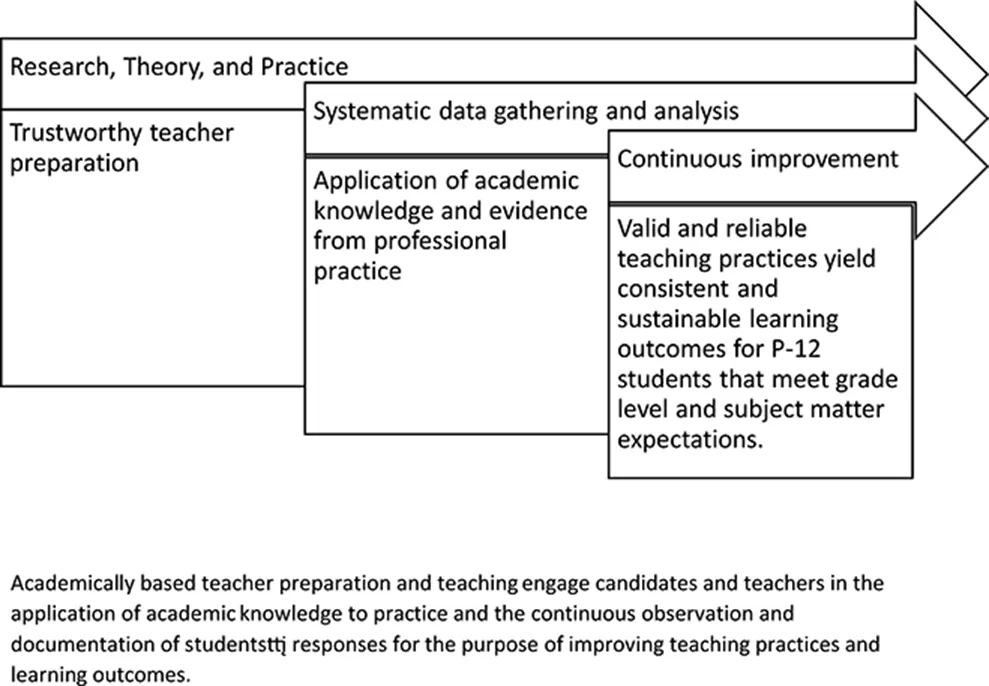
Academically based teacher preparation is a meticulously designed approach grounded in the most reliable research, theory, and practice available; and that employs continuous data gathering and analysis for validation and improvement of practices, outcomes, and impact (Figure 1.1). The conceptual and structural elements within an academically based approach are interconnected and reciprocal in design and function. The relationship between the philosophical stance (a conceptual element) in a teacher preparation program and candidate recruitment (a structural element) is an example of interconnected and reciprocal design and function. The philosophical stance describes attributes of the candidates recruited for the program, what they will be prepared to do, their target students, the expected outcomes for students, and the impact on communities (Hollins, 2019). The recruitment plan includes a description of the characteristics of potential candidates that match the philosophical stance including knowledge, experiences, dispositions, perceptions, and values; tools for assessing candidates’ suitability for the program based on the philosophical stance; and strategies for data gathering for validation and improvement. Academically based preservice teacher preparation is supported by purposefully designed clinical experiences located in authentic settings and focused on the preparation for teaching students from diverse cultural and experiential backgrounds and with different needs.
Figure 1.1 Academically based teacher preparation and teaching
Embedded within an academically based approach to teacher preparation is an approach to academically based teaching practices. Academically based teaching practices are grounded in theory, research, evidence from practice, and continuous improvement of learning outcomes through the process of observation, documentation, and analysis. Clinical experiences provide candidates opportunities for developing the habits of mind and practices associated with academically based teaching. Academically based teaching practices are modeled in the program design, and in pedagogies and learning experiences provided for candidates. Facilitating candidates’ learning during clinical experiences is an example of modeling academic teaching practices. During clinical experiences, candidates learn to make observations, document teaching practices and students’ responses, and to use knowledge of students, subject matter, and pedagogy in planning learning experiences. Candidates learn to use academic tools such as a class profile, curriculum mapping, curriculum framing, learning cycle, and teaching cycle to enhance instructional planning and to develop more powerful learning experiences. Candidates learn to rely on research, theory, and documented evidence from their own practice to increase their understanding of teaching and learning.
Academically based teaching practices are guided by knowledge of learners and learning, including that on child and adolescent growth and development, a theoretical perspective and discipline specific research. The conceptualization of academically based teaching practices employed in subsequent chapters in this book is referred to as teaching as an interpretive practice/process. Teaching as an interpretive practice/process is based on a constructivist theoretical perspective. This approach incorporates a teaching cycle of planning based on knowledge of students, subject matter, and pedagogy; enactment of planned learning experiences; observation and documentation of students’ responses during the planned learning experiences; and interpretation and translation of students’ responses to learning experiences for evidence to inform subsequent planning (Hollins, 2011). Teaching as an interpretive practice/process is supported during clinical experiences using specifically designed instruments including the pre-observation conference format, observation checklist, and post observation conference described in Chapter 6; and key assessments described in Chapter 7. Incorporated within each of these instruments are the habits of mind, and professional knowledge and practices associated with academically based teaching, specifically teaching as an interpretive practice.
Identifying Characteristics of Academically Based Teacher Preparation Programs
Academically based teacher preparation programs include central and instrumental characteristics. Central characteristics include coherence, continuity, consistency, and trustworthiness. Instrumental characteristics include collaboration, interrelatedness of conceptual and structural elements, and systematic data collection. The central characteristics are program quality indicators. Instrumental characteristics are essential for program development, continuous improvement, and meeting the expectations of the quality indicators.
Figure 1.2 Academically based teacher preparation program design
Central Characteristics
The central characteristics of academically based teacher preparation guide program design. For example, coherence is developed through the methodical alignment of professional knowledge within and across courses, and with application to practice in clinical experiences (Canrinus, Klette, & Hammerness, 2019; DeLuca & Bellara, 2013). In the process of learning to teach, professional knowledge is aligned and applied when examining and planning student learning experiences. Specific aspects of methodically aligned professional knowledge are applied during clinical experiences in the observation, documentation, and analysis of teaching, learning, and the social context in classrooms. In planning instruction, professional knowledge is applied in framing the curriculum and creating learning experiences.
Continuity is the developmental sequencing of methodically aligned professional knowledge and clinical experiences to foster learning that is interrelated, increasingly complex, and cumulative (Zeichner, 2009). This developmental sequencing provides opportunities for positioning benchmarks for assessing candidates’ progress in developing the knowledge and skills required for competent teaching, providing interventions when necessary, and evaluating the effectiveness of aspects of the teacher preparation program.
Consistency refers to stability of professional knowledge and clinical experiences over time. The professional knowledge base and clinical experiences are based on the best research, theory, and practice available at the time of program design or redesign. The opportunity for developing coherence and continuity in a teacher preparation program depends on stability in professional knowledge and clinical experiences. Maintaining coherence and continuity in a program requires purposeful adjustments and interventions for improvement.
There are three recognized sources for changes in the professional knowledge base and clinical experiences. First, changes are in response to new knowledge derived from valid and reliable research, theory, and practice in the field. Second, changes are in response to the analysis of data collected in the program or at the clinical experience site. Third, changes are in response to state or national mandates for teacher preparation, requirements for accreditation, or mandated changes in the P-12 school curriculum or school practices. The proposed changes are carefully examined and aligned within the existing professional knowledge base and clinical experiences, rather than unnecessarily expanding the knowledge base to include new content or experiences. This can result in adjustments in the content and framing of the existing professional knowledge base and clinical experiences.
Trustworthiness is based on the quality and consistency in the preparation of candidates, their performance as teachers in the classroom, and learning and developmental outcomes for their students. The combination of coherence, continuity, and consistency form the foundation for trustworthiness. When any one of the other central characteristics is absent, trustworthiness is compromised. Data collected on programs that do not meet the conditions of the quality indicators are unlikely to provide reliable evidence for substantive improvements, except in identifying the absence of these characteristics. In the absence of program quality indicators, program graduates often depend on knowledge gained from mentors during clinical experiences and colleagues in schools where they are placed as full-time teachers. Some teachers from these programs will develop high levels of competence, others will remain low-performing teachers for the duration of their careers. Programs with such unreliable and inconsistent outcomes are not trustworthy.
Instrumental Characteristics
The central characteristics for academically based teacher preparation are supported by three instrumental characteristics that include:
collaboration among faculty participants and contributors, school partners and other stakeholders;
interrelatedness of conceptual and structural elements in the program; and
systematic data collection, analysis, and the application of findings for the improvement of program practices.
These instrumental characteristics provide the context and process for developing the central characteristics of academically based teacher preparation.
Collaboration
Collaboration among faculty participants and contributors, partners, and other stakeholders is essential for determining the appropriateness, relevance, and interconnectedness among professional knowledge, clinical experiences, the P-12 school curriculum, and the school context (Burroughs, et. al., 2020). Teacher education faculty collaborate in identifying the most valid and reliable research, theory, and practice available to form the professional knowledge base for learning to teach. Further, the teacher education faculty is responsible for ensuring that the program meets the expectations for academically based teacher preparation and the mandates and standards for state and national accreditation. Teacher education faculty collaborate with practitioners in partner schools to identify problems of practice, changes in school conditions, and new mandates that influence or require adjustments in professional knowledge and skills (Ball, 2000). Teacher education faculty and school partners collaborate in designing and sequencing clinical experiences.
Faculty in the arts and sciences are responsible for the specific subject matter preparation of teacher candidates. Teacher education faculty are responsible for ensuring that the subject matter preparation of teacher candidates meets the required state and national standards for program accreditation, candidate knowledge assessments, and the requirements for the specific curriculum expectations for elementary, middle, and secondary school students. The responsibilities shared by teacher education faculty and faculty in the arts and sciences require collaboration to ensure that candidates meet expectations for professional knowledge and specific subject matter knowledge for teaching (Ball, Thames, & Phelps, 2008).
Interrelatedness of Conceptual and Structural Elements
The conceptual and structural elements form the foundational context for the central characteristics of academically based teacher preparation. The interrelatedness of these elements is at the core of program coherence. The conceptual elements include the philosophical stance, theoretical perspective, professional knowledge and skills, and epistemic practices. Systematic correlation exists within and between conceptual and structural elements in the teacher preparation program. For example, the interrelationship between the philosophical stance and the theoretical perspective frames the professional knowledge and skills in the teacher preparation program. Epistemic practices embody...
Table of contents
Cover
Half Title
Title Page
Copyright Page
Dedication
Table of Contents
List of Illustrations
Preface
1. Academically Based Teacher Preparation
2. Collaboration among Teacher Educators and with Stakeholders
3. Framework for Program Design
4. Program Explication
5. Course Alignment
6. Clinical Experiences in Authentic Contexts
7. Monitoring and Assessing Progress Toward Competent Teaching
8. Responding to Needs, Mandates, and Standards
9. Epilogue
Index
Trusted by 375,005 students
Access to over 1.5 million titles for a fair monthly price.
Study more efficiently using our study tools.
Frequently asked questions
Yes, you can cancel anytime from the Subscription tab in your account settings on the Perlego website. Your subscription will stay active until the end of your current billing period. Learn how to cancel your subscription
No, books cannot be downloaded as external files, such as PDFs, for use outside of Perlego. However, you can download books within the Perlego app for offline reading on mobile or tablet. Learn how to download books offline
Perlego offers two plans: Essential and Complete
Essential is ideal for learners and professionals who enjoy exploring a wide range of subjects. Access the Essential Library with 800,000+ trusted titles and best-sellers across business, personal growth, and the humanities. Includes unlimited reading time and Standard Read Aloud voice.
Complete: Perfect for advanced learners and researchers needing full, unrestricted access. Unlock 1.5M+ books across hundreds of subjects, including academic and specialized titles. The Complete Plan also includes advanced features like Premium Read Aloud and Research Assistant.
Both plans are available with monthly, semester, or annual billing cycles.
We are an online textbook subscription service, where you can get access to an entire online library for less than the price of a single book per month. With over 1.5 million books across 990+ topics, we’ve got you covered! Learn about our mission
Look out for the read-aloud symbol on your next book to see if you can listen to it. The read-aloud tool reads text aloud for you, highlighting the text as it is being read. You can pause it, speed it up and slow it down. Learn more about Read Aloud
Yes! You can use the Perlego app on both iOS and Android devices to read anytime, anywhere — even offline. Perfect for commutes or when you’re on the go. Please note we cannot support devices running on iOS 13 and Android 7 or earlier. Learn more about using the app
Yes, you can access Rethinking Teacher Preparation Program Design by Etta R. Hollins,Connor K. Warner in PDF and/or ePUB format, as well as other popular books in Education & Education General. We have over 1.5 million books available in our catalogue for you to explore.