More Planning to Teach Writing
eBook - ePub

More Planning to Teach Writing

A Practical Guide for Primary School Teachers

  1. 230 pages
  2. English
  3. ePUB (mobile friendly)
  4. Available on iOS & Android
eBook - ePub

More Planning to Teach Writing

A Practical Guide for Primary School Teachers

About this book

Written by an experienced teacher and literacy consultant, this book offers an easy-to-use approach that will reduce teachers' planning time while raising standards in writing. Building on the success of Planning to Teach Writing, it includes modern and classic picture books, short stories, and novels to provide a fantastic new range of hooks to inspire teaching and learning.

Using a tried and tested planning approach and explaining how best to use baseline assessment to build upon children's writerly knowledge and skills it help teachers to produce effective unit plans for writing, and in doing so, they will be able to concentrate on the core business of teaching units that help children to fulfil their potential as writers.

The book uses a simple formula for success:

  1. Find your students' gaps in learning.
  2. Choose a hook that you know will engage your students.
  3. Select a unit plan that you know will support you to get the best writing out of your students.
  4. Tailor it to your students.
  5. Teach it!

This latest book is the perfect starting point for teachers planning to teach writing in their classroom, and the new stories and activities provide fresh ideas to those who are already familiar with the circle planning approach used in Planning to Teach Writing.

Frequently asked questions

Yes, you can cancel anytime from the Subscription tab in your account settings on the Perlego website. Your subscription will stay active until the end of your current billing period. Learn how to cancel your subscription.
At the moment all of our mobile-responsive ePub books are available to download via the app. Most of our PDFs are also available to download and we're working on making the final remaining ones downloadable now. Learn more here.
Perlego offers two plans: Essential and Complete
  • Essential is ideal for learners and professionals who enjoy exploring a wide range of subjects. Access the Essential Library with 800,000+ trusted titles and best-sellers across business, personal growth, and the humanities. Includes unlimited reading time and Standard Read Aloud voice.
  • Complete: Perfect for advanced learners and researchers needing full, unrestricted access. Unlock 1.4M+ books across hundreds of subjects, including academic and specialized titles. The Complete Plan also includes advanced features like Premium Read Aloud and Research Assistant.
Both plans are available with monthly, semester, or annual billing cycles.
We are an online textbook subscription service, where you can get access to an entire online library for less than the price of a single book per month. With over 1 million books across 1000+ topics, we’ve got you covered! Learn more here.
Look out for the read-aloud symbol on your next book to see if you can listen to it. The read-aloud tool reads text aloud for you, highlighting the text as it is being read. You can pause it, speed it up and slow it down. Learn more here.
Yes! You can use the Perlego app on both iOS or Android devices to read anytime, anywhere — even offline. Perfect for commutes or when you’re on the go.
Please note we cannot support devices running on iOS 13 and Android 7 or earlier. Learn more about using the app.
Yes, you can access More Planning to Teach Writing by Emma Caulfield in PDF and/or ePUB format, as well as other popular books in Education & Classroom Management. We have over one million books available in our catalogue for you to explore.

Information

Publisher
Routledge
Year
2021
eBook ISBN
9781000390124
Edition
1

Part 1

The circles planning approach

The approach to medium-term planning used in this book is centred on a model provided by the Primary National Strategies (PNS). This model is taken from Eve Bearne's excellently researched structure for planning as set out in the joint UKLA/PNS publication ā€˜Raising Boys' Achievements in Writing’ (2004). Longer, extended units of work are planned following a sequence of first reading, then planning, and, finally, writing.
Based on the work of Bearne (2002), the research recommended a structured sequence to planning where the children and teachers began by familiarising themselves with a text type, capturing ideas for their own writing followed by scaffolded writing experiences, resulting in independent written outcomes.
(PNS 2008)
Not only does this approach allow teachers to see the big picture of a unit before they start teaching, it also enables them to plan a rich and impactful learning journey. Additionally, as the broad view of teaching is clear in the teacher's head, s/he is better equipped to allow the unit to twist and turn according to the needs and interests of learners. The research findings in 2004 were:
…a three-week block was a new way of working, which was challenging but was seen to reap considerable benefit. For example:
…the slow build up to the writing objective really helped my young writers, particularly the boys who enjoyed the variety across time around one text.
…identifying specific long term intentions for each unit…enabled them to work more flexibly
and creatively as they travelled towards these intentions and prompted them to listen to the children more acutely in the process. In focusing on the writing end product, they explicitly ā€˜built in more time to develop thinking and imagination’ and ā€˜planned for more time for the children to enact and perform’.
…a general sense of satisfaction in being able to cover short-term objectives within a longer
time frame. Some felt that in the past, in trying to cover a range of short-term objectives, their work had been fragmented; they enjoyed what they perceived as increased flexibility to respond to the needs and interests of the children, whilst still being guided by the overall intention of the unit.
(UKLA/PNS 2004)
The strongest and the most structured parts of my recommended model are the first two phases: the teaching and learning that build up to the children drafting and shaping their writing. Once these parts are taught, the teacher will have a greater sense of how long they need to give to the shared, guided, and supported part of ā€˜the final write’. If the ground work has been done, children will have firm foundations upon which to build – they will find the writing easier and more successful. The UKLA/PNS (2004) study called this ā€˜Providing time to journey’; it found that
A core issue emerged of a focus on less literal time allocated to writing, but more generative thinking time in the form of an extended enquiry through drama and visual approaches. This time was energetically spent in imaginative and engaging explorations of texts. Such time was significant as it allowed the teachers/practitioners to feel less hurried and to listen and learn more about individuals. It also meant that when the children did undertake writing, they were unusually focused and sustained their commitment, persisting and completing their work.
The third phase of teaching and learning should also be mapped out so that the teacher has a sense of how the writing will progress over time. Two considerations may be whether they will ask children to write in chunks, using teacher modelling to support as and when needed or whether they will be drafting in one sitting and following it up with some redrafting over time. What we know is that providing space and time for children to develop a piece of writing leads to better quality writing:
Allowing time for the writing to develop and giving the learners space in which to develop their ideas and move slowly and gradually towards a final piece of writing…clearly influenced the quality of the final pieces and partly accounted for the raised standards in writing.
(UKLA/PNS 2004)

Independent writing

The circles planning approach assumes that children are given opportunities to independently use and apply their writing skills at the end of the three phases. Teachers must provide opportunities for children to show what they have learned and to practise writing entirely independently. Following any non-fiction unit, children should have the opportunity to use and apply their skills across the curriculum. Additionally, children should be required to independently write short (or long) narratives once they are confident of story writing.
In most primary schools there are long-term plans for the writing curriculum, which record the coverage and content for each term of the year; there are medium-term plans, which indicate the coverage and content for each block of work, or ā€˜unit’; and there are daily plans.
Each circles plan covers what has come to be known as a unit of work. The timescale for coverage of the unit depends on the amount of teaching and learning that needs to be done, and on the pace at which pupils learn. For example, a poetry unit on creating shape poems may span five lessons, or a narrative unit on creating a spooky story may span fifteen lessons. Broadly, before the unit starts, the teacher will have a sense of how many lessons it will take for children to complete the journey through the phases of learning; however, there must be flexibility so that if pupils need parts of the journey to be repeated or skipped, then this should happen.
The circles plan is made up of three phases. Each phase plays an equal and vital part in building up to a final written outcome. Progression through the phases should feel like a journey for both pupils and teachers – a teaching journey for teachers and a learning journey for pupils. The journey should have twists and turns; there may even be diversions and delays, but the process itself should be enriching and engaging, and the final outcome: the destination should be truly fulfilling.
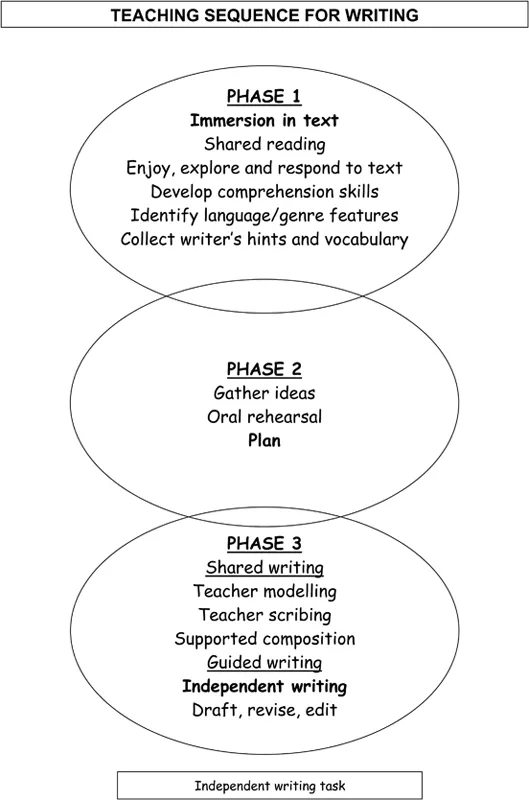
The purpose of phase 1 is for the pupils to be fully immersed in a text – the text type that they will eventually be authors of. The final outcome of phase 1 should always be that pupils know ā€˜what a good one looks like’ (WAGOLL), and in many cases, ā€˜sounds like’ too. Phase 2 is the time for pupils to think about, plan, orally rehearse, and play with their ideas for writing. Phase 3 is the writing phase; an opportunity for children to be taught how to bring everything together into a successful piece of writing. The journey begins at reading and ends with writing. This process is also known as (and rooted in) the ā€˜Teaching Sequence for Writing’.
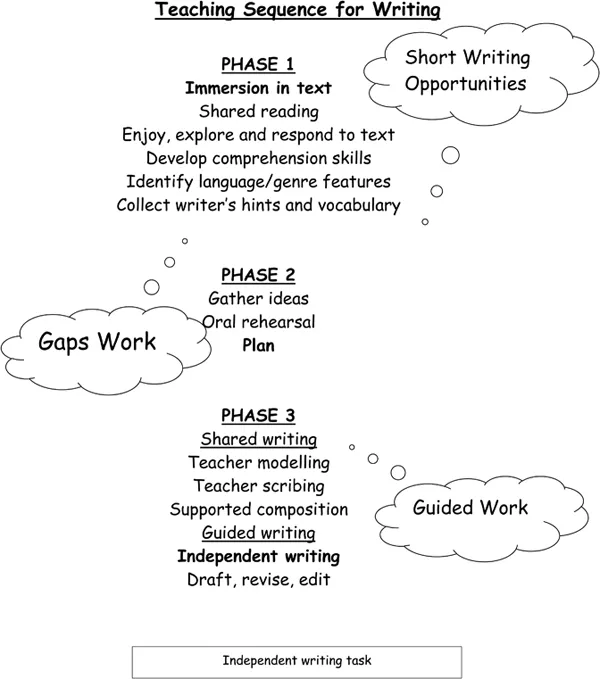
We have already established that the Teaching Sequence for Writing has three phases that are discrete yet linked, which is why it is presented as a Venn diagram. We also know that the sequence is a map that guides teaching through a journey, the final destination of which is a piece of writing. The sequence is just that – a guide – it is the big picture of a unit of work; it should not be followed to the letter (the detail of teaching will be in the daily planning), but flex in response to pupils' learning. Equally, there are no timescales attached to the sequence. Some units may take a week of lessons; others may take three weeks.

Phase 1: immersion in text type

AIM OF PHASE 1: TO KNOW WHAT A GOOD ONE LOOKS AND SOUNDS LIKE

A simple fact that cannot be argued with is that it is very difficult to write a particular text type if you are not familiar with it. Familiarisation with the text type is the first step; by the end of phase 1, children should be so immersed in it that they could write it if they had to. In The Really Useful Literacy Book, Martin et al. (2004: 39–41) say that:
writers have to have read the text type they are trying to write or have it read to them…From the experience of being read to and then wide reading, the writer builds ideas of what a successful piece of writing looks and sounds like…Children need to read and read and read – in order to both absorb the structures, sentence constructions and vocabulary of written texts…
Immersion is done through shared reading, when the teacher acts as a model reader making overt what good readers do, for example, by paying attention to the punctuation, using expression and intonation to aid understanding and bring the text alive, and asking themselves questions and predicting. Pupils should always be able to see and follow the text during shared reading.
Shared reading is an opportunity to examine the purpose and audience of text, as this will be very useful when pupils begin to write their own: ā€˜if we add together purpose and audience (why am I writing and who will be reading it?) we find ourselves considering the best ways to construct the text we want to write’ (Martin et al. 2004: 34).
In addition to and during shared reading, the text should be brought alive so that children engage with it, understand it and respond to it as readers. It is really important that children are given opportunities to explore their responses to text; as children engage in ā€˜booktalk’, an expression coined by Aidan Chambers (1993) in his ā€˜Tell Me’ approach. They experience being the audience – understand how it feels to make sense of, and respond emotionally to what they read. The purpose of this, within the teaching sequence for writing, is to help writers to begin to consider what response they may want to elicit from the reader. You can't truly write for an audience unless you've walked in the footsteps of the audience.
Besides eliciting the reader's response, immersion in the text enables children to hear and collect vocabulary and language patterns, internalise plot structures, and deepen their understanding. At this point in phase 1, children should be supported to gather vocabulary that they like and think they will utilise in their writing, and appropriate synonyms too.
Equally, rather than the teacher giving the children a list of elements that feature in a text type, they should be collecting them as they read and engage in the text type. During phase 1, children should be given opportunities to collect, in addition to vocabulary, ideas and authorial effects to be used, later, in their own compositions. These lists are sometimes referred to as ā€˜success criteria’ or similar; however, it is my belief that the more child-friendly, less threatening labels such as ā€˜writer's hints' make more sense to children, and therefore, are more likely to be used when they write. These lists can be used as checklists during or after writing, but they should always be displayed, perhaps on a ā€˜working wall’, during the unit.
Booktalk and close analysis of the text – this time focussing on how the writer has achieved effects on the reader, and being supported to understand what the writer has done to elicit this response and have that effect – are also key parts of phase 1 of the teaching sequence. These ideas should be added to the ā€˜writer's hints' list mentioned above.
Phase 2: gathering ideas and shaping them into a plan

AIM OF PHASE 2: TO HAVE PLANNED MY WRITING

In order to be ready to compose a text, we need to have collected ideas, played with them, decided on the best ones and then shaped them into some form of a pla...

Table of contents

  1. Cover
  2. Half Title
  3. Endorsements
  4. Title Page
  5. Copyright Page
  6. Contents
  7. Preface
  8. Introduction
  9. PART 1 THE CIRCLES PLANNING APPROACH
  10. PART 2 UNIT PLANS
  11. References
  12. Appendix
  13. Index