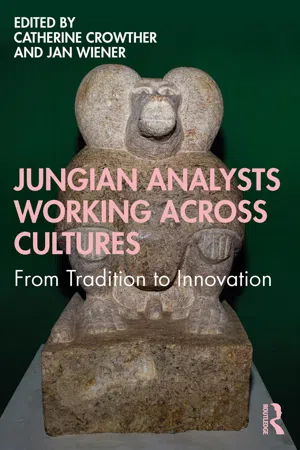
Jungian Analysts Working Across Cultures: From Tradition to Innovation gives a fascinating account of the wide variety of experiences of Jungian analysts working in different cultures across the world. They describe and reflect on experiences of both offering and receiving training within these cross-cultural partnerships. This is a book not only about training but is also an enlightening cultural commentary for our times. The powerful bi-directionality of cultural influence and discovery is apparent in different ways in every chapter, prompting a re-appraisal of concepts essential to the core values of Jungian practice which show an outdated adherence to culture-bound attitudes. The publication of this book is a timely reminder that when Jungian analysis as we know it is floundering in some Western countries, new projects in countries seeking to develop an analytic culture give hope for sustaining our professional practice.
eBook - ePub
Jungian Analysts Working Across Cultures
From Tradition to Innovation
- 342 pages
- English
- ePUB (mobile friendly)
- Available on iOS & Android
eBook - ePub
Jungian Analysts Working Across Cultures
From Tradition to Innovation
About this book
Information
CHAPTER 1
ARCHETYPES ACROSS CULTURAL DIVIDES
While it’s very exciting and enticing to travel to distant lands to teach the theory and practice of analytical psychology, it’s also an eye-opener. Psychoanalysis and analytical psychology are products of modernity in the West. Their discoveries were made and their methods of treatment were forged under the specific cultural conditions of middle Europe during the late nineteenth and early twentieth centuries. Sitting in our offices and classrooms in the West today one hundred years later, we may be oblivious to the reality that our modern and secular cultural values and attitudes have not been taken up and adopted equally everywhere in the world. Even as globalization has carried in its train many of our habits of thought pertaining to technology and science and has planted them in widely dispersed regions of the world, the psychological and social assumptions characteristic of Western modernity have not necessarily traveled along with them. For many people in other than Western nations, psychoanalysis and psychotherapy look exotic and foreign, even threatening to basic assumptions, especially religious and traditional ones based in ancient habits of living and thinking. To what extent does this inhibit the possible transfer of our analytic methods and psychological perspective to other parts of the global stage in the twenty-first century?
In our recent efforts to teach analytical psychology throughout the world, we have come into contact with many peoples who are not so deeply influenced or impressed by our own local philosophies and social understandings. In many cases, we (I am referring here to efforts on the part of members of the International Association for Analytical Psychology) have encountered significant differences in mentality that have often provoked deep resistance, whether vociferously voiced or signaled by silent withdrawal, to our methods and ways of conducting Jungian psychoanalysis. As we work with people from cultures really different from our own, whether in supervision, analysis, or clinical seminars, it has become starkly obvious to us that at significant points, we do not share similar assumptions about many things that belong specifically to our ways of thinking and working. While we may start out with the fantasy of teaching, we end up with the need for dialogue.
At first we might be shocked and surprised because our theoretical and clinical assumptions seem so self-evident and obvious to us. But the opposite is true. There is nothing self-evident about them at all. They are not universals. They are built on earlier convictions, beliefs (religious and philosophical), and cultural habits that grew up in the West over centuries. It is within and as part of these established cultural patterns that we have been trained to work as analysts and therapists. Psychotherapy must be conducted in a particular way, we are inclined to believe, or it will not be transmutative and nothing will change or develop in the client’s inner world. For us, these rules of practice may seem transcribed like the Ten Commandments in stone, but for others who are foreign to our traditions they may appear socially unacceptable or even bizarre. To question these assumptions puts us on a line of thinking that must lead to profound considerations about the fundamental nature of the human psyche and its possibilities for transformation in the general human population. Teaching in cultures widely different from our own, we are challenged to question and perhaps even forced to relativize our convictions, at least to a degree, and to rethink many of our preconceptions and often un-reflected upon conventions of practice. Old habits die hard on both sides—that of the student and that of the teacher. In the end, if we are fortunate, we may arrive by a kind of alchemy at an agreeable compound of the positions.
Why do these cultural differences exist at all? Where do they come from and how do they arise and become embedded in social groups? This question has many answers depending on one’s preferred modes of understanding the origins of human culture and its varieties of expression. From a Jungian perspective, we hypothesize that all human forms of culture are manifestations of underlying universal archetypal patterns of human behavior, cognition, and imagination. Partly they are creations of human beings who have needed to adapt to different specific environments, and partly they are manifestations of underlying possibilities that have emerged from the universal (archetypal) psychic matrix. They are a product of the interaction of psyche with object world. All cultural forms of behavior and attitude reflect psychic constants, but there are innumerable variations on these embedded themes because of environmental differences and historical processes in given social groups.
In this chapter, I will speak of some of the problems that arise in the supervision, training, and analysis of persons from cultures different from our own in the West, and I will do so in the light of some archetypal constants that might play a role in bridging differences and solving some of the dilemmas we confront as we seek to take analytical psychology into the global community.
Bridging cultural differences is made somewhat easier by recent developments in Western attitudes and mentality. Today, rapid change in cultural preferences and sharp differences of opinion with regard to human and political values are becoming the norm in the West. Europe and North America and their direct descendants (which is what I mean primarily when I refer to the West) have become multicultural to an unprecedented degree in the last few decades, and this has brought in its wake an urgent need to relativize all religious and traditional cultural values and to find a way of containing traditional cultural differences within a larger, embracing, mandala-like cultural attitude.
On the surface of rational consciousness, this makes sense. But it is a different picture at deeper levels of unconscious assumptions and acculturations. We may believe that our standards of practice are of only relative validity, but they are deeply embedded in us and remain unreflected upon until they are challenged. To some extent, however, we have grown accustomed to living in cultural flux and with neighbors who are different from ourselves. We see this as individuation, a step forward in the evolution toward wholeness, on a cultural level. We realize that cultural standards and values are something that passed for absolute truth in previous centuries in the West, but do so no longer. For example, in the time when colonialism was in full swing, the norms of the imperial nations were unquestioned and were imposed on subjected peoples without a second thought about their universal validity for everyone. The colonial powers believed without serious question that they were raising the cultural standards and attitudes of the colonized peoples by educating them to a higher level and even saving their heathen souls by baptism into the Christian faith. Today, we totally reject this view of the civilizing influence of the colonial powers; if anything, we demonize this position for totally overlooking the values and religious beliefs of the cultures they were colonizing.
Jung affirmed the spiritual and psychological value of cultures very different from our own in the West.1 They are, he argued, not only equal to ours on a relativistic measure—i.e., made up of habits that are, like ours, without ontological standing—they actually offer something that we lack. In some respects, they are to be deemed superior. They may remain in much closer contact with archetypal (i.e., religious or mythological) ideas and images that give them great power and grounding in the fundaments of the human psyche. In a sense, Jung reversed the colonialist position and instead of placing Western culture at the top, he moved it to a much less exalted position.2 He brought the West down to a much more humble place and forced us to rethink our attitudes vis-à-vis, for instance, the religions of the East. Spiritually speaking, we are poverty-stricken and they are wealthy. The West, in Jung’s view, has severed connections with nature, which “primitive cultures” have not;3 the West has lost contact with the archetypal and the spiritual, which the East has not. What the West has developed is rational, positivistic science, and it has purchased this at the expense of deep psychological awareness of body and soul. When other traditional cultures look at the West, they admire the technology but shudder at the spiritual poverty.
At the same time, Jung affirmed a common psychic ground for all of humanity in what he chose to refer to as a “collective unconscious.”4 This was not a return to absolutes as these had been conceived and believed in during earlier phases of Western history, in the Middle Ages for example, but rather it was a perception of underlying (archetypal) patterns and motifs that play beneath the surface of all cultural traditions and religions, a common source of inspiration and motivation. Inhering within this psychological foundation of humanity are archetypal images that tie us all together, such as Mother, Father, Family, Hero, the Couple, Good and Evil, the Center, and Wholeness. Each of these archetypal patterns finds expression in some manner in every culture created by our species. It is therefore to this level that we refer when we express the sentiment that all men and women are brothers and sisters, that we all belong to humanity equally and share a common psychological heritage. It is on this basis that we can offer psychotherapeutic assistance to people of all cultures. Our psychotherapy must be cognizant of cultural difference but grounded in underlying commonality, otherwise we will fall either into the trap of cultural imperialism or find ourselves totally irrelevant. This is a Scylla and Charybdis problem. Awareness of archetypal patterns may help us bridge cultural divides.5
It can be a great challenge to work in analysis with deep cultural differences between analyst and patient. Frequently, analysts must confront their own particular cultural limits and decide whether they can continue working with a person who exceeds what they feel is tolerable. I once supervised a candidate in training who was working with a middle-aged woman of European and Christian descent, much like herself, but who had converted to Islam and was married to a much older man from a Middle Eastern country. The therapist was stumped by the patient’s attitude toward what we would generally consider to be the husband’s quite severe verbal (but not generally physical) abuse. The patient was a highly accomplished academic on the one hand, and yet she behaved like a submissive dependent child toward her senior husband on the other. In supervision we worked on the assumption that a pathological masochistic complex rooted in her childhood relationship with her father was operating to distort the patient’s thinking and feeling, leading her to split off and dissociate from her received abuse in order to maintain her relationship and protect her self-esteem. Normally, this could have been worked on, and possibly resolved, in the analytic process, if the patient and analyst would have shared a perspective on what constitutes intolerable behavior. While under the influence of the husband’s cultural standards and expectations, however, she took the abuse as a normal state of affairs. In the other sectors of her life, such behavior would have been intolerable. In the cultural context of the marriage, moreover, divorce was not an option. Her choice was to travel as much as possible for her career and live in bondage when at home. I came to regard this as an irresolvable impasse in the analytical process because it could not be challenged effectively. Individuation possibilities seemed to have come to a halt in the face of a cultural pattern that does not regard women as fully human and capable of mature wholeness; however, in the course of time my student and I both realized that a much more profound religious need was being addressed by this woman’s seemingly irrational adherence to cultural patterns so different from the ones we are familiar with and consider norms. She was in fact sacrificing her own inherited cultural identity and freedoms as a woman on the altar of what she experienced as a transcendent value of spirituality in a tradition quite foreign to her own native one. We could not force our convictions on her without damaging her (to us seemingly bizarre) individuation process.
I have never forgotten this case. As Jung taught us, the human psyche is a great mystery and has its own ways. We must be humble in the face of such paradoxes and try to understand them from a deeper perspective that steps beyond our personal cultural assumptions and preferences. Fortunately, this particular candidate, a mature woman with much experience as a psychotherapist, was able to continue working with this patient on the Jungian assumption that the self is at work even when we do not understand it.
MOTHER AND FATHER AS ARCHETYPAL AND CULTURAL IMAGES
I will address now some of the archetypal patterns underlying all cultures and reflect on how differences from culture to culture in their manifestations and formative influences have an impact on how teaching and training psychoanalysis and psychotherapy is carried out or problematized. The first of these is Mother and Father, the Parents.
Every culture in the world knows of mothers and fathers. Beyond their biological significance, they are psychic images and forces. Jung and those following his line of thought speak of the mother archetype and the father archetype, which have mythological expressions in many cultures. Jung wrote of the mother in this sense in his essay, “Psychological Aspects of the Mother Archetype,”6 and Erich Neumann authored the standard work on this image in The Great Mother.7 Every culture has a more or less generally accepted image of motherhood, whether explicit or implicit, and these seem to be quite similar across cultures. Fatherhood seems to be less defined and more variable from culture to culture, although Father Gods appear quite universally.
Mother and Father, however, generally show two aspects—one positive and the other negative. Typically, these contrasting features are represented in a culture’s myths, fairy tales, art, and other imaginative expressions. Most traditional cultures create images of divine Mothers and Fathers and hold these up as ideal or fearsome models. Modern cultures depict the images of ideal or demonic mothers and fathers in movies, cartoons, or in other popular media. Generally, the definitions of what constitutes the maternal or the paternal are unquestioned in a culture; they are simply enacted and lived. We also know that while there is a mother and a father archetype in the background, the actual mothering and fathering that is done by individual women and men in different cultural contexts, while embedded in a sort of instinctual base that humans share with other mammals, is quite flexible and capable of a wide variety of expression.
Archetypally, Mother signifies containment (the womb and the lap) and nurturance (the breast) on the positive side, and restriction (smothering) and death (the tomb) on the other. Both images can be found in mythologies worldwide. Father, archetypally speaking, signifies the demand for achievement and performance, the rule of law, and hierarchical social structure with all of their concomitant features, positive and negative. Every culture has both maternal and paternal features, but the degree of dominance of one or the other varies considerably.
In our efforts to train psychotherapists in cultures different from our own, we need to keep in mind the general preferences and emphases the student’s culture places on the mothering and fathering...
Table of contents
- Cover
- Halftitle Page
- Title Page
- Copyright Page
- Table Of Contents
- Contributors
- Acknowledgements
- Introduction
- Chapter 1 Archetypes across Cultural Divides
- Chapter 2 Reflections on the Bi-Directionality of Influence in Analytical Work Across Cultures
- Chapter 3 The Self and Individuation: Universal and Particular
- Chapter 4 Pioneers or Colonialism?
- Chapter 5 Cultural Complexes and Working Partnerships
- Chapter 6 Understanding Group and Organisational Dynamics in Cultural Partnerships
- Chapter 7 Issues of Cultural Identity and Authorship When Receiving Training from Other Cultures
- Chapter 8 Women and Professional Identity in Russia
- Chapter 9 Influenced, Changed, or Transformed? Reflections on Moments of Meeting in a Borderland
- Chapter 10 Bridging Two Realities: A Foreign Language
- Chapter 11 The Delivery of Training: Personal Experiences as a Trainer in Other Cultures
- Chapter 12 Shuttle Analysis Across Cultures Personal Analysis by Shuttle: Can It Work?
- Chapter 13 An East-West Coniunctio: The Relational Field in Cross-Cultural Analysis
- Chapter 14 Giving Voice to Psychic Pain: The British-Mexican Connection, On the Vicissitudes of Creating a Home for Street Children
- Chapter 15 Returning to China
- Chapter 16 From Tradition to Innovation: What Have We Learned?
- Index
Trusted by 375,005 students
Access to over 1.5 million titles for a fair monthly price.
Study more efficiently using our study tools.
Frequently asked questions
Yes, you can cancel anytime from the Subscription tab in your account settings on the Perlego website. Your subscription will stay active until the end of your current billing period. Learn how to cancel your subscription
No, books cannot be downloaded as external files, such as PDFs, for use outside of Perlego. However, you can download books within the Perlego app for offline reading on mobile or tablet. Learn how to download books offline
Perlego offers two plans: Essential and Complete
- Essential is ideal for learners and professionals who enjoy exploring a wide range of subjects. Access the Essential Library with 800,000+ trusted titles and best-sellers across business, personal growth, and the humanities. Includes unlimited reading time and Standard Read Aloud voice.
- Complete: Perfect for advanced learners and researchers needing full, unrestricted access. Unlock 1.5M+ books across hundreds of subjects, including academic and specialized titles. The Complete Plan also includes advanced features like Premium Read Aloud and Research Assistant.
We are an online textbook subscription service, where you can get access to an entire online library for less than the price of a single book per month. With over 1.5 million books across 990+ topics, we’ve got you covered! Learn about our mission
Look out for the read-aloud symbol on your next book to see if you can listen to it. The read-aloud tool reads text aloud for you, highlighting the text as it is being read. You can pause it, speed it up and slow it down. Learn more about Read Aloud
Yes! You can use the Perlego app on both iOS and Android devices to read anytime, anywhere — even offline. Perfect for commutes or when you’re on the go.
Please note we cannot support devices running on iOS 13 and Android 7 or earlier. Learn more about using the app
Please note we cannot support devices running on iOS 13 and Android 7 or earlier. Learn more about using the app
Yes, you can access Jungian Analysts Working Across Cultures by Catherine Crowther, Jan Wiener, Catherine Crowther,Jan Wiener in PDF and/or ePUB format, as well as other popular books in Psychology & Mental Health in Psychology. We have over 1.5 million books available in our catalogue for you to explore.