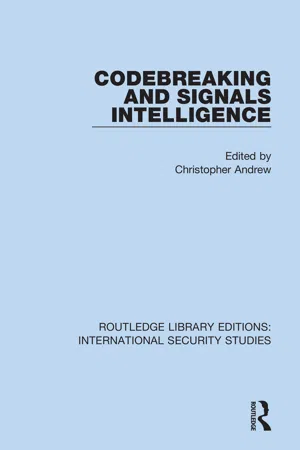
Despite publicity given to the successes of British and American codebreakers during the Second World War, the study of signals intelligence is still complicated by governmental secrecy over even the most elderly peacetime sigint. This book, first published in 1986, lifts the veil on some of these historical secrets. Christopher Andrew and Keith Neilson cast new light on how Tsarist codebreakers penetrated British code and cypher systems. John Chapman's study of German military codebreaking represents a major advance in our understanding of cryptanalysis during the Weimar Republic. The history of the Government Code and Cypher School – forerunner of today's GCHQ – by its operational head, the late A.G. Denniston, provides both a general assessment of the achievements of British cryptanalysis between the wars and a tantalising glimpse of what historians may one day find in GCHQ's forbidden archives. The distinguished cryptanalyst of Bletchley Park, the late Gordon Welchman, describes in detail how the Ultra programme defeated the German Enigma machine, while another Bletchley Park cryptographer, Christopher Morris, reminds us in his account of the valuable work on hand cyphers that wartime sigint consisted of much more than Ultra. Roger Austin's study of surveillance under the Vichy regime shows the continuing importance of older and simpler methods of message interception such as letter-opening. Taken together, the articles establish sigint as an essential field of study for both the modern historian and the political scientist.
- 144 pages
- English
- ePUB (mobile friendly)
- Available on iOS & Android
eBook - ePub
Codebreaking and Signals Intelligence
From Polish Bomba to British Bombe: The Birth of Ultra
Gordon Welchman
I
The Poles, The British and The French
Until just before the Second World War a small Polish team of three mathematician-cryptologists, headed by the brilliant Marian Rejewski, had been happily breaking the German military cipher machine, the Enigma, for many years. A small British team under the First World War cryptanalyst, Dilly Knox, was near to success, but was foiled by failure to make a guess which, in retrospect, seems an obvious one. The French cryptanalysts do not appear to have tried, but Captain Gustave Bertrand, involved in French espionage, achieved a coup without which the Polish breaks and the subsequent British successes might never have been achieved.
The Poles kept their secret to themselves until July 1939 when, with the German invasion of their country imminent, they gave all their knowledge, as well as working replicas of the Enigma machine, to the French and British. In England, at Bletchley Park, we were quick to exploit the golden opportunity that the Poles had handed us. In France Bertrand established an organisation near Paris, code-named Bruno, at which Marian Rejewski and his associates Henryk Zygalski and Jerzy Rozycki, having escaped from Poland, continued to work on Enigma. There was collaboration between Bletchley and Bruno until the German advance on Paris forced an evacuation.
Ultra intelligence, based on decodes of the Enigma traffic of the German army and air force, was born early in 1940. Its heyday started after the battles of El Alamein and Stalingrad in the autumn of 1942 and the Allied landing in North Africa in November 1942. By that time the Allies had become strong enough to take advantage of this extraordinarily prolific source of intelligence, and a satisfactory means of sending Ultra information to commanders in the field had been developed.
As early as 1941 and 1942 Rejewski wrote reports in Polish on the prewar breaking of the Enigma cipher. More than 30 years later, in 1973, Bertrand, infuriated by the publication of a completely erroneous account, decided to break silence. He published a book revealing that Enigma had been broken during the war.1 This book, however, was not reviewed in any important periodical and sold very badly. The publication of Winterbotham’s book, The Ultra Secret,2 in 1974 was a very different story. Awareness of the major contribution that Ultra had made to Allied victory spread rapidly around the world. It is ironical that the editor of a French translation of Winterbotham’s book had no idea of the existence of Bertrand’s publication.
Since 1974 a great deal has been written about Ultra and many misconceptions have arisen. I myself, as author of The Hut Six Story,3 have given rise to some of these. When I arrived at Bletchley Park in September 1939, Dilly Knox told me nothing about how the Poles had acquired the knowledge that they passed on to us. I had not even appreciated our debt to Rejewski until Professor Stengers sent me a copy of his paper in the February 1981 issue of L’Histoire.4 With my book going to press a few months later, all I could do was make minor additions in the text and pay tribute to Rejewski in the dedication. Although Jozef Garlinski’s book The Enigma War 5 was published in the USA in 1980, I did not hear of it in time to take advantage of the appendix by Colonel Tadeusz Lisicki, which contains an account of Rejewski’s achievements.
The January 1982 issue of Cryptologia contained a translation of an article by Rejewski himself,6 together with other information about his work. The April 1982 issue reviewed another article by Rejewski that had been published in The Annals of the History of Computing.7 Two years later, an article by Professor Jean Stengers, ‘Enigma, The French, the Poles and the British, 1931-1940’ was published in England as part of The Missing Dimension, edited by Christopher Andrew and David Dilks.8 Another book published in 1984 was Enigma by Wladyslaw Kozaczuk, edited and translated by Christopher Kasparek,9 which appears to be an updated version of a book published in Polish in 1979.10 It contains, as appendices, copies of all but one of the Rejewski articles that appeared in Cryptologia. Its last appendix contains many lengthy quotations from my book, The Hut Six Story.
The time has come to deal with many misconceptions that have arisen in these and other writings; particularly in Appendix 1 of Volume 1 of the official history of British Intelligence in the Second World War.11 For example, a careful study of Rejewski’s writings shows that the ‘Bomba’ was not as important as it has been made out to be. It had its brief day of glory, but was already ineffective when the Poles got us off to a flying start by telling us their secrets in July 1939. It would have been of no use to us, as will become apparent after I have discussed Rejewski’s brilliant cryptanalytical work. Its name was given to it by Jerzy Rozycki because the idea for the machine came to Rejewski while the three of them were together and happened to be eating a very popular ice cream, known as a bomba, plural bomby.
II
The Critical Six Months: August 1939 to January 1940
Towards the end of 1983 Andrew Hodges’ fascinating book Alan Turing – The Enigma 12 reminded me of the early days at Bletchley Park, when Turing and I, with strong support from Edward Travis, then deputy head of GCHQ, were laying the foundations for Ultra. Until I read Hodges’ book I did not know that Turing, while at Princeton before the war, had become interested in the use of machines for cryptanalysis. On his return to England he had made contact with Alastair Denniston’s GC & CS and was working on Enigma with Dilly Knox, Peter Twinn and Tony Kendrick before the Poles revealed their secrets at Pyry.
The vital secret was the Enigma machine, of which the Poles gave us a replica. The Poles told Knox about the methodology that they had developed and the machines they had built, namely the bomba and the cyclometer. The most important method at that time had been invented by Zygalski and involved the use of large numbers of perforated sheets.
Although I have no firm information on what happened immediately after Pyry, it seems that Knox, Twinn and Kendrick must have set in motion the manufacture of perforated sheets early in August. Turing, probably in consultation with the others, developed several of the new ideas that were involved in the British bombe. Travis made arrangements for the manufacture of the bombe by British Tabulating Machine Company (BTM).
When I turned up at Bletchley at the outbreak of war in September 1939, I was sent along to join Dilly in the Cottage, but he soon sent me off to another building, the School, to work on call signs and discriminants. All I knew at this point was that the Poles had given us an Enigma machine, how it worked, and what enciphering procedures were then in use. I was not even told about the Zygalski sheets or about plans for the bombe. I knew nothing of the clever ways in which Rejewski, Zygalski and Rozycki had taken advantage of the weaknesses of earlier procedures.
As was explained in The Hut Six Story, my banishment from the Cottage to work on call signs and discriminants associated with intercepted Enigma messages proved extremely fortunate. In addition to masses of meaningless enciphered texts I was given a small number of decoded German Enigma messages. What happened then is summarised on pages ...
Table of contents
- Cover
- Half Title
- Title Page
- Copyright Page
- Original Title Page
- Original Copyright Page
- Table of Contents
- Notes on Contributors
- Codebreaking and Signals Intelligence
- Tsarist Codebreakers and British Codes
- No Final Solution: A Survey of the Cryptanalytical Capabilities of German Military Agencies, 1926-35
- The Government Code and Cypher School Between the Wars
- From Polish Bomba to British Bombe: The Birth of Ultra
- Ultra’s Poor Relations
- Surveillance and Intelligence under the Vichy Regime: The Service du Controle Technique, 1939-45
Trusted by 375,005 students
Access to over 1.5 million titles for a fair monthly price.
Study more efficiently using our study tools.
Frequently asked questions
Yes, you can cancel anytime from the Subscription tab in your account settings on the Perlego website. Your subscription will stay active until the end of your current billing period. Learn how to cancel your subscription
No, books cannot be downloaded as external files, such as PDFs, for use outside of Perlego. However, you can download books within the Perlego app for offline reading on mobile or tablet. Learn how to download books offline
Perlego offers two plans: Essential and Complete
- Essential is ideal for learners and professionals who enjoy exploring a wide range of subjects. Access the Essential Library with 800,000+ trusted titles and best-sellers across business, personal growth, and the humanities. Includes unlimited reading time and Standard Read Aloud voice.
- Complete: Perfect for advanced learners and researchers needing full, unrestricted access. Unlock 1.5M+ books across hundreds of subjects, including academic and specialized titles. The Complete Plan also includes advanced features like Premium Read Aloud and Research Assistant.
We are an online textbook subscription service, where you can get access to an entire online library for less than the price of a single book per month. With over 1.5 million books across 990+ topics, we’ve got you covered! Learn about our mission
Look out for the read-aloud symbol on your next book to see if you can listen to it. The read-aloud tool reads text aloud for you, highlighting the text as it is being read. You can pause it, speed it up and slow it down. Learn more about Read Aloud
Yes! You can use the Perlego app on both iOS and Android devices to read anytime, anywhere — even offline. Perfect for commutes or when you’re on the go.
Please note we cannot support devices running on iOS 13 and Android 7 or earlier. Learn more about using the app
Please note we cannot support devices running on iOS 13 and Android 7 or earlier. Learn more about using the app
Yes, you can access Codebreaking and Signals Intelligence by Christopher Andrew in PDF and/or ePUB format, as well as other popular books in History & Military & Maritime History. We have over 1.5 million books available in our catalogue for you to explore.