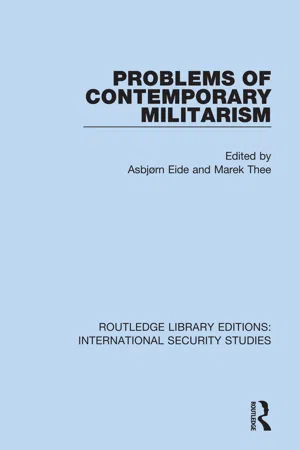
This book, first published in 1980, presents a comprehensive and detailed look at the problem of international militarisation. It examines the key issues, the meaning of the problem, the international context and the spread of militarism to the Third World, its fast growth and dangerous implications – including to the development of often poorer countries.
- 414 pages
- English
- ePUB (mobile friendly)
- Available on iOS & Android
eBook - ePub
Problems of Contemporary Militarism
About this book
Information
PART I
INTRODUCTION
Introduction
Asbjørn Eide and Marek Thee
Militarisation is one of the most conspicuous aspects of contemporary global development. Militarisation manifests itself in the increase in armaments, advances in the destructive capacity of weapons, growing number of people under arms, and dramatic increases in military expenditure. Militaristic attitudes accompany this process of militarisation. The inclination to rely on military means of coercion for the handling of conflicts, which is the most pervasive feature of militaristic attitudes, seems to be gaining ground everywhere.
In 1941, when the world was in turmoil due to aggression unleashed by some highly militarised states, President Roosevelt outlined the values that were to be promoted when the war was over. One of them was the following:
The fourth is freedom from fear - which, translated into world terms, means a world-wide reduction of armaments to such a point and in such a fashion that no nation will be in a position to commit an act of physical aggression against any neighbour anywhere in the world.
Alas, this was not to be. Starting with the very participation in World War II itself, by way of the growth of military production and other military preparations, a qualitative leap into a dynamic process of militarisation had been inaugurated. It was to be quickly accelerated under the impact of the Cold War.
The dramatic increase in the influence of the military was highlighted by President Eisenhower who, in his memorable farewell address, warned “against the acquisition of unwarranted influence in the councils of government and state’ by what he terms ‘the military-industrial complex’. As subsequently revealed in many studies, this influence has today a very large socio-political base. It relies on a competitive alliance of vested interests which include not only the military and the military industry, but also the state political bureaucracy interested in using military power as an instrument of diplomacy and politics. Included also is a strong establishment of physical and engineering scientists working for military research and development and planning armaments for years ahead. It is therefore more appropriate to speak now of the military-industrial-technological-bureaucratic complex which favours and stimulates armaments, and serves to enhance the position of the military in national and international life.
The impact of this complex is most strongly felt within the superpowers, East and West. But through military alliances, it also has serious consequences for medium powers and small nations. The military alliances give rise to a bureaucracy of security specialists, and simultaneously there is an increasing integration of armament production. The net effect of this is the formation, on the level of the alliance itself, of an international military-industrial-bureaucratic network, much more concerned with the maintenance of the alliance than with the protection of the national security of the individual member of the alliance.
Furthermore, the process of decolonisation, on the one hand, and of neo-colonial aspirations of the industrialised countries on the other, brought about the creation and strengthening of the position of armed forces of many of the new states. These have been actively encouraged to intervene in domestic politics, to replace civilian governments and to carry out rigid, coercive policies. The effects of contemporary militarisation in Third World countries are, therefore, most detrimental. Many of these live under military regimes, some of which are extremely cruel. The burden these countries have had to pay in the economic, political, social and cultural field is staggering. Development priorities have been distorted, political expression has been suffocated, and human rights have been extensively violated. Thus, militarisation has today a global reach. Given the constant increase and sophistication of the tools of war, conventional and nuclear, tactical and strategic, a dynamic has been set in motion which corrupts society, wastes precious human and material resources, undermines democracy and increases the probability of armed conflict and war. The armament dynamic seems to have gone beyond social and political control.
It is important that we become conscious of the dangers of contemporary militarisation and militarism. At stake is the fate of the human being and the survival of humanity.
This book is intended as a modest contribution by the International Peace Research Institute in Oslo, and by the wider community of peace researchers, to the study of the problems of contemporary militarism. Its aim is to spread awareness of the dangers inherent in the growth of armaments and militarism. The social, economic, political and other processes which are forced by militarisation need to be made more transparent. Better knowledge should help to increase awareness and activate public opinion in the struggle to halt the arms race and to counteract militarism and militarisation.
The nature and the strength of the forces behind the arms race have been extensively studied by peace researchers over the last years, and they have also demonstrated convincingly the lack of serious commitment to disarmament. Their work is one of the stimuli for this study. Another impulse came from the programme of the World Council of Churches on Militarism and the Arms Race, and we are also inspired by the stand against armaments by the concerned international scientific community as represented by the Pugwash Conferences on Science and World Affairs.
Some of the papers in this book were presented, in preliminary versions, at the Pugwash Symposium on Militarism and National Security held in Oslo in 1977, and at the Consultation on Militarism held by the World Council of Churches at Glion in 1977. Other papers have been produced by members of the Study Group on Militarization Versus Development and Human Rights of the International Peace Research Association.
We are grateful to all those who have made this book possible. In particular, we are indebted to those who have contributed their papers for this collection, but also we are grateful to those who have joined the discussions in the peace research community during the last years, and whose knowledge and insights are reflected in the present collection.
PART II
THE GLOBAL DIMENSION
1 Militarism and Militarisation in Contemporary International Relations*
Marek Thee
1 Introduction: the Problem Defined
Ours is a sick society. One symptom of the sickness is the spread of militarism and militarisation around the globe. Yet, except in peace research circles, this phenomenon has not attracted sufficient attention in scholarly literature. Militarism is discussed rather as a local or regional issue, while its overall international aspects, its structure, dynamics, mushrooming growth and implications are seldom analysed. Scholars seem alarmed - and rightly so - at the spread of military regimes to Third World countries. Yet the roots and interrelations that this development has with the current international political, social and economic structure are rarely examined.
In the following, under the term ‘militarism’ I subsume such symptoms as a rush to armaments, the growing role of the military (understood as the military establishment) in national and international affairs, the use of force as an instrument of supremacy and political power, and the increasing influence of the military in civilian affairs. Seen from this angle, militarism has indeed become a global phenomenon. I understand ‘militarisation’ as being an extension of military influence to civilian spheres, including economic and socio-political life. The impact of militarism and militarisation, in a disguised or open form, is deeply felt in international relations, and increasingly in the internal life of many nations as well.
We need more research and a more informed discussion on problems of militarism and militarisation. The very terms ‘militarism’ and ‘militarisation’ need more elucidation, and need to be given a meaningful contemporary currency. These terms are often used with different connotations in East and West, North and South, and are too often applied in the political debate without precise definition. Generally, ‘militarism’ is used to convey developments paralleling such well known historical phenomena as Bonapartism, the rise of the German imperial strength, the ascendancy of Japan as a world power, or some Fascist variants of expansionist regimes. However, these models are inadequate for a deeper understanding and analysis of contemporary militarism, both in the Third World and in the developed countries, capitalist and socialist. And such case studies as exist on the new role of the military in Asia, Africa or Latin America usually lack the global perspective necessary for understanding the internal dynamics.
* Paper presented at the Pugwash Symposium on Militarism and National Security, Oslo, 21-5 November 1977, and at the 7th General Conference of the International Peace Research Association, Oaxtepec, Mexico, 11-16 December 1977. First version published in Bulletin of Peace Proposals, vol 8, no. 4 (1977). References and reading list are amalgamated into the bibliography at the end of the book.
The aim of this chapter is to outline and take up for initial discussion the role of the military and the impact of military ascendancy in contemporary international relations. Starting from the historical context, I point to the socio-political dynamics, present a set of indicators and arrive at a typology and classification of contemporary militarism. Guided by the thinking developed in the peace research community, the paper then discusses some aspects of the world military order, its structure and hierarchy, the militarism and armaments dynamics and the spread of military regimes to Third World countries. The intention is to take account of existing findings and attempt to define a coherent global perspective. Finally, some remarks are made on possible action, in research and socio-political life, to confront the danger of militarism.
2 The Phenomenon of Militarism
2.1 The Historical Context
Historically, militarism developed as a corollary to rule and privilege. The military habitually served the interests of the ruling classes, and in the process tended to acquire autonomous strength and a privileged socio-political position in society. It also produced its own doctrine of state and government marked by a cult of power and national aggrandisement. A product of existing conflicts by the use of force, contributing at times to revolutionary change but most often sustaining conservative rule. In relations between states, militarism tended tp channel into expansionism. War became a simple extension of politics with other means.
In...
Table of contents
- Cover
- Half Title
- Title Page
- Copyright Page
- Original Title Page
- Original Copyright Page
- Table of Contents
- Part I: Introduction
- Part II: The Global Dimension
- Part III: Meaning of Militarism
- Part IV: The Military in the Third World
- Part V: Legal, Social and Cultural Spheres
- Part VI: Appendices
- Select Bibliography
- Notes on Contributors
- Index
Trusted by 375,005 students
Access to over 1.5 million titles for a fair monthly price.
Study more efficiently using our study tools.
Frequently asked questions
Yes, you can cancel anytime from the Subscription tab in your account settings on the Perlego website. Your subscription will stay active until the end of your current billing period. Learn how to cancel your subscription
No, books cannot be downloaded as external files, such as PDFs, for use outside of Perlego. However, you can download books within the Perlego app for offline reading on mobile or tablet. Learn how to download books offline
Perlego offers two plans: Essential and Complete
- Essential is ideal for learners and professionals who enjoy exploring a wide range of subjects. Access the Essential Library with 800,000+ trusted titles and best-sellers across business, personal growth, and the humanities. Includes unlimited reading time and Standard Read Aloud voice.
- Complete: Perfect for advanced learners and researchers needing full, unrestricted access. Unlock 1.5M+ books across hundreds of subjects, including academic and specialized titles. The Complete Plan also includes advanced features like Premium Read Aloud and Research Assistant.
We are an online textbook subscription service, where you can get access to an entire online library for less than the price of a single book per month. With over 1.5 million books across 990+ topics, we’ve got you covered! Learn about our mission
Look out for the read-aloud symbol on your next book to see if you can listen to it. The read-aloud tool reads text aloud for you, highlighting the text as it is being read. You can pause it, speed it up and slow it down. Learn more about Read Aloud
Yes! You can use the Perlego app on both iOS and Android devices to read anytime, anywhere — even offline. Perfect for commutes or when you’re on the go.
Please note we cannot support devices running on iOS 13 and Android 7 or earlier. Learn more about using the app
Please note we cannot support devices running on iOS 13 and Android 7 or earlier. Learn more about using the app
Yes, you can access Problems of Contemporary Militarism by Asbjørn Eide,Marek Thee in PDF and/or ePUB format, as well as other popular books in Computer Science & Cyber Security. We have over 1.5 million books available in our catalogue for you to explore.