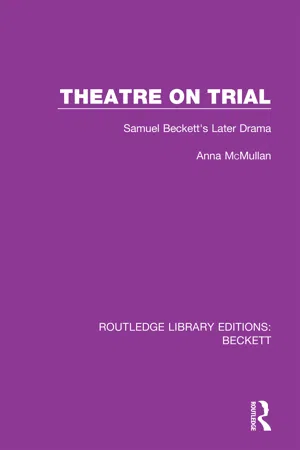
This book, first published in 1993, is the first full-length analysis of Samuel Beckett's later drama in the context of contemporary critical and performance theory. It employs a close, textual examination of the later plays as a springboard for exploring ideas around authority, gender and the ideology of performance. Recent work in the world of critical theory has suggested new ways of looking at performance practice. McMullan argues that, while contemporary theory can deepen our understanding of Beckett's dramatic practice, his drama places performance in the context of a metaphysical history and a metatheatrical tradition, thereby confronting and provoking some of the central debates in performance studies' engagement with critical theory.
- 160 pages
- English
- ePUB (mobile friendly)
- Available on iOS & Android
eBook - ePub
About this book
Information
1
Mimicking Mimesis
Subverting patriarchal mimesis is what we might call mimesis-mimicry, in which the production of objects, shadows, and voices is excessive to the truth/illusion structure of mimesis, spilling into mimicry, multiple ‘fake off spring’.1There is still. . . nothing more dramatic than a trial.... There is a sense in which every performance is a trial, offering up evidence.2
Knowledge, in the Western philosophical tradition, has been associated with reason, clarity and illumination. It is concerned with the process of making the truth visible, the revelation of the subject of inquiry to the interrogating eye. In modern European history, the Enlightenment project aimed specifically to relate knowledge more closely to scientific modes of enquiry. Truth and knowledge were defined primarily in rational terms, reinforcing the rejection of that which cannot be comprehended and illuminated by reason:
The development of rational forms of social organisation and rational modes of thought promised liberation from the irrationalities of myth, religion, superstition, release from the arbitrary use of power as well as from the dark side of our own human natures. Only through such a project could the universal, the eternal and the immutable qualities of all humanity be revealed.3
Hence the propagation of forms of knowledge and representation which privilege unity, plenitude and the mastery or repression of that which cannot be known or seen. The very term Enlightenment suggests the links between knowledge, vision and truth. However, some contemporary critics suggest that, while aiming at liberation and progress, ‘the Enlightenment project was doomed to turn against itself and transform the quest for human emancipation into a system of universal oppression’.4
In Discipline and Punish, Michel Foucault demonstrates how the Enlightenment spirit of enquiry and mastery was applied to the surveillance and discipline of individual bodies by the socio-political structures of power and authority in Western societies: ‘the exercise of discipline presupposes a mechanism that coerces by means of observation.’5 The term theatre derives from the Greek word for ‘to see’, and indeed theatre has frequently dealt with the revelation of truth through the unmasking of false identities or assumptions before an assembled audience. Theatre as scene of truth can therefore be linked to the human drive towards the interrogation of self and species in the pursuit of knowledge and understanding. However, as contemporary revisions of the Enlightenment project suggest, the search for integrity and knowledge can become the will to dominate. The mechanisms of theatre may therefore reproduce the operation of power as judgement and spectacle.
Much of Beckett’s theatre focuses on strategies of surveillance and spectacle — most of the bodies which appear in his plays are subject to discipline and cannot escape either the confines of the stage or the relentless glare of the spotlight. This is perhaps a major reason why the late plays are rarely performed in the round — precisely because of the way they set up a frame, offering that which appears within it as spectacle. Beckett plays on relations and levels of authority within the theatrical apparatus: the authority of the text, the author, the director or the audience. The body of the actor is frequently foregrounded as the material on which this authority is inscribed and displayed. Beckett’s plays also draw attention to the act of spectating, and the power relations inherent within it. Theatre can therefore make a spectacle of the operations of power — exposing, mimicking and subverting its strategies.
The physical restriction of movement or of the physical body has figured in all of Beckett’s plays. Vladimir and Estragon cannot leave the stage space — at least for the duration of the performance. Like most of Beckett’s characters they are hampered by physical disabilities. In subsequent plays, physical disabilities or restrictions frequently eliminate mobility altogether. Winnie in Happy Days is buried up to her waist in the first act, to her neck in the second. Play seems to carry on where the last act of Happy Days ends. The three talking heads on stage have no power of movement. Each is held tightly in the mouth of an urn and rigidly separated from the others. Each head is also subjected to the operation of the Light, which rapidly switches from one head to the other. When each head is illuminated, it begins to utter. The heads do not have control over their own speech, which is ‘extracted’ by the Light.
More than in any of Beckett’s previous plays, therefore, Play foregrounds the framework of discipline and control in relation both to the characters’ bodies and to their speech. In Happy Days, the Light, accompanied by a bell, dictated the beginning and end of Winnie’s day, but not the pattern and rhythm of her speeches. The enforced immobility of the heads and the use of the spotlight reinforce the connotations of interrogation, and even torture: ‘M: Why not keep on glaring at me without ceasing? I might start to rave and — [Hiccup] — bring it up for you.’6 This association of the drive to knowledge with the operation of power specifically upon individual bodies is explored in Beckett’s last play for the stage, What Where, while Catastrophe focuses on the presentation of a silenced body as visual spectacle by a figure of institutional power. In these plays, therefore, the body is foregrounded as a locus of the struggle for control and mastery, either within the subject who has internalized the laws of identity and authority, or between the subject and the external modes of law and discipline. In particular, these three plays explore the structures of power operating within the mechanisms of narrative and spectacle — traditionally the raw materials of theatrical representation.
Play: Theatre on Trial
Play self-consciously refers to those operations of sight and judgement essential to the establishment of truth according to logocen-tric rules. The three heads are forced to relate their texts under the interrogation of the Light. The Light is therefore associated both with revelation and with judgement. Indeed, the play juxtaposes two levels of perception and judgement: firstly, the figures’ narration of their life-(hi)stories in an attempt to ‘be seen’ and judged by the Light, and secondly, the play itself as a representation of those processes of representation and perception, to be perceived by the audience. While the first level stresses the attempt to present or perceive the lives of the characters as a coherent narrative, the second level continually undermines any attempt to achieve either visual or narrative coherence, and in the process exposes and parodics the mechanisms through which representation has attempted to master the fragmentary and the unknown.
In particular, Beckett’s presentation of the body in Play and in subsequent plays belies any stable or unitary concept of self which the narratives may attempt to establish. Lacanian theory is once again useful in investigating the importance of the visual image of the body as guarantee of the unified identity and authority of the self. Lacan has identified the emergence of the concept of self with the ‘mirror stage’ when the child (mis)recognizes [his] ‘self’ in the mirror reflection of the body, perceived as a totalized whole, in contrast to the ‘fragmented body’ which [he] has experienced until then. According to Lacan, the desire for a unified self is inseparable from, and indeed is constituted by, the perception of the body as a unified, totalized image. Jane Gallop refers to the mirror stage as ‘a turning point. After it, the subject’s relation to [him]self is always mediated through a totalizing image that has come from outside. For example, the mirror image becomes a totalizing ideal that organizes and orients the self.... It is the founding moment of the imaginary mode, the belief in a projected image.’7 It can be seen as a model and paradigm of the attempt on the part of the subject to achieve mastery of both the internal and the external worlds through representation, with representation itself predicated on the image of the ‘whole’ body. Lacan emphasizes that this impression of mastery is associated with the visual fixity of the image in contrast to the unfigurable mobility of the drives:
The fact is that the total form of the body by which the subject anticipates in a mirage the maturation of [his] power is given to [him] only as Gestalt, that is to say, in an exteriority in which this form is certainly more constituent than constituted, but in which it appears to [him] above all in a contrasting size (un relief de stature) that fixes it and in a symmetry that inverts it, in contrast with the turbulent movements that the subject feels is animating [him].8
Lacan stressed, however, that this stable, unified image, which apparently unites the inner and the outer, Y Innenwelt and Y Umwelt, is an illusion, and by identifying with it the subject paradoxically condemns [him] self to a perpetual cycle of self-division and alienation:
Thus, this Gestalt. . . symbolizes the mental permanence of the I, at the same time as it prefigures its alienating destination; it is still pregnant with the correspondences that unite the I with the statue in which [man] projects [him]self, with the phantoms that dominate [him], or with the automaton in which, in an ambiguous relation, the world of [his] own making tends to find completion.9
Moreover, as Jane Gallop indicates, this totalized self-image brings with it a terrifying awareness of the fragmentation which it is supposed to replace: ‘The mirror stage would seem to come after “the body in bits and pieces” and organize them into a unified image. But actually, that violently unorganized image only comes after the mirror stage so as to represent what came before’10 Indeed, Lacan has suggested that such an awareness of ‘violent unorganization’ continues to haunt consciousness and to threaten the self-mastery desired by the ego: ‘this illusion of unity, in which a human being is always looking forward to self-mastery, entails a constant danger of sliding back again into the chaos from which he started; it hangs over the abyss of a dizzy Ascent in which one can perhaps see the very essence of Anxiety.’11 The consciousness of a fundamental disunity or ‘abyss’ appears within the Imaginary as images of fragmentation, and in particular, fragmented images of the body. This conflict between the desire for mastery, associated with wholeness and coherence, and the actuality of fragmentation and incompleteness seems to be reflected in the text and structure of Play. While the text indicates the desire for or insistence upon a unified image/narrative of self, the play presents fragmentation and difference on all levels, both within and between image and text.
The visual image of Play seems to reflect both the rigidity and the alienating effect of the imago — the body is literally turned into an object, encased in the petrified form of the urn, recalling Lacan’s ‘statue in which man projects himself’ — and also the fragmentation of the splintered Imaginary. The protruding heads are severed from the rest of the body and the image itself is in three separate parts — Beckett specifies in the stage directions that...
Table of contents
- Cover
- Half Title
- Title Page
- Copyright Page
- Original Title Page
- Original Copyright Page
- Table of Contents
- Acknowledgements
- Introduction
- 1 MIMICKING MIMESIS
- 2 MASQUERADES OF SELF
- 3 THIS SEX WHICH IS NOT ONE
- 4 REFIGURING AUTHORITY
- Conclusion: Beckett and Performance - Back to the Future
- Notes
- Bibliography
- Index
Trusted by 375,005 students
Access to over 1.5 million titles for a fair monthly price.
Study more efficiently using our study tools.
Frequently asked questions
Yes, you can cancel anytime from the Subscription tab in your account settings on the Perlego website. Your subscription will stay active until the end of your current billing period. Learn how to cancel your subscription
No, books cannot be downloaded as external files, such as PDFs, for use outside of Perlego. However, you can download books within the Perlego app for offline reading on mobile or tablet. Learn how to download books offline
Perlego offers two plans: Essential and Complete
- Essential is ideal for learners and professionals who enjoy exploring a wide range of subjects. Access the Essential Library with 800,000+ trusted titles and best-sellers across business, personal growth, and the humanities. Includes unlimited reading time and Standard Read Aloud voice.
- Complete: Perfect for advanced learners and researchers needing full, unrestricted access. Unlock 1.5M+ books across hundreds of subjects, including academic and specialized titles. The Complete Plan also includes advanced features like Premium Read Aloud and Research Assistant.
We are an online textbook subscription service, where you can get access to an entire online library for less than the price of a single book per month. With over 1.5 million books across 990+ topics, we’ve got you covered! Learn about our mission
Look out for the read-aloud symbol on your next book to see if you can listen to it. The read-aloud tool reads text aloud for you, highlighting the text as it is being read. You can pause it, speed it up and slow it down. Learn more about Read Aloud
Yes! You can use the Perlego app on both iOS and Android devices to read anytime, anywhere — even offline. Perfect for commutes or when you’re on the go.
Please note we cannot support devices running on iOS 13 and Android 7 or earlier. Learn more about using the app
Please note we cannot support devices running on iOS 13 and Android 7 or earlier. Learn more about using the app
Yes, you can access Theatre on Trial by Anna McMullan in PDF and/or ePUB format, as well as other popular books in Literature & Literary Criticism. We have over 1.5 million books available in our catalogue for you to explore.