Peace, Discontent and Constitutional Law
eBook - ePub

Peace, Discontent and Constitutional Law

Challenges to Constitutional Order and Democracy

  1. 260 pages
  2. English
  3. ePUB (mobile friendly)
  4. Available on iOS & Android
eBook - ePub

Peace, Discontent and Constitutional Law

Challenges to Constitutional Order and Democracy

About this book

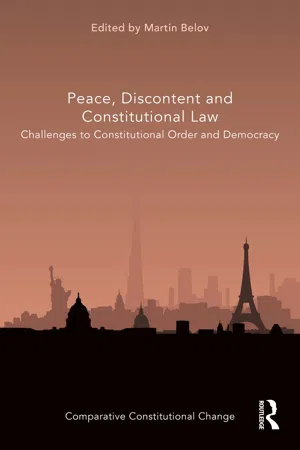
This book offers a multi-discursive analysis of the constitutional foundations for peaceful coexistence, the constitutional background for discontent and the impact of discontent, and the consequences of conflict and revolution on the constitutional order of a democratic society which may lead to its implosion. It explores the capacity of the constitutional order to serve as a reliable framework for peaceful co-existence while allowing for reasonable and legitimate discontent. It outlines the main factors contributing to rising pressure on constitutional order which may produce an implosion of constitutionalism and constitutional democracy as we have come to know it. The collection presents a wide range of views on the ongoing implosion of the liberal-democratic constitutional consensus which predetermined the constitutional axiology, the institutional design, the constitutional mythology and the functioning of the constitutional orders since the last decades of the 20th century. The constitutional perspective is supplemented with perspectives from financial, EU, labour and social security law, administrative law, migration and religious law. Liberal viewpoints encounter radical democratic and critical legal viewpoints. The work thus allows for a plurality of viewpoints, theoretical preferences and thematic discourses offering a pluralist scientific account of the key challenges to peaceful coexistence within the current constitutional framework.

The book provides a valuable resource for academics, researchers and policymakers working in the areas of constitutional law and politics.

Trusted by 375,005 students

Access to over 1.5 million titles for a fair monthly price.

Study more efficiently using our study tools.

Information

Publisher
Routledge
Year
2021
Print ISBN
9780367539726
eBook ISBN
9781000385335
Topic
Law
Index
Law

Part I
The constitutional foundations of democratic peace and democratic discontent in times of crisis and transition

1 Constitutional foundations of peace and discontent

Martin Belov

1 Introduction

This chapter aims to provide an outline of some of the conceptual issues related to the constitutional foundations of order and disorder viewed through the prism of peace and discontent.1 The constitutional shaping of order and disorder is, in fact, a matter of establishing the framework of the range of legally permissible political discontent with its conceptual, institutional, normative, and pragmatic implications.2 Hence, this chapter will try to present the constitutional strategies and models for safeguarding of obedience and trust as fundamental prerequisites for promotion of peaceful political coexistence and constitutional order. These strategies are subsumed under the overall constitutional models for maintenance of peace and discontent.
One of the key assumptions of this chapter is that constitutions are the main instruments for measuring, framing, and legalising the degrees of public discontent. They also serve as exclusion of forms of disorder due to their constitutionally defined anti-systemic role and potential. The systemic or anti-systemic character of disorder and discontent is a matter of political choice of the constitutional legislator followed by its subsequent constitutional entrenchment. In fact, this is one of the main tasks of the constitutional models of peace and discontent – to define which forms of peace and discontent are systemic and anti-systemic.
Not only discontent, but also peace may be anti-systemic phenomenon. This is the case of the unilaterally imposed peace suffocating political pluralism and legitimate expression of discontent in democratic orders experiencing transition to illiberal democracies and authoritarianism. This problem will be discussed further especially in Section 3 of this chapter.

1 See Azin Tadjdini, ‘The Constitutional Dimension of Peace’, in Cecilia Marcela Bailliet and Kjetil Mujezinovic Larsen (eds) Promoting Peace Through International Law (Oxford University Press 2015), Allen S. Weiner, ‘Constitutions as Peace Treaties: A Cautionary Tale for the Arab Spring’ (2011) 8 Stanford Law Review Online 64.
2 See Michael Sandel Democracy’s Discontent: America in Search of a Public Philosophy (Harvard University Press 1998) 1–432.

Indeed, it should be admitted that the constitution is only one of the factors for maintenance of peaceful coexistence and satisfaction with the established constitutional order and political regime. Peace and discontent are variables which are dependent also on a range of socio-legal factors contributing to the legality and the legitimacy of the constitutional system and the political establishment. Nevertheless, the constitution is supposed to serve as an institutional channel for expression of discontent and as an instrument for the promotion of peace due to its ordering and legitimation functions. Thus, special attention will be devoted to the ordering function of the constitution as well as to the models for peace and discontent it provides.
Order and disorder are considered as social phenomena with fundamental political importance, which are also entrenched in the constitution and the constitutional law. In addition, they have important implications for the constitutional and political anthropology of societies, for the intellectual apprehension of the permissible or forbidden forms of expression of trust, distrust, anger, or alienation. Conceptually, the constitutional models of peace and disorder also play an educational role for the people and the civil society. In mid- and long term, they form durable attitudes to freedom and its legitimate limits which are gradually being entrenched in the constitutional anthropology of the society. In other words, the constitution serves as an indicator not only for the legal, but also for the legitimate limits of constitutional freedom, the means for its achievement and the instruments for authoritative imposition of order and peace. Thus, the constitution and the overall constitutional tradition serve as determinants for the socially justified frames of consensus and conflict, peace, and discontent.
Hence, peace and discontent are socio-legal categories stretched between the ideal, social, and legal dimensions of constitutionalism. They have projections in the legal mentality, anthropology and consciousness of the people which is based on their socio-political acculturation, education and experience and is framed, thus also being influenced, by the constitutional foundations of peace and discontent. In fact, all three aspects – the ideal, the socio-political, and the legal – have constitutional implications. They altogether form the constitutional foundations of peace and discontent.
Indeed, the constitutions are one of the most important determinants of peace and discontent but are not the ultimate or exclusive factor for the legitimacy of disorder and discontent. They are just the official marker of the borderlines between order and disorder, peace, and discontent. Hence, the constitutions are allocated in the power grid stretched between legality and legitimacy which are the two ultimate criteria for evaluation of the public order, the political order, and the constitutional order.3

3 For the conceptual problems of legality and legitimacy, the interrelation and tensions between them see Carl Schmitt, Legality and Legitimacy (Duke University Press 2004) 1–212, David Dyzenhaus, Legality and Legitimacy: Carl Schmitt, Hans Kelsen and Hermann Heller in Weimar (Oxford University Press 2000) 1–304, Lars Vinx, Hans Kelsen’s Pure Theory of Law. Legality and Legitimacy (Oxford University Press 2007) 59 and the following and Max Weber, ‘Die drei reinen Typen der Legitimen Herrschaft’ in Max Weber, Soziologie. Weltgeschichtliche Analysen. Politik (Kröner Verlag 1968).

The chapter will start with an outline of the ordering function of the constitution.4 Then it will explore the foundational role of constitutional conflict and constitutional consensus for liberal-democratic constitutionalism. Special emphasis will be put on the epistemology of the constitutional models for peace and discontent, on their nature, structure, and essential elements.

2 The ordering function of the constitution

The mission of the constitution is to order the society. It must organise socio- political relations making them well-ordered, systematic, predictable, and rational. The constitution has assumed this role after the adoption of the first written constitutions. Before them, states had their political constitution as the durable de facto order of rules for socio-political behaviour. The unwritten constitution was not detachable from its ordering function because it was immediately ordering the society by the very fact of its existence. Thus, the unwritten constitution unites in a simultaneous phenomenon the legal and the socio- political ordering of the society. It is the result of a permanent interaction between content and discontent. It is materialising in itself the fragile equilibrium between political conflict and political consensus. It requires the simultaneous existence of conflict and consensus – the first allowing for evolution and the second granting a degree of stability and predictability.
In the context of unwritten constitutions the constitutional conflict and consensus are merged with the socio-political conflict and consensus. There is no explicit, written model of permissible disorder and conflict detached from the socio-political interaction between the different political players on the ground. The epistemology of order is based on the lack of disorder, but also on the integration of disorder in the official schemes for accomplishment of government and power.
This is not the case with written constitutions. They are the deliberate creation of the human mind resulting in an artificial model of human behaviour imposed on socio-political reality. The written constitution is an abstract model aimed at normative ordering of the socio-political relations conceived as both determinants of this model and as result of it but in any case, as separate from the realm of written constitutional normativity. The written constitution is the result of collective use of intellectual forces for the creation of widely or more narrowly negotiated or imposed rules of the political game. The written constitution rests on the suggestion for improvement of the social world, for its improvement in the name of big ideals and in the light of values, principles, and aims constituting the moral-political foundations of the institutional design. Thus, the written constitution contains a deliberate model of constitutional peace and discontent with its axiological, institutional, and socio-legal implications. It establishes constitutional models of desired order and permissible disorder. These models will be outlined later in the chapter.

4 For the ordering function of the constitution see Georg Jellinek, Allgemeine Staatslehre, (Springer 1921) 505 and Joachim Detjen ‘Verfassung und Werte’ in Die Werteordnung des Grundgesetzes. (VS Verlag fĂŒr Sozialwissenschaften 2009), 15. https://doi.org/10.1007/978-3-531-91604-0_2.

The very term constitution means to establish something, to create a foundational structure for the society, to give it a durable political form, to shape the mass of facts within a durable and legitimate legal form, to offer official institutional channels for expression of content and discontent, trust and mistrust, agreement, and disagreement. The constitution is called upon to serve as a legal map of the shapes and forms of the state and the political organisation of the society. Thus, by providing the institutional design and the parameters of social and political freedom the constitution is at the core of the processes for social acculturation and socio-political integration.5 A real, recognised, and efficient constitution must be capable of assuring its place as the central determinant of social peace and obedience and should impose legitimate, proportionate, and just limits to political freedom.
Political freedom is at the core of liberal constitutionalism. The concerns for the full protection of human rights and for establishment of the widest possible sphere for personal liberty is central to it. Thus, liberal constitutionalism is focused on the constitutional frames of liberty and more precisely on the constitutional limitations for public discontent. More radical democratic versions of constitutionalism require an extended frontier for expression of political discontent. Constitutional democracy structured around the concepts of deliberative and participatory democracy presupposes not only traditional liberal tools for expression of discontent and dissatisfaction such as the classic political rights (e.g. freedom of expression, freedom of assembly, freedom of speech etc.), but also more intense forms of disagreement like the right to protest and the right to civil disobedience. In fact, they suggest the need for scaled – proportionate and adequate – responses to illegitimate governmental action. This claim is demonstrated in detail in Chapter 2 of this book by JosĂ© Luis MartĂ­.
Depending on the context and the concrete political imperatives of the day the constitution performs its ordering function differently. First, the constitution may need to establish order out of disorder. Second, the constitution may be called upon to reshape the existing order replacing it with new order. Finally, the constitution may be adopted to confirm the existing order projecting it into the future.
The constitution should establish order out of disorder in case of radical break down of the previous constitutional and political order. Usually, such disorder is the result of deep and radical ruptures of the constitutional and political system and its underlying political consensus or at least modus vivendi. They may be caused by war, civil conflict, or insurmountable tensions within the society.

5 See Dieter Grimm, ‘Integration durch Verfassung’ (2004) 32, Leviathan 448–463 https://doi.org/10.1007/s11578-004-0031-7 and Gary Schaal, ‘Integration durch Verfassung und Verfassungsrechtssprechung? Theoretische Anmerkungen’ (2001) 30(2) Österreichische Zeitschrift fĂŒr Politikwissenschaft, 221‒232 https://nbnresolving.org/urn:nbn:de:0168-ssoar-59721.

It should be noted that the first written constitutions did not always establish order out of disorder. Indeed, it seems logically reasonable to accept that it is precisely the task of the first written constitution in the history of a particular national constitutional model to establish order out of disorder. In fact, this is one of the most appealing claims of modern written constitutions – to rationalise the world, to impose a systematic power grid on the turbulent and fuzzy socio-political relations.
However, the political history shows that in many cases there has been pre-established order which predates the imposition or negotiation of the first written constitutions. Hence, the first constitutions are acts aimed more or less at radical political reform rather than instruments for creation of order out of disorder. Frequently, they destroy the old order and replace it with a new one. Thus, the ordering function of the first written constitutions has been frequently bound to their disordering and deconstructive function. Ordering and construction has been predetermined and fulfilled in conjunction with deconstruction.
That is why, the constitution is very often called upon to reshape the existing order replacing it with new order. It is a device for reestablishment of the constitutional foundations of peace and discontent, order and disorder, conflict and consensus. In fact, the constitution is always stretched between the societal forces of order and disorder. In that regard, the constitution resembles the Earth. It needs magma, earthquakes, and volcanic eruptions to be alive but it must also try to stabilise the magnetic field and prevent big disasters for life to continue. Thus, the ordering function of the constitution is predestined to maintain the delicate equilibrium between peace and discontent, conflict and consensus since all of them are necessary prerequisites for a viable constitutional order and especially for the establishment and maintenance of constitutional democracy.
Finally, as mentioned above, some constitutions are adopted with the aim to confirm the existing order and to project it into the future. Such ‘consolidating constitutions’6 make the impression of establishing order out of order. However, they are typically used for political or ideological purposes aiming at demonstrating the persistence of peace and consensus while suppressing the discontent and hoping to prevent disorder. Thus, consolidating constitutions are instruments for maintenance and prolongation of the established order suffocating demands for radical change. They are political choice usually detrimental to democracy. Examples are the second wave of communist constitutions which were adopted in the late 1960s and the early 1970is in Central and Eastern Europe aiming to stabilise the Soviet type of constitutionalism and to simulate the advancement to a new stage of communist development while masquerading as the prolongation of the totalitarian regimes.

6 See Evgeni Tanchev, Introduction in Constitutional Law (Sibi 2003) 198 (in Bulgarian).
3 The foundational role of constitutional conflict and constitutional consensus for the liberal-democratic constitutionalism

Constitutional conflict and constitutional consensus are central concepts of modern constitutionalism. They are widely discussed in the theory of political pluralism. They play a pivotal role for the constitutional dynamics. Constitutional confli...

Table of contents

  1. Cover
  2. Half Title
  3. Series Page
  4. Title Page
  5. Copyright Page
  6. Table of Contents
  7. About the authors
  8. Introduction
  9. Part I The constitutional foundations of democratic peace and democratic discontent in times of crisis and transition
  10. Part II Peace and discontent in the EU constitutional order
  11. Part III Peace, order, and disorder in composite societies: national, ethnocentric, and religious factors for peace or discontent
  12. Part IV Economic challenges to constitutional peace and order in times of crisis of neoliberalism
  13. Conclusion
  14. Index

Frequently asked questions

Yes, you can cancel anytime from the Subscription tab in your account settings on the Perlego website. Your subscription will stay active until the end of your current billing period. Learn how to cancel your subscription
No, books cannot be downloaded as external files, such as PDFs, for use outside of Perlego. However, you can download books within the Perlego app for offline reading on mobile or tablet. Learn how to download books offline
Perlego offers two plans: Essential and Complete
  • Essential is ideal for learners and professionals who enjoy exploring a wide range of subjects. Access the Essential Library with 800,000+ trusted titles and best-sellers across business, personal growth, and the humanities. Includes unlimited reading time and Standard Read Aloud voice.
  • Complete: Perfect for advanced learners and researchers needing full, unrestricted access. Unlock 1.5M+ books across hundreds of subjects, including academic and specialized titles. The Complete Plan also includes advanced features like Premium Read Aloud and Research Assistant.
Both plans are available with monthly, semester, or annual billing cycles.
We are an online textbook subscription service, where you can get access to an entire online library for less than the price of a single book per month. With over 1.5 million books across 990+ topics, we’ve got you covered! Learn about our mission
Look out for the read-aloud symbol on your next book to see if you can listen to it. The read-aloud tool reads text aloud for you, highlighting the text as it is being read. You can pause it, speed it up and slow it down. Learn more about Read Aloud
Yes! You can use the Perlego app on both iOS and Android devices to read anytime, anywhere — even offline. Perfect for commutes or when you’re on the go.
Please note we cannot support devices running on iOS 13 and Android 7 or earlier. Learn more about using the app
Yes, you can access Peace, Discontent and Constitutional Law by Martin Belov in PDF and/or ePUB format, as well as other popular books in Law & Administrative Law. We have over 1.5 million books available in our catalogue for you to explore.