This concise overview of the practice and processes of management in the African context is the first of its kind, and the introductory volume in the new Essentials of Business and Management in Africa short-form textbook series.
This book covers the activities that all managers undertake regardless of their functional specialization and is organised around a model of management that consists of planning, organising, staffing, directing and controlling. After introducing each topic, the authors discuss particular characteristics of Africa and African countries and how these influence the topic being covered; for example, relative levels of poverty, prevalence of small and informal businesses and the inadequacy of infrastructure will influence aspects of planning and decision-making, and motivation. Each chapter includes illustrative real-life examples and experiential exercises/short cases. The book begins with a general overview of the African continent and ends with discussions of ethical issues and corporate social responsibility including the management philosophy of Ubuntu.
Undergraduate and postgraduate students in Africa and other parts of the world with an interest in the area will appreciate the focus on a region so little discussed in the business and management literature. Due to this dearth of material, this book will also appeal to current and future practicing managers in African countries.
This chapter provides a contextual background for the remaining chapters dealing with aspects of management. We give an overview of Africa’s current levels of development and consider African countries’ role in today’s global business environment. We briefly look at Africa’s geography and present a short history of Africa highlighting developments over the past 600 years. Measures of development for African countries’ performance are discussed. Throughout we relate issues to doing business and managing in the African context. Students of management and managers need this background picture to understand effective management in the African context.
DOI: 10.4324/9781003017516-1
Learning Outcomes
After completing this chapter, you will be able to:
Discuss the implications of Africa’s geography for doing business.
Give an overview of African cultural values.
Explain the recent history of the African continent.
Explain how slavery and colonialism have influenced African countries.
Discuss changes over the past 30 years that influenced business in Africa today.
Discuss the current situation in Africa including issues associated with trade and foreign investment.
Review African countries’ performance on various development measures.
Relate the information in the chapter to managing in Africa today.
The origin of the word ‘Africa’ is debatable. Some believe the name referred to native Libyans, ancestors of modern Berbers. Others believed that it was named by Epher, a grandson of Abraham, whose descendants claimed to have invaded Libya. Several other accounts exist.
There are many stories today of entrepreneurs making fortunes by catering to the needs of Africa’s rural poor. One African entrepreneur set up a company using solar power to show videos and make ice cream. The company’s vans travel to rural villages with no electricity, and although the people have little money, they save up to attend these events.
An anthropologist proposed a game to a group of African children—he placed a basket of sweets near a tree and had the children stand 100 m away. Then he announced that whoever reached the basket first would get all the sweets in the basket. He said ‘ready, set, go!’ To his surprise they all held hands, ran together towards the tree, divided the sweets equally among themselves and all enjoyed them. He asked them why and they answered ‘Ubuntu’ by which they meant ‘How can one be happy when the others are sad?’ Ubuntu has been translated as ‘I am because we are’ and provides a strong and positive message for all.
In the past, Africa was portrayed as having poor governance, poverty, economic stagnation and social services lagging the rest of the world. African countries were considered difficult for businesses, with many regulations, slow procedures, substantial corruption and needing illegal payments to get things done. Infrastructure was poor with unpaved roads, inefficient ports, poor banking systems and so on, making setting up and managing a business challenging and seemingly impossible for some. Today, this is changing. Concerns remain across Africa, but progress has been made. Several countries are performing well on development indicators. Income/capita is generally growing; more people are getting out of poverty and have more disposable incomes for goods/services. More people are better educated so the stock of skilled labour is increasing. We discuss development in Africa, then African geography and history and measures of development.
Africa’s Development: An Overview
A combination of factors contributes to socioeconomic changes in Africa. Importantly for managers, African countries are implementing reforms to improve economic management, liberalise economies and improve resource utilisation. These reforms create opportunities for businesses and encourage the flow of foreign direct investments (FDIs) into the continent. Tanzania enacted reforms to attract FDIs through incentives to entrepreneurs/investors, including institutional mechanisms for promoting investments. Other African countries have made similar efforts.
Africa’s abundance of natural resources, especially extractive ones, has attracted new investments in the past 20 years, especially from the People’s Republic of China (PRC). The increasing presence of Chinese business is encouraging others to re-examine the perceptions about Africa. The concept of the ‘fortune at the bottom of the pyramid’ (Prahalad, 2006), illustrating the potential of the world’s poor as a market, has also encouraged businesses to consider African markets.
‘Africa’ means different things to different people. For some, images of animals migrating and safaris to see lions, elephants, giraffes, rhinos etc. For some, thoughts of child soldiers, famine, poverty and war. For others, feelings of reverence for the birthplace of mankind. All are part of the picture of Africa, but for businesspeople today, Africa means opportunity. Africa, especially now, is ‘open for business’. The term ‘African lions’ has been used to refer to successes of countries and businesses and points to Africa’s potential. There are substantial numbers of businesses that see Africa as the next big growth frontier and Africa has been described as in the midst of a historic acceleration, lifting millions of people out of poverty, creating an emerging consumer class and propelling growth in many economies (Kaberuka, 2010).
The world, however, is constantly changing. In 2019–2020, the world was affected by a pandemic (COVID-19). The results are expected to be devastating for world economies and individual countries. We do not know the outcome for Africa, but forecasts suggest a substantial decline in gross domestic product (GDP)/capita and FDI, although some sources suggest continued growth in Africa at relatively high rates.
Africa contains many and varied countries and to manage effectively requires understanding its geography, culture and history. Next, we briefly describe Africa’s geography, dominant cultural values and review historical development. These topics are complex, and we provide a superficial overview. Readers should pursue these topics to get a more well-rounded perspective. In addition, historians and others do not always agree on the reality of the situation in Africa, and the interested reader may find alternative explanations. Our attempt is to provide ‘a bird’s eye view’.
Geography, Cultural Values and History
Firstly, we describe the African continent from a physical perspective. We consider the size and makeup of the continent.
Geography
Africa is the second largest continent in the world (Asia, the largest), measuring over 11.5 million square miles (over 30 million km2), with a population of over a billion. The Economist’s (2010) map of Africa illustrates its size, with China, India, Japan, Mexico, the United States and Western Europe fitting into the continent together. The continent covers 20.4% of the Earth’s total land area.
Africa encompasses more than 50 countries. Various sources identify 54, 56, 57 countries and Answers Africa (2020) cautions it is not clear which territories can be considered countries. World Population Review (2019) says 54 countries, 9 territories and 2 independent states (with limited/recognition) are widely used estimates and, given Africa’s complex political situation and colonial legacy, the exact makeup and number of officially recognised countries are contentious. We can say there are many, they are varied and most people agree on 54. Africa is often divided into regions—north, south, west, east, central and sub-Saharan (countries south of the Saharan desert, distinguished from the rest of Africa). There are economic groupings recognised by the Africa Union (AU) mirroring these: Arab Maghreb Union (AMU), Southern Africa Development Community (SADC), Economic Community of West African States (ECOWAS), East Africa Community (EAC), Economic Community of Central African States (ECCAS) and Common Market for Eastern and Southern African States (COMESA).
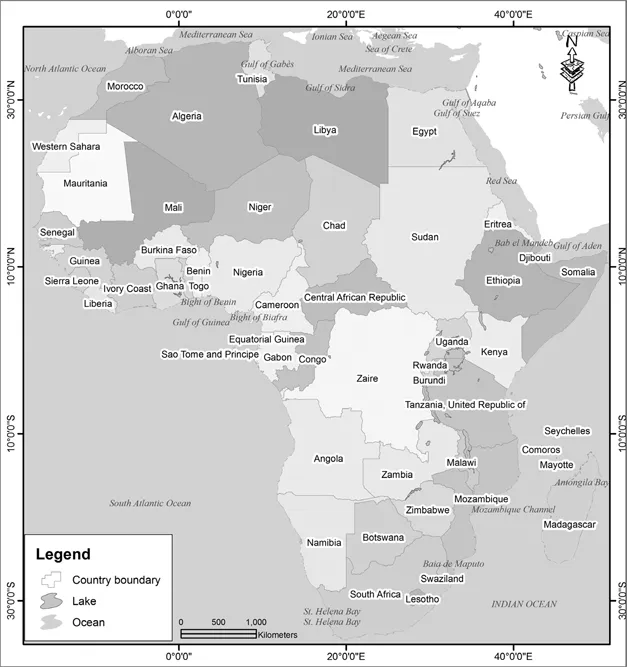
African countries range from very large, for example Algeria with about 7% of the continent’s land mass, to small island countries, for example the Seychelles, 115 islands along the eastern coast. Egypt belongs to the AU, although a small part of Egypt is in Asia, and it is often grouped with Middle East countries. The continent has many tribes/ethnic groups, with some very large and others small. The Democratic Republic of Congo (DRC) has about 200 tribes/ethnic groups and Tanzania has some 120. The largest tribes/ethnic groups are the Fulani and Yoruba. All tribes/ethnic groups have their own languages and cultures. The current make-up of the continent in terms of countries is the direct result of colonialism. The map in Figure 1.1 shows the continent and its countries.
Figure 1.1 Map of Africa showing countries
This map illustrates the variation in the size and shape of countries; some small, others large; some with lengthy coastlines, others landlocked with no ports. Africa’s topography is varied, including high mountains (Kilimanjaro, Tanzania at about 6,000 m), flat plains (the Rift Valley), the world’s longest river (the Nile, running from Burundi to Egypt into the Mediterranean) and the deepest (the Congo). It has some of the largest animal sanctuaries in the world, including Selous Game Reserve, Serengeti National Park, Ngorongoro Crater, Central Kalahari Game reserve, Masai Mara and Kruger.
Across the vast continent, cultures vary and cultural characteristics are important for doing business. Next, we look briefly at cultural values identified in the African context.
Cultural Values
African people appear to share certain cultural values, based on the Hofstede culture value model. Hofstede’s model is Western-designed but has been used worldwide. It was not intended to capture African-centric values; nevertheless, scores provide a comparison of African countries with other countries. The values measured are:
Power distance—degree to which differences in power are considered right and acceptable.
Individualism/collectivism—degree to which individual/group activities are stressed.
Masculinity—degree to which traditional masculine values (assertiveness, achievement, material possessions) predominate over feminine values (nurturing, quality of life).
Uncertainty avoidance—degree to which certainty is preferred over uncertainty/risk.
Confucian dynamism—degree to which society takes a long-term view, focusing on the future.
Indulgence—degree to which gratification and enjoyment are preferred to restraint and regulation.
Following are scores for 16 African countries (with the United States for comparison):
Country
PDI
IDV
MAS
UAI
CD
IND
Burkino Faso
70
15
50
55
27
Cabo Verde
75
2...
Table of contents
Cover
Half Title
Series Page
Title Page
Copyright Page
Contents
About the Authors
1 The African Continent
2 The Management Process
3 Planning
4 Organising
5 Staffing
6 Directing
7 Controlling
8 Business Ethics
Index
Trusted by 375,005 students
Access to over 1.5 million titles for a fair monthly price.
Study more efficiently using our study tools.
Frequently asked questions
Yes, you can cancel anytime from the Subscription tab in your account settings on the Perlego website. Your subscription will stay active until the end of your current billing period. Learn how to cancel your subscription
No, books cannot be downloaded as external files, such as PDFs, for use outside of Perlego. However, you can download books within the Perlego app for offline reading on mobile or tablet. Learn how to download books offline
Perlego offers two plans: Essential and Complete
Essential is ideal for learners and professionals who enjoy exploring a wide range of subjects. Access the Essential Library with 800,000+ trusted titles and best-sellers across business, personal growth, and the humanities. Includes unlimited reading time and Standard Read Aloud voice.
Complete: Perfect for advanced learners and researchers needing full, unrestricted access. Unlock 1.5M+ books across hundreds of subjects, including academic and specialized titles. The Complete Plan also includes advanced features like Premium Read Aloud and Research Assistant.
Both plans are available with monthly, semester, or annual billing cycles.
We are an online textbook subscription service, where you can get access to an entire online library for less than the price of a single book per month. With over 1.5 million books across 990+ topics, we’ve got you covered! Learn about our mission
Look out for the read-aloud symbol on your next book to see if you can listen to it. The read-aloud tool reads text aloud for you, highlighting the text as it is being read. You can pause it, speed it up and slow it down. Learn more about Read Aloud
Yes! You can use the Perlego app on both iOS and Android devices to read anytime, anywhere — even offline. Perfect for commutes or when you’re on the go. Please note we cannot support devices running on iOS 13 and Android 7 or earlier. Learn more about using the app
Yes, you can access Essentials of General Management in Africa by Lemayon Lemilia Melyoki,Betty Jane Punnett in PDF and/or ePUB format, as well as other popular books in Business & Business General. We have over 1.5 million books available in our catalogue for you to explore.