Mycotoxins are secondary metabolites produced by fungi in a wide range of foods (cereals, peanut, tree nuts, dried fruits, coffee, cocoa, grapes, spices…) both in the field and after harvest, particularly during storage. They can also be found in processed foods of plant origin, or by transfer, in food products of animal (milk, eggs, meat and offal). Mycotoxins are of major concern since they can cause acute or chronic intoxications in both humans and animals which are sometimes fatal. Many countries, particularly in Europe, have set maximum acceptable levels for mycotoxins in food and feed.
The book reviews the latest literature and innovations on important aspects of mycotoxins, e.g. mycotoxin producing fungi and the related ecosystems, mycotoxin occurrence, toxicity, analysis and management. Quantitative estimation of impacts of climate change on mycotoxin occurrence have been made recently, using predictive modelling. There is also a growing interest in studying the occurrence and toxicity of multiple mycotoxins in food and feed, including emerging or modified forms of mycotoxins. Innovative tools have also developed to detect and quantify toxinogenic fungi and their toxins. In order to reduce the use of chemicals that are harmful to the environment and health of consumers, alternative methods of prevention and decontamination of mycotoxins were tested in pre- and post-harvest, using microorganisms, natural substances or radiation treatments.
During the last several years, substantial advancements in green chemistry principles have developed for the valorization of crop residues and cleaner production such as biopesticides (Saravanakumar et al. 2016). The market of biopesticides is growing quickly in comparison to conventional chemical pesticides that cause significant losses in agriculture, and their repeated use promotes the development of chemically resistant pathogen strains (Shah and Pell 2003, Keswani et al. 2016, Hamrouni et al. 2019a). Strong growth in the use of the biopesticides market is observed annually at a rate of 44% in North America, 20% in Europe and Oceania, 10% in Latin and South American countries and 6% in Asia (Tranier et al. 2014, De la Cruz Quiroz et al. 2015). Biopesticides are offering a more ecological manner for the management of pests, but they also face several challenges, such as increased barriers for the use of biological products, a lack of awareness towards the use of agricultural biological products, and most importantly a lack of global availability (Olson 2015, Zachow et al. 2016). To enhance the feasibility of using biopesticides, it is necessary to increase the metabolites with an antibiotic effect and biomass of species of interest (Vinale et al. 2014, Roussos et al. 2020).
Biopesticide production mainly uses biological control agents (BCA), because they are used as natural enemies of phytopathogens as mycotoxigenic fungi (Vinale et al. 2014). Furthermore, the use of microorganisms for pest management in agriculture is one of the most effective strategies of biological control (Loera-Corral et al. 2016). The outcomes of using beneficial microbes are strain dependent and the advantages for the associated plants include:
Suppression of pathogens,
Growth promotion,
Establishment of an antagonistic microbial community in the rhizosphere, and
Enhanced host resistance to both biotic and abiotic stresses (Howell et al. 2003).
Most of the microorganisms used in biocontrol are filamentous fungi because they are ubiquitous colonizers of their habitats as well as for their secretion capacity for antibiotic metabolites and enzymes, but also some bacteria such as Bacillus thuringiensis and Bacillus subtillis with biocontrol ability have been used (Harman 2000, Reino et al. 2008).
Fungi belonging to the Trichoderma genus are well known producers of secondary metabolites (SMs) with a direct activity against phytopathogens and compounds that substantially affect the metabolism of the plant, they are contributing as much as 50% of BCA’s fungi (Reithner et al. 2005, Rubio et al. 2009). Although not essential for their primary metabolic processes, Trichoderma strains produce various SMs, including compounds of industrial and economic relevance. The production of SMs has been often correlated to specific stages of morphological differentiation and is associated with the phase of active growth (Thines et al. 2004, Vinale et al. 2006).
SMs show several biological activities possibly related to survival functions of the organism, such as competition against other micro- and macro-organisms, symbiosis, and metal transport. Furthermore, they play an important role in regulating interactions between organisms. Some example of SMs are” mycotoxins (SMs produced by fungi that colonize crops capable of causing disease and death in humans and other animals), phytotoxins (SMs produced by fungal pathogens that attack plants), pigments (colored compounds also with antioxidant activity) and antibiotics (natural products capable of inhibiting or killing microbial competitors (Renshaw et al. 2002, Lehner et al. 2013).
In addition, there are other ways to apply biocontrol compounds such as fungal spores, which are the most virulent form, have a long shelf life (Brand 2006, Hamrouni et al. 2019a) and they are cell structures more adapted to grow in a field and resist environmental conditions in situ (Shah and Pell 2003). Fungal spores and SMs can be produced by solid state fermentation (SSF). Use of agro-industrial wastes and SSF technology offers an alternative to bio-pesticide production (Hamrouni et al. 2019c, De la Cruz Quiroz et al. 2015, De la Cruz Quiroz et al. 2017a).
SSF can be defined as a fermentation process involving solid material in the absence (or near absence) of free water, but with enough moisture to support the growth and metabolism of the microorganisms (Pandey 2003, De la Cruz Quiroz et al. 2015). It uses agro-industrial residues as substrates for the production of bio-active products of commercial interest; this process falls under waste management technology (Roussos et al. 1997). This technology is receiving renewed attention because of the growing need for new metabolites in various industries such as agriculture (biopesticides), health, food and cosmetics (Thomas et al. 2013) obtaining in this way an inexpensive biotechnological option for modern agriculture in developing countries.
In this paper we summarize the most important metabolites types produced by Trichoderma species, emphasizing their biological activities, especially the role that these metabolites play in biological control mechanisms. Some aspects relating to the biosynthesis of these metabolites and related compounds are also discussed. It must be stressed that some of the groups of products mentioned here are the most important fungal metabolite families known.
2.Phylogeny, Biodiversity and Biotechnology of Trichoderma
The first description of Trichoderma fungi dates back to 1794 (Persoon 1794). In 1865, a link to the sexual state of a Hypocrea species was suggested. Hence, in 1969 the development of a concept for its detailed identification was initiated (Rifai 1969). Trichoderma are classified as follows:
Class: Euascomycetes (Fungi that tend to form lichen with other organisms)
Phylum: Ascomycota (Fungi that are characterized by their ascus (structure for reproduction)
Order: Hypocreales
Family: Hypocreaceae
Genus:Trichoderma
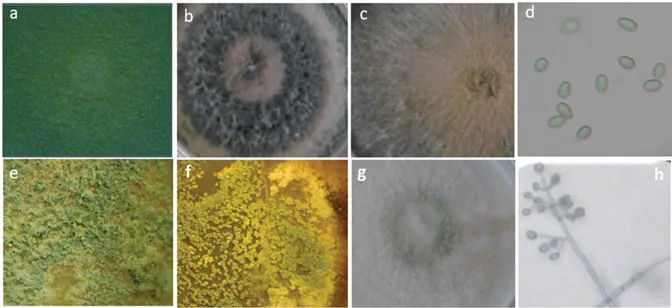
Characterization of the genus Trichoderma was based firstly on morphological character such as conidial form, size, color, branching pattern with short side branches, short inflated phialides and the formation of sterile or fertile hyphal elongations from conidiophores. Generally, they produce a broad array of pigments from bright greenish-yellow to reddish in color, although some are also colorless. Similarly, conidial pigmentation varies from colorless to various green shades and sometimes also gray or brown (Hamrouni et al. 2019d). Mycelial form varies from Floccose to arachnoid with white color (Fig. 1). In addition, Trichoderma species are free-living fungi which are highly interactive in soil, root, and foliar environments.
Figure 1. Characteristic features of Trichoderma strains. (a) T. viride, (b) T. asperellum DWG3, (c) T. harzianum, (d) conidia of T. asperellum, (e) T. longibrachiatum, (f) T. longibrachiatum during confrontation with Fusarium strain, (g) T. asperellum Tv 104, (h) T. harzianum germination and growing on PDA medium.
In fact, the taxonomic confirmation of the genus Trichoderma, based only on morphological markers, can be considered to be limited and of low accuracy, due to the similarity of morphological characters and increasing numbers of morphologically cryptic species (Yedidia et al. 2003). Thereafter, many new species of Trichoderma strains were discovered, and by 2006, the genus already comprised more than 100 phylogenetically defined species (Druzhinina et al. 2006). Sometimes, especially in earlier publications, misidentifications of certain species occurred, for example the name Trichoderma harzianum has been used for many different species.
In recent years, with the advent of molecular biology methods, it is now possible to identify every Trichoderma isolate and determine it as a putative new species (18S rDNA sequence analysis) (Kullnig et al. 2001).
At present, the current diversity of the Hypocrea/Trichoderma is reflected in approximately 160 species including; T. viride, T. virens, T. harzianum, T. asperellum, T. longibrachiatum, T. yunnanense, T. parareesei, T. hamatum, T. atroviride, T. gamsii, T. orientale and T. spirale.
Trichoderma are the subject of various industrial applications in agriculture, food, pharmacy and biorefinery. Several species have economic importance as sources of enzymes, antibiotics, plant growth promoters, decomposers of lignocellulosic substrates, and as commercial biopesticides. Actually, strains of Trichoderma are commercially available to control plant disease in environmentally friendly agriculture (Harman et al. 2004).
3.Trichoderma Strains Used as Biopesticides in Biocontrol
Filamentous fungi have generated special importance due to the fact that they have a higher spectrum of disease control and greater biomass yield. Trichoderma strains are an important fungus as a biopesticide; these fungi could be a good model for biocontrol application.
After publication of Trichoderma viride acting as a parasite on other fungi in 1932 (Weindling 1932), research on antagonistic properties of Trichoderma strains progressed rapidly. Nowadays, the most important species in this field are T. harzianum (in earlier reports sometimes misidentified as T. atroviride), T. virens, T. viride and T. asperell...
Table of contents
Cover
Half Title
Series Page
Title Page
Copyright Page
Foreword
Preface to the Series
Preface
Contents
1. Trichoderma Species: Novel Metabolites Active for Industry and Biocontrol of Mycotoxigenic Fungi
2. Food Processing and Decontamination Approaches to Control Mycotoxins
3. New Insight of Preventive and Curative Approaches to Reduce Aflatoxin B1 (AFB1) and Ochratoxin A (OTA) Contamination
4. Microbial Characterization of Organic Amendments and Their Potential for Biocontrol of Phytopathogenic and Mycotoxigenic Fungi in Amended Soils
5. Advances and Criticisms on the Use of Mycotoxin Detoxifying Agents
6. Plants for Plants: Would the Solution Against Mycotoxins be the Use of Plant Extracts?
7. Binders Used in Feed for Their Protection against Mycotoxins
8. Toxicology of Mycotoxins: Overview and Challenges
9. Gut Microbiome and Their Possible Roles in Combating Mycotoxins
10. Climatic Change, Toxigenic Fungi and Mycotoxins
11. Are There Advantages of GMO on Mycotoxins Content?
Index
Trusted by 375,005 students
Access to over 1.5 million titles for a fair monthly price.
Study more efficiently using our study tools.
Frequently asked questions
Yes, you can cancel anytime from the Subscription tab in your account settings on the Perlego website. Your subscription will stay active until the end of your current billing period. Learn how to cancel your subscription
No, books cannot be downloaded as external files, such as PDFs, for use outside of Perlego. However, you can download books within the Perlego app for offline reading on mobile or tablet. Learn how to download books offline
Perlego offers two plans: Essential and Complete
Essential is ideal for learners and professionals who enjoy exploring a wide range of subjects. Access the Essential Library with 800,000+ trusted titles and best-sellers across business, personal growth, and the humanities. Includes unlimited reading time and Standard Read Aloud voice.
Complete: Perfect for advanced learners and researchers needing full, unrestricted access. Unlock 1.5M+ books across hundreds of subjects, including academic and specialized titles. The Complete Plan also includes advanced features like Premium Read Aloud and Research Assistant.
Both plans are available with monthly, semester, or annual billing cycles.
We are an online textbook subscription service, where you can get access to an entire online library for less than the price of a single book per month. With over 1.5 million books across 990+ topics, we’ve got you covered! Learn about our mission
Look out for the read-aloud symbol on your next book to see if you can listen to it. The read-aloud tool reads text aloud for you, highlighting the text as it is being read. You can pause it, speed it up and slow it down. Learn more about Read Aloud
Yes! You can use the Perlego app on both iOS and Android devices to read anytime, anywhere — even offline. Perfect for commutes or when you’re on the go. Please note we cannot support devices running on iOS 13 and Android 7 or earlier. Learn more about using the app
Yes, you can access Mycotoxins in Food and Beverages by Didier Montet, Catherine Brabet, Sabine Schorr-Galindo, Ramesh C. Ray, Didier Montet,Catherine Brabet,Sabine Schorr-Galindo,Ramesh C. Ray in PDF and/or ePUB format, as well as other popular books in Technology & Engineering & Toxicology. We have over 1.5 million books available in our catalogue for you to explore.