A groundbreaking new history of how the Vietnam War thwarted U.S. liberal ambitions in the developing world and at home in the 1960s
At the start of the 1960s, John F. Kennedy and other American liberals expressed boundless optimism about the ability of the United States to promote democracy and development in Asia, Africa, the Middle East, and Latin America. With U.S. power, resources, and expertise, almost anything seemed possible in the countries of the Cold War's "Third World"—developing, postcolonial nations unaligned with the United States or Soviet Union. Yet by the end of the decade, this vision lay in ruins. What happened? In The End of Ambition, Mark Atwood Lawrence offers a groundbreaking new history of America's most consequential decade. He reveals how the Vietnam War, combined with dizzying social and political changes in the United States, led to a collapse of American liberal ambition in the Third World—and how this transformation was connected to shrinking aspirations back home in America.
By the middle and late 1960s, democracy had given way to dictatorship in many Third World countries, while poverty and inequality remained pervasive. As America's costly war in Vietnam dragged on and as the Kennedy years gave way to the administrations of Lyndon B. Johnson and Richard M. Nixon, America became increasingly risk averse and embraced a new policy of promoting mere stability in the Third World. Paying special attention to the U.S. relationships with Brazil, India, Iran, Indonesia, and southern Africa, The End of Ambition tells the story of this momentous change and of how international and U.S. events intertwined.
The result is an original new perspective on a war that continues to haunt U.S. foreign policy today.
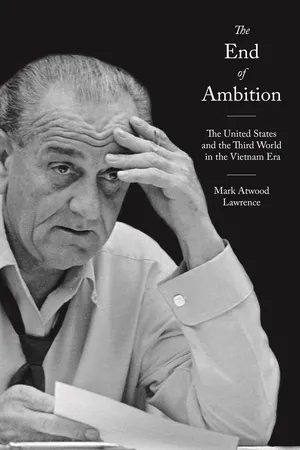
eBook - ePub
The End of Ambition
The United States and the Third World in the Vietnam Era
- 376 pages
- English
- ePUB (mobile friendly)
- Available on iOS & Android
eBook - ePub
About this book
Information
Publisher
Princeton University PressYear
2021Print ISBN
9780691264608
9780691126401
eBook ISBN
9780691226552
1
The Liberal Inheritance
WHAT SORT OF PRESIDENT would Lyndon Johnson be? The question reverberated throughout the United States—indeed throughout the world—in the hours following the assassination of John F. Kennedy on November 22, 1963. The New York Times editorial page saw reason for optimism about the new commander in chief but conceded, “No one can really know his qualities as a leader until he has had a chance to demonstrate them in an assignment more difficult than any other on earth.”1 The Associated Press captured another reason for uncertainty: the sheer complexity of the enigmatic Texan. “He has been called self-centered and considerate; a humanitarian and power-hungry; a shrewd opportunist and a political genius; tough and yet vulnerable; vain, friendly, sensitive, flamboyant,” the AP observed.2 Who knew which qualities would shine through when he occupied the Oval Office? The British ambassador, Sir David Ormsby Gore, fretted that nothing would become clear until after the 1964 election, when American voters would give shape to an uncertain political environment. “The internal political situation,” he advised the government in London two days after the assassination, “has been thrown into the melting pot.”3
Eager to allay pervasive anxieties, LBJ projected purpose and confidence, above all by staking himself to the record of his predecessor. In his speech to a joint session of Congress on November 27, essentially Johnson’s presidential debut before the nation, he hammered away at the theme of continuity. Unquestionably, the gray, bespectacled southerner, who appeared older than his fifty-five years, offered a stark contrast to the youthful, urbane Kennedy. LBJ’s colorless delivery featured little of the soaring eloquence that Americans had come to expect of JFK. In its substance, though, the speech left no doubt that Kennedy’s priorities lived on. The nation’s challenge at an agonizing time of transition, asserted LBJ, was “not to hesitate, not to pause, not to turn about and linger over this evil moment, but to continue on our course so that we may fulfill the destiny that history has set for us.” In his celebrated inauguration speech back in January 1961, Kennedy had laid out an ambitious program of domestic and international reform, urging, “Let us begin.” Now LBJ echoed those words, declaring, “Let us continue.” Indeed, Johnson used the verb “continue” five times in his address and highlighted his dedication to JFK’s agenda in virtually every paragraph.4
Johnson’s reassuring message served its purpose. Around the world, the Washington Post reported, LBJ’s words went a long way toward easing concern that the transition to a new leader would bring “uncertainty and confusion.”5 But LBJ’s words were, in various senses, misleading. In the arena of domestic policy, Johnson undoubtedly embraced Kennedy’s priorities but was eager to go far beyond anything JFK had contemplated in connection with civil rights, education, poverty, and an array of other issues. Six months later, Johnson’s appeal for nothing less than a “great society” rooted in bold government-led reform would make clear just how much LBJ’s aspirations exceeded those of his predecessor. In the arena of foreign affairs, Johnson’s assurances of continuity were problematic in a different way. Kennedy bequeathed no clear-cut agenda, and Johnson himself had few strong predilections. To be sure, Johnson spoke of his dedication to existing U.S. commitments abroad, maintenance of a military “second to none,” continued cooperation with the United Nations, and support for ongoing economic assistance programs. But such bland promises, affirming the broadest contours of U.S. foreign policy, revealed little about how LBJ understood his predecessor’s approach or how he would cope with complex international problems.
With the benefit of hindsight, it is easy to see continuity between Kennedy and Johnson in connection with Washington’s most dangerous foreign policy challenge: managing the nuclear-tinged rivalry with the Soviet Union. Following the Cuban Missile Crisis of October 1962, perhaps the most perilous moment of the entire Cold War, JFK had reoriented U.S. policy toward Moscow and worked to reduce the likelihood of nuclear war. In partnership with similarly chastened Soviet leaders, the Kennedy administration had lowered the temperature of superpower tensions—the start of what some historians have dubbed the “little détente”6—and achieved tangible successes, above all the Limited Test Ban Treaty of 1963, the first important arms control agreement of the Cold War. Johnson endorsed this bid for improved U.S.-Soviet relations, not least so that he could focus on his domestic ambitions. Under Johnson’s guidance, the United States played a leading role in negotiating the Treaty on the Non-Proliferation of Nuclear Weapons and laid the groundwork for talks aimed at limiting the superpowers’ stockpiles of ballistic missiles, efforts that would culminate in treaties signed during the Nixon presidency.
In other domains of foreign policy, however, it is difficult to assess the extent to which Johnson sought or achieved continuity in any meaningful sense. One major reason is that Kennedy, despite a propensity for bold rhetoric, often failed to establish clear policies that his successor could reasonably hope to perpetuate. With regard to Western Europe, Kennedy proposed an ambitious “Grand Design” to establish a more productive partnership with America’s most important allies and trade partners. As historian Thomas Schwartz demonstrates, however, Kennedy’s achievements fell far short of his ambitions, leaving an ambiguous inheritance for Johnson.7 Much the same can be said about U.S. policymaking toward the Third World. Kennedy and his team spoke boldly of their determination to remake the U.S. relationship with the emerging nations of Asia, Africa, the Middle East, and Latin America by throwing American support and resources behind their aspirations for development and a greater voice in global affairs. Yet, as this chapter demonstrates, the Kennedy administration conceived no consistent or coherent approach to the Third World generally or to specific challenges that arose on its watch. When LBJ gained the presidency, he inherited a muddled set of policies that offered no blueprint for the future.
Appreciating this murkiness is the starting point for understanding Lyndon Johnson’s approach to the Third World during his sixty-two months in office. To be sure, the attitudes that LBJ and his aides brought with them to the Oval Office—the subject of chapter 3—are important as well. But looking backward to the peak years of liberal ambitions in the Third World helps reveal the ways in which decision making during the Johnson years was shaped by what came just before. This chapter exposes the indeterminacy of U.S. policymaking by examining the broad lines of intellectual and bureaucratic debate that swirled within the Kennedy presidency with respect to a set of issues that took center stage during the early 1960s.
“The Most Powerful Single Force in the World Today”
As he campaigned for the presidency in 1960, John F. Kennedy dwelled on the shortcomings of U.S. foreign policy. Above all, he declared in speech after speech that the United States had failed under Republican leadership to cope with the profound transformation sweeping across much of Asia, Africa, the Middle East, and Latin America. Unsophisticated, unimaginative men—not least Vice President Richard Nixon, now the Republican presidential nominee—had done little to shore up American power, leaving these vast areas “on the razor’s edge of decision” between East and West, vulnerable to neutralism or, much worse, absorption into the communist bloc.8 “Never before have we experienced a more critical decline in our prestige, driving our friends to neutralism and neutrals to hostility,” the Massachusetts senator scolded in one campaign appearance, pointing to dangerous leftward swings in Cuba, Laos, and the Congo. “Never before has the grip of communism sunk so deeply into previously friendly countries.”9 Under Eisenhower, Kennedy insisted in his speech accepting the Democratic nomination, “Communist influence has penetrated further into Asia, stood astride the Middle East and now festers some ninety miles off the coast of Florida.” What was needed, he declared, was youthful and energetic leadership capable of appreciating the aspirations of young and vigorous peoples clamoring for a place in the sun. “More energy is released by this awakening of these new nations than by the fission of the atom itself,” added Kennedy in a statement that suggested both the scale of the problem and the stakes of failing to solve it.10
Unquestionably, such words were chosen partly for their political effect. Numerous studies undertaken by the Democratic Party before the 1960 vote found that the Republicans held an edge in perceptions of their determination to stand up to Moscow but that Kennedy stood to gain by projecting youthful dynamism in confronting new kinds of problems and reassuring voters about declining American influence around the world. A typical assessment of Kennedy’s appeal in 1958 pointed out that voters tended to see the young senator as a “forward-looking and vital new force” who offered “new and progressive approaches.”11 After Kennedy won the nomination in 1960, his political advisers stressed the need to stick with that theme, which seemed to register with Americans unsettled by the Cuban revolution and other setbacks around the world. A study of the political situation in New York, for example, urged “constant reiteration” of Kennedy’s “promise of rebuilding our position in the world, of moving ahead.”12
Yet Kennedy’s words did not reflect only political calculation. Despite a lackluster performance in Congress, JFK had demonstrated unusual interest in the dynamics of social and political change in the Third World and made a name for himself through his strong views on the subject long before 1960. Kennedy’s interest may have flowed from his Irish American heritage, which generated sensitivity to the effects of colonialism, or a sense of noblesse oblige inculcated by his father. But a tour of the Middle East and South Asia in 1951 seems to have cemented his conviction that rising nationalism would play a major role in global affairs in the years to come. Following that trip, Representative Kennedy spoke of nationalism “sweeping with forest-fire fury” across the Middle East and Asia and, with nuanced appreciation of the underlying social dynamics rare in the heyday of the Red Scare, listed an array of problems that spelled trouble for the United States: “exploitation by foreign countries of the resources and manpower of backward nations”; widespread “illiteracy, misery, and starvation”; domination of local administrations by “venal and corrupt politicians”; “massive and inefficient” bureaucracies unresponsive to their people’s needs; and “a new and self-conscious proletariat” arising in many places. It was time for Americans to abandon a “weak and vacillating approach” that had too often prioritized stability over change, he asserted in a speech to Massachusetts constituents. “We have been anti-communist,” he declared. “We have been ‘Pro’ nothing. That puts us in partnership with the corrupt and reactionary groups whose policies breed the discontent on which Soviet Communism feeds and prospers.”13 It was insufficient, he believed, to defend American interests merely by manipulating the highest echelons of power in Third World territories; enduring stability could be achieved only by promoting economic and political progress that served the ordinary people who lived there.14
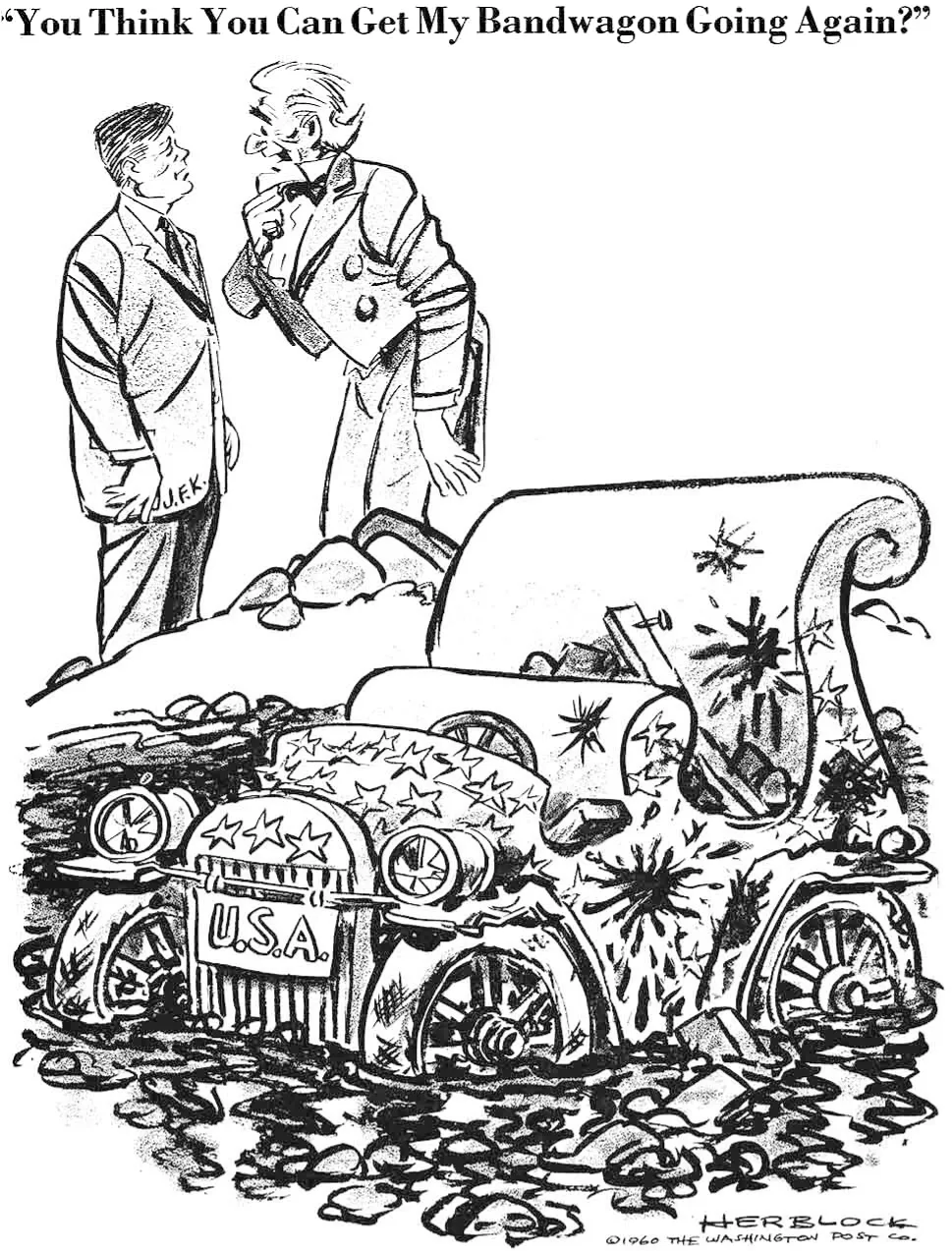
FIGURE 1.1. During the 1960 presidential race, Democratic candidate John F. Kennedy capitalized on a widespread perception that U.S. foreign policy had lost its vitality under Republican leadership. Herbert Block captured the mood in this cartoon published in the Washington Post on July 15, 1960. A 1960 Herblock Cartoon, © The Herb Block Foundation.
Kennedy returned to these themes in a widely noted 1957 speech on the Senate floor criticizing Eisenhower for passivity in the face of French repression in North Africa and demanding that Washington back Algerian independence. “The most powerful single force in the world today,” he declared, was not communism or capitalism or even nuclear weapons. Rather, it was “man’s eternal desire to be free and independent.” The biggest enemy of that desire, Kennedy continued, was “imperialism”—both the Soviet and Western varieties. He hastened to add that the two must not be “equated,” an essential proviso to keep his comments within the parameters of acceptable debate. But he nevertheless distanced himself from the sitting administration’s emphasis on slow, deliberate change carefully managed by the colonial powers. “The single most important test of American foreign policy today,” he asserted, lay in responding to these imperialisms and determining “what we do to further men’s desire to be free.” The uncommitted nations of the Third World were watching, as were peoples trapped behind the Iron Curtain. Alas, he concluded, the United States, committed to Eisenhower’s “head in the sand policy,” was “failing to meet the challenges of imperialism—on both counts—and thus failing our responsibilities to the free world.”15
In his inauguration speech three and a half years later, Kennedy hit many of the same notes in unprecedentedly grandiose language. First, he made clear that his administration would tolerate non-alignment. Addressing “new states whom we welcome to the ranks of the free,” the president vowed that the United States would not always “expect to find them supporting our view,” though he expected them to defend their freedom from the communists. He also declared that the United States would be guided by moral purpose in putting its resources to work for poor nations. In the breathtaking boldness and open-endedness of this promise lay Kennedy’s sharpest break from the previous administration. “To those people in the huts and villages of half the globe struggling to break the bonds of mass misery,” he avowed, “we pledge our best efforts to help them help themselves, for whatever period of time is required—not because the communists may be doing it, not because we seek their votes, but because it is right.” The challenge amounted to nothing less than a test of the new generation’s abilities to secure the nation’s claim to global leadership in a new age. “If a free society cannot help the many who are poor,” Kennedy said, “it cannot save the few who are rich.”16
Contradictions
Many Americans responded enthusiastically to Kennedy’s call to energize America’s role in the Third World.17 What precisely his grandiose words meant in practice was, however, anything but clear as the Kennedy era began in January 1961. The president’s rhetoric suggested new priorities and a dedication to innovate. Yet JFK neither articulated nor possessed any detailed blueprint for coping with the problems he so often described in colorful and urgent ways. How would the administration convince Congress and the public to dedicate more resources to remote, unfamiliar parts of the world? How would Kennedy and his team balance the interests...
Table of contents
- Cover
- Series Page
- Title Page
- Copyright
- Contents
- Preface
- Abbreviations
- Introduction
- 1. The Liberal Inheritance
- 2. A World of Dilemmas
- 3. Lyndon Johnson’s World
- 4. Brazil: The Allure of Authoritarianism
- 5. India: The Partnership That Faded
- 6. Iran: A Relationship Transformed
- 7. Indonesia: Embracing the New Order
- 8. Southern Africa: Settling for the Status Quo
- Conclusion
- Notes
- Bibliography
- Index
Trusted by 375,005 students
Access to over 1.5 million titles for a fair monthly price.
Study more efficiently using our study tools.
Frequently asked questions
Yes, you can cancel anytime from the Subscription tab in your account settings on the Perlego website. Your subscription will stay active until the end of your current billing period. Learn how to cancel your subscription
No, books cannot be downloaded as external files, such as PDFs, for use outside of Perlego. However, you can download books within the Perlego app for offline reading on mobile or tablet. Learn how to download books offline
Perlego offers two plans: Essential and Complete
- Essential is ideal for learners and professionals who enjoy exploring a wide range of subjects. Access the Essential Library with 800,000+ trusted titles and best-sellers across business, personal growth, and the humanities. Includes unlimited reading time and Standard Read Aloud voice.
- Complete: Perfect for advanced learners and researchers needing full, unrestricted access. Unlock 1.5M+ books across hundreds of subjects, including academic and specialized titles. The Complete Plan also includes advanced features like Premium Read Aloud and Research Assistant.
We are an online textbook subscription service, where you can get access to an entire online library for less than the price of a single book per month. With over 1.5 million books across 990+ topics, we’ve got you covered! Learn about our mission
Look out for the read-aloud symbol on your next book to see if you can listen to it. The read-aloud tool reads text aloud for you, highlighting the text as it is being read. You can pause it, speed it up and slow it down. Learn more about Read Aloud
Yes! You can use the Perlego app on both iOS and Android devices to read anytime, anywhere — even offline. Perfect for commutes or when you’re on the go.
Please note we cannot support devices running on iOS 13 and Android 7 or earlier. Learn more about using the app
Please note we cannot support devices running on iOS 13 and Android 7 or earlier. Learn more about using the app
Yes, you can access The End of Ambition by Mark Atwood Lawrence in PDF and/or ePUB format, as well as other popular books in History & Asian History. We have over 1.5 million books available in our catalogue for you to explore.