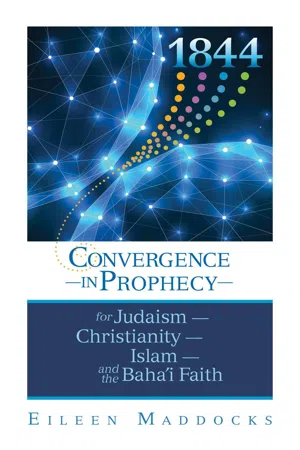
What in the world happened in 1844? Followers of William Miller and the Millerite movement expected the Advent, the Second Coming of Jesus, in 1844. When the Advent did not happen as expected, the Great Disappointment ensued. Miller was wrong. But was he? Did the spirit of Christ return in 1844 in the Middle East? The dawn of God’s Prophets of today’s major religions had all arisen in the East. After the Great Disappointment, the Millerite movement splintered into many Adventist sects, and the history of the three remaining today––the Advent Christian Church, the Church of God (Seventh-day), and the Seventh-day Adventist Church––is given. In the East, the year 1844 saw the emergence of the Báb, the Herald of Bahá’u’lláh, and the Bábí movement, and then the emergence of Bahá’u’lláh, the Prophet of the Baha'i Faith. These events are likewise presented. Miller followed biblical guidance as best he could, and he may well have been part of God’s plan in the nineteenth century. Miller and other Adventist Bible scholars did accurately pinpoint the year 1844, but events unfolded a world away in Persia and they had no inkling of them. Today the world suffers increasingly from the divisive forces of strife and intolerance, armed with strident ideologies and weapons that could kill countless millions of people. What is the destiny of our global civilization? Has divine light once again risen from the East for our day? Explore the prophecies of Daniel and follow the events in nineteenth century East and West to an amazing conclusion that will affect everyone.
eBook - ePub
1844
Convergence in Prophecy for Judaism, Christianity, Islam, and the Baha'i Faith
- English
- ePUB (mobile friendly)
- Available on iOS & Android
eBook - ePub
About this book
Trusted by 375,005 students
Access to over 1.5 million titles for a fair monthly price.
Study more efficiently using our study tools.
Information
Topic
Theology & ReligionSubtopic
Asian ReligionsCHAPTER 1
Moving to Fever Pitch
The evangelical and religious revitalization of the First Great Awakening swept Europe and the American colonies, especially in the Northeast. Peaking in the 1730s and ‘40s, the First Great Awakening gave rise to John Wesley and evangelical Methodism, a reaction to the Episcopal Church. Methodism achieved its name through its emphasis on logic and reason, a spiritual method of living. Methodism negated the need for ceremony and church hierarchy, stressing instead that faith was an intensely personal matter that fostered spiritual conviction and redemption, or salvation, only through Jesus Christ. Not only was self-study of the Bible paramount, but Methodism called for preaching the gospel outside the confines of any established church. This was a step far beyond Martin Luther.
This new freedom for every person not only to study but to preach, and the evangelical nature of early Methodism, gave rise to the itinerant minister. “Circuit riders … held a hallowed place in Methodist history and mythology. Missionary work was the hallmark of early Methodism and its first institutionalized form were the circuit riders or itinerant preachers. They were the new St. Pauls in the Methodist pantheon. … In some ways, after 1740, these itinerants may be viewed as an invading army violating the home or parish of the established Anglican Church.”1 Whether ordained ministers or lay preachers with limited education, these circuit riders paved the way for the waves of itinerant Millerite and other preachers of the Second Great Awakening of the nineteenth century.
While Wesley and the Methodists reinforced the belief in the return of Jesus, called the Second Coming, few tried to project a date for the event. Those who did attracted few followers. Many Christians expected the Second Coming to be a literal return of Jesus in the same body He had inhabited so many centuries before. They also expected His return to be marked by the occasion of the Last Judgment when the living and the dead would be sorted toward heaven or hell.
Adventism was inherently part of Christian theology because Jesus said He would return. The book of Matthew, Chapter 24, verses 1–51, contains a long discourse from Jesus to His disciples about His return. Here He told them that disasters and turmoil, wars and the rumors of wars, would precede His return. However, He disclaimed any knowledge of the timing: “But about that day or hour no one knows, not even the angels in heaven, nor the Son, but only the Father.” (Matthew 24:36)
Jesus did, however, give one hint: “So when you see standing in the holy place ‘the abomination that causes desolation,’ spoken of through the prophet Daniel—let the reader understand …” (Matthew 24:15) What was “the abomination that causes desolation”? It would be a long wait to find out because the words of Daniel were “rolled up and sealed until the time of the end.” (Daniel 12:9)
Not even a hundred years after the First Great Awakening commenced, the Second Great Awakening began. Many students of the Bible undertook serious investigation of the return, mostly working alone. They calculated possible dates for the Advent from biblical prophecies. An atmosphere of religious expectancy spread as these students found each other and began to collaborate. By the 1830s, Adventism, the expectation of the Second Coming, roared through English and American Protestantism. Adventist believers expected the imminent return of Jesus Christ.
What lit the fire for the Second Great Awakening? Natural phenomena that seemed highly irregular, or even supernatural, for one. In the American Northeast, people experienced the “Dark Day” of 1780 when raging wildfires in Canada produced smoke that totally obscured the sun.
Then came the “year without a summer,” 1816. Europe and North America had a normal spring, but hard frosts hit throughout the normally hot season. Crop failures caused widespread hunger. Unknown to either Europeans or Americans at the time, the Pacific volcano of Mount Tambora had erupted in massive fashion that April, spewing so much ash that it obscured the sun half a globe away. During that awful summer, a group of writers including Lord Byron, Percy Shelley, and Shelley’s future wife, Mary Wollstonecraft Godwin, challenged each other to write horrid tales inspired by the dark and frosty season—one was Mary Shelley’s classic, Frankenstein.
On November 12, 1833, a spectacular meteor shower of previously unseen scale, the Leonids from the Comet Tempel-Tuttle, filled the sky over the eastern United States. An estimated 240,000 “falling stars” rained down for several hours. This spectacular, frightening display seemed to fulfill the words of Isaiah as told by Jesus:
Immediately after the distress of those days ‘the sun will be darkened, and the moon will not give its light;
the stars will fall from the sky, and the heavenly bodies will be shaken.’
(Matthew 24:29, quoting Isaiah 13:20 and 34:4)
The Second Great Awakening reached fever pitch in the United States in the early 1840s. It was a turning away from Deism, which was the belief that God was impersonal and that man should rely on rational thinking. It was also a repudiation of church liturgy and structure and an embrace of evangelical Christianity. Church membership increased dramatically. All Protestant denominations of the time, except perhaps the Quaker and Universalist, believed in the physical return of Christ to earth for the final judgment of the living and the dead and the establishment of a reign of righteousness. But now there was a growing emphasis on when Jesus would return although He had said that only the Father knew:
Therefore keep watch, because you do not know on what day your Lord will come. But understand this: If the owner of the house had known at what time of night the thief was coming, he would have kept watch and would not have let his house be broken into. So you also must be ready, because the Son of Man will come at an hour when you do not expect him. (Matthew 24:42–43)
Enter William Miller (1782–1849), a farmer and Baptist lay preacher in Low Hampton, New York, just across the border from Vermont. The oldest of sixteen children, he had a conventional childhood. He was raised in a devout Baptist farm household with a grandfather and several other relatives who were ministers and preachers. Miller’s mother taught him to read, but his formal education was limited to three months each winter during his school years. He was an avid reader of the few books belonging to the family and those that he could borrow. His early, burning desire to learn and his wide reading of various subjects helped form his eloquent, thoughtful writing as an adult.
Surprisingly, considering his Baptist origins and his later pioneering effort in Adventism, Miller spent fourteen years of his early adulthood embracing Deism, an outgrowth of the Age of Enlightenment that rejected the Bible as the standard of religious truth. Miller questioned for many years the Christian doctrines taught to him in childhood and rejected the idea of divine revelation. Instead, he studied the writings of Voltaire, Thomas Paine, Ethan Allen, Benjamin Franklin, and other Deist thinkers who held the belief that God had created the world and then let His creation evolve on its own. Human observation and reasoning were sufficient for a rational life, they suggested. Deist attitudes about life after death ran the gamut from a belief in an afterlife as a natural part of human creation, with suitable rewards and punishments for conduct in this life, to a certainty that the grave was the end of one’s existence. Even though Miller identified with the intellectuals who favored Deism, he faithfully accompanied his wife and children to the local Baptist church services. His livelihood was farming. His social life revolved around the Masonic Order in which he attained the highest degree available in his area. His passions were reading and studying.
Miller was also a patriot. His father served as a captain in the Revolutionary War and the younger Miller joined the Vermont militia as a lieutenant in 1810. He had been promoted to the rank of captain in the United States Army by 1813. During the War of 1812, he fought at the pivotal battle of Plattsburgh, a small town in New York on the western shore of Lake Champlain, a short distance south of the Canadian border.
As the years passed, Miller found less and less comfort in Deism. He seemed to have long embraced the nihilistic belief that life ended at the grave. However, the wartime death of a close friend named Spencer brought forth nagging doubts about his beliefs and prompted him to write the following anguished words in a letter to his wife:
But a short time, and, like Spencer, I shall be no more. It is a solemn thought. Yet, could I be sure of one other life, there would be nothing terrific; but to go out like an extinguished taper is insupportable—the thought is doleful. No! Rather let me cling to that hope which warrants a never-ending existence; a future spring, where troubles shall cease, and tears find no conveyance; where never-ending spring shall flourish, and love, pure as the driven snow, rest in every breast.2
Miller wrote of that time in his memoirs:
Annihilism was a cold and chilling thought, and accountability was a sure destruction to all. The heavens were as brass over my head, and the earth as iron under my feet. Eternity!—what was it? And death—why was it? The more I reasoned, the further I was from demonstration. The more I thought, the more scattered were my conclusions. I tried to stop thinking, but my thoughts would not be controlled. I was truly wretched, but did not understand the cause. I murmured and complained, but knew not of whom. I knew that there was a wrong, but knew not how or where to find the right. I mourned, but without hope.3
Epiphany came for Miller in 1816 while he was delivering a talk in church. It happened as a startling mystical experience, an intense inner vision that he described as follows:
Suddenly the character of a Saviour was vividly impressed upon my mind. It seemed that there might be a Being so good and compassionate as to himself atone for our transgressions, and thereby save us from suffering the penalty of sin. I immediately felt how lovely such a Being must be, and imagined that I could cast myself into the arms of, and trust in the mercy of, such an One. But the question arose, How can it be proved that such a Being does exist? Aside from the Bible, I found that I could get no evidence of the existence of such a Saviour, or even of a future state … I was constrained to admit that the Scriptures must be a revelation from God … The Bible now became my chief study, and I can truly say, I searched it with great delight. I found the half was never told me … I lost all taste for other reading, and applied my heart to get wisdom from God.4
Miller embarked on an intensive, disciplined study of the Bible, starting with Genesis and comparing verse with verse as he went along. For the rest of his life, Miller studied only the Bible, aided by Cruden’s Concordance.5 He became convinced that the Bible was its own interpreter and that its parables and metaphors were either understandable within their immediate connection or elsewhere in the Bible, in which cases the explanations showed them to be literally true—unless the explanations were symbolic, such as the term “day” given in certain prophetic utterances. The Bible was for Miller a system of revealed truths, simply and clearly given, to be understood with common sense, at least with what he construed to be common sense. As Methodism sought methodical order, Millerism would pursue a rational approach.
Miller was especially interested in biblical prophecies and came to believe that all of them had been or would be literally fulfilled. Along with many other biblical scholars of his day, Miller took the prophecies of Daniel to heart, especially Daniel 8:14: “He [a holy one] said to me, ‘It will take 2,300 evenings and mornings; then the sanctuary will be reconsecrated.’”
By 1822, Miller believed that he understood the various prophecies about the return of Jesus Christ. He wrote: “With the solemn conviction that such momentous events were predicted in the Scriptures, to...
Table of contents
- Cover
- Title
- Copyright
- Dedication
- Contents
- Acknowledgments
- Foreword
- Introduction
- Chapter 1 Moving to Fever Pitch
- Chapter 2 The Prophet Daniel: 2,300 Days
- Chapter 3 A Frenzy of Preparation
- Chapter 4 The Great Disappointment
- Chapter 5 Expectancy in the East
- Chapter 6 The Search in the East
- Chapter 7 1844 Fulfilled
- Chapter 8 Daniel: 70 Weeks and 1,260, 1,290, and 1,335 Days
- Chapter 9 Muhammad: The Seal of the Prophets
- Chapter 10 The Divine Springtime
- Chapter 11 The Sectarian Survivors of Millerism
- Chapter 12 Understanding Matthew 24
- Chapter 13 Bahá’u’lláh: The Glory of God
- Epilogue
- Appendix A A Pen Portrait of Bahá’u’lláh
- Appendix B “Important Truths”
- Appendix C A Remarkable Parallel: Jesus and the Báb
- Appendix D “What Is an Advent Christian?”
- Appendix E Basic Principles of the Baha’i Faith
- Notes
- Bibliography
- The Gate: The Dawn of the Baha’i Faith
Frequently asked questions
Yes, you can cancel anytime from the Subscription tab in your account settings on the Perlego website. Your subscription will stay active until the end of your current billing period. Learn how to cancel your subscription
No, books cannot be downloaded as external files, such as PDFs, for use outside of Perlego. However, you can download books within the Perlego app for offline reading on mobile or tablet. Learn how to download books offline
Perlego offers two plans: Essential and Complete
- Essential is ideal for learners and professionals who enjoy exploring a wide range of subjects. Access the Essential Library with 800,000+ trusted titles and best-sellers across business, personal growth, and the humanities. Includes unlimited reading time and Standard Read Aloud voice.
- Complete: Perfect for advanced learners and researchers needing full, unrestricted access. Unlock 1.5M+ books across hundreds of subjects, including academic and specialized titles. The Complete Plan also includes advanced features like Premium Read Aloud and Research Assistant.
We are an online textbook subscription service, where you can get access to an entire online library for less than the price of a single book per month. With over 1.5 million books across 990+ topics, we’ve got you covered! Learn about our mission
Look out for the read-aloud symbol on your next book to see if you can listen to it. The read-aloud tool reads text aloud for you, highlighting the text as it is being read. You can pause it, speed it up and slow it down. Learn more about Read Aloud
Yes! You can use the Perlego app on both iOS and Android devices to read anytime, anywhere — even offline. Perfect for commutes or when you’re on the go.
Please note we cannot support devices running on iOS 13 and Android 7 or earlier. Learn more about using the app
Please note we cannot support devices running on iOS 13 and Android 7 or earlier. Learn more about using the app
Yes, you can access 1844 by Eileen Maddocks in PDF and/or ePUB format, as well as other popular books in Theology & Religion & Asian Religions. We have over 1.5 million books available in our catalogue for you to explore.