Fourteen papers explore a variety of inter-disciplinary approaches to understanding the Viking past, both in Scandinavia and in the Viking diaspora. Contributions employ both traditional inter- or multi-disciplinarian perspectives such as using historical sources, Icelandic sagas and Eddic poetry and also specialised methodologies and/or empirical studies, place-name research, the history of religion and technological advancements, such as isotope analysis. Together these generate new insights into the technology, social organisation and mentality of the worlds of the Vikings.
Geographically, contributions range from Iceland through Scandinavia to the Continent. Scandinavian, British and Continental Viking scholars come together to challenge established truths, present new definitions and discuss old themes from new angles. Topics discussed include personal and communal identity; gender relations between people, artefacts, and places/spaces; rules and regulations within different social arenas; processes of production, trade and exchange, and transmission of knowledge within both past Viking-age societies and present-day research. Displaying thematic breadth as well as geographic and academic diversity, the articles may foreshadow up-and-coming themes for Viking Age research. Rooted in different traditions, using diverse methods and exploring eclectic material – Viking Worlds will provide the reader with a sense of current and forthcoming issues, debates and topics in Viking studies, and give insight into a new generation of ideas and approaches which will mark the years to come.
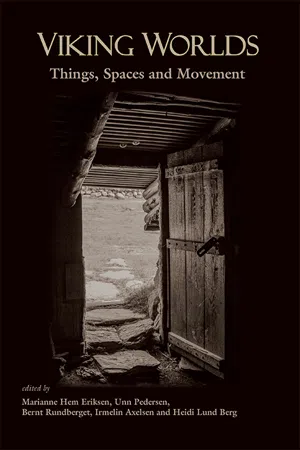
eBook - ePub
Viking Worlds
Things, Spaces and Movement
- 176 pages
- English
- ePUB (mobile friendly)
- Available on iOS & Android
eBook - ePub
Viking Worlds
Things, Spaces and Movement
About this book
Information
Topic
StoriaSubtopic
Storia europeaChapter 1
From Ginnungagap to the Ragnarök. Archaeologies of the Viking worlds
Abstract
The Viking Worlds conference marks a landmark in interdisciplinary Viking studies, with the birth of what will hopefully become a regular open-access forum for all researchers – and especially those at an early stage of their careers – to exchange ideas and build collaborative projects. It also comes at a time when our perspectives on the Viking worlds (definitely in the plural) are changing dramatically. This paper briefly charts some milestones in that process, with a focus on Norse conceptions of the realities within which they understood themselves to move. These transformations in our understanding of the Viking Age will be considered primarily through their material reflection in the archaeological record: as ideas made manifest through social action, they are no longer marginalised as imaginative codas to settlement studies and art history, but co-exist with them as varied points of access to the Viking worlds in every sense of the term.
Introduction
One thing must be admitted about the Vikings: they’ve come a remarkably long way in a relatively short space of time.
A hundred years ago, and for a century before that, they were the Nordic archetypes of choice. As blond supermen (definitely men) with horned helmets, they terrorised the world in their dragon ships, but somehow – strangely to us – in an admirable and heroic way. They were seen to have laid the foundations of modern Scandinavia and were pioneers of northern Christianity, though in a fashion that nonetheless permitted the remembrance of their excitingly savage paganism. Romance was blended with nationalism that manipulated a blurred sense of emergent identity, supposedly rooted in the deep past.
Eighty years ago, as Europe fell to fascism, these fictions of a racially pure North took on a still darker tone, and Viking studies would take decades to recover from the contamination. In the post-war years there was a resulting emphasis on data collection above interpretation, the latter being deemed still too risky, and our knowledge base grew while our understanding remained largely static. By the 1970s and ’80s, the Vikings began to revive but in a new and more peaceable incarnation, their warrior stereotypes not exactly forgotten but instead giving way to a cosmopolitan population of traders, crafts-workers, travellers and poets.
Until about 25 years ago – with some notable exceptions – the notion of the female Viking was a contradiction in terms, and the unquestioningly androcentric view of the period took a very long time indeed to be engendered.
In more recent years, the violent Vikings have begun to return, albeit contextualised. We are also becoming increasingly interested in the contents of their minds as well as the substance of their actions, creations and landscapes.
A review of current perspectives on the early medieval Scandinavian world shows them to be numerous, pluralistic and in constant flux (Price 2005, 2014). Archaeologists share the field with historians, linguists, textual scholars, students of comparative religion, runologists, anthropologists, and specialists from the full spectrum of natural, physical and biological sciences (Brink and Price 2008). Very little has actually been left behind, and instead the traditional views of the Viking Age are being expanded and nuanced with other, more cognitive readings, which are in turn feeding back into new studies of materiality, of things.
To some extent it even comes as a surprise that the Viking Age is still a viable concept, because there have been serious challenges to that. The time of the Vikings has been dismissed as an imperial, nationalistic construct artificially combining ethnic identities that were in reality distinctive and separate (Svanberg 2003), and reconfigured as a mere component of a general Continental shift in economic strategies balanced against the Arab world (Hodges 2006). There is truth in this. The societies of what is now Scandinavia, from the mid-8th to the late 11th centuries CE, were indeed heterogeneous, varied and changeable, dynamic rather than static or monolithic. As we have seen, a millennium after their time those same societies were undoubtedly appropriated in the cause of imperialising agendas, and worse. But all this is to ignore the very real cultural (and linguistic) continuity from the Danish border to the high arctic, over and above regional variation. Similarly, we cannot overlook the genuinely significant social changes that took place during these three centuries that were so different from what came before and after. In acknowledging that the Vikings have fascinated a long line of colonial agents, from the Victorians to the Nazis, we must have the confidence to assert our own right to study them without being influenced or steered by past prejudice.
Viking worlds
There is, however, one truly fundamental change. As scholars of the early medieval North we have had a ‘Viking world’ for a very long time, a singular concept perpetuated in numerous books bearing variants of that title, a trend to which I myself have certainly contributed. And this brings us to the present volume, and the meeting on which it is based. It was both a pleasure and privilege to deliver the keynote opening address in Oslo, at the start of the first Viking Worlds conference, and that pluralism – worlds – is important. Part of my purpose with this paper, deliberately retaining something of the flavour of my oral delivery from the day, is to explain just why I think this development is so timely.
Viking studies has been in great need of a regular, large-scale international forum for new research, open to all, in particular to provide a general platform for the work of younger, early career scholars rather than the Usual Suspects (a term I use with no disrespect as I suppose, alas, that I’m one of them). A glance at the list of authors for this volume reinforces the point, a new generation with new ideas: and what a lot there has been to learn about even in recent years, the timeframes of many of the contributors’ PhDs.
In expanding our existing horizons, there has been a host of new work at familiar places, including the major projects underway at Kaupang (Skre and Stylegar 2004, and the ongoing Norske Oldfunn report series), Hedeby (Maixner 2012), Birka (Hedenstierna-Jonsson 2013), Oseberg and Gokstad (Bill and Daly 2012), at the Danish circular fortresses (Dobat 2013 and the forthcoming Aggersborg publications), and many key sites. Several of these also feature as the subject of specific, focussed research, such as the new pathologies emerging from the Norwegian ship burials (Holck 2009).
More generally, we may think of all the studies of coinage, hoarding and economy; of manufacturing and craftwork; of trade and economics. This is supported by research on material culture of every kind; all the studies of dating, origin, and movement. An emerging field, with links to more mainstream archaeological theory, is the exploration of networks and the agents within them, building on long-standing research into studies of acculturation, ethnicity and identity. Power and the nuanced study of state formation continue to occupy a central role in Viking scholarship, as does the ever-expanding interest in religion and spirituality, symbolism and the mind.
And then there’s the new, really unexpected stuff. The papers in this book take up many of the developments of recent years and present the latest research, but it is worth pausing before some recent breakthroughs. Who would have thought we would learn that a significant proportion of Viking-Age men filed their teeth (Ahlström Arcini 2011; Arcini 2005)? Or that we could trace the movements of Norwegians through the genetic signals of the mice that came with their ships (Jones et al. 2012)? Or that the men in the Trelleborg cemetery largely came from Germany (Price et al. 2011)? Or that we would find a sacred hall decorated with sacrificial heads at Hofstaðir (Lucas 2009)? Or (one for me) that a sorceress had white facepaint like a geisha, a blue dress of translucent linen, and may have swallowed balls of human ash and fat (Pentz et al. 2009)? Or that we would find a Viking mass grave from Ridgeway Hill in Dorset, where isotopes tell us that a raiding party came from all over Scandinavia, including north of the arctic circle (Loe et al. 2014)? Or – perhaps the most spectacular of all – that two ship burials with more than 40 battle casualties would be found on an Estonian island, a site now dated to c. 750 and thus a pretty good candidate for the earliest archaeological evidence of properly Viking raids (Peets 2013)?
Some of the most intriguing discoveries are so recent that they are as-yet (July 2013) unpublished even in popular form, though with a strong online presence. The replica of Valhöll that was built on the royal terrace at Gamla Uppsala, with spears for doors; and the discovery that King Harald’s Jelling was bigger than we ever expected.
Then there are the individual unparalleled finds, many of them emerging through new collaborations with metal detectorists. What are we to make of the figurine from Uppåkra (Helmbrecht 2013), that due to its specific iconography we really can identify as Völundr in his flying suit? And there are so many more of these kinds of things, feeding into a public interest that remains unabated, as we see in the success of the latest major international exhibition (Williams et al. 2013).
Popular Vikings
Popular fascination takes other shapes too, one of which has been a surprisingly long time in coming: after years of waiting, the Vikings have finally made it to Hollywood in not too disgraceful a form. The American cable channel History has started drama programming alongside its documentaries, and in early 2013 launched the nine-part series Vikings, based (loosely) on the story of Ragnarr Loðbrók. Written by the creator of The Tudors, the series had a budget of $40 million – a fact that all Viking scholars would do well to digest, in view of the show’s impact and the material on which its look is inevitably based, otherwise known as our work. A month after the first installment was screened, Vikings was renewed for another ten commissioned episodes, and we should take that very seriously indeed.
For the most part the series manages to avoid the traditional clichés. The material culture is pretty good, and some of the new Viking archaeology has made it in there, slipped past the stereotypes in a way that does more to inform the public than we might realise. By way of example, over the past few months I’ve been asked many, many times whether Vikings really wore what appears to be eyeliner and mascara, and the answer is, yes, they did. This is where our research makes a difference, however subtle, because someone involved with that series must have read the new commentaries on Ibrahim ibn Yaqub al-Tartushi, who wrote of both sexes’ beauty being enhanced by eye make-up as he witnessed during his visit to Hedeby around 950. A small thing perhaps, but Vikings with guyliner would have been pretty much unthinkable 20 years ago, despite the fact that al-Tartushi’s words were there for all to read.
Another positive aspect of the Vikings series is the presence of female warriors, and as major characters too. Nor are they ridiculous Wagnerian clones, but recognisable women with weapons. This admittedly plays to a stereotype of sorts (shield maidens and so on), but still, it is encouraging because if I had to isolate one single development of recent years more important than all the others, something I deliberately have not mentioned much so far, I would choose the slow recognition of women in the Viking Age.
Women with weapons
In a sense, of course, women have always been topics of discussion in Viking research, especially in relation to their supposed receptiveness to Christianity and their presence in rune stone inscriptions. However, a far more prominent aspect of Viking-Age women was unfortunately another cliché, one of relative emancipation combined with a hint of warlike ferocity. The idea that Nordic women enjoyed greater social independence than most of their European sisters has been around almost as long as the myth of the Viking warrior, a kind of arc from the Noble Savage to the Noble Housewife. As with many stereotypes there is some core of fact in this, but it may owe more to the spirited female characters of the medieval sagas than to any Viking-Age reality, supported by the equally fantastical qualities attributed to supernatural warrior women such as the valkyries. In everyday life, notwithstanding the independent rights of divorce and the possibility of personal landholding and inheritance, it seemed that women were still socially subordinate to men. However, here as in other areas of Viking re...
Table of contents
- Cover
- Title Page
- Copyright
- Contents
- List of contributors
- Preface: Exploring Viking Worlds
- Chapter 1: From Ginnungagap to the Ragnarök. Archaeologies of the Viking Worlds
- Part I: Real and Ideal Spaces
- Part II: Gendered Things, Gendered Spaces?
- Part III: Production, Exchange and Movement
Trusted by 375,005 students
Access to over 1.5 million titles for a fair monthly price.
Study more efficiently using our study tools.
Frequently asked questions
Yes, you can cancel anytime from the Subscription tab in your account settings on the Perlego website. Your subscription will stay active until the end of your current billing period. Learn how to cancel your subscription
No, books cannot be downloaded as external files, such as PDFs, for use outside of Perlego. However, you can download books within the Perlego app for offline reading on mobile or tablet. Learn how to download books offline
Perlego offers two plans: Essential and Complete
- Essential is ideal for learners and professionals who enjoy exploring a wide range of subjects. Access the Essential Library with 800,000+ trusted titles and best-sellers across business, personal growth, and the humanities. Includes unlimited reading time and Standard Read Aloud voice.
- Complete: Perfect for advanced learners and researchers needing full, unrestricted access. Unlock 1.5M+ books across hundreds of subjects, including academic and specialized titles. The Complete Plan also includes advanced features like Premium Read Aloud and Research Assistant.
We are an online textbook subscription service, where you can get access to an entire online library for less than the price of a single book per month. With over 1.5 million books across 990+ topics, we’ve got you covered! Learn about our mission
Look out for the read-aloud symbol on your next book to see if you can listen to it. The read-aloud tool reads text aloud for you, highlighting the text as it is being read. You can pause it, speed it up and slow it down. Learn more about Read Aloud
Yes! You can use the Perlego app on both iOS and Android devices to read anytime, anywhere — even offline. Perfect for commutes or when you’re on the go.
Please note we cannot support devices running on iOS 13 and Android 7 or earlier. Learn more about using the app
Please note we cannot support devices running on iOS 13 and Android 7 or earlier. Learn more about using the app
Yes, you can access Viking Worlds by Marianne Hem Eriksen, Unn Pedersen, Bernt Rundberget, Irmelin Axelsen, Heidi Lund Berg, Marianne Hem Eriksen,Unn Pedersen,Bernt Rundberget,Irmelin Axelsen,Heidi Lund Berg, Bernt Rundberget in PDF and/or ePUB format, as well as other popular books in Storia & Storia europea. We have over 1.5 million books available in our catalogue for you to explore.