eBook - ePub
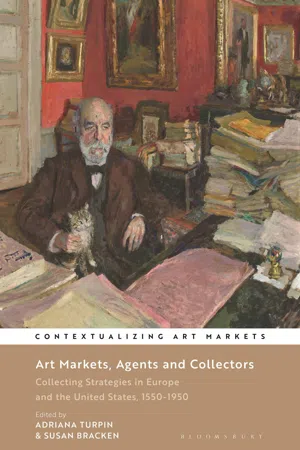
Art Markets, Agents and Collectors
Collecting Strategies in Europe and the United States, 1550-1950
- 400 pages
- English
- ePUB (mobile friendly)
- Available on iOS & Android
eBook - ePub
Art Markets, Agents and Collectors
Collecting Strategies in Europe and the United States, 1550-1950
About this book
Art Markets, Agents and Collectors brings together a wide variety of case studies, based on letters and detailed archival research, which nuance the history of the art market and the role of the collector within it. Using diaries, account books and other archival sources, the contributions to this volume show how agents set up networks and acquired works of art, often developing the taste and knowledge of the collectors for whom they were working. They are therefore seen as important actors in the market, having a specific role that separates them from auctioneers, dealers, museum curators or amateurs, while at the same time acknowledging and analyzing the dual positions that many held. Each chronological period is introduced by a contextual essay, written by a leading expert in the field, which sets out the art market in the period concerned and the ways in which agents functioned. This book is an invaluable tool for those needing a broader introduction to the intricate workings of the art market.
Information
Part I
Agents in the market, 1550–1720
I
Introduction
Agents in the art market, 1550–1720
Sandra van Ginhoven
Agents permeated all areas of life in early modern Europe. Broadly conceived, agents were embedded in politics, diplomacy, economic policy, and cultural, intellectual and commercial exchanges to such an extent that historians have identified early modern brokerage as one of the fundamental organizational principles of that society.1 Art production and its circulation were no exception to this organizational principle, and agents have been fundamental actors in the history of art and the art markets.2 As diplomatic envoys, they acted as representatives of their patrons and through their travels and extended networks they also disseminated news and information. In princely art commissions and gift exchanges, agents were crucial information brokers, facilitating connections and translating valuations when assessments needed to be made, often in the context of hierarchical relations based on asymmetrical reciprocity. Especially in competitive environments where artists contended for the patronage of the church, the courts and the most prominent families, agents were fundamental in promoting the careers of artists among prominent benefactors, and conversely by conveying to artists their patrons’ requests and also favours.3
What constitutes effective art brokerage is generally perceived as the ways in which agents were instrumental in culturally significant outcomes. Examples abound, ranging from agents’ mediation role between parties, to their interventions in order to produce particular results; it is in this sense that Marika Keblusek has remarked that the agents’ function mattered more than their actual profession.4 Whether orators, secretaries, ambassadors, artists or merchants, they brought their expertise and abilities in different areas to their cultural brokerage. A case in point is Adriana Concin’s account in Chapter 1 of this book of the hitherto little-known contributions that Hans Albrecht von Sprinzenstein made, via his early education and networks in Italy, as well as his negotiating skills, to the successful acquisition of key works for the collections of the Archduke Ferdinand II of Tyrol. Better known as a military man, Sprinzenstein’s trajectory shows other effects of successful art brokerage, such as the enhanced reputation of the agent among other (potential) patrons, resulting in expanded networks and areas of influence. Dealings also helped agents develop connoisseurial expertise and collecting practices that could result in tastes aligned across collections – their own and those of their patrons.
Agents were unquestionably integral to the cultural and artistic life of early modern Europe, but the creation of open markets for artworks and the rise of the art dealer as a professional category constitute two specific developments during the period that concerns us here. The sixteenth and seventeenth centuries brought about a spectacular growth in the activity of artists who could not aspire to royal appointments or princely patronage, as well as new wealthy urban classes able and willing to spend on paintings and other (semi) luxuries.5 In the case of paintings, a growing local consumer base, including new collectors from the professional and commercial groups, fuelled a demand that created new market segments as artists began to specialize in affordable landscapes, still lifes and genre scenes.6 As a result of these developments, artists producing for local buyers or for export, directly or indirectly through dealers, without relying on commissions but rather on what has been called ‘replication and reformulation of successful models’, became a dominant impetus for art production and exchange from the sixteenth century; this was fully instituted during the seventeenth century.7 At the forefront of these developments was the city of Antwerp, with the production of paintings and other luxuries on spec exhibited in fairs and dedic ated sales halls.8 Though without ever replacing the primary commission circuits of the patronage system, fairs and halls provided the ideal place of exchange between artists and their clients, where artists learned what would or would not sell and buyers would in turn stimulate demand and thus new production.
While much research has concentrated on northern Europe and on paintings, more recent studies focused on Italy, France, Spain, elsewhere in Europe and overseas have identified analogous expansions in the art markets, though under different circumstances.9 For example, in Bologna, rich merchants who started buying art, often applying their mercantile mindset, fuelled a level of diversification of supply that needed the mediation of experts appearing in the early decades of the seventeenth century.10 Also in early-seventeenth-century Rome, buyers were much more numerous and diverse than previously assumed and middlemen participated in the way that certain preferences for paintings spread throughout different layers of society.11 In Naples, middle and aristocratic classes connected to the Spanish administration brought their taste for collecting with them, which attracted foreign painters such as Caravaggio, Ribera and Artemisia Gentileschi, further expanding consumer tastes and artists’ specializations.12 In Madrid and Paris, painters and works from Flanders and Italy initially dominated the artistic landscape, but as the seventeenth century progressed local workshops and dealers increasingly took over.13 This was also the case in Seville and Cadiz, with the difference that the Americas constituted a major impetus.14 With regard to other parts of the world and beyond paintings, it is through case studies on specific dealers and their networks, as well as on the activities of merchants in raw and precious materials and finished goods, that scholarship has begun to uncover the nature of the expansion of the art trade during this period.15
From a market perspective, the relatively high levels of uncertainty about both the demand for and quality of cultural goods in general and of artworks, in particular, create the space and need for market intermediaries.16 While in theory artworks constitute unique or heterogeneous products with little or no substitutes, the actual level of substitutability depends on how well the available supply meets buyers’ motives (aesthetic, cultural, social, financial, historical, decorative to mention a few) and matches the features buyers seek in the works they purchase. However, buyers can be uncertain about issues of quality and valuation, unless they have invested in gaining knowledge and developing experience as collectors. For this reason, they often need help in translating mysterious concepts such as value, taste , reputation, fashion and novelty, especially when the material aspects of works of art are insufficient to make these judgements. Therefore, the perceived merit of artworks to a large extent relies on the credibility of experts being able to articulate the different kinds of value that buyers can derive as owners and capable of bringing artworks possessing certain qualities to potential buyers looking for those or similar qualities. In acting on the knowledge of what sort of artworks are in demand, what features buyers prefer, what price ranges can these works command and how to attract collectors, market intermediaries can influence art production, buyer behaviour and collecting practices, and even become fashion-makers.
In this context, the art dealer constitutes a special type of agent that emerged as a recognizable professional category during the period addressed here. Throughout the long seventeenth century, these intermediaries became increasingly professionalized, relying on extended networks and introducing new distribution and marketing techniques that added stimulus to existing markets. In some places, art dealers appeared earlier than in others and their activities and impact on the artistic environment were not the same everywhere. In most places and in contrast to later developments that Bénédicte Miyamoto, Anne Helmreich and Inge Reist address in their introductory chapters in this book, the distinctions of dealers’ and agents’ areas of influence were incipient ones, mostly articulated in terms of the types and array of goods traded.
As remarked, most attention has been directed to paintings, and the resulting picture that continues to emerge underscores the blurred lines within the price-quality spectrum, the many coexisting market segments, as well as the multiplicity and adaptability of functions dealers played. Many operated in both the primary and secondary markets, specialized in paintings and other luxury products or staple goods, were active only locally or also cross-border directly or through their networks, and some dealt directly with prominent collectors as well as ventured into the open markets. In fact, dealing in art was a highly diversified activity.
Changes in the way dealers described their occupation indicate levels of specialization in the art trade, which functioned within specific institutional frameworks and codes. In Antwerp, dealers who specialized in paintings (e.g. handelt met schilderijen) appeared in the guild’s records in the late 1580s, but were more pronounced in numbers between the 1610s and the 1630s.17 In Amsterdam, they became much more common from the 1630s and 1640s as the market also grew in scale and scope.18 Similar specializations emerged in Naples a little later, by the mid-seventeenth century, with the dealer in paintings (mercanti di quadri) as a specialist seller in the upper strata of the market.19 In Rome, levels of specialization have been identified also in terms of the occupations involved: sellers of paintings among other luxuries; those who sold only paintings, especially from the middle of the seventeenth century, and people from other trades also engaged in selling paintings.20 Similar groups sold paintings in Venice, but prima...
Table of contents
- Cover
- Half-Title
- Series
- Title
- Contents
- List of Plates
- List of Figures
- Series Editor’s Introduction
- Acknowledgements
- Introduction
- Part I Agents in the market, 1550–1720
- Part II Agents in the long eighteenth century
- Part III The agent in the modern European art market, 1820–1950
- Part IV Agents in the market for American collectors
- Bibliography
- Contributors
- Index
- Plates
- Copyright
Trusted by 375,005 students
Access to over 1.5 million titles for a fair monthly price.
Study more efficiently using our study tools.
Frequently asked questions
Yes, you can cancel anytime from the Subscription tab in your account settings on the Perlego website. Your subscription will stay active until the end of your current billing period. Learn how to cancel your subscription
No, books cannot be downloaded as external files, such as PDFs, for use outside of Perlego. However, you can download books within the Perlego app for offline reading on mobile or tablet. Learn how to download books offline
Perlego offers two plans: Essential and Complete
- Essential is ideal for learners and professionals who enjoy exploring a wide range of subjects. Access the Essential Library with 800,000+ trusted titles and best-sellers across business, personal growth, and the humanities. Includes unlimited reading time and Standard Read Aloud voice.
- Complete: Perfect for advanced learners and researchers needing full, unrestricted access. Unlock 1.5M+ books across hundreds of subjects, including academic and specialized titles. The Complete Plan also includes advanced features like Premium Read Aloud and Research Assistant.
We are an online textbook subscription service, where you can get access to an entire online library for less than the price of a single book per month. With over 1.5 million books across 990+ topics, we’ve got you covered! Learn about our mission
Look out for the read-aloud symbol on your next book to see if you can listen to it. The read-aloud tool reads text aloud for you, highlighting the text as it is being read. You can pause it, speed it up and slow it down. Learn more about Read Aloud
Yes! You can use the Perlego app on both iOS and Android devices to read anytime, anywhere — even offline. Perfect for commutes or when you’re on the go.
Please note we cannot support devices running on iOS 13 and Android 7 or earlier. Learn more about using the app
Please note we cannot support devices running on iOS 13 and Android 7 or earlier. Learn more about using the app
Yes, you can access Art Markets, Agents and Collectors by Adriana Turpin, Susan Bracken, Adriana Turpin,Susan Bracken in PDF and/or ePUB format, as well as other popular books in Art & Art General. We have over 1.5 million books available in our catalogue for you to explore.