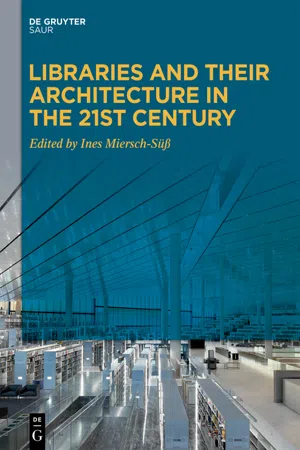
Libraries and Their Architecture in the 21st Century
eBook - ePub

Libraries and Their Architecture in the 21st Century

  1. 239 pages
  2. English
  3. ePUB (mobile friendly)
  4. Available on iOS & Android
eBook - ePub

Libraries and Their Architecture in the 21st Century

About this book

Libraries have quietly changed over the last 20 years. They have adapted early and consciously to the changes of digitalization, they have recognized the changed need of their users for collaborative work and derived new spatial concepts from this. Transparency and access to information, knowledge and encounters are the prerequisites for holistic social development. It is the challenge of the 21 st century as the information age. This book presents the latest developments in library architecture as well as the way scientists and architects are meeting this challenge.

With essays by Achim Bonte, Catherine Lau, Max Dudler, Georg Gewers, Henning Larsen Architects, MSAO Architects, Claudia Lux, Marco Muscogiuri, Schmidt Hammer Lassen Architects, Snøhetta, Sauerbruch Hutton, gmp Architects followed by a conversion with Oliver Jahn and Dante Bonuccelli.

KNOWLEDGE TALK´s, curated and organized by the editor Architect Ines Miersch-Süß, take place in occasion of the Book Publishing.

KNOWLEDGE TALK#1 Renaissance - KNOWLEDGE FOR ALL with Prof. Dr. Claudia Lux and Prof. Dr. Eike Schmidt on YouTube: https://www.youtube.com/watch?v=aKk_wRBGt1E
The new role of the Uffizi, Florence and the opening of knowledge to a wider society are subject of the first Knowledge Talk with Prof. Dr. Claudia Lux and Prof. Dr. Eike Schmidt live from the Uffizi on International Museum Day, May 18, 2021. The Knowledge Talk connects the topics from the new publication "Libraries and Their Architecture in the 21st Century.

KNOWLEDGE TALK#2 Creativity: RÄUME FÜR BÜCHER fand am 5. Juli 2021 in der Zentralbibliothek Zürich statt: Max Dudler im Gespräch über seine Bibliotheken. Lassen Sie sich diesen informativen Austausch nicht entgehen:
https://www.zb.uzh.ch/de/events/max-dudler-im-gesprach-uber-seine-bibliotheken?date=316

KNOWLEDGE TALK #3 Change Exchange - ARCHITECTURE TO (GET IN) TOUCH was on Sunday, October 10, 2021, in DOKK1, Aarhus. Eight architects from Denmark and Germany introduce themselves. On the occasion of the German-Danish Year of Friendship 2020
https://msaofuturefoundation.com/architecture-for-this-century/knowledge-talk-3-change-exchange

KNOWLEDGE TALK #4 Engagement - ÖFFENTLICH BAUEN - DAS PERSPEKTIVEN-GESPRÄCH wird am 22. März 2022 um 18: 00 Uhr im Felleshus der Nordischen Botschaften Berlin stattfinden! Alle Aktualitäten und das Programm finden Sie hier:
https://msaofuturefoundation.com/architecture-for-this-century/

KNOWLEDGE TALK #5 Accessibility - DAS STADT-GESPRÄCH - ZUR STADTARCHITEKTUR DER ZUKUNFT: fand am 8. September 2022 um 19: 00 Uhr im Lingnerschloss in Dresden statt! Im 5. und letzten Knowledge Talk der Reihe verbinden wir das Thema Zugang mit dem brennenden Fragen zur Nachhaltigkeit. Der Sächsische Staastminister Wolfram Günther, die Generaldirektorin Katrin Stump der SLUB und Jette Hopp von SnØhetta diskutierten zusammen zu den Themen Nachhaltigkeit und Open Access. Das Programm finden Sie hier: https://msaofuturefoundation.com/architecture-for-this-century/

Frequently asked questions

Yes, you can cancel anytime from the Subscription tab in your account settings on the Perlego website. Your subscription will stay active until the end of your current billing period. Learn how to cancel your subscription.
No, books cannot be downloaded as external files, such as PDFs, for use outside of Perlego. However, you can download books within the Perlego app for offline reading on mobile or tablet. Learn more here.
Perlego offers two plans: Essential and Complete
  • Essential is ideal for learners and professionals who enjoy exploring a wide range of subjects. Access the Essential Library with 800,000+ trusted titles and best-sellers across business, personal growth, and the humanities. Includes unlimited reading time and Standard Read Aloud voice.
  • Complete: Perfect for advanced learners and researchers needing full, unrestricted access. Unlock 1.4M+ books across hundreds of subjects, including academic and specialized titles. The Complete Plan also includes advanced features like Premium Read Aloud and Research Assistant.
Both plans are available with monthly, semester, or annual billing cycles.
We are an online textbook subscription service, where you can get access to an entire online library for less than the price of a single book per month. With over 1 million books across 1000+ topics, we’ve got you covered! Learn more here.
Look out for the read-aloud symbol on your next book to see if you can listen to it. The read-aloud tool reads text aloud for you, highlighting the text as it is being read. You can pause it, speed it up and slow it down. Learn more here.
Yes! You can use the Perlego app on both iOS or Android devices to read anytime, anywhere — even offline. Perfect for commutes or when you’re on the go.
Please note we cannot support devices running on iOS 13 and Android 7 or earlier. Learn more about using the app.
Yes, you can access Libraries and Their Architecture in the 21st Century by Ines Miersch-Süß in PDF and/or ePUB format, as well as other popular books in Architecture & Architecture générale. We have over one million books available in our catalogue for you to explore.

Information

III Building for the Knowledge Society - The Creation of Library Architecture

“Without a doubt. Design is and always will be able to create spaces where people can gather, though design alone can’t guarantee that a collection of highly divergent individuals will come together as a vibrant, communicative community.” Oliver Jahn, Future Talk.

New Developments of Library Buildings Worldwide

Claudia Lux
Prof. Dr. Claudia Lux, Humboldt University Berlin
Fig. 1: Biblioteca Medicea Laurenziana 1571. Attribution: Sailko https://commons.wikimedia.org/wiki/File:Biblioteca_laurenziana,_sala_lettura_04.webp I, Sailko / CC BY-SA (https://creativecommons.org/licenses/by-sa/3.0)

A Brief History and Two Concepts of Reading Rooms

Any discussion of new developments need a look back into history, as it may explain some features and structures of development as such. There are plenty of ancient libraries, famous in their time and their region. This short overview gives no room to discuss the history of great libraries like the Biblioteca Alexandrina (300 AD), the eighth century Bayt al Hikmah - The House of Wisdom - in Baghdad, the Tian Yi Ge library in Ningbo, China (1561) or early libraries of monasteries in Europe (sixth to eighth century). There are wonderful coffee table books on the most beautiful libraries of the world, on old monastery libraries and more.1, 2 A book produced by Shanghai Library, New library buildings of the world, shows the architecture of many beautiful libraries at the end of the last century.3 This article looks back into the history of libraries and focuses on special elements of libraries, on patterns that have changed or have developed into the present.
A picture of the old reading room of Michelangelo’s Biblioteca Medicea Laurenziana that opened in 1571 in Florence, Italy shows a wide room with long reading banks. We cannot see the chains under each lecterns for the “libri catinati”, the books on chains, as each book was an expensive copy manuscript. Though the room was wide and open, there were many restrictions on using the books in this library. Restrictions for readers accompany the development of libraries and it is a long way from here to a modern open area library, where people are able to touch and take out books as they wish.
What a difference between the old library in Florence and the many new university and public libraries built in the 1970s in the Western hemisphere. They are open and accessible to anyone, a new democratic access to knowledge. The architecture of some buildings shows this concept of openness. One example is the State Library of Berlin, opened in 1978 in West Berlin and designed by architect Hans Scharoun.
The beautiful open area reveals an endless view on a “reading landscape” filled with books in the State Library of Berlin, even though most books of the collection are in the stacks. This openness is consistent with a change towards the user, though in the 1970s and 1980s the usage of libraries was not as high as today and in Eastern Europe access to libraries was more restricted. Very often the libraries reserved access to the collection for “qualified users”.
Fig. 2: Reading landscape of State Library Berlin. Attribution: Gunnar Klack. https://commons.wikimedia.org/wiki/File:Staatsbibliothek-Berlin-Haus-Potsdamer-Str-Berlin-Tiergarten-Lesesaal-Mrz-2011-d.webp Gunnar Klack / CC BY-SA (https://creativecommons.org/licenses/by-sa/4.0)
Fig. 3: Seattle public library - living room of the city. The new library comprised extensive Internet services and new technology. © Claudia Lux
However, during the 1980s some West-European national libraries including the French, the German and the British started to plan their new buildings but did not change their service concept: to protect the books from the readers. The National Library of France, planned by Dominique Perrault in 1988, opened in 1996. Compared to the reading landscape of the state library, here there is a different way of structuring the areas of a library - separated reading rooms around the book archives. The concept of reading rooms is as common in old and new libraries.
These two different architectural concepts for libraries represent two different ways of library services - closed and controlled structure compared to openness and self-service.

Library Service Concepts Represented in Library Buildings

In the mid-1990s the Internet and Google became available and transformed the world of knowledge. The end of libraries were a part of general prognoses. Many politicians around the world and even many cultural ministers no longer had interest in libraries. In China, some modern government representatives declared that there was no need for library buildings as all information could be found on the Web. However, the contrary happens in China today; during the last 15 years, numerous new big libraries have been built and are heavily used.
Under the previous negative circumstances, it was a significant success to build a new Shanghai Public Library unified with the Science Information Institute, a mixture of public and scientific libraries. The Shanghai Library building opened at the end of 1996 and soon gained a growing number of visitors. For the first time in China, escalators, a model from the Rotterdam public library, led up to the higher floors of a library. However, this library concept keeps separated reading rooms on each floor to control access on different levels of the library. It is not the open, free accessible area of modern libraries.
On a smaller scale, already at the end of the nineties, France was the first in Europe to start initiatives to build new regional and public libraries, called “médiathèques”. These new libraries were and still are wide, bright and open and embrace new media in their services. From Marseille to Bordeaux, the latter famous for having one of the first modern chaotic automatic sorting systems in library stacks, these new médiathèques attract visitors of all ages. This is an expression of the period in which these libraries feature, when libraries worldwide add video and other multimedia to their services. These elements have an impact on the internal architecture of libraries, in the structure, such as shelves, and in places for video recorders and other equipment.
A number of large national libraries have special new buildings on the South American continent. The National Library of Argentine in Buenos Aires, one such example, opened in 1961. Testa, Cazzanica and Bullrich are the architects of this “brutal architecture” of the 1960s, but this building does have an attractive reading room with a view into the sky. Elsewhere, completed in 1999 and opened in 2008, Oscar Niemeyer’s National Library in Brasilia is a part of the architectural design of the new capital, though inside it has a traditional style.
In 1997, IFLA’s (International Federation of Library Associations and Institutions) Section of Library buildings and Equipment met in The Hague’s’ newest white-coloured public library for a seminar on library buildings. Here, the architect Harry Faulkner-Brown presented the ten commandments of library buildings.4
With the Library2000 program5 of 1994, Singapore became famous, and still is in the library world, for realizing the program systematically. The National Library Board constructed many new libraries for children, arts lovers, and for the public. They bu...

Table of contents

  1. Title Page
  2. Copyright
  3. Contents
  4. I Introduction
  5. II Awakening the Knowledge Society - The Role of Library Architecture
  6. III Building for the Knowledge Society - The Creation of Library Architecture
  7. IV Future Talk
  8. V Profiles of Authors
  9. VI Special Thanks