Tourism has huge significance as a global economic and social phenomenon, and given the growing reliance on the industry by service-dependent economies around the world, the lack of focus on tourism planning and development in South Asia is surprising. Current issues including social, environmental and cultural aspects underpinned by security challenges have defined the tourism development narratives in many South Asian countries over the last decades and lead to fluid demand and supply patterns. The appetite for and reliance on tourism growth is seen regardless of the numerous challenges faced by the region. Despite a rich and steady history of tourism and demand driven by numerous pull-destinations, most South Asian countries have not invested or benefitted from global tourism growth trends.This book discusses tourism planning and development in South Asian countries and reveals successful and unsuccessful stories by: providing thorough analyses of the nature and focus on tourism development in South Asia;analysing the experiences and challenges addressed via country-focused chapters;identifying the key impacts and current challenges;including cases from Bangladesh, Bhutan, India, Maldives, Pakistan, Nepal, Sri Lanka and more.Written by scholars with extensive research experience on tourism in these countries, this book is a much-needed resource and an invaluable reference for researchers, policy makers and other tourism stakeholders involved in tourism planning and development.
eBook - ePub
Tourism Planning and Development in South Asia
- 152 pages
- English
- ePUB (mobile friendly)
- Available on iOS & Android
eBook - ePub
Tourism Planning and Development in South Asia
About this book
Information
1 A Case Study on Impacts of Community Participation in Tourism Planning and Destination Management in Kerala, India
ANU TREESA GEORGE1*, MIN JIANG2 AND TERRY DELACY1
1Victoria University, Australia; 2City of Whittlesea, Australia
*E-mail: [email protected]
Introduction
Recently, destination design has emerged as a prominent area in tourism research, with the literature focusing on exploring various concepts, perceptions and factors related to destination management (Dredge, 1999; Matsumoto et al., 2012; Fesenmaier and Xiang, 2017). Destination design can contribute to socio-economic improvements and environmental sustainability in tourist destinations (Dredge, 1999; Clark et al., 2009; Paget et al., 2010). Design science in tourism is explicitly focused on developing new artefacts for enabling tourism managers to create innovative processes, systems and places (Fesenmaier and Xiang, 2017). Most designers have outlined the primary stages of design in tourism, which begins with understanding and discovery, progressing to proposing solutions, and finally to evaluation and redesign (Fesenmaier and Xiang, 2017). The factors considered in a destination design are those that ‘can enhance the appeal of the core resources and attractors, strengthen the quality and effectiveness of the supporting factors and resources and best adapt to the constraints imposed by the situational conditions’ (Crouch and Ritchie, 1999, p. 149). Destination design and management of resources are complicated, as expectations and impacts vary from one destination to the other. The smart design acts as a pathway to relate and include all the internal and external participants in the tourism development process. The best outcome can be generated through constant, dynamic, innovative methods and engagement with all stakeholders that empower communities for sustainable development in a destination (Schaffers et al., 2011).
The participatory design and bottom-up approach help to explore the various socio-cultural and environmental factors that need to be considered for a particular destination (Tosun, 2006; Scoones, 2009). The local community and local authorities have a better understanding of the positive and negative impacts of tourism in the destinations (Choi and Turk, 2011). It is essential to prioritize the development plans according to available resources. Directly or indirectly, the participatory approach paves the way for better strategies and policies for sustainable development in the destinations (Wood, 2002; Tsaur et al., 2006). It generates opportunities to enhance economic benefits and socio-cultural inclusion through marketing locally produced goods and services. The local community, local tourism stakeholders and participating government agencies can develop a comprehensive vision about tourism development according to the needs and demands of the destination (Reed, 1997). It helps to build a common platform for presenting innovative ideas and suggestions, solving conflicts and discussing plans for the tourism industry. So, participatory design plays a vital role in developing a better conceptual framework through a critical review of every aspect of the destination (Timothy and Tosun, 2003).
In brief, the literature shows relatively limited examples of community consultation for participatory tourism development. To address this gap, in a developing context, this case study in Kerala, India explores the positive impacts of community participation on economic, socio-cultural and environmental factors through Responsible Tourism initiatives in Kumarakom destination. This research evaluates the effectiveness, fundamental elements and conceptual foundation of participatory design in the case study destination. The results of the case study indicate that participatory design can accelerate local community development, innovative initiatives, leadership, employment opportunities, demand for local products and sustainable development in the destination. The rest of the chapter is organized as follows. Section 1.1 provides a brief literature review and a description of the case study area and Responsible Tourism in Kerala. Section 1.2 discusses the methodology and methods used for data collection and analysis. Section 1.3 summarizes and discusses the case study findings. Lastly, the final section concludes the chapter.
1.1 Background
1.1.1 Review of literature
Destination design includes the strategic planning and organizing of hospitality services, tourist attractions, and cultural and experiential activities along with stakeholders in the destination (Hall and Page, 2003; Howie, 2003). Destination design is a complex framework as it considers every aspect of sustainable development in a destination (Fesenmaier and Xiang, 2017). Fry (2009) defines the designing concept as: ‘it has infused every aspect of human conduct at the most basic level. – Our built environment, forms of work, modes of transport, manufactured products, media, infrastructure systems, and myriad other things are all designed concerning use. In actuality, the design is one of the main operative agents of the social, cultural, and economic functioning and dysfunction of humanity’s made world’ (p. 25). This holistic definition balances and evaluates various aspects and impacts of tourism from the primary level. In the context of urban tourism, it considers how the practical and logistical issues are managed by local authorities; for example, car parking, street cleaning, waste removal, control of crowds and visitors by the police during special events and environmental issues (Hall and Page, 2003; Howie, 2003; Fry, 2009). From a management perspective, it is defined as systematic planning and implementation of strategic plans in a tourist destination with management organizations, destination marketing, human resources and environmental management (Ritchie, 2004). In the destination, guests are linked with tourism products, services, physical boundaries, tourism stakeholders and host communities (Gnoth, 2002; Frischhut et al., 2012).
Most of the growing literature and research focuses on expanding destination management concepts along with sustainable development in destinations (Komninos et al., 2013). But the question is how to frame and conceptualize a smart framework; from whom we seek suggestions; by whom it should be implemented. Stakeholder theory is an essential component of effective destination design as it emphasizes the well-being of internal and external stakeholders in the destination (d’Angella and Go, 2009; Dwyer et al., 2009). Participatory design is considered a new paradigm for integrating the activities and tourism stakeholders in the tourism destination (Boes et al., 2015). The literature has defined three pillars of a smart destination, namely human capital, infrastructure and information (Komninos et al., 2013). Hence, it is essential to include the human capital, namely the internal and external tourism stakeholders, in developing a framework in a destination. The participatory approach of tourism development is limited in the context of developing nations (Tosun, 2005). The significant complexities and difficulties to simultaneously relating tourism and local participation in developing nations are: lack of transparency, political instability, lack of information and undemocratic exceptional circumstances (Tosun, 2005, p. 337). The priorities of a smart destination can be evaluated by providing intelligent platforms to gather and distribute information among local stakeholders about tourists’ travel experience (Nam and Pardo, 2011). The destination design assesses the knowledge about the demand and supply sides of available resources in the destination (Del Chiappa and Baggio, 2015). The destination design will include an effective and efficient solution for practical and logical issues in destinations (Hall and Page, 2003; Howie, 2003).
The direct involvement of local stakeholders and local government can accelerate economic development through local community empowerment and expanding achievable, sustainable tourism goals (Jackson and Morpeth, 1999). White (1982) argues that community participation is vital for tourism development as it helps to accomplish more results; services can be provided at lower cost; and intrinsic value for participants acts as a catalyst for growth, creates a sense of responsibility, ensures right ways to implement, guarantees the need, uses expertise and indigenous knowledge, and frees communities from dependence. Consequently, it helps to generate a sense of responsibility among the population and stimulates the implementation of better strategies in the tourism industry. Moreover, planning authorities can estimate and understand the local resources which are available for tourism development through consultation with local authorities and communities.
Participation is an instrument to educate and enlighten the local community and tourism stakeholders about rules and laws. Participatory design is heavily concentrated on developing an application framework or planning a practical design with the local community and tourism stakeholders, through reviewing the strengths, weakness, opportunities and threats (SWOT) of a tourism destination (Jackson and Morpeth, 1999). The participatory design should be incorporated with the destination design and management to achieve the competitive advantage of sustainable development in destinations.
1.1.2 Brief description of the case study area
India is a tourism hotspot blessed with tradition, cultural heritage, flora and fauna, and ancient monuments. The World Travel & Tourism Council (WTTC) estimated that between 2016 and 2026, India will top the list of the ten fastest-growing destinations for leisure travel, followed by Angola, Uganda, Brunei, Thailand, China, Myanmar, Oman, Mozambique and Vietnam. Kerala is one of the states in India at the forefront in the tourism and hospitality industry. Kerala enjoys unique geographic features and is known as ‘God’s Own Country’ (Pulikottil, 2002; Vasudevan, 2008). Figure 1.1 highlights the location of Kerala State in India.
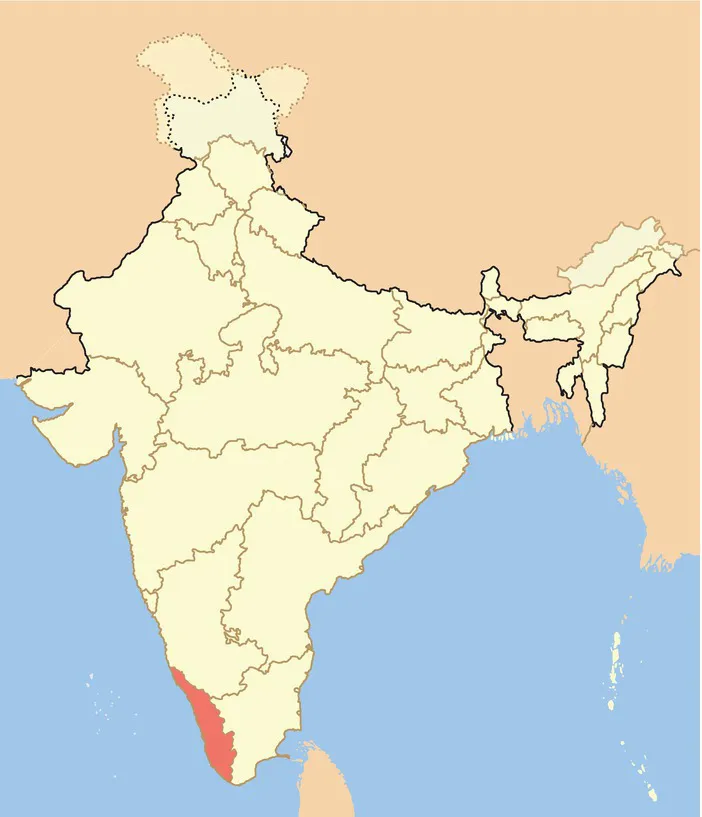
Fig. 1.1. Map showing location of Kerala (source: https://commons.wikimedia.org/wiki/File:India-KERALA.svg, accessed 4 November 2020).
Kerala was formed as a state on 1 November 1956 from Travancore, Kochi and Malabar by combining Malayalam-speaking regions and now is divided into 14 districts (Ratcliffe, 1978; Franke and Chasin, 1992). Kerala experiences a humid, equatorial, tropical climate and lies at a latitude of 8°18′ to 12°48′N and a longitude of 74°52′ to 77°22′E (Kore et al., 2016; Mathew and John, 2016). The total area of the state, which is about 38,864 km2, is only 1.18% of the area of India. In 1986 the foreign tourist arrivals were 50,000, and Kerala reached a status of 1,096,407 international tourist arrivals in 2018 (Department of Tourism, 2018, p. 40). The total revenue from tourism during 2018 showed an increase of 8.61% over the previous year. The WTTC has selected Kerala as a partner state for enhancing the tourism industry (Chettiparamb and Kokkranikal, 2012). Kerala’s unique selling proposition for marketing ‘one of the ten paradises of the world’ is ABC, an acronym for ‘Ayurveda, Backwaters, Culture and cuisine’ (Dhanesh, 2010).
Kumarakom is a destination comprising a cluster of islands that lie a few feet below sea level. The village covers an area of 51.67 km2, which is inclusive of 24.13 km2 of Vembanad Lake. Fishing, agriculture, shell mining and household industries are the main occupations. Records from the early 19th century indicate that the area was only sparsely populated. The 2001 census survey showed that the population had increased to about 23,000 and the number of households was approximately 5120 (Department of Tourism, 2007). Kumarakom has been declared a Special Tourism Zone by the Kerala State Government, as legislated for by the Kerala Tourism Act, 2005.
1.1.3 Role of responsible tourism in Kerala
Responsible tourism is about making better places for people to live in and better places for people to visit (Cape Town Declaration, 2002). From a different point of view, responsible tourism is not a niche tourism product or brand but explains the ways responsible visitation can accelerate and foster a sense of responsibility in visitors and local people (Harrison and Husbands, 1996; Ebitu, 2010). It also focuses on three pillars of sustainable development, namely economic, social and environmental sustainability. Responsible tourism concentrates on fostering a sense of responsibility by visitors who enjoy the destination and enhancing the trust of local people (Goodwin and Francis, 2003; Frey and George, 2010). It focuses on inspiring visitors, local communities and stakeholders in the tourism industry to take more responsibility for making...
Table of contents
- Cover
- Half Title
- Title
- Copyright
- Contents
- Contributors
- Contributors’ Biographies
- Introduction
- 1. A Case Study on Impacts of Community Participation in Tourism Planning and Destination Management in Kerala, India
- 2. Planning Agritourism Development in Sri Lanka: Farmers’ Incentives and Barriers
- 3. History of Tourism Planning and Development in Nepal: Achievements and Challenges to Sustainable Future of Tourism
- 4. Tourism in Afghanistan
- 5. Planning for Sustainable Tourism Development in Bhutan
- 6. Tourism Policy Planning in Bangladesh: Perspective and Propositions
- 7. Tourism Development and its Impact on Economic Growth in Pakistan
- 8. The Role of International Tourism in the Maldives
- Conclusion
- Index
- Cabi
- Back
Trusted by 375,005 students
Access to over 1.5 million titles for a fair monthly price.
Study more efficiently using our study tools.
Frequently asked questions
Yes, you can cancel anytime from the Subscription tab in your account settings on the Perlego website. Your subscription will stay active until the end of your current billing period. Learn how to cancel your subscription
No, books cannot be downloaded as external files, such as PDFs, for use outside of Perlego. However, you can download books within the Perlego app for offline reading on mobile or tablet. Learn how to download books offline
Perlego offers two plans: Essential and Complete
- Essential is ideal for learners and professionals who enjoy exploring a wide range of subjects. Access the Essential Library with 800,000+ trusted titles and best-sellers across business, personal growth, and the humanities. Includes unlimited reading time and Standard Read Aloud voice.
- Complete: Perfect for advanced learners and researchers needing full, unrestricted access. Unlock 1.5M+ books across hundreds of subjects, including academic and specialized titles. The Complete Plan also includes advanced features like Premium Read Aloud and Research Assistant.
We are an online textbook subscription service, where you can get access to an entire online library for less than the price of a single book per month. With over 1.5 million books across 990+ topics, we’ve got you covered! Learn about our mission
Look out for the read-aloud symbol on your next book to see if you can listen to it. The read-aloud tool reads text aloud for you, highlighting the text as it is being read. You can pause it, speed it up and slow it down. Learn more about Read Aloud
Yes! You can use the Perlego app on both iOS and Android devices to read anytime, anywhere — even offline. Perfect for commutes or when you’re on the go.
Please note we cannot support devices running on iOS 13 and Android 7 or earlier. Learn more about using the app
Please note we cannot support devices running on iOS 13 and Android 7 or earlier. Learn more about using the app
Yes, you can access Tourism Planning and Development in South Asia by Dimitrios Stylidis, Boopen Seetanah, Dimitrios Stylidis,Boopen Seetanah in PDF and/or ePUB format, as well as other popular books in Business & Hospitality, Travel & Tourism Industry. We have over 1.5 million books available in our catalogue for you to explore.