The philosophy of Lesson Study in Japan—teacher ownership, teacher professionalism, student learning-focused dialogue, teacher collaboration, and teacher professional community—has attracted educators and researchers worldwide. However, Lesson Study does not have the same meaning as its original Japanese expression Jugyou Kenkyuu, a combination of two Japanese words—Jugyou meaning instruction or lesson(s) and Kenkyuu meaning study or research. To bridge the gap between Jugyou Kenkyuu and Lesson Study and therefore maximize the potential of Lesson Study in the world, this edited volume provides two "mirrors" for those who wish to reflect on and implement Lesson Study within their own contexts. One section discusses how Lesson Study is utilized in Japanese teacher education and how this system reproduces the very culture of Lesson Study. The other section addresses case studies showcasing Lesson Study implementation in several countries such as the United States, Germany, Norway, Peru, and Uganda and discusses the opportunities and challenges that arise when Lesson Study-based teacher education expands beyond Japan to the rest of the world. This book will appeal to anyone interested in learning about Lesson Study.
eBook - ePub
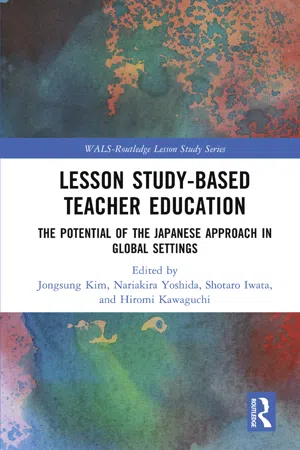
Lesson Study-based Teacher Education
The Potential of the Japanese Approach in Global Settings
- 220 pages
- English
- ePUB (mobile friendly)
- Available on iOS & Android
eBook - ePub
Lesson Study-based Teacher Education
The Potential of the Japanese Approach in Global Settings
About this book
Information
1 Introduction
The potentials of Lesson Study-based teacher education
For Japanese educators, Lesson Study is like air, felt everywhere because it is implemented in everyday school activities.(Fujii, 2014, p. 68)
Lesson Study is widely spread throughout Japanese teacher education. Pre-service teachers take methodology courses such as Practice of Lesson Study for Mathematics and Introduction of Lesson Study for Elementary School Teachers. In-service teachers also participate in Lesson Study within their schools and sometimes visit other schools to observe and discuss a lesson with other educators. For teachers in Japan, Lesson Study is not a specialized word. Within Japanese teacher education, the phenomenon of Lesson Study is called “Lesson Study-based teacher education”.
Lesson Study-based teacher education takes various forms. Lesson Study can mean pre-service teachers’ lesson planning processes in their method courses. Lesson Study would also indicate in-service teachers’ activities of reading and analysing the descriptions of “good” classroom practices. Of course, Lesson Study includes the series of teachers’ actions where “collaboratively plan, observe, and analyze actual classroom practice” (Lewis, Perry, Hurd, & O’Connell, 2006, p. 273), recognized as “Lesson Study” outside of Japan.
The reason Lesson Study in Japan has many patterns, different from Lesson Study outside of Japan, is that the approach has only a loose, common goal, which is improving the classroom activities and students’ learning, but the process is not strictly defined. Katakami (2011) described the purpose of Lesson Study as constructing a practice-based theory that can improve teaching and learning quality in the classroom. According to him, anyone, whether a researcher, teacher educator, or in-service or pre-service teacher, can conduct Lesson Study if they seek the goal above. Thus, Lesson Study in Japan has a broader meaning than Lesson Study outside of Japan.
Another reason for Lesson Study’s variation in Japan could be attributed to its long history. Originally, Lesson Study began with a top-down approach, dating back to the 1870s when elementary schools, based on the modern school system influenced by Western culture, were established. An American educator, Marion McCarrell Scott, was invited to Japan to introduce the whole-class teaching method. In order to implement the newly adopted teaching methods, the groups who supported the transition from a traditional school to a modern one trained teachers by having them prepare lesson plans together and conduct, observe, and discuss a research lesson (Ishii, 2017). The mentioned series of actions was the starting point of Lesson Study, which was regarded as an effective approach to localizing new ideas (e.g., national education policy and pedagogy).
However, during social changes surrounding school education, Lesson Study changed its appearance from a top-down approach to a grassroots approach. In the 1910s, democratic thoughts gradually spread in Japan, including teacher communities. The expansion of democracy in schools created a movement, the so-called Free Education Movement in the Taisho Era (1912–1926). During this movement, teachers developed their own teaching methods instead of learning them from authority and took a critical stance against the government, seeking liberal education that respected learners’ initiatives and individuality (Nagata, 2006). In this era, teachers tried to improve their classroom activities autonomously. As one of their professional development strategies, they created educational practice records (jugyou kiroku) and used the records to reflect on their own practices within teacher communities. These records were not written rigidly; rather, they were a “narrative style of records of educational practices” (Ishii, 2017, p. 58) written in teachers’ own words. The culture of reflecting lessons utilizing lesson records within teacher communities created unique languages and forms of Lesson Study in individual groups.
The aforementioned Lesson Study-based teacher education, which aims to develop a culture to recognize teachers as researchers who can design and study teaching and learning in the classroom, has earned worldwide attention since the late 1980s. Researchers interested in why Japanese students acquired high scores in global scale tests such as Programme for International Student Assessment (PISA) investigated the country’s educational systems and policies, national curriculum, and instructional activities (e.g., Lewis, 1995, 2002; Stigler, Lee, & Stevenson, 1987). Among them, Stigler and Hiebert’s (1999) work, The Teaching Gap, which attributed Japanese students’ high academic achievement to Lesson Study culture in the country, acted as a catalyst for the approach’s official debut in the world.
Behind the worldwide introduction of Lesson Study, there was a trend of enlarging the meaning of teacher education and professional development from the late 1980s to the 1990s (Hiebert, Gallimore, & Stigler, 2002). Cochran-Smith and Lytle (2009) described the educational climate at that time as “call[ing] for the professionalization of teaching, enlarged roles for teachers, and enhanced teacher leadership” (p. 6). Within this new shift, teacher research, “a form of inquiry approached from teacher perspectives”, (Craig, 2009, p. 61) was highlighted in teacher education discourses (Zeichner, 2003). In teacher research, teachers are recognized as the agents of producing the professional knowledge, not the consumer. In light of fostering “students of teaching” (Dewey, 1904, p. 16) who are intellectually vital and independent learners and who can continue to learn and make informed decisions throughout their lives, Lesson Study worked well with the new shift of teacher education and the emphasis on teacher research.
Cochran-Smith and Lytle (1992) articulated four main obstacles to expanding teacher research in their context: teacher isolation, a school culture that works against raising questions, a technical view of knowledge for teaching, and the reputation of educational research (pp. 304–305). Lesson Study in Japan is not the only answer to their questioning; however, the Lesson Study-based teacher education system in Japan, which reproduces the culture of fostering a student of teaching and creating a space for discussing lessons, is worth referring to in exploring the answer.
From the time of university or even when prospective teachers were K-12 students themselves, they became familiar with the term Lesson Study and even other words such as research question (kenkyuu kadai) and research lesson (kenkyuu jugyou). In-service teachers describe their collective and reflective cycle of lesson improvement with the word “research”. For Japanese teachers, doing Lesson Study as teacher researchers is one of their missions that identifies their existence in the school setting. Teachers can publish their Lesson Study in academic research journals, and their work is recognized as valuable educational research. In this Lesson Study-based teacher education system in Japan, teachers develop their identity as researchers (kenkyuu-sya) and contribute to accumulating a “professional knowledge base from practitioner knowledge rather than from researcher knowledge” (Hiebert et al., 2002, p. 9).
Also, in Japan, a lesson is not merely interactions between teachers and students; rather, it is recognized as a venue where teachers’ educational philosophies are revealed (Usui, 2011). Lesson Study is where teacher philosophies intersect and create practitioners’ knowledge by sharing their practical wisdom. With the belief that sharing one another’s opinions about a lesson can improve the lesson itself and their own lessons and teaching philosophy, teachers create the culture of raising questions within each other’s practices, not from a technical view of teaching but from the viewpoint of educational philosophy.
The purpose and structure of this volume
Lesson Study has been implemented in many countries across Africa, Asia, Europe, North and South America, and Oceania. Under the World Association of Lesson Studies’ leadership since 2007, Lesson Study research rapidly increased; almost 900 Lesson Study articles have been published since the 1990s (see Chapter 3). Over the course of 20 years, Lesson Study took its position in the global teacher education community through the efforts of researchers who elucidated Japanese Lesson Study characteristics and implemented the approach in their own settings (Matoba, 2005; Shibata, 2017).
This eruptive Lesson Study trend, however, may cause unintended results. Lewis, Perry, and Murata (2006) warned that Lesson Study may fail like “so many other once-promising reforms” (p. 3) if there is not enough effort to provide a fuller view of the methodology. To avoid this pitfall, many researchers and teacher educators have expanded their knowledge of Lesson Study and have illustrated the mechanisms of the methodology to assist those who want to introduce the approach in their own contexts. However, such research only focuses on some aspects of Lesson Study and thus falls short of providing a bigger picture of how the approach intertwines with overall teacher education. Additionally, there is a scarcity of narrative research, which describes how teacher educators have introduced the approach in their respective contexts, the kinds of challenges they have encountered, and how they have overcome such challenges.
As mentioned previously, this volume aims to showcase how teacher educators in Japan utilize Lesson Study, clarify its meaning in teacher education, and discuss the opportunities and challenges that arise when Lesson Study-based teacher education expands from Japan to the rest of the world. In Part I, two chapters discuss Lesson Study in Japan and the world. In Chapter 2, Kim, a Korean “stranger” (Simmel, 1950) in Japanese teacher education, illustrates the full view of Lesson Study-based teacher education in Japan and the socio-cultural background that has supported the approach’s success in the country. In Chapter 3, Yoshida, Matsuda, and Miyamoto describe how Lesson Study has been researched globally. Through a mass-scaled analysis of 891 articles focusing on the variable transformation worldwide, the authors capture the landscape of Lesson Study.
In Part II, according to Kim’s illustration of the scenery of Lesson Study in Japan—method courses, teaching practicum, school-based Lesson Study, and off-site Lesson Study—four chapters suggest a more detailed “mirror” of Lesson Study-based teacher education in Japan. In Chapter 4, Kawaguchi and Watanabe describe the results of interviews with nine Japanese teacher educators about their utilization of Lesson Study and illustrate the various interpretations and implementations of the approach. In Chapter 5, Mase explains the historical background of the utilization of Lesson Study in teaching practicum and shares a case of how a university utilizes Lesson Study for student teaching. In Chapter 6, Iwata and Hamamoto report a case study of their school-based Lesson Study project focusing on how their intervention could change teachers’ views and thinking about physical education lessons. In Chapter 7, in light of Japan’s professional development system, Miyoshi and Komatsu depict how Lesson Study has been implemented outside of school, including in the public sector and private educational research organizations.
In Part III, citing cases within Norway, the United States, Germany and other German-speaking countries, Peru, and Uganda, various Lesson Study patterns in the world are showcased as the second “mirror” for audiences to reflect their own context. In Chapter 8, Smith argues that Lesson Study, in the Norwegian context and even beyond it, can be a methodology for teacher educators’ professional development like other practitioner research such as action research and self-study. In Chapter 9, Harris and her colleagues describe how Lesson Study has been implemented in the United States and report their case study of Lesson Study in social studies education. In Chapter 10, Hallitzky and her colleagues review how Lesson Study has been researched in German-speaking countries since the mid-2000s and discuss the meaning of Lesson Study based on the tradition of unterrichtsforschung [descriptive classroom research]. In Chapter 11, Saito and Shiraishi report their implementation of Lesson Study in physical education in Peru and Uganda as international education cooperation and share the projects’ achievements and challenges.
In Part IV, two concluding chapters critically examine the current Lesson Study in Japan and the world and suggest strategies for a better Lesson Study implementation. In Chapter 12, Yoshida and his colleague depict their community-based Lesson Study project, practiced with the va...
Table of contents
- Cover
- Half Title
- Series Page
- Title Page
- Copyright Page
- Contents
- List of Figures
- List of Tables
- List of Contributors
- Foreword
- Preface
- 1 Introduction: The potentials of Lesson Study-based teacher education
- PART I: Lesson Study in Japan and the world
- Part II: The scenery of Lesson Study-based Teacher Education in Japan
- Part III: The potentials and challenges of Lesson Study-based teacher education globally
- Part IV: For a better Lesson Study-based teacher education
- Index
Trusted by 375,005 students
Access to over 1.5 million titles for a fair monthly price.
Study more efficiently using our study tools.
Frequently asked questions
Yes, you can cancel anytime from the Subscription tab in your account settings on the Perlego website. Your subscription will stay active until the end of your current billing period. Learn how to cancel your subscription
No, books cannot be downloaded as external files, such as PDFs, for use outside of Perlego. However, you can download books within the Perlego app for offline reading on mobile or tablet. Learn how to download books offline
Perlego offers two plans: Essential and Complete
- Essential is ideal for learners and professionals who enjoy exploring a wide range of subjects. Access the Essential Library with 800,000+ trusted titles and best-sellers across business, personal growth, and the humanities. Includes unlimited reading time and Standard Read Aloud voice.
- Complete: Perfect for advanced learners and researchers needing full, unrestricted access. Unlock 1.5M+ books across hundreds of subjects, including academic and specialized titles. The Complete Plan also includes advanced features like Premium Read Aloud and Research Assistant.
We are an online textbook subscription service, where you can get access to an entire online library for less than the price of a single book per month. With over 1.5 million books across 990+ topics, we’ve got you covered! Learn about our mission
Look out for the read-aloud symbol on your next book to see if you can listen to it. The read-aloud tool reads text aloud for you, highlighting the text as it is being read. You can pause it, speed it up and slow it down. Learn more about Read Aloud
Yes! You can use the Perlego app on both iOS and Android devices to read anytime, anywhere — even offline. Perfect for commutes or when you’re on the go.
Please note we cannot support devices running on iOS 13 and Android 7 or earlier. Learn more about using the app
Please note we cannot support devices running on iOS 13 and Android 7 or earlier. Learn more about using the app
Yes, you can access Lesson Study-based Teacher Education by Jongsung Kim, Nariakira Yoshida, Shotaro Iwata, Hiromi Kawaguchi, Jongsung Kim,Nariakira Yoshida,Shotaro Iwata,Hiromi Kawaguchi in PDF and/or ePUB format, as well as other popular books in Education & Classroom Management. We have over 1.5 million books available in our catalogue for you to explore.