Numbers are the backbones of mathematics. From 1 to infinity, numbers accompany and underlie the learning of mathematics and research. While perceived as familiar and understood, numbers present fascinating and often mysterious patterns, relationships and pedagogical issues. The Learning and Teaching of Number explores how mathematics education research has addressed issues related to the structure of numbers and number operations and provides a classroom context. It invites readers to explore less-travelled paths through a well-trodden terrain of number.
This fascinating book combines mathematical content with pedagogical ideas and research results. Focusing on number, the book illustrates central ideas related to numbers via a variety of tasks at different levels of complexity. The Learning and Teaching of Number will allow the reader to
examine and develop personal understanding of number sets and the relationships among them;
enhance personal understanding of familiar topics associated with number operations;
engage in a variety of tasks and strengthen personal problem-solving skills;
enrich their repertoire of mathematical tasks and pedagogical actions; and
consider research ideas and results related to teaching numbers, number operations and number relationships.
This is a valuable resource for teacher education courses, graduate programs in mathematics education and professional development programs. Teacher trainers and maths teachers will find their personal understanding of numbers and relationships enriched and will draw connections between research and classroom pedagogy which will extend and enhance their teaching.
Numbers have verbal names and symbolic representations.1 Strictly speaking, the symbols 1, 2, 3, 4, … are numerals. They are not themselves numbers, but names or symbols serving to denote or refer to numbers. These well-accepted and succinct symbols feature one of several common representations to capture numbers. In ancient times, numbers were represented by tallies, such as markings on a stick or pebbles in a bowl. However, as numbers got bigger, the development of some more succinct notation became essential. In this snapshot we review several ways to capture numbers through different representations. Note that each representation stresses some number features and ignores others.
1Denoting
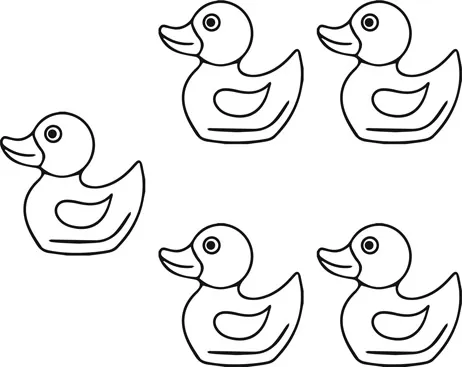
Write down a number that describes how many ducks there are in Figure 1.1. For the same ducks, make another, different record; and another; …; and another.
FIGURE 1.1 Some number of ducks
Most people write or at least imagine “5”. People with English as their first language can say “five”. The names “5” and “five” are the most readily accessed elements in their example space. Closely connected are decompositions such as 1 + 4, or 1 + 2 + 2. Tasks like this can be carried out in kindergarten, where children can be asked to make a record so that they can look at their record and know without looking at them how many ducks there are (Hughes, 1986). But such tasks can also be worthwhile for prospective teachers and others, since they can potentially lead to engaging discussions on number representation.
Indeed, “5” is the obvious choice for representing the number of ducks in the picture. However, is there another way to capture this number?
The strategy of asking for “another, and another” was developed by Watson and Mason (2005) in their work on learner generated examples. They described this strategy as a valuable pedagogy which pushes the learner to consider examples beyond those immediately available and so to extend personal example spaces. The size, diversity and richness of interconnections of personal example spaces indicate the quality of understanding.
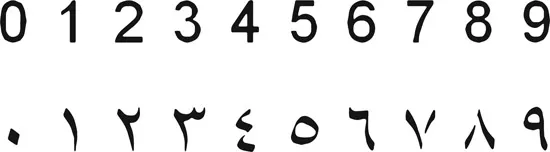
Describing the number of ducks in Figure 1.1, we write “5”, or “five” or “cinco”. From there, this seemingly naïve task can be developed in different directions. One possible direction, which usually comes up in a class of (prospective) teachers, is acknowledgement of other ways to write down “five”, such as V or
. The symbol “V” is a familiar Roman numeral, so we direct readers’ attention to the symbol “
” and Figure 1.2.
FIGURE 1.2 Arabic digits
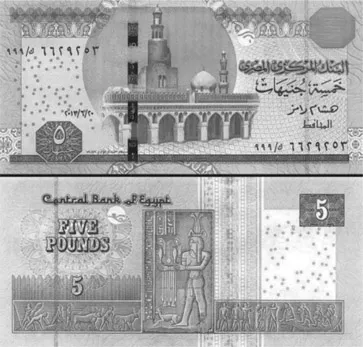
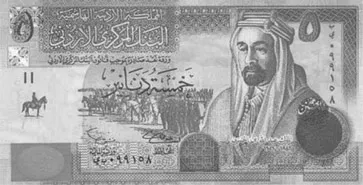
Figure 1.3 shows the banknote of five pounds used in Egypt, of five riyals used in Saudi Arabia and of five dinars used in Jordan. The symbol “
” can be clearly identified, while the opposite sides of the bills denote the value as “5” and “five”.
FIGURE 1.3 Banknotes used in Egypt, Saudi Arabia and Jordan
It is often a surprise that while today the commonly used digit symbols and numeration system are referred to as Arabic or Hindu-Arabic (also Indo-Arabic, e.g., Ore, 1998), different symbols for digits are used in some Arab countries. But this surprise is an opportunity to focus on the distinction between symbols for digits and a numeration system. While V and
both represent the number that English speakers call “five”, the difference between symbols and numeration systems is highlighted when we represent, for example, “thirty-seven” with symbols.
Compare: 37
XXXVII
Note the number of symbols and the correspondence among the different symbols in the three representations. And how about larger numbers, like four thousand seventy-six?
TASK: EXPERIENCING THE DIFFERENCE BETWEEN NUMBER REPRESENTATIONS
Represent the numbers “four thousand seventy-six” and “five thousand five hundred and seven” with (a) Roman numerals and (b) digit symbols from Figure 1.2.
Discuss what each numeral system highlights or stresses and what it puts in the background or ignores.
Such a task emphasizes that the strangely written symbols in Figure 1.2 are part of the same conventional numeration system that we use and are used to, while the more familiar Roman numerals are part of a very different numeration system. To recall, the main components of Hindu-Arabic numeration system are positional notation, also known as place value; base-ten; and ten symbols for digits conventionally denoted with “1”, “2”, “3”, “4”, “5”, “6”, “7”, “8”, “9” and “0”. Thus, the symbol sequence 10 is made up of two symbols and actually means “one ten and no units”. “Ten” itself has no self-contained symbol.
Returning to the number “five”, we have noted an example, namely Roman numerals, that does not use our standard positional notation. We have also seen an example of different symbols used for...
Table of contents
Cover
Half Title
Series Page
Title Page
Copyright Page
Contents
Preface
Entering the terrain
Getting ready to act
Snapshot 1 – Capturing numbers
Snapshot 2 – Departing from base-ten: On decimal and non-decimal representations
Snapshot 3 – Measuring with numbers
Snapshot 4 – Exploring variations in algorithms for arithmetic operations
Snapshot 5 – Cycling through numbers: Focus on repeating patterns
Snapshot 6 – Representing numbers multiplicatively: Some topics in number theory
Snapshot 7 – Revisiting fractions: Not just pieces of pie
Snapshot 8 – Transitioning between numerical domains
Snapshot 9 – Playing with numbers: Puzzles, riddles and paradoxes
The journey continues
Index
Trusted by 375,005 students
Access to over 1.5 million titles for a fair monthly price.
Study more efficiently using our study tools.
Frequently asked questions
Yes, you can cancel anytime from the Subscription tab in your account settings on the Perlego website. Your subscription will stay active until the end of your current billing period. Learn how to cancel your subscription
No, books cannot be downloaded as external files, such as PDFs, for use outside of Perlego. However, you can download books within the Perlego app for offline reading on mobile or tablet. Learn how to download books offline
Perlego offers two plans: Essential and Complete
Essential is ideal for learners and professionals who enjoy exploring a wide range of subjects. Access the Essential Library with 800,000+ trusted titles and best-sellers across business, personal growth, and the humanities. Includes unlimited reading time and Standard Read Aloud voice.
Complete: Perfect for advanced learners and researchers needing full, unrestricted access. Unlock 1.5M+ books across hundreds of subjects, including academic and specialized titles. The Complete Plan also includes advanced features like Premium Read Aloud and Research Assistant.
Both plans are available with monthly, semester, or annual billing cycles.
We are an online textbook subscription service, where you can get access to an entire online library for less than the price of a single book per month. With over 1.5 million books across 990+ topics, we’ve got you covered! Learn about our mission
Look out for the read-aloud symbol on your next book to see if you can listen to it. The read-aloud tool reads text aloud for you, highlighting the text as it is being read. You can pause it, speed it up and slow it down. Learn more about Read Aloud
Yes! You can use the Perlego app on both iOS and Android devices to read anytime, anywhere — even offline. Perfect for commutes or when you’re on the go. Please note we cannot support devices running on iOS 13 and Android 7 or earlier. Learn more about using the app
Yes, you can access The Learning and Teaching of Number by Rina Zazkis,John Mason,Igor' Kontorovich in PDF and/or ePUB format, as well as other popular books in Education & Education General. We have over 1.5 million books available in our catalogue for you to explore.