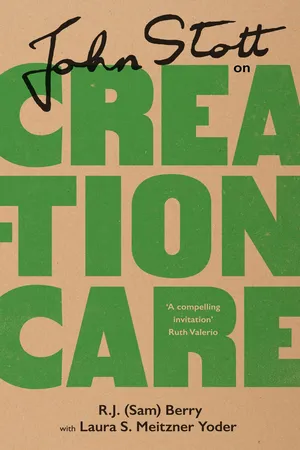
Discover John Stott's writings on creation care, brought together for the first time in this definitive collection for the global church. Compiled by R. J. Sam Berry and Laura Yoder, this brilliant anthology demonstrates both Stott's passion for the environment and its place in Christian discipleship.
Showcasing his unique way of explaining the Bible simply and clearly, John Stott on Creation Care traces Stott's own process of coming to embrace creation care as a vital part of the Christian life - and in turn shows us how creation care must have an integral place in our own discipleship.
Commentary by noted scientist R. J. (Sam) Berry connects Stott's writings together and illuminates how his wisdom still speaks to us today. Alongside reflections from others that Stott inspired and discipled, John Stott on Creation Care is the perfect resource for every Christian looking to understand biblical teaching on the environment and how creation care should form part of their discipleship. It is also an ideal biblical and theological resource for those involved in creation care ministry.
Published as part of the John Stott Centenary celebrations, proceeds from John Stott on Creation Care will go to A Rocha International, a charity that carries community-based conservation projects in response to biodiversity loss around the world.
John Stott viewed creation care as an inevitable implication of the biblical message, and as a grounding for Christian engagement in environmental commitments. This collection will give you a deeper, more thorough understanding of his writings and how his views developed, and will leave you motivated and inspired to look again at your discipleship and how you approach creation care.
- English
- ePUB (mobile friendly)
- Available on iOS & Android
eBook - ePub
John Stott on Creation Care
About this book
Information
1
John Stott’s journey
Living to reflect love for our Creator
When John Stott died in 2011 at the age of ninety, a service of thanksgiving for his life filled St Paul’s Cathedral, with archbishops and the Bishop of London present. It was said of Stott that, alongside William Temple, he was ‘the most influential clergyman in the Church of England’ in the twentieth century (The Times 2011). His reputation was even greater outside the UK. Billy Graham wrote:
Few people have influenced my life and ministry more than my good friend John Stott. His dedication to Jesus Christ, his commitment to the authority of the Bible, and his passion for world evangelization were a great encouragement to me. His commitment to social justice and his profound compassion for the poor and oppressed of the world challenged us to think more deeply about these important dimensions of our faith.
(Graham 2012)
In the 2005 TIME magazine citation that included Stott on its annual list of the 100 most influential people in the world, Billy Graham noted that John Stott ‘represents a touchstone of authentic biblical scholarship that . . . has scarcely been paralleled since the days of the 16th-century European Reformers.’ His work was ‘a significant factor in the explosive growth of Christianity’ worldwide, given his intentional personal investment in training and resourcing church leaders in Asia, Africa and Latin America from the early 1960s and throughout his life’s ministry (Graham 2005). Despite his heritage of class privilege and a significant public profile, Stott embraced a simple lifestyle as part of his life of faith (Stott 2010b; Labberton 2021). Notably, Billy Graham’s short 2005 commendation mentioned that Stott’s own royalties funded much international ministry, and that the ‘modesty of his lifestyle is evidenced in the simplicity of his living quarters, limited to a two-room flat in London . . . and a renovated farm on the Welsh coast, where he has written his books’ longhand, in rustic conditions. A New York Times commentator suggested that if evangelicals had a pope, it would have been Stott (Brooks 2004).
In his A History of the Church of England 1945–1980, Paul Welsby wrote:
In the pre-war and immediately post-war years many evangelicals had been more concerned with preserving their own purity of doctrine than with attempting to co-operate with others in evangelism and the ecumenical movement and were too parochially orientated to take any influential part in the higher councils of the Church . . . During the nineteen-fifties, however, a gradual change took place and this was largely due to the status and influence of one man. John Stott was a person of wide vision and deep understanding, and very persuasive. A gifted expositor of the Bible, a prolific writer and an evangelist, he was also a statesman who possessed the ability to understand other points of view.
(Welsby 1984, pp. 212–213)
Stott made major contributions to biblical understanding, particularly the theology of the atonement, together with the nature of mission and social ethics. He was also a highly effective evangelist. In 1952, only two years after becoming Rector of All Souls Church Langham Place, in the heart of London’s West End, he led a mission to his alma mater, Cambridge; it was the first of what would become more than forty university missions and it ushered in a new style of thoughtful evangelism. It was reported that ‘he was biblical, scholarly though not academic, firm but not caustic, more evidently a man with love for people than some of the older preachers’ (Barclay and Horn 2002, p. 238). Crowds attended and many professed faith. His addresses formed the basis of his book Basic Christianity, published in 1958, which by 2010 had sold more than 2.5 million copies and had been translated into more than fifty languages (Stanley 2013, p. 122). He wrote around fifty books. Two compilations of his writings have been published (Dudley-Smith 1995b; Keswick Classics 2008); he has been the subject of five biographies (Catherwood 1984; Dudley-Smith 1999, 2001; Steer 2009; Cameron 2012; Chapman 2012); a bibliography (Dudley-Smith 1995a); and two books of reminiscences (Cameron 2020; Wright 2011) . Many of his books have been reprinted often; two of them (Men with a Message and Christian Mission in the Modern World) have been republished with extensive commentaries.
Stott’s reputation was built on the basis of disciplined Bible study and careful expository preaching. It could well be said of him, as Charles Spurgeon wrote of John Bunyan, ‘Prick him anywhere – his blood is Bibline, the very essence of the Bible flows from him.’ His ministry has been described as both apostolic and Abrahamic (Wright 2020, p. 31). Apostolic because ‘it faithfully reflected the passion and priorities of the biblical apostles: evangelism and teaching’; and Abrahamic because of his commitment to reaching out to the nations through the number of international evangelical bodies with which he had close association – the Lausanne Movement, World Evangelical Alliance, International Fellowship of Evangelical Students, Scripture Union, A Rocha, Tearfund – together with his passion for the truth of a gospel that he believed had not been grasped until its radical demands, as well as its gracious promises, had been grasped and lived out by ‘integrated Christians’.
Christopher Catherwood, his first biographer, writing in 1984, described him as ‘above all a preacher’, albeit with ‘the aim to relate God’s unchanging Word to our ever-changing world . . . earthing of the Word in the World is not something optional’ (Catherwood 1984, p. 31). Stott himself wrote that ‘the Christian preacher is neither a speculator who invents new doctrines which please him, nor an editor who excises old doctrines which displease him, but a steward, God’s steward, dispensing faithfully to God’s household the truths committed to him in the Scriptures, nothing more, nothing less, and nothing else’ (Catherwood 1984, p. 37). Catherwood is careful to emphasize Stott’s concern for social issues and his insistence on ‘balanced Christianity’ but, to him, Stott was first and foremost a preacher and expositor. Near the end of his life, Stott declared that he would like to be remembered as ‘an ordinary Christian who has struggled to understand, expound, relate and apply the word of God’ (Cameron 2020, p. 5).
Notwithstanding, and despite his formidable intellect and personal asceticism, Stott was a ‘people person’. He had an enviable ability to remember people he had met and had a quick rapport with all ages, without in any way lessening or compromising any of his beliefs or his submission to Jesus as his master and Saviour. This did not reduce at all his acknowledging and teaching the authority of God’s revelation in Scripture.
Accepting the danger of oversimplifying, it is possible to identify five interconnected, consistent and progressive themes that characterized Stott’s life and became ever clearer to him as his ministry developed and matured.
- He was immersed in and subordinated to God’s word as set out in the Scriptures.
- He insisted that God’s workings can – and should – be seen in both creation and redemption.
- He abominated the dualistic separation of body and spirit; his emphasis was on the necessity of ‘double listening’ – to both ancient word and modern world.
- He believed that it was illegitimate to separate the ‘Great Commandment’ (‘To love one’s neighbour as oneself’) from the ‘Great Commission’ (‘Go and make disciples’): the two should be seen as complementary.
- He was prepared to change his mind if he believed his interpretation of Scripture was wrong. He changed his attitude to pacifism, creationism, abortion and, most importantly in the present context, to God’s mandate for creation care.
These elements of Stott’s life can be seen clearly in his last book The Radical Disciple, published the year before he died, and which reasonably can be taken to be his considered testament to the Church. In it, Stott presented a challenge:
That we who claim to be disciples of the Lord Jesus will not provoke him to say again, ‘Why do you call me Lord, Lord, and do not do what I say?’ (Luke 6:46) . . . Our common way of avoiding radical discipleship is to be selective; choosing those areas in which commitment suits us, and staying away from those areas in which it will be costly. But because Jesus is Lord, we have no right to pick and choose the areas in which we will submit to his authority.
(Stott 2010b, pp. 14–16)
The Radical Disciple lists eight characteristics of Christian discipleship that Stott considered essential but neglected. Seven of them were shown by Stott in his own life: non-conformity, Christlikeness, maturity, simplicity, balanced judgment, involvement in community and death, in the sense of death and life in Christ. Death for Stott, as he approached his own physical death, was not merely the termination of life but also...
Table of contents
- About the authors
- Foreword
- Foreword
- Preface
- Acknowledgments
- Introduction
- 1
- 2
- 3
- 4
- 5
- 6
- 7
- 8
- 9
- Afterword
- Appendix 1
- Appendix 2
- Bibliography
- Search items for Scripture references
Trusted by 375,005 students
Access to over 1.5 million titles for a fair monthly price.
Study more efficiently using our study tools.
Frequently asked questions
Yes, you can cancel anytime from the Subscription tab in your account settings on the Perlego website. Your subscription will stay active until the end of your current billing period. Learn how to cancel your subscription
No, books cannot be downloaded as external files, such as PDFs, for use outside of Perlego. However, you can download books within the Perlego app for offline reading on mobile or tablet. Learn how to download books offline
We are an online textbook subscription service, where you can get access to an entire online library for less than the price of a single book per month. With over 1.5 million books across 990+ topics, we’ve got you covered! Learn about our mission
Look out for the read-aloud symbol on your next book to see if you can listen to it. The read-aloud tool reads text aloud for you, highlighting the text as it is being read. You can pause it, speed it up and slow it down. Learn more about Read Aloud
Yes! You can use the Perlego app on both iOS and Android devices to read anytime, anywhere — even offline. Perfect for commutes or when you’re on the go.
Please note we cannot support devices running on iOS 13 and Android 7 or earlier. Learn more about using the app
Please note we cannot support devices running on iOS 13 and Android 7 or earlier. Learn more about using the app
Yes, you can access John Stott on Creation Care by R.J. (Sam) Berry,Laura Yoder,R. J. (Sam) Berry in PDF and/or ePUB format, as well as other popular books in Biological Sciences & Christian Theology. We have over 1.5 million books available in our catalogue for you to explore.