Deirdre Nansen McCloskey's latest meticulous work examines how economics can become a more "human" science.
Economic historian Deirdre Nansen McCloskey has distinguished herself through her writing on the Great Enrichment and the betterment of the poor—not just materially but spiritually. In Bettering Humanomics she continues her intellectually playful yet rigorous analysis with a focus on humans rather than the institutions. Going against the grain of contemporary neo-institutional and behavioral economics which privilege observation over understanding, she asserts her vision of "humanomics," which draws on the work of Bart Wilson, Vernon Smith, and most prominently, Adam Smith. She argues for an economics that uses a comprehensive understanding of human action beyond behaviorism.
McCloskey clearly articulates her points of contention with believers in "imperfections," from Samuelson to Stiglitz, claiming that they have neglected scientific analysis in their haste to diagnose the ills of the system. In an engaging and erudite manner, she reaffirms the global successes of market-tested betterment and calls for empirical investigation that advances from material incentives to an awareness of the human within historical and ethical frameworks. Bettering Humanomics offers a critique of contemporary economics and a proposal for an economics as a better human science.
eBook - ePub
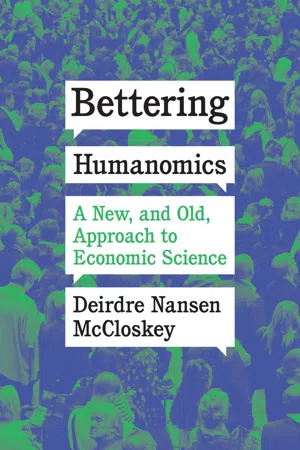
Bettering Humanomics
A New, and Old, Approach to Economic Science
- English
- ePUB (mobile friendly)
- Available on iOS & Android
eBook - ePub
About this book
Information
Publisher
University of Chicago PressYear
2021Print ISBN
9780226826516
9780226765921
eBook ISBN
9780226766089
PART I
The Proposal
CHAPTER ONE
Humanomics and Liberty Promise Better Economic Science
I offer here, in the first of this pair of books, a prospect, with examples in some detail, for that better and bettering humanomics. The word names an economic science that accepts (with commonsense repairs) the models and mathematics and statistics and experiments and the like of the orthodoxy circa 2021 but then adds the immense amount we can learn about human action in the economy from the myriad forms of human speech if we will but listen, really listen—the news on the Rialto, the rhetoric of the chat rooms in controlled experiments, the sober testimony of businesspeople at Rotary meetings, the gossip of the Kaffeeklatsch, the findings of interspecies experiments, the results of value alignment in AI, the politics on the stump and in the cloakroom, the ethical and epistemological ruminations about suitable categories (national income, to be sure, but which definition of the nation, or of income?), the stories of historians, the reflections of theologians, the introspections of poets and philosophers, the surveys of public opinion, the wisdom of the visual arts and of songs, films, plays, novels, poems, operas, the Grand Ole Opry. And, concerning all of this human speaking, a humanomics marshals, too, the reflection about the art and speech, what are called in America “the humanities” and in Britain “arts subjects,” the enormous, ramifying project since ancient times of looking back critically on human thinking and speaking and their results in human action. In short, we economists should use all the evidence we can get our hands on. If we don’t, we aren’t being serious scientists but mere drunks of scientism, or New Guinea highlanders.
As put by the Chinese psychologist and economic thinker Ning Wang and the 1991 Nobelist Ronald Coase, a pioneer of humanomics before the letter, “The stupendous loss in the depth and richness of human nature is a noticeable part of the price we have paid in transforming economics from a moral science of man creating wealth to a cold logic of choice in resource allocation. No longer a study of man as he is, modern economics has lost its anchor and drifted away from economic reality. As a result, economists are hard pressed to say much that is coherent and insightful, although their counsel is badly needed in this time of crisis and uncertainty.”1
In Round the Bend (1951) the Australian novelist Nevil Shute (most famous for On the Beach [1957], made in 1959 into a poignant film starring Gregory Peck) told of the owner of an air-transport company reflecting on his business after the death of his brilliant chief engineer Constantien (he was called Connie, and was a religious man):
I was lonely and troubled, and at first there didn’t seem to be much point in going on with anything; I was very tired, and I didn’t know what to do. I thought of selling out my business, to Airservice, perhaps. . . . But after a time I got settled down, and then it seemed to me that it would be a better thing to carry on the business and run it in the way that Connie liked, so that in a materialistic world my air line should be an example running through Asia to show that men can keep the aircraft safe by serving God in Connie’s way, and yet keep on the black side of the ledger. I’d go so far as to say, from my experience, that only by serving God in this way can you keep out of the red.2
Shute is pointing to a human characteristic, our need for a transcendent purpose, even in business, and our need for the guidance of love, even in business. It’s just the way nonsociopathic humans are, in addition to their pursuit of materialistic profit. The pursuit of profit, after all, is shared with all of life, from bacteria and moss through our cousins the great apes. It’s not at all especially human. A human science about “the ordinary business of life” (as Alfred Marshall a long time ago defined economics) needs to acknowledge such nonprofit purposes as much as it acknowledges balance sheets. It doesn’t give up what we learned from Adam Smith or Marshall or Keynes or Samuelson. An Adam Smithian science would combine what the first editor of the Economist, Walter Bagehot, called in his exposition of the British constitution the “efficient” and the “dignified,” the quotidian and the transcendent, the means and the ends. Both. Thus, humanomics.
Economists routinely defend their sneering dismissal of ethics and their accompanying scorn for most of human knowledge by appealing to specialization. “Ah, you see, economics itself recommends specialization. Shoemaker, stick to your last.” But they don’t then complete the economics. Piling up specialized products in the backyard is pointless if one does not trade them. Specialization, and then trade, is what economics since Adam Smith recommends. An economist dismissing the transcendent purposes of economic actors, ignoring their talk, and treating them like ants to be observed, isn’t trading with other human knowledge.
We are, you will have noticed, humans. A big part of our human behavior is thinking and talking about human action, not merely solipsistic and thoughtless reaction to, say, a budget constraint. Human action (a technical term in the Austrian economics of Mises and Hayek and Lachmann and Kirzner and Lavoie and Boettke) is the exercise of free will, so typical of humans. It is in fact the free will about which theologians argue. Humanomics therefore goes beyond the artificially narrowed evidence of a silent, solitary, reactive, positivistic, predestined, observational behaviorism.
Behaviorism has ruled economics and many other fields of the human sciences since the 1930s, but without much philosophical reflection about what a speaking species does. In opposing for the human species such a behaviorism, the entomologist E. O. Wilson, when asked about a top-down, behaviorist idea for treating humans like ants, such as in thoroughgoing Marxism, said, “Karl Marx was right, socialism works, it is just that he had the wrong species.”3 The Austrian American economist and early student of the rhetoric of economics, Fritz Machlup, pointedly asked what physics would look like if atoms could . . . wait for it . . . talk.4 For a science of talking humans, it is still a highly relevant question.
The word humanomics was coined around 2010, I have noted, by the astonishing experimental economist Bart Wilson, who with the Nobelist Vernon Smith wrote in 2019 Humanomics: Moral Sentiments and the Wealth of Nations for the Twenty-First Century. Then in 2020 Wilson, who is also a professor of law, wrote a humanomical study of the uniquely human habit of alienable property in a book called The Property Species: How Humans Make Things “Mine,” How “Mine” Makes Us Human. For many years Wilson has taught with Jan Osborn (a colleague from the Department of English at Chapman University in California) a freshman course introducing economics through such texts as an English translation of Goethe’s Faust.
Yes, you heard that right, Faust. Early in the epic, for instance, the misled Doctor Faust articulates a complaint that illuminatingly violates the no-free-lunch postulate of economics or its related twenty-shilling-note theorem. The theorem is that routine learning, picking up twenty-shilling notes that might perhaps have fallen on the roadside, earns merely routine profits:
Proof. Axiom: humans are acquisitive. Fact: they eagerly pick up twenty-shilling notes lying on the roadside. Fact: there are plenty of such humans entering most roads. And there are often no powerful ethical prohibitions, or no thugs from the mafia or the government, preventing the entry of the pickers-up. Conclusion: Not many twenty-shilling notes lie around for Faust to pick up on the basis of routine knowledge. ∎
The Doctor whines, “I have neither money nor treasures. / Nor worldly honors of earthly pleasures.”5 Routine learning, he is complaining, has not resulted in a free lunch of supernormal profits. It is a childish and antieconomic complaint, implied daily in the chatter of “technical analysts” on CNBC. He therefore turns to magic, or chartist financial advisers, or econometricians, “That I might see what secret force / Hides in the world.”6 And finally in vexation he turns to Mephistopheles.
Humanomics learns, then, from Faust as from covered interest arbitrage. The full range of such an approach will become evident. Philosophers note that one sort of definition of a term is “ostensive” (Latin ostendere, to show). You can show what is meant by the word chair by showing a dozen of them in varied designs, from Windsor to Eames. This book provides an ostensive definition of humanomics.
But recently it hit me that over the past fifteen years I’ve provided such an ostensive definition of humanomics without realizing it—speaking prose without realizing it—in the trilogy on the economics and history of the Bourgeois Era (2006, 2010, 2016), and in the popular version written with Art Carden, Leave Me Alone and I’ll Make You Rich: How the Bourgeois Deal Enriched the World (2020), and in the political book I’ve mentioned, Why Liberalism Works (2019). Then it hit me, too, in rereading the short critical and responsive pieces I’ve been writing all my academic career on history, economics, and liberalism, gathered now under the rubric of Impromptus in three volumes, that I’ve been reaching for a humanomics in a confused way since the 1960s. And—now more self-consciously—I propose later to do it again, in a planned book on English agricultural history, The Prudent and Faithful Peasant: An Essay in Historical Humanomics, and even, God willing, in a theological book, God in Mammon: Episcopalian Sermons. Crazy.
Yet even so I am embarrassingly late to the party. Much earlier works by wiser economists than I, such as Albert Hirschman and Arjo Klamer, back to the blessed Adam Smith himself, anticipated humanomics many decades, if not centuries, before I finally and fully realized it. They show an economics going beyond behaviorism to establish a real, non–cargo-cult science.
* * *
So the humanomics exhibited in this book of the pair is an extended example of getting beyond the orthodoxy—the neoinstitutionalism and other little-child behaviorisms criticized in the other book. The pair together propose instead that we economists grow up and get seriously modest about the logic and evidence of a human science, embracing the liberty and the creativity of adults.
Economic logic itself contradicts social engineering in its varied forms. If the social engineers were so smart, as I noted long ago in studying the rhetoric of storytelling in economics, why aren’t they rich?7 Industrial policy, anyone? It’s a fair question to ask of any expert proposing to run your life with helpful suggestions or with coerced policies based on an alleged ability to predict the future. Supernormal profit, as Dr. Faust understood, is a strict implication of a supposed ability to predict and control. Yet we can’t predict and control, not profitably, not in a creative economy. Name the economist who predicted the internet or containerization or the Green Revolution or the automobile or the modern university or the steam engine. If you think you can name one, I’ll doubt it until you show me her bank account. “If thou find’st one, let me know, / Such a pilgrimage were sweet; / Yet do not, I would not go, / Though at next door we might meet.” Growing up requires an expanded but modest humanistic science that analyzes the creativity of human action in retrospect and accepts in prospect the epistemological limits on ant-like prediction and control. It’s the humanities in humanomics.
The recommendation to take the humanities seriously in economics, understand, is not an attack on mathematics. I side with Léon Walras, who wrote in 1874, “As for those economists who do not know any mathematics, who do not know what is meant by mathematics and yet have taken the stand that mathematics cannot possibly serve to elucidate economic principles, let them go their way repeating that ‘human liberty will never allow itself to be cast into equations’ or that ‘mathematics ignores frictions which are everything in social science.’”8 If you want my opinion (no extra charge), I think there should be more mathematics and statistics in economics, not less—though I have long argued that many of the present tools along such lines constitute a cargo cult. We should do more scientifically relevant mathematics and statistics, not less, and at a much higher level than we do now. We should do simulations and error bounds, Bayesian analysis and functional approximations, learned from engineering and physics, with evolutionary mathematics learned from biology, instead of grinding away at pointless existence theorems, on/off, learned from the Department of Mathematics, and pointless t-tests, on/off, learned from a Fisherian, anti-Bayesian Department of Statistics.9 And we should get beyond the Samuelsonian commandment that all models have to consist of the adventures of a sociopath named Max U.
The lesson of humanomics, in short, is that modesty in the face of creativity by free adults is in order. No more human masters. God and nature alone master us. In the way Rachel Carson argued about silent springs in 1963, Jane Jacobs in 1984 argued about vibrant cities: “Germane correction depends on fostering creativity in whatever forms it happens to appear in a given city at a given time. It is impossible to know in advance.”10 DDT looked like a miracle treatment, and asbestos looked like a miracle material, and econometrics looked like a miracle tool of economic engineering until they didn’t. Robert Moses’s takings by eminent domain in New York City looked brilliant until they didn’t. Brilliant miracles are not routinely achievable by central plan. The production function, if it is imagined to be about masterful causes rather than a modest retrospective accounting (as Moses Abramowitz wisely put it, “a measure of our ignorance”), is cargo-cult science. I myself practiced it for decades, mea maxima culpa. We humans live in economies the way we live in cities and in language and in art and in cookery and in the natural environment. Attempts at overmastering by central planning usually do not work. We should restrain therefore the impulse for a masterful prediction and control, an impulse theorized in Auguste Comte’s constructivist rubric two centuries ago savoir pour pouvoir. As it was put by the philosopher Yogi Berra (and, it turns out, the physicist Niels Bohr), in the face of human creativity, or of quantum mechanics, prediction is difficult, especially about the future. So, therefore, is control.
Stop it. Then get serious about a richly descriptive yet ethically restrained human science of economic life. Humanomics.
CHAPTER TWO
Adam Smith Practiced Humanomics, and So Should We
Let’s start therefore where it started, with that blessed Adam Smith.
A worrying feature of economic science as now practiced is that it ignore...
Table of contents
- Cover
- Title Page
- Copyright Page
- Contents
- Preface
- part i. The Proposal
- part ii. The Killer App
- part iii. The Doubts
- Notes
- Works Cited
- Index
Trusted by 375,005 students
Access to over 1.5 million titles for a fair monthly price.
Study more efficiently using our study tools.
Frequently asked questions
Yes, you can cancel anytime from the Subscription tab in your account settings on the Perlego website. Your subscription will stay active until the end of your current billing period. Learn how to cancel your subscription
No, books cannot be downloaded as external files, such as PDFs, for use outside of Perlego. However, you can download books within the Perlego app for offline reading on mobile or tablet. Learn how to download books offline
Perlego offers two plans: Essential and Complete
- Essential is ideal for learners and professionals who enjoy exploring a wide range of subjects. Access the Essential Library with 800,000+ trusted titles and best-sellers across business, personal growth, and the humanities. Includes unlimited reading time and Standard Read Aloud voice.
- Complete: Perfect for advanced learners and researchers needing full, unrestricted access. Unlock 1.5M+ books across hundreds of subjects, including academic and specialized titles. The Complete Plan also includes advanced features like Premium Read Aloud and Research Assistant.
We are an online textbook subscription service, where you can get access to an entire online library for less than the price of a single book per month. With over 1.5 million books across 990+ topics, we’ve got you covered! Learn about our mission
Look out for the read-aloud symbol on your next book to see if you can listen to it. The read-aloud tool reads text aloud for you, highlighting the text as it is being read. You can pause it, speed it up and slow it down. Learn more about Read Aloud
Yes! You can use the Perlego app on both iOS and Android devices to read anytime, anywhere — even offline. Perfect for commutes or when you’re on the go.
Please note we cannot support devices running on iOS 13 and Android 7 or earlier. Learn more about using the app
Please note we cannot support devices running on iOS 13 and Android 7 or earlier. Learn more about using the app
Yes, you can access Bettering Humanomics by Deirdre Nansen McCloskey in PDF and/or ePUB format, as well as other popular books in Business & Business General. We have over 1.5 million books available in our catalogue for you to explore.