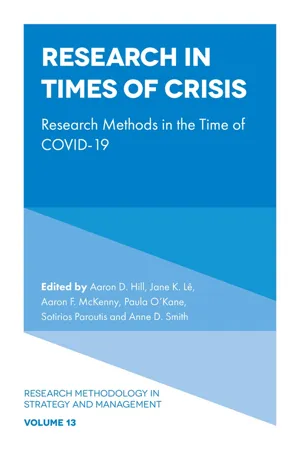
Research in Times of Crisis
eBook - ePub

Research in Times of Crisis

Research Methods in the Time of COVID-19

  1. 232 pages
  2. English
  3. ePUB (mobile friendly)
  4. Available on iOS & Android
eBook - ePub

Research in Times of Crisis

Research Methods in the Time of COVID-19

About this book

Research Methodology in Strategy and Management advances understanding of the methods used to study organizations – including managers, strategies, and how firms succeed.

Just like the impact felt across many other aspects of life and work, COVID-19 significantly changed the way we approach and conduct research. Many researchers will need to tread unfamiliar methodological ground to address these challenges and seize these opportunities to hone their craft, conducting interesting research in a novel environment. That is precisely why we are making 'crisis' the central focus of this volume.

Research in Times of Crisis is an informative book for all academics and researchers working in the fields of management, strategy, international business, entrepreneurship and organization theory.

Trusted by 375,005 students

Access to over 1.5 million titles for a fair monthly price.

Study more efficiently using our study tools.

Information

Year
2021
Print ISBN
9781800717985
eBook ISBN
9781800717992
Subtopic
Management

The Bivariate Probit Model in Strategy and Management Research: Applications and Potential

Ke Gong and Scott Johnson

Abstract

In the early days of the COVID-19 pandemic, an area could only report its first positive cases if the infection had spread into the area and if the infection was subsequently detected. A standard probit model does not correctly account for these two distinct latent processes but assumes there is a single underlying process for an observed outcome. A similar issue confounds research on other binary outcomes such as corporate wrongdoing, acquisitions, hiring, and new venture establishments. The bivariate probit model enables empirical analysis of two distinct latent binary processes that jointly produce a single observed binary outcome. One common challenge of applying the bivariate probit model is that it may not converge, especially with smaller sample sizes. We use Monte Carlo simulations to give guidance on the sample characteristics needed to accurately estimate a bivariate probit model. We then demonstrate the use of the bivariate probit to model infection and detection as two distinct processes behind county-level COVID-19 reports in the United States. Finally, we discuss several organizational outcomes that strategy scholars might analyze using the bivariate probit model in future research.
Keywords: Dichotomous outcomes; partial observability; bivariate probit; convergence difficulty; Monte Carlo simulation; COVID-19

Introduction

Strategic management researchers often study binary organizational outcomes such as corporate wrongdoing, acquisitions, hiring, and new venture establishments. In many cases, the observable binary outcome is actually jointly determined by two distinct latent processes (Poirier, 1980). For example, the process that makes a firm more likely to engage in fraud may be distinct from the process that makes the fraudulent firm more likely to get caught subsequently (and thus observed in the data). Ignoring these two distinct latent processes can generate biased results in research that lead to incorrect conclusions. For example, Wang (2013) demonstrates that in a bivariate probit analysis, research and development (R&D) investment increases the likelihood of committing fraud but decreases the likelihood of that fraud being detected, while these two opposite effects cancel each other out in a standard probit model, leading to inaccurate policy implications. The recent COVID-19 pandemic and resulting data availability in the United States allows for an analysis of a similar dynamic. The observed detection of COVID-19 cases in a US county is driven by the likelihood of infection in that county and the likelihood of detecting infection conditional on the presence of infection. At the county level, the drivers of infection may be different than the drivers of detection, just as the drivers of an organizational event may be different than the drivers of the detection of that event.
Despite its benefits in theoretically and methodologically distinguishing between the distinct latent processes, the use of a bivariate probit is often avoided for two reasons – difficulty in specifying the model and unstable convergence. The difficulty in specifying the model stems from the requirement for exclusion restrictions – at least one variable that predicts each latent variable but that is unrelated to the other latent process. For example, a bivariate probit model of fraud would require at least one variable that predicts the commission of fraud but that is unrelated to the detection of fraud and at least one variable that predicts the detection of fraud but that is unrelated to the commission of fraud. The identification of these variables requires strong theoretical arguments. Similar exclusion requirements are required for instrumental variable models. We hope that the difficulties in specifying the model will diminish as authors and reviewers become more acquainted with this kind of reasoning (Hill, Johnson, Greco, O'Boyle, & Walter, 2021).
Even if the bivariate probit model f...

Table of contents

  1. Cover
  2. Series Editor
  3. Title
  4. Copyright
  5. Contents
  6. About the Editors
  7. About the Contributors
  8. List of Contributors
  9. Introduction to Research Methods in Times of Crisis: The Case of COVID-19
  10. Tracking Disasters: Researching at the Edge of Chaos
  11. The Accidental Methodologist: Reflections on a Serendipitous Career
  12. Doing Discourse Analysis in COVID-19 Conditions: A Foucauldian Approach
  13. Advancing Research Methods in Crisis Management
  14. Critical Perspectives on Disaster and Crisis Research: Revealing and Responding to Vulnerability
  15. The Bivariate Probit Model in Strategy and Management Research: Applications and Potential
  16. Quantifying the Robustness of Empirical Inferences in Strategic Management: The Impact Threshold of a Confounding Variable and Robustness of Inference to Replacement
  17. Research in Crisis: COVID-19 and Methodological Adaptation

Frequently asked questions

Yes, you can cancel anytime from the Subscription tab in your account settings on the Perlego website. Your subscription will stay active until the end of your current billing period. Learn how to cancel your subscription
No, books cannot be downloaded as external files, such as PDFs, for use outside of Perlego. However, you can download books within the Perlego app for offline reading on mobile or tablet. Learn how to download books offline
Perlego offers two plans: Essential and Complete
  • Essential is ideal for learners and professionals who enjoy exploring a wide range of subjects. Access the Essential Library with 800,000+ trusted titles and best-sellers across business, personal growth, and the humanities. Includes unlimited reading time and Standard Read Aloud voice.
  • Complete: Perfect for advanced learners and researchers needing full, unrestricted access. Unlock 1.5M+ books across hundreds of subjects, including academic and specialized titles. The Complete Plan also includes advanced features like Premium Read Aloud and Research Assistant.
Both plans are available with monthly, semester, or annual billing cycles.
We are an online textbook subscription service, where you can get access to an entire online library for less than the price of a single book per month. With over 1.5 million books across 990+ topics, we’ve got you covered! Learn about our mission
Look out for the read-aloud symbol on your next book to see if you can listen to it. The read-aloud tool reads text aloud for you, highlighting the text as it is being read. You can pause it, speed it up and slow it down. Learn more about Read Aloud
Yes! You can use the Perlego app on both iOS and Android devices to read anytime, anywhere — even offline. Perfect for commutes or when you’re on the go.
Please note we cannot support devices running on iOS 13 and Android 7 or earlier. Learn more about using the app
Yes, you can access Research in Times of Crisis by Aaron D. Hill,Jane K. Lê,Aaron F. McKenny,Paula O'Kane,Sotirios Paroutis,Anne D. Smith in PDF and/or ePUB format, as well as other popular books in Business & Management. We have over 1.5 million books available in our catalogue for you to explore.