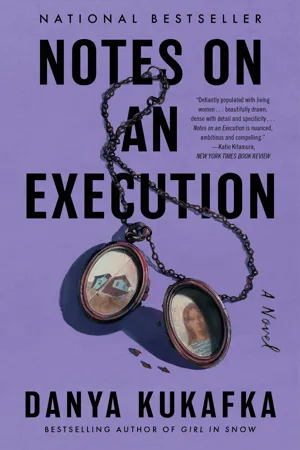
Your witness is here, the chaplain says.
Fifty-six minutes, and the dread is a sieve. A sluggishness has arrived, but it lifts with these words—everything lightens, your muscles stretching alert.
Blue, you say. She came.
She is older now. She does not want to see you. She does not want to talk. You will not lay eyes on her until she appears in the witness box—seven years have passed since that Blue House summer. She must be different. But it does not matter how Blue has grown. To you, she is eternally sixteen. To you, Blue will always be that teenager at the hostess stand, thumbs poked through the holes in her sweatshirt sleeves.
* * *
There was no big event. No life-changing reveal. When you think about the Blue House now, the simplicity brings a sort of devastation: there was only comfort.
There was only you, in the tall grass with Blue. She asked you questions about work, about school, about your favorite food as a child. She told you stories about her father, a man you came to know during those short bright weeks, a series of recounted memories. You could not believe that this girl was a result of the infant on the farmhouse floor, of the tragedy that had dogged you all these years. In her face, you found absolution.
It was easy, at the Blue House. You sat at the bar while Rachel and Blue closed up, telling stories about foster care, about Jenny, about the book you were writing. Your Theory. Blue fixed you a plate of homemade pie—the apple melted sweet on your tongue.
The truth feels stupid, in the shadow of tonight. Heartbreakingly simple. You had not known, until the Blue House, what you were capable of becoming. It was fleeting, ethereal. It was tragically uncomplicated.
At the Blue House, you were free.
* * *
Now, your last meal arrives.
You sit on the floor with your back resting against the bedframe, holding the tray in your lap: a slippery hunk of pork chop, a lump of mashed potato, a cube of neon green Jell-O. You cut into the meat with the side of your fork—it is the same meat they serve to the low-security prisoners at the rest of the Walls Unit. Nothing special. The infamous Last Meal is no longer a thing, banished years ago when requests got too outlandish and a new warden took charge. The meat splits easily. You stab a chunk, bring it to your mouth. It tastes rubbery, salty, unreal—you swallow, imagining how it will travel down your throat then into your intestines, how it will dissolve slowly along with the photograph. Whatever you eat now will not have the time to pass through you. It will decompose along with your skin and your internal organs, in a cheap cedar box paid for by the state, four and a half feet below the ground in an unmarked plot at the graveyard down the road.
You heave. That was it, you realize. It’s already over.
You missed your own last bite.
* * *
The chaplain returns. He sits outside your cell, his chair flipped backward, like a teacher trying to be cool. He holds a leather-bound copy of the Holy Bible, and his thumb circles the cover in repetitive strokes.
I can pass a message along to Blue, the chaplain says. Is there anything you’d like to say?
You have nothing more to tell her. Blue has seen it already—the stickiest proof of your own humanity. Your Theory, compounded. There exists inside you a galaxy of possibility, a universe of promise.
How can they do it? you ask.
The chaplain grimaces, sheepish.
How can they go through with this, Chaplain?
I don’t know.
That girl out there, you say. Blue. She is living proof. I can be normal. I can be good.
Of course you can be good, the chaplain says. Everyone can be good. That’s not the question.
The chaplain looks unbearably paunchy. Fleshy, weak. You want to reach through the bars, take fistfuls of his potato face in your hands. There are practiced ways you could still gain control: You could embarrass him. You could outwit him. You could hurl yourself against the bars, intimidate him with pure physical force. But these options require too much inertia. You have forty-four minutes left, and the game feels pointless.
The question is how we face what you have done, the chaplain continues. The question is how we ask forgiveness.
Forgiveness is flimsy. Forgiveness is like a square of warm sun on the carpet. You’d like to curl up in it, feel its temporary comfort—but forgiveness will not change you. Forgiveness will not bring you back.
* * *
Jenny comes to you then. A ghost, an accusation. The softest thing.
She exists now in pure distillation—in minuscule details, daily routines, mundane remembrances of a life before this place. An ache, for that old house. The flannel bedsheets Jenny chose at the department store, the curtains over the sink, embroidered with lace. The beige carpet, which never seemed to look clean, the TV sitting dusty on its stand. You can picture her there, still. Jenny, coming through the front door in her nurse’s scrubs, stomping the salt from her winter boots.
Love? she calls. I’m home.
The texture of Jenny. Fruit shampoo, hangover breath. You remember how she used to tease you, hands on your cheeks. It’s okay to feel things, she liked to say with a laugh, and this always irritated you. But if you could go back now, you would clap your hands over hers, relish in the knobby warmth of Jenny’s fingers—the only person who dared to stand between the world and yourself.
Please, you would beg. I’ll feel anything.
Just show me how.
* * *
You can see the line now, in the spotlight of retrospect. The direct link, from the Blue House to Jenny.
The Harrisons sent you away on a Sunday morning. Blue and Rachel stood in the restaurant parking lot, their arms crossed, a palpable unease in their eyes. Don’t come back, they said. We don’t want you here anymore. You’d heard those words many times over the course of your life, but they felt different, coming from the Harrisons. The Blue House had brightened you, softened you, proven so much—finally, you were a part of something. A family.
But Rachel’s voice was determined. You did not know what they’d learned or how they’d learned it, only that it was too much.
As you climbed into your truck and pulled out of the parking lot, a furious itch rose in your fingertips. Everything fuzzed, slanted. You watched Blue and Rachel disappear in the rearview, their gazes searing permanent: they were afraid of you.
You drove to Texas. It took four days. You could not imagine going back to Vermont; you could not even go back to the motel. You left everything in that damp little room, your clothes and your cash, your razor and your toothbrush, the photograph Blue had gifted of the Blue House, shot on an overcast morning. You drove, blank and fuming, wondering how much more hurt your human body could sustain. The desperation was a parasite.
There was only one certainty, and that was Jenny. Her shape. Her smell. Her breath, sour on the pillow first thing in the morning. You needed it like you needed oxygen. How naive, how foolish you had been, to think that the Blue House could ever take her place.
So you slept in the bed of your truck. You tossed and twitched through each gusty night, until the air turned humid and leafy highways shifted into desert plains.
Jenny had blocked your number. She had only called once, since she left ten months earlier, to make sure you signed the divorce papers, her lawyer breathing heavy on the conference line.
When you finally reached Houston, you checked into a seedy motel and found a public library. On a computer between the musty stacks, you typed her name—Facebook surfaced right away. In her profile photo, Jenny wore a pair of plastic sunglasses, her shoulders tan and surprisingly toned. She had been tagged, a few days earlier, in a photo of three women standing in a parking lot. Last day of work for Bethany! the caption read. Behind them, a sign bared the first four letters of the hospital’s name. Google proved it—the hospital was in the suburbs. Not far from here. Your chest thrummed. Your body shaped itself momentarily back into something you understood.
Hope, like a blade.
The next morning, you waited in your car, patient outside the emergency room. You knew from Facebook that Jenny had cut her hair into a stylish bob, but you had not imagined it would suit her so well. It thinned out her face, lengthened her. Jenny looked good. She held a coffee cup in one hand and her phone in the other—when she laughed into the speaker, the echo drifted through your windshield. Maybe things would have been different if you’d just done it then, talked to her in the shock of day, as people streamed through the revolving doors. But you were too curious.
The hours passed, your story expanding as it smothered in the heat. You would fix things—a second chance. You would go back to that house with the cherry red curtains, to nights fossilized on the couch. By the time Jenny came out, the sun was glowing pink over the asphalt, and she was walking with a man. The man wore a pair of sky-blue scrubs, his jaw scruffy and angular. He leaned to plant a slow kiss on Jenny’s cheek.
A flush of rage, lightning hot.
After a long goodnight that made you queasy, after the man had gotten into his own car and driven away, you followed Jenny through a neighborhood of sprawling gingerbread-style mansions, then into a smaller subdivision. She stopped in front of a bland modern condo, which looked the same as all the condos around it, painted pastel, lined up like crayons. Jenny stood on the stoop, digging through her purse for her house keys. It was the same purse she always carried, the fake leather flaking off in chunks. Inside, you knew, there would be a pile of crinkled receipts and ChapStick tubes with crumbs stuck to their rims.
The lights in the apartment clicked on. Darkness had fallen like a sheet from the rafters, and everything solidified in those long throbbing minutes, before you slid from your car. The man’s thumb, knuckling Jenny’s cheek. The hurt, the crave, the shame—it all congealed, rancid.
You turned the knob. Locked.
So you kicked until the door flung open. Louder, more violent than you’d planned. This would be a point of contention, later—the felony charge, the prosecution claiming burglary, making you eligible for the death penalty.
But in that moment, there was only Jenny. She stood in the open marble kitchen, her back to the stove—Jenny’s house was clean, gleaming. She had bought a fancy new espresso machine, shining against the granite countertop, and there were fresh flowers bathing in a vase by the windowsill. Gas clicked beneath the teakettle, as one of her favorite old Sheryl Crow songs trilled from the...