This book is a collection of articles by anthropologists and social scientists concerned with gendered labour, care, intimacy and sexuality, in relation to mobility and the hardening of borders in Europe. Interrogating the relation between physical, geopolitical borders and ideological, conceptual boundaries, it offers a range of vivid and original ethnographic case studies that will capture the imagination of anyone interested in gendered migration, policies of inclusion and exclusion, and regulation of reproduction and intimacy.
The book presents ethnographic and phenomenological discussions of people's changing lives as they cross borders, how people transgress and reshape moral boundaries of proper gender and kinship behaviour, and moral economies of intimacy and sexuality. It also focuses on migrants' navigation of social and financial services in their destination countries, putting questions about rights and limitations on citizenship at the core.
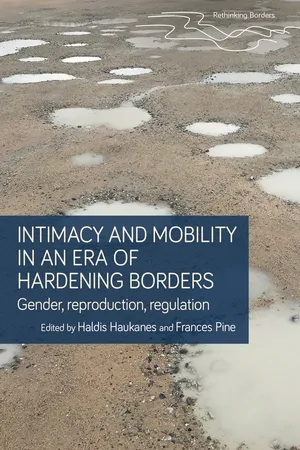
eBook - ePub
Intimacy and mobility in an era of hardening borders
Gender, reproduction, regulation
- 242 pages
- English
- ePUB (mobile friendly)
- Available on iOS & Android
eBook - ePub
Intimacy and mobility in an era of hardening borders
Gender, reproduction, regulation
About this book
Information
Topic
Ciencias socialesSubtopic
Antropología cultural y social1
Reconceptualising borders and boundaries: gender, movement, reproduction, regulation
Introduction
Borders and boundaries, and bordering as a process, are at the centre of this chapter. Our primary focus is on Europe, but we recognise that it is imperative to locate Europe in relation to history and to the rest of the world, and to identify the shifts which have taken and take place over time both in the borders of Europe, and in borders within and between different European nation states. We show that borders, and processes of bordering, are never static; they represent very different experiences for different people, for different kinds of bodies, and at different times. As has been repeatedly witnessed over the past century, people who live within a nation's borders as recognised citizens can suddenly find that, overnight, they lose the rights or status of citizenship, the right to live where they have long been settled, and/or the possibility of mobility between different states. One has only to think of the situation of European Jews in the 1930s and 1940s, of the Windrush generation who arrived in the UK from the Caribbean between 1948 and 1970 (and then found in 2019 that they had no rights to remain), of current changes in UK migration policy after Brexit, or of former Soviet citizens who found that national borders became hard in ways that changed life worlds unexpectedly and sometimes irrevocably. Borders do not mean the same thing for all people, and neither do they mean the same thing for the same people at different points in their lives and in history.
As we turn our attention to the processes of bordering and boundary making which have been taking place over recent decades, it is helpful to consider what constitutes a moral community or a community of value (Anderson 2013), who is considered to belong, and who is excluded. As we show, these notions of morality or value rest on shifting sands; people who are included for long periods may become excluded, as different economies and political ideologies emerge (for instance, in many European countries following the acceleration of migration globally leading up to the 2015 refugee crisis). For some of the world's population, in and outside Europe, established safety nets, based on state benefits, healthcare and social services, and care and support from family, kin, and community, have been eroded; this erosion has serious consequences in terms of the possibilities for mobility and for a reasonable quality of life both for those who want to cross borders, and for those within states where polarisation between rich and poor, often perceived as deserving and undeserving, widens.
In recent years there has been a plethora of work on borders and boundaries (see, for instance, Butler 1993, Donnan and Wilson 1999, Lan 2003, Constable 2007, Fassin 2011, Follis 2012, De Genova 2013, 2017, Green 2013, Donnan, Hurd, and Leutloff-Grandits 2017). Broadly, it falls into several loose categories: conceptual and theoretical work; work on practices, regulations, and consequences of material borders and boundaries; work on borders and boundaries as systems of classification; and work on borders of bodies, sexualities, genders. While much of the material is very rich, there has been, with a few exceptions (see for instance, Fassin 2011, Green 2013, Morris 2018), little attempt to address the areas of intersection where the different meanings, understandings, and theoretical and analytical uses of the terms meet, overlap, or converge. Ethnography offers a powerful tool for untangling these points of intersection, and the shifting sands on which borders and boundaries are erected, enforced, and differentially experienced (see Khosravi 2010).
In this chapter, therefore, we want to focus on these areas of intersection. We first identify the broad areas which are relevant for our topics, and then offer a brief review of the work which has most influenced or challenged our thinking. We are not aiming to provide a complete or comprehensive overview of the literature on borders and boundaries, but to engage with that pertinent for the present volume and suggest how the different approaches can usefully be combined to widen our understanding of the complexities of bodies, borders, and regulation.
Migration is not a new phenomenon. Humans have always moved (see Castles and Miller 2009, Kaneff and Pine 2011). What is striking, however, about the current ‘age of migration’ (Faist 2000, Castles and Miller 2009) is its intensity, its ubiquitous nature, and the speed with which information about it and images of it appear throughout the world. This speed of communication and instant access to images and knowledge (of sorts) also takes place in the spread of political movements and ideologies, ideas about personhood and bodies, and understandings of sexualities and genders. As is the case with all kinds of social and political movements, whether of people or of ideas and classifications, these processes must be contextualised and historicised. We would argue that in the aftermath of the 2008 financial crisis in the West, and acceleration of war and violent conflict in the Middle East, we witnessed not only a full blown global refugee crisis but also – related to these phenomena – the rise of the new right and populist politics in much of Europe, and increasing attempts by some states to regulate both sexuality and reproduction. These processes are all in different ways implicated in the commodification of bodies and the financialisation of certain kinds of ‘intimate’ labour (i.e. childcare, elder care, sex work). This process of market expansion and commodification is intricately connected to the changing locations of production and the values attached to labour, the growth of global capital investment in privatised care institutions, movements of both labour force and commodities/products of labour, and global growth of precarious labour.
With these points in mind, we want to look back at the very busy twentieth century, and the events and movements which led to critical change in ideology, reproduction, and regulation. What becomes apparent when such a timeline of history is laid out is the frequency with which new ideas are introduced, resisted, and then incorporated, leading to changes in political regimes and social classifications. What at one period might look like a definitive move to the right may be superseded by a widespread embrace of leftist socialist ideas or feminist principles, which in turn may be eroded by a sweeping tide of neo-liberal individualism. Neither time nor history ever stands still; what is striking about the past two decades, though, is the speed and pace of change, and the resultant sense of anxiety and uncertainty that marks many people's daily existence.
Background
Critical moments, resulting in regulation and alteration of both geo-political and ideological/conceptual borders, recurred throughout the twentieth century. Between 1914 and 1918, the First World War laid the foundations for the realignment of European imperial powers, and the creation of some new (or newly merged) nations and the geographical redefinition of others in the Treaty of Versailles in 1919. Politically, the European world was split from the mid 1930s into countries aligned with the fascism of Italy and later Spain and Germany, those opposed to fascism and its spread, and those which remained neutral. From the time of the Spanish Civil War to the end of the Second Word War, allegiances were formed and broken, states were incorporated into the political realms of more powerful others, and all of Europe, as well as much of the rest of the world, existed in a state of uncertainty and rupture. In 1945, the Yalta Conference and the Potsdam Treaty again re-drew the boundaries of Europe, and at the same time, resistance movements in Africa and Asia against colonial power grew. Between 1945, when the division of Europe between the Soviet and the Western Blocs was made, and 1961, when this division was materialised in militarised metal and bricks, the Iron Curtain dividing the socialist and capitalist worlds solidified. In 1989, the states of the Soviet Bloc one by one fell, and eventually, in 1991, the Soviet Union itself began to disintegrate.
All of these alignments and re-alignments were accompanied by movements of people, sometimes forced and sometimes chosen. Simultaneously, other people were trapped behind militarised borders, frozen, unable to move even when they wanted to. These regime and border changes all created extreme economic, political, and affective changes in people's daily lives and livelihoods. And they all generated new attempts by states to impose particular ideologies and to regulate people's bodies, families, reproduction, and ways of being in the world. This was by no means confined to European space and Europeans. In the same postwar period, movements of people, opening and hardening of borders, and various forms of regulation led to new arrangements of people and ideas throughout the world. In the early postwar years, refugees continued to try to return to their homes, or find new homes elsewhere. Migration from Africa and the Caribbean, particularly, was encouraged by the UK in order to fill the holes in the British labour forces resulting from war; similar movements took place between other waning or former colonial powers and their territories, as in France and North Africa. War, anti-colonial revolt, drastic economic changes often categorised as ‘development’, and environmental change all led to instability and famine in parts of Africa, Asia, and the Middle East. Huge movements of people within and between countries and continents marked, for instance, the aftermath of civil war and ethnic cleansing in Uganda, famine in Ethiopia, and war in Viet Nam, the Cuban Revolution, and the periods of violent unrest and oppression across Latin America, notably in Chile and Argentina. In many ways, events of the second half of the twentieth century laid the foundations for the challenges facing the economy worldwide and the crisis in the environment which were to mark the first two decades of the twenty-first century.
As geo-political border enforcements and hardenings were taking place, and as migration increasingly became people's reaction to crises such as war, famine, and environmental disaster, as well as to entrenched poverty, ideas and ideologies concerning personhood and citizenship, bodies and reproduction, sexuality and gender were also undergoing enormous change. In the early twentieth century, concepts of citizenship in many countries widened as women received the vote. In 1948, the Universal Declaration of Human Rights was adopted by the United Nations’ General Assembly, and the concept of universal rights, regardless of nationality, colour, or creed gradually became accepted. By the 1960s, in the West, developments in birth control were accompanied by a ‘sexual revolution’. The w...
Table of contents
- Cover
- Half-title page
- Series page
- Title page
- Copyright page
- Dedication
- Contents
- List of contributors
- Acknowledgements
- Introduction
- 1 Reconceptualising borders and boundaries: gender, movement, reproduction, regulation
- Part I Gendered life worlds: migrants’ imaginaries and obligations in contested contexts of intimacy
- Part II Gender, entitlement, and obligation: migrants interacting with the state and voluntary services
- Part III Shifting gendered policies: reproduction and care in national and historical perspectives
- Index
Trusted by 375,005 students
Access to over 1.5 million titles for a fair monthly price.
Study more efficiently using our study tools.
Frequently asked questions
Yes, you can cancel anytime from the Subscription tab in your account settings on the Perlego website. Your subscription will stay active until the end of your current billing period. Learn how to cancel your subscription
No, books cannot be downloaded as external files, such as PDFs, for use outside of Perlego. However, you can download books within the Perlego app for offline reading on mobile or tablet. Learn how to download books offline
Perlego offers two plans: Essential and Complete
- Essential is ideal for learners and professionals who enjoy exploring a wide range of subjects. Access the Essential Library with 800,000+ trusted titles and best-sellers across business, personal growth, and the humanities. Includes unlimited reading time and Standard Read Aloud voice.
- Complete: Perfect for advanced learners and researchers needing full, unrestricted access. Unlock 1.5M+ books across hundreds of subjects, including academic and specialized titles. The Complete Plan also includes advanced features like Premium Read Aloud and Research Assistant.
We are an online textbook subscription service, where you can get access to an entire online library for less than the price of a single book per month. With over 1.5 million books across 990+ topics, we’ve got you covered! Learn about our mission
Look out for the read-aloud symbol on your next book to see if you can listen to it. The read-aloud tool reads text aloud for you, highlighting the text as it is being read. You can pause it, speed it up and slow it down. Learn more about Read Aloud
Yes! You can use the Perlego app on both iOS and Android devices to read anytime, anywhere — even offline. Perfect for commutes or when you’re on the go.
Please note we cannot support devices running on iOS 13 and Android 7 or earlier. Learn more about using the app
Please note we cannot support devices running on iOS 13 and Android 7 or earlier. Learn more about using the app
Yes, you can access Intimacy and mobility in an era of hardening borders by Haldis Haukanes,Frances Pine, Hastings Donnan in PDF and/or ePUB format, as well as other popular books in Ciencias sociales & Antropología cultural y social. We have over 1.5 million books available in our catalogue for you to explore.