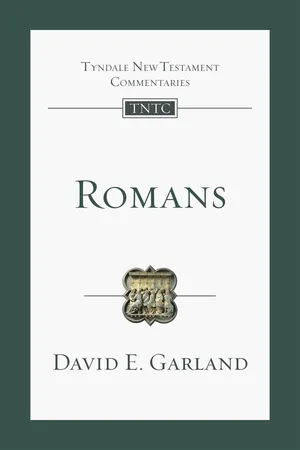
- English
- ePUB (mobile friendly)
- Available on iOS & Android
eBook - ePub
About this book
Romans has been described as the theological epistle par excellence. The apostle Paul emphasizes that salvation is by God's grace alone, and gives the assurance that freedom, hope, and the gift of righteousness are secured through Christ's death on the cross, with the promise of a new and glorious destiny. Through the power of the Holy Spirit, believers can discern and do the will of God in everyday life. God's purpose is to bring Jews and Gentiles together so that they may glorify the God and Father of our Lord Jesus Christ with one voice. David Garland offers clear guidance along the rewarding, though sometimes difficult, paths of this great letter.
Information
COMMENTARY
1. THE LETTER OPENING (1:1–17)
A. Salutation (1:1–7)
Context
The Greek epistolary greeting was normally short: sender, recipients, greeting (Acts 15:23; 23:26; 1 Thess. 1:1). Verses 1 and 7 would constitute this usual greeting, but Paul freely modifies epistolary conventions. He expands the prescript to include a profile of his credentials as a divinely called apostle and a concise summary of the gospel he preaches. Though Timothy is identified as the co-sender in other letters (2 Cor. 1:1; Phil. 1:1; Col. 1:1; 1 Thess. 1:1; 2 Thess. 1:1) and is mentioned as Paul’s co-worker who sends greetings in 16:21, he is not identified as the co-sender of Romans. The focus falls solely on Paul, his divine call as an apostle, his divine message, and his divine commission to bring the gospel to the Gentiles. He does not introduce this information because he is on the defensive, as he was in Galatians with its extended greeting (Gal. 1:1–5). Paul had never visited Rome but knows some of the letter’s recipients (16:3–15). He is confident that he will receive a sympathetic hearing for his message and that they will support his mission to Spain (15:23–29). This sender formula, which is ten times longer than is typically found in Paul’s other letter openings, reveals his concern to present his credentials for writing this letter to the Christians in Rome. They were not converted by him and may have heard negative rumours about him (cf. 3:8; 6:1, 15), but he wants them to view with favour both him and the gospel he presents in this letter.
The Greek word translated as ‘gospel’ (euangelion) frames the entire letter. It appears three times in the letter opening (1:1–17; in 1:1, 9, 16) and three times in the letter closing (15:13 – 16:27; in 15:16, 19; 16:25), six out of the nine occurrences in the letter (cf. 2:16; 10:16; 11:28). The gospel proclaims what God has done in keeping the promises to Israel and in raising Jesus from ‘the domain of death’ (Keck, p. 46). The gospel about God’s ‘Son, who was descended from David according to the flesh’ (1:3) is not only good news for Israel. That he was ‘declared to be Son of God with power according to the spirit of holiness by resurrection from the dead’ (1:4) means that he is more than Israel’s Messiah; he is Lord over all. In fulfilling the promises to Israel and raising Jesus from the dead God reveals ‘the riches of his glory for the objects of mercy, which he has prepared beforehand for glory’, and these include those ‘whom he has called, not from the Jews only but also from the Gentiles’ (9:23–24). The letter unfolds the gospel’s implications for Israel and for the Gentile world.
Comment
1. In identifying himself to his recipients, Paul cites three credentials rather than limiting them to just one as he usually does in his greetings. First, he is a servant [‘slave’, doulos] of Jesus Christ. In the Greek, Paul refers to him as ‘Christ Jesus’ rather than Jesus Christ, which makes it clear that he does not understand Christ to be part of a double name but a title. He is Messiah Jesus, anointed by God. Rendering it ‘servant of Christ Jesus’ is conducive for hearing an echo of the title ‘the servant of the LORD’ that is used of Abraham (Ps. 105:42), Moses (2 Kgs 18:12; Ps. 105:26; Dan. 9:11), Joshua (Josh. 24:30 [LXX]; Judg. 2:8), Jonah (Jon. 1:9 [LXX]), David (2 Sam. 7:5; Ps. 78:70; 89:3), the prophets (2 Kgs 17:23; Amos 3:7; Zech. 1:6) and even Israel (Isa. 41:8–9). Paul would use this term to represent his ministry in terms of the Isaianic ‘servant of the LORD’ as the herald of salvation to the nations (Isa. 42:1–6; 52:7, 10; 61:1).1 It is estimated that one in five persons in Rome was a slave,2 so it is more likely that Paul intends to conjure up for the original audience images from their familiarity with slavery (6:6–22; cf. Matt. 6:24; 1 Cor. 7:21) rather than from their knowledge of the term’s use in Scripture. He does not intend to exalt himself with this title since he uses the language of slavery also to speak of all believers who have been acquired by Christ (1 Cor. 6:20; 7:22–23; Eph. 6.6; Col. 4:12). A slave is under the complete authority of the master who bought him or her and has no right to self-determination (Schnabel, I, p. 83). Paul understands himself to be in bondage to Christ, wholly owned by him and no more than his tool (Wolter, I, p. 80; cf. Luke 17:7–10), which raises the spectre of dishonour. He reminds the Philippians that Christ took the form of a slave, humbling himself and dying the slave’s death on the cross. To read this
metaphor in the context of political or social advancement is to misunderstand Paul’s humility in subordinating himself to one who has already lowered himself to the point of dying a slave’s death. As Jesus embraced dishonour, so Paul, in calling himself a slave of Christ, embraces dishonour.3
Being Christ’s slave is not analogous to being Caesar’s slave, with its lofty status and privileges. As the slave of Christ who ‘did not please himself’ (15:3), Paul understands himself to be the ‘slave of all’ (1 Cor. 9:19; 2 Cor. 4:5; cf. Mark 10:44; Gal. 5:13), indebted to Greeks and barbarians and to the wise and foolish (1:14).
Second, Paul introduces himself as a called . . . apostle, an ambassadorial agent. The unspoken agent in this calling is God, not others. Paul did not volunteer for this role or arrogate this title to himself, nor did he rise in the ranks to be elected an apostle by others. Nor did God invite him to consider becoming an apostle. He is an apostle by ‘God’s sovereign action, God’s deliberate choice’ (Keck, p. 40).
Third, Paul underscores that God chose him for this special task. He was set apart for the gospel of God, which draws on imagery used by the prophets Isaiah (Isa. 49:1) and Jeremiah (Jer. 1:5) to imply that he could not resist God’s sovereign choice in conscripting him (cf. Gal. 1:15–16). Similarly, in 2 Corinthians 5:14, he asserts that the love of Christ constrains and sustains him in this call.
The gospel also receives a threefold qualification in these opening verses. Paul identifies it first as the gospel of God, which may imply both that it has been initiated and sent by God and that it is about God. Cranfield contends that most of the inhabitants of the Roman Empire would have associated ‘gospel’ with Roman imperial propaganda and the announcements of such events as the birth of an heir to the emperor, his coming of age and his accession to the throne, as glad tidings or gospels with the emperor cult (Cranfield, I, p. 55).4 The emperor cult, however, was promoted in the provinces and not in the city of Rome, and the Greek noun for ‘gospel’ (euangelion) and its verb form were also used for good tidings in everyday life and need have no political overtones (Wolter, I, p. 83). Paul distinguishes the one gospel from everyday good news or imperial good news by asserting that it is the gospel from the one God about ‘Messiah Jesus’. It is true that the gospel proclaims that Jesus is Lord and King, not Caesar, but it is universally true that the gospel is far more than word of something pleasant, fortunate or otherwise positive. It is news about God’s reign that brings eternal salvation.
2. Second, Paul affirms that this gospel was promised beforehand through his prophets in the holy scriptures (3:21; 4:3, 6–8; 16:26; cf. Gal. 3:8). Three inferences may be drawn from this assertion. (1) God has been faithful to fulfil the promises of old (4:13–25; 15:8). The term ‘gospel’, as Paul understands it, germinates from the soil of Isaiah (cf. 10:14–16 where Paul cites Isa. 52:7) where the verb form is associated with announcing the good news that God has come (Isa. 40:9), reigns (Isa. 52:7) and brings liberation (Isa. 61:1), and that the nations will proclaim the praise of the Lord (Isa. 60:6). (2) The Scriptures are read correctly only when it is recognized that ‘the gospel is the fulfilment, not the negation, of God’s word to Israel’.5 The gospel neither nullifies the law (3:31) nor negates the promises but celebrates their fulfilment. (3) The gospel is not the contrivance of a new religion but the good news heralding that God’s promises to Israel and engagement in their history have reached their climax, quite surprisingly, in the crucifixion and resurrection of the Messiah.6 The message of the cross and resurrection must be understood through the Old Testament ‘categories of sacrifice, atonement, suffering, vindication’ (cf. 1 Cor. 15:3–4).7
3–4. Third, the gospel reveals that God’s plan for humanity’s salvation centres on his Son, Jesus Christ. Paul’s summary of the basic content of the gospel reflects the consensus among believers. Whether Paul adopts or adapts an existing Christian confession, as many contend, is immaterial.8 Breytenbach asserts: ‘Paul cites or alludes to tradition because he agrees to it.’ 9 Moo therefore is correct: ‘The meaning of these verses . . . is to be determined against the background of Paul and his letters, not against a necessarily hypothetical traditions-history’ (Moo, pp. 43–44).
The phrase descended from David according to the flesh refers to Jesus’ genealogical descent as an actual man. The flesh in this context has a neutral (cf. 4:1; 9:3, 5; 11:14; 1 Cor. 10:18), not a negative, meaning. In the incarnation, Jesus met the Jewish expectation that the Messiah would be David’s descendant (cf. 9:5; 15:12, ‘the root of Jesse’; 2 Tim. 2:8). His Davidic ancestry confirms God’s fidelity in fulfilling the covenant with David (2 Sam. 22:51; Ps. 18:50)10 and substantiates the fact that the gospel is firmly anchored in Israel’s history.
That he was declared to be Son of God does not mean that Jesus became the Son of God for the first time at his resurrection. The phrase with power modifies the title Son of God and not the verb declared. Before his resurrection he was the Son of God in weakness. The incarnation that reached its climax in the crucifixion veiled his all-powerful lordship (2 Cor. 13:4, ‘For he was crucified in weakness’; cf. Acts 2:31–36). The resurrection manifes...
Table of contents
- Cover
- Title
- Copyright
- Contents
- General Preface
- Author’s Preface
- Abbreviations
- Select Bibliography
- Introduction
- Analysis
- Commentary
Trusted by 375,005 students
Access to over 1.5 million titles for a fair monthly price.
Study more efficiently using our study tools.
Frequently asked questions
Yes, you can cancel anytime from the Subscription tab in your account settings on the Perlego website. Your subscription will stay active until the end of your current billing period. Learn how to cancel your subscription
No, books cannot be downloaded as external files, such as PDFs, for use outside of Perlego. However, you can download books within the Perlego app for offline reading on mobile or tablet. Learn how to download books offline
Perlego offers two plans: Essential and Complete
- Essential is ideal for learners and professionals who enjoy exploring a wide range of subjects. Access the Essential Library with 800,000+ trusted titles and best-sellers across business, personal growth, and the humanities. Includes unlimited reading time and Standard Read Aloud voice.
- Complete: Perfect for advanced learners and researchers needing full, unrestricted access. Unlock 1.5M+ books across hundreds of subjects, including academic and specialized titles. The Complete Plan also includes advanced features like Premium Read Aloud and Research Assistant.
We are an online textbook subscription service, where you can get access to an entire online library for less than the price of a single book per month. With over 1.5 million books across 990+ topics, we’ve got you covered! Learn about our mission
Look out for the read-aloud symbol on your next book to see if you can listen to it. The read-aloud tool reads text aloud for you, highlighting the text as it is being read. You can pause it, speed it up and slow it down. Learn more about Read Aloud
Yes! You can use the Perlego app on both iOS and Android devices to read anytime, anywhere — even offline. Perfect for commutes or when you’re on the go.
Please note we cannot support devices running on iOS 13 and Android 7 or earlier. Learn more about using the app
Please note we cannot support devices running on iOS 13 and Android 7 or earlier. Learn more about using the app
Yes, you can access Romans by David Garland in PDF and/or ePUB format, as well as other popular books in Theology & Religion & Christianity. We have over 1.5 million books available in our catalogue for you to explore.