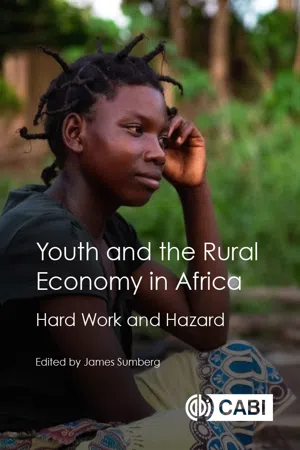
This book brings together recent findings from quantitative and qualitative research from across Africa to illuminate how young men and women engage with the rural economy, imagine their futures and how development policies and interventions find traction (or not) with these realities. Through framing, overview and evidence-based chapters, it provides a critical perspective on current discourse, research and development interventions around youth and rural development. It is organised around commonly-made foundational claims: that large numbers of young people are leaving rural areas; have no interest in agriculture; cannot access land; are stuck in permanent waithood; that the rural economy provides (or can provide) a wealth of opportunity; and that they can be the engine of rural transformation. It draws from existing literature and new analysis arising from several multi-country and multi-disciplinary studies, focusing on gender and other aspects of social difference. It is a major contribution to current debates and development policy about youth, agriculture and employment in rural Africa.
- 184 pages
- English
- ePUB (mobile friendly)
- Available on iOS & Android
eBook - ePub
About this book
Information
1 African Youth and the Rural Economy: Points of Departure
James Sumberg1, Justin Flynn1, Marjoke Oosterom1, Thomas Yeboah2, Barbara Crossouard3 and Dorte Thorsen1
1Institute of Development Studies, Brighton, UK; 2Bureau of Integrated Rural Development (BIRD), Kwame Nkrumah University of Science and Technology (KNUST), Kumasi, Ghana; 3University of Sussex, Brighton, UK

Introduction
How do young people across Africa engage with the rural economy? What are the implications of this engagement for their efforts to build their livelihoods, and for their futures, for society and for rural areas? These are the questions that motivate this book and the research that underpins it. Such questions will be of interest to researchers, policy makers, development professionals and others concerned with the well-being and aspirations of young people, with their search for employment and decent work, and with the relationship between schooling and work. Individuals working on rural poverty and food security, agriculture and rural development – and rural transformation more broadly – should certainly be interested in rural young people’s lives and livelihoods, and the futures they imagine for themselves. Finally, a more nuanced understanding of young people’s engagement with the rural economy can help to ground debates about demographic change, including migration and urbanization, and provide a much needed reality check of common assumptions and narratives concerning youth, conflict and radicalization.
The fact that a number of these same concerns – including education, decent work and migration – are integral to the Sustainable Development Goals (SDGs), and that several of the SDGs speak directly to the situation of youth, demonstrates the central place that young people have come to occupy in development debates and policy. Indeed, there is a growing body of youth-focused scholarship, policy analysis, implementation guidance and programme evaluations – as well as a plethora of youth-targeted development initiatives. Taken together, these suggest that youth in rural Africa are being taken seriously, and it appears that this focus will continue well into the future. Whether they are being taken seriously for the right reasons, and whether they are well served by the policy and development investments made in their name, are important points of debate.
The book’s ambition is to advance the understanding of young people as social and economic actors in rural Africa. It does this through new empirical analyses, both quantitative and qualitative, involving a significant number of rural young people across multiple countries. These new analyses are brought to bear on the narratives and debates that frame and channel much of the current interest in youth-specific policy and investment.
At this point, readers might be asking themselves, ‘With the recent publication of Creating Opportunities for Rural Youth (IFAD, 2019) and Youth and Jobs in Rural Africa: Beyond Stylized Facts (Mueller and Thurlow, 2019), do we really need another book on African rural youth?’ Our response is an emphatic ‘Yes’, based primarily on the fact that neither of these two works bring the histories, lives, voices or imagined futures of rural youth into the equation. Youth and the Rural Economy in Africa: Hard Work and Hazard begins to address this critical lacuna.
To allow the voices of young people to emerge, this book both starts with different questions and draws from an expanded set of intellectual and conceptual traditions, and data sources. For example, the first question Mueller et al. (2019) pose in Youth and Jobs in Rural Africa: Beyond Stylized Facts is, ‘Are rural youth active participants in the national growth process?’ They go on to ask how their involvement in agricultural technology adoption, rural income diversification and urban migration ‘affect rural transformation’ (Mueller and Thurlow, 2019, p.3). It is clear from this that while the book investigates ‘the role of rural youth in sub-Saharan Africa’s (SSA) development’ (Mueller and Thurlow, 2019, p.3), the primary interest is in national growth processes and rural transformation, not youth. This explains the prominence given to Timmer’s four-stage model of agricultural transformation (Timmer, 1988) and the striking absence of any theoretical or conceptual treatment of youth as social and economic actors. Mueller and Thurlow (2019) and IFAD (2019) rely almost exclusively on survey data collected through exercises that generally were not designed with a particular youth focus in mind.
In contrast, in Youth and the Rural Economy in Africa: Hard Work and Hazard we start with the simple question, ‘What are rural young people doing?’ In placing their actions, and their views about those actions, at centre stage, we make no assumptions about what they should be doing, how or where they should be doing it, or what their motivations should be. This is not to say that we approached the research without preconceptions or hypotheses – indeed, as will become clear, we draw on a wide array of conceptual insights and disciplinary approaches. While not abandoning microeconomic analytical frameworks and survey data analysis, we have made a conscious effort to bring these together with relevant literature from the broader social sciences including anthropology, sociology, social geography, youth studies, gender studies, education and policy studies, and with a wider range of data and modes of analysis. In so doing we have sought to grapple with the heterogeneity – of rural areas, family contexts and young people – which is still largely overlooked by the majority of policy-oriented analyses.
This chapter proceeds as follows. The next section situates the current interest in Africa’s rural youth, and the place of this book, within the broader discussion of policy narratives. It then identifies seven narratives about rural youth in SSA that channel much contemporary policy and development intervention. Following this the argument that runs through the book is outlined. The key conceptual resources that the various chapters draw upon are briefly introduced in the following section. The last section provides a brief summary of each of the subsequent chapters.
Policy Narratives
What they are and why they matter
As with all policy problems, policy and interventions relating to rural youth in SSA are built around narratives or stories (Roe, 1991, 1995; Jones and McBeth, 2010). Narratives are central to policy processes, serving as an important vehicle for organizing and communicating policy information (Shanahan et al., 2011). They set out the problem, explain why it has arisen and propose how it should be addressed. A successful policy narrative – one that is memorable, taken up and integrated into policy and public discourse – cuts through complexity and heterogeneity, and sets nuance aside. In this way it provides a compelling and powerful framing, a justification and call to arms. It is particularly important to note that a successful narrative will foreground certain solutions or interventions (or development pathways), while explicitly or implicitly delegitimizing others.
Narratives provide a lens through which to view and make sense of a complex and perhaps threatening problem. Successful, compelling narratives are often constructed around a memorable word or phrase: for example, phrases like ‘youth bulge’, ‘demographic dividend’, ‘farming as a business’, ‘digital native’ and ‘waithood’ are at the core of the key narratives about rural youth in SSA. Narratives are about communication and persuasion, and they are acutely political. They are constructed, disseminated and used with the aim of promoting a particular perspective on a problem and a set of preferred solutions. As such, a narrative will serve or advance the interests of some individuals, groups and coalitions, while seeking to thwart the interests of other actors.
Policy narratives can be thought of as dominant (hegemonic) or alternative (emergent). However, it is usually not useful to think of them as true or false, right or wrong. Around all important development issues – like rural youth in SSA – there is just too much heterogeneity, too many unknowns and too many legitimate differences in perspective, for any necessarily simplistic narrative to be true in all or most contexts. Ultimately, this does not matter because the job of a narrative is not to convey truth, but to be believable, to stimulate and facilitate a policy response, and to promote certain responses over others. It is nevertheless important to critically examine policy narratives with the aim of understanding, for example, how they foreground or background different groups (e.g. male or female youth) in a variety of rural situations (e.g. high or low potential areas), and how they drive policy responses in particular directions (e.g. toward the youth themselves and away from structural problems). How narratives are used to advance the interests of some groups over others is a particularly important area for research.
Specifically, this book, with its focus on youth in the rural economy, is interested in (i) how dominant narratives align with the different realities of young people’s lives in a range of rural contexts; (ii) how they promote certain possible responses and close down discussion of others; and (iii) the politics around their use. This approach to development narratives is different from fact checking, ‘myth busting’ or ‘telling myth from fact’ (Christiaensen, 2017; Christiaensen and Demery, 2018; Mabiso and Benfica, 2019). While these exercises are also important, they often fail to appreciate the political nature of policy narratives, and that in policy processes, ‘a good narrative is worth a thousand facts’.
The relationship between narrative and evidence is complex and often awkward: an evidence-based narrative is not necessarily the most desirable or the most powerful tool. Too much attention to the detail and nuance of the evidence, the sense that every individual story or village is unique, makes it impossible to construct a strong narrative. This is why ‘essentialism’ is at the core of the most powerful policy narratives. Phillips (2010, p.47) defines essentialism as ‘the attribution of certain characteristics to everyone subsumed within a particular category’. In the narratives addressed in this book, essentialism is expressed through statements like ‘African youth are…’, ‘rural areas in SSA are…’, ‘agriculture in SSA is…’ and ‘Africa’s youth bulge is…’. Essentialism is de rigueur for a compelling policy narrative, but it provides a very poor basis for evidence generation, policy development or investment decisions.
As will become apparent, and despite the recent upsurge in published work, there is little direct evidence with which to cleanly interrogate some of the most important narratives around youth and the rural economy. The challenge is magnified by a lack of clarity around key concepts and categories (i.e. ‘youth’, ‘migration’ and ‘aspirations’), and the considerable heterogeneity both among young people and rural spaces. A closely related challenge is that because the evidence base is so patchy, research findings from a detailed study in a particular setting can subsequently be projected across an entire region, country or the whole subcontinent. While nationally representative household survey data address some concerns (see Chapter 2, this volume), they also raise others (Carletto and Gourlay, 2019).
Key narratives about rural youth in sub-Saharan Africa
Debate about, and actions to address, the challenges associated with youth ...
Table of contents
- Cover
- Half Title
- Title
- Copyright
- Contents
- Contributors
- Acknowledgements
- Abbreviations
- 1 African Youth and the Rural Economy: Points of Departure
- 2 Empirical Windows on African Rural Youth
- 3 Are Africa’s Rural Youth Abandoning Agriculture?
- 4 Young People and Land
- 5 Mobility and the Rural Landscape of Opportunity
- 6 Are Young People Transforming the Rural Economy?
- 7 The Social Landscape of Education and Work in Rural Sub-Saharan Africa
- 8 Are Rural Young People Stuck in Waithood?
- 9 Young People’s Imagined Futures
- 10 Young People and the Rural Economy: Syntheses and Implications
- Index
- Cabi
- Back
Trusted by 375,005 students
Access to over 1.5 million titles for a fair monthly price.
Study more efficiently using our study tools.
Frequently asked questions
Yes, you can cancel anytime from the Subscription tab in your account settings on the Perlego website. Your subscription will stay active until the end of your current billing period. Learn how to cancel your subscription
No, books cannot be downloaded as external files, such as PDFs, for use outside of Perlego. However, you can download books within the Perlego app for offline reading on mobile or tablet. Learn how to download books offline
Perlego offers two plans: Essential and Complete
- Essential is ideal for learners and professionals who enjoy exploring a wide range of subjects. Access the Essential Library with 800,000+ trusted titles and best-sellers across business, personal growth, and the humanities. Includes unlimited reading time and Standard Read Aloud voice.
- Complete: Perfect for advanced learners and researchers needing full, unrestricted access. Unlock 1.5M+ books across hundreds of subjects, including academic and specialized titles. The Complete Plan also includes advanced features like Premium Read Aloud and Research Assistant.
We are an online textbook subscription service, where you can get access to an entire online library for less than the price of a single book per month. With over 1.5 million books across 990+ topics, we’ve got you covered! Learn about our mission
Look out for the read-aloud symbol on your next book to see if you can listen to it. The read-aloud tool reads text aloud for you, highlighting the text as it is being read. You can pause it, speed it up and slow it down. Learn more about Read Aloud
Yes! You can use the Perlego app on both iOS and Android devices to read anytime, anywhere — even offline. Perfect for commutes or when you’re on the go.
Please note we cannot support devices running on iOS 13 and Android 7 or earlier. Learn more about using the app
Please note we cannot support devices running on iOS 13 and Android 7 or earlier. Learn more about using the app
Yes, you can access Youth and the Rural Economy in Africa by James Sumberg in PDF and/or ePUB format, as well as other popular books in History & African History. We have over 1.5 million books available in our catalogue for you to explore.