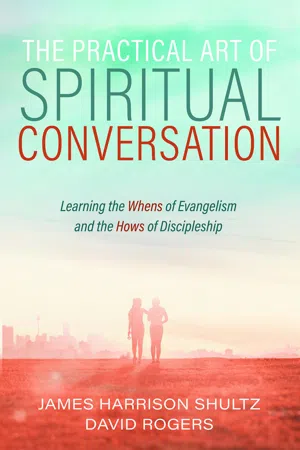
eBook - ePub
The Practical Art of Spiritual Conversation
Learning the Whens of Evangelism and the Hows of Discipleship
- 150 pages
- English
- ePUB (mobile friendly)
- Available on iOS & Android
eBook - ePub
The Practical Art of Spiritual Conversation
Learning the Whens of Evangelism and the Hows of Discipleship
About this book
The Practical Art of Spiritual Conversation is about the art of when, if, and how to engage in a spiritual conversation. The whens and the ifs inform the how. Christians can be so concerned with how to share the gospel that they often fail to consider where the person is spiritually and when, or even if, they should share the gospel. To be sure, the Scriptures are clear that followers of Christ must spread the good news. Yet there are times when sharing the gospel would be undeniably inappropriate. How, then, do gospel-centered, evangelistic Christians discern when to share Christ or when to stay silent? What determines when and if someone is even ready to hear the gospel? How does one meaningfully engage a person who has already accepted the gospel? Refined through tens of thousands of spiritual encounters, this book provides a helpful framework for discerning where a person is spiritually and how to encourage each person to take a step toward Christ regardless of where they may presently be in their faith journey. You will be equipped in the practical art of spiritual conversation so that you can meaningfully encourage every person to take a step toward Christ.
Information
Topic
Teologia e religioneSubtopic
Ministro del culto cristiano1
Spiritual Health
Understanding Spiritual Health
Imagine going to the doctor with an ache or pain in your leg that hurts so badly you can barely walk. Your purpose for being there in that exam room describing your ailment is simple: You believe that this person has the knowledge to help you get back to health. This scenario carries some assumptions. It assumes that this is your doctor and not your mechanic. It assumes that you and the doctor agree on some definition of health. It assumes that this doctor knows medical interventions that will help you get to this shared idea of health. Further, it assumes that the person you’re talking to actually has the training and knowledge to diagnose what’s ailing you so that you can apply the right therapy. Without these assumptions, the scenario is senseless.
Now, as Christians, God calls us to be like physicians. Our task goes well beyond a hurting leg. God invites us to facilitate health holistically—not just for ourselves, but in all of creation. This, too, assumes many things. It assumes we’re Christians and actually follow the restorative ways of Christ. It assumes that we agree with God on what health looks like in this world. It assumes that we’ve taken the time to learn how to diagnose what’s wrong in creation. It assumes that we have access to interventions that might help facilitate health. Without these assumptions, true change remains impossible.
How do we get to the place where we can excel at our task as God’s physicians? Before we can discuss how healing works, we must begin with a shared idea of what health is.
Shared Idea of Health
In order to be spiritual physicians, we need to have a clear idea of what it means to be spiritually healthy. We can’t possibly diagnose what’s wrong if we don’t know what’s right. It would do no good to speak of someone being healed from an illness if we had no understanding of health. Categories such as illness assume there’s a way it should be. If that weren’t the case, everything would be a series of arbitrary experiences that are neither healthy nor unhealthy. How would we even begin to describe what holistic health would look like?
Biblically, the word that’s used to describe reality in total, perfect health is the Hebrew word shalom. Cornelius Plantinga defines it this way:
The webbing together of God, humans, and all creation in justice, fulfillment, and delight is what the Hebrew prophets call shalom. We call it peace, but it means far more than mere peace of mind or a cease-fire between enemies. In the Bible, shalom means universal flourishing, wholeness and delight—a rich state of affairs in which natural needs are satisfied and natural gifts fruitfully employed, a state of affairs that inspires joyful wonder as its Creator and Savior opens doors and welcomes the creatures in whom he delights. Shalom, in other words, is the way things ought to be.1
Shalom is God’s picture for health. This isn’t just spiritual health as we usually understand it, but the health of all things. This vision for health includes everything, because in God’s design everything is spiritual. Because everything is spiritual, spiritual health means health in all areas. So as Christians, we partner with God in his great work of restoring health—shalom—to every aspect of all reality.
This shalom vision of health includes moments like when a crossing guard helps a child cross the street safely, when you cook your family dinner, or when a doctor sets your broken leg. It includes prayer, Bible study, and fasting. It includes small group Bible study or coffee with a friend. It includes doing your job well or loving your family. It includes overseas missions and local soup kitchens. It involves government, social media, trimming trees, and advances in technology. Everything is spiritual.
This may be new to you. Many of us have been given a vision for spiritual health that is only about saving souls. As a result, understanding spiritual health in such broad terms under the banner of shalom—the health of all things—is hard for us to reconcile. But if God really is inviting us to be his physicians restoring health in the world, and that invitation assumes we agree on what health is, we need to get this right. We need a vision for health that aligns with God’s understanding of health.
Jesus casts a vision for what shalom looks like when he speaks of the kingdom of God. Jesus spoke of the kingdom more than anything else because the definition of health was crucial to his mission. And it always has been. When the prophet Jeremiah charged the false teachers of his time, it was because they claimed they’d brought about healing, when in reality their understanding of health fell short. As Jer 8:11 says, “They have healed the wound of my people lightly, saying, ‘Peace [shalom], peace [shalom],’ when there is no peace [shalom].” Jeremiah was confronting those whose vision for shalom was too small. A superficial healing won’t do. We’re not compartmentalized people who have a spiritual part of us that’s separate from everything else.
How might we be tempted to have too small of a vision for shalom? Humans have many aspects: physical, relational, social, intellectual, and emotional. When Christians try to focus only on the spiritual part of someone’s humanity with no regard for the rest, it’s superficial, because it ignores humans as God created them. It would be like reading chapters 23 to 25 of a fifty-chapter novel and assuming you know the whole story. You don’t. You couldn’t. You’re missing critical portions of the beginning, character development, plotline, climax, and resolution. When we treat people as if only their spiritual lives matter, we miss key parts of how God made people, and as a result we provide superficial healing.
Let’s go back to the physician’s office. We may not think of the healing of our leg as something spiritual. After all, it’s our physical body that’s in need of mending. But this compartmentalizing doesn’t seem to match the New Testament story. Matthew 4:23 and 9:35 offer summary statements of Jesus’ ministry and tell us clearly that he didn’t just preach and teach, but healed diseases as well. When Jesus described neighbor love (Luke 10:25–37), he included things like bandaging wounds (10:34), giving a ride to the hospital (10:34), and covering someone’s bills (10:35). And this more holistic vision of restoration isn’t just about physical healing. When Jesus says that ministry to “the least of these” (Matt 25:31–46) is counted as being done for him, he had in mind giving people food or water (25:35), clothing those who are naked (25:36), welcoming strangers, and even visiting the imprisoned (25:36). Healing and restoration in any area is spiritual healing.
In order to restore shalom in our lives and in the lives of others, it requires us to fix any broken thing we find, even if we wouldn’t normally categorize it as spiritual. God invites us as his followers to partner with him in restoring shalom. This seems like an impossible task, because this world is so tragically broken. After all, the world isn’t in a state of shalom. What happened? What went wrong?
What Has Gone Wrong?
God created this world as good and intended for it to exist in shalom, or perfect, holistic health. This perfect, holistic health is spiritual health. Not only does this mean that we should live in a perfect relationship with God, but also in relationship with others, and that every aspect of our world should lead to flourishing for all people as well as all of creation. Just a few minutes looking at news headlines, however, makes clear that this isn’t the world we live in.
What’s gone wrong? Sin.
Wait. Are we really saying that all the brokenness we experience in this world is because of sin? Does that mean that sin is the reason for awful things like childhood cancer? What sin did they commit to deserve that? Is sin why tsunamis happen? Are nations with less natural disasters less sinful than nations with more tornados?
Most of us are uncomfortable blaming the specific brokenness we experience on sin—and for good reason. A ...
Table of contents
- Title Page
- Acknowledgments
- Introduction
- Chapter 1: Spiritual Health
- Chapter 2: Diagnosing the Illness
- Chapter 3: A Framework for Spiritual Conversations
- Chapter 4: Who Cares?
- Chapter 5: From Lost to Found
- Chapter 6: Obstacles to the Gospel and Receptivity
- Chapter 7: Christian Growth
- Chapter 8: From Theory to Practice
- Chapter 9: A Call to Spiritual Conversations
- Bibliography
Trusted by 375,005 students
Access to over 1.5 million titles for a fair monthly price.
Study more efficiently using our study tools.
Frequently asked questions
Yes, you can cancel anytime from the Subscription tab in your account settings on the Perlego website. Your subscription will stay active until the end of your current billing period. Learn how to cancel your subscription
No, books cannot be downloaded as external files, such as PDFs, for use outside of Perlego. However, you can download books within the Perlego app for offline reading on mobile or tablet. Learn how to download books offline
Perlego offers two plans: Essential and Complete
- Essential is ideal for learners and professionals who enjoy exploring a wide range of subjects. Access the Essential Library with 800,000+ trusted titles and best-sellers across business, personal growth, and the humanities. Includes unlimited reading time and Standard Read Aloud voice.
- Complete: Perfect for advanced learners and researchers needing full, unrestricted access. Unlock 1.5M+ books across hundreds of subjects, including academic and specialized titles. The Complete Plan also includes advanced features like Premium Read Aloud and Research Assistant.
We are an online textbook subscription service, where you can get access to an entire online library for less than the price of a single book per month. With over 1.5 million books across 990+ topics, we’ve got you covered! Learn about our mission
Look out for the read-aloud symbol on your next book to see if you can listen to it. The read-aloud tool reads text aloud for you, highlighting the text as it is being read. You can pause it, speed it up and slow it down. Learn more about Read Aloud
Yes! You can use the Perlego app on both iOS and Android devices to read anytime, anywhere — even offline. Perfect for commutes or when you’re on the go.
Please note we cannot support devices running on iOS 13 and Android 7 or earlier. Learn more about using the app
Please note we cannot support devices running on iOS 13 and Android 7 or earlier. Learn more about using the app
Yes, you can access The Practical Art of Spiritual Conversation by James Harrison Shultz,David Rogers in PDF and/or ePUB format, as well as other popular books in Teologia e religione & Ministro del culto cristiano. We have over 1.5 million books available in our catalogue for you to explore.