Society has long been fascinated with the freakish, shocking and strange. In this book Gary Cross shows how freakish elements have been embedded in modern popular culture over the course of the 20th century despite the evident disenchantment with this once widespread cultural outlet. Exploring how the spectacle of freakishness conflicted with genteel culture, he shows how the condemnation of the freak show by middle-class America led to a transformation and merging of genteel and freak culture through the cute, the camp and the creepy.
Though the carnival and circus freak was marginalised by the 1960s and had largely disappeared by the 1980s, forms of freakish culture survived and today appear in reality TV, horror movies, dark comedies and the popularity of tattoos. Freak Show Legacies will focus less on the individual 'freak' as 'the other' in society, and more on the audience for the freakish and the transformation of wonder, sensibility and sensitivity that this phenomenon entailed. It will use the phenomenon of 'the freak' to understand the transformation of American popular culture across the 20th century, identify elements of 'the freak' in popular culture both past and present, and ask how it has prevailed despite its apparent unpopularity.
eBook - ePub
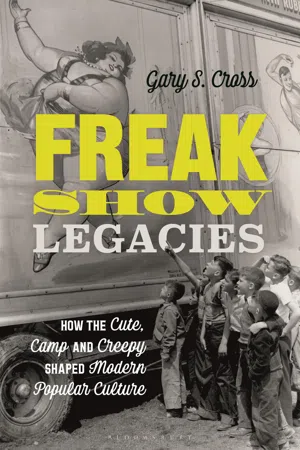
Freak Show Legacies
How the Cute, Camp and Creepy Shaped Modern Popular Culture
- 248 pages
- English
- ePUB (mobile friendly)
- Available on iOS & Android
eBook - ePub
About this book
Information
1
Freaking Out
In the depth of the Depression in January of 1932, Freaks opened in San Diego. This film was an unusual tale of a circus midget and his misguided love for a trapeze artist, set in the world of sideshow human oddities. The bigger story was of the public hostility to this movie and how this puts us on a journey across decades of American popular culture that sets the stage for this book: This is a story first of middle-class rejection of the freak and the carnival, and subsequently the revival of some elements of the freakish in popular culture.
The freak was hardly a marginal figure in American popular culture. Most were born with or developed aberrations from the biological norm (though some were ethnic or racial minorities); they were gazed, even gawked, at as objects of pity but also wonder; and they were frequently made more interesting (or tolerable) when they were “normalized” in dress, demeanor, and skills. Broadly, they personified the carnival—a culture of difference where the unexpected is expected and where sensual wonder prevails over rational order. The freak symbolized a broader culture of “freakery”—presentations and persons (real and virtual) so abject as to evoke a disturbing response. And they were part of a world that middle-class modernity would eventually marginalize, though never destroy. Freaks and its fate provide a window on the fate of freakery in modern America.
This film was directed and produced by Tod Browning, a Hollywood veteran, first as an actor in the 1910s and then as a screenwriter and director. As a youth, he had been a “talker” in carnival sideshows and had long been intrigued with the life and art of freaks. Gaining the support of MGM’s powerful executive, Irving Thalberg, Freaks promised audiences a backstage view of the lives and personalities of the midgets, bearded ladies, pinheads, hermaphrodites, and Siamese twins that commonly appeared in circus sideshows. However, the movie was really a horror show.
Browning’s portrayal was shaped by his recent experience as a maker of films of the grotesque and gruesome drama, including a 1925 silent feature called The Unholy Three involving a crime spree by a trio of circus performers, including a midget. In 1931, Browning contributed to the new craze for horror (that included the smash hits of Frankenstein and King Kong) with his version of Dracula. His next film, Freaks, would continue down that horrific path with a story that culminated with a band of angry freaks creeping through mud on a rainy night to attack the villain, the “normal” trapeze artist Cleopatra and her strongman lover, Hercules. In the course of the movie, Cleopatra had humiliated the gentle and sympathetic midget Hans who foolishly has fallen in love and married her. After his money all along, Cleopatra and Hercules plot to murder Hans. After being mocked at the wedding party and learning of the plot, the freaks band together to seek revenge. No violence is shown as the freaks attack Cleopatra, but the results are—her reduction to a legless squawking duck-like figure—as evidence of the potent rage of freaks when one of their kind is mistreated.1
Viewed by modern eyes, the film is not very horrifying (just as King Kong and Frankenstein are not). Like other horror films of the 1930s, there is more melodrama than terror on the screen. Much of the film is the story of a sympathetic, but naïve, Hans and a caring, if sometimes pitiful, Frieda, his midget girlfriend whom he leaves for Cleopatra. Despite its horrifying climax, Freaks was pretty tame. It had to be, produced as it was under the mainstream logo of MGM rather than a low-class “Grindhouse” studio that specialized in exploitation movies. In most ways, Freaks was a familiar melodrama for its time: the story of a misguided desire for love, a manipulative female, and ultimately the reconciliation of an appropriate couple (albeit midgets). We sympathize with the freaks, at least the midget couple. They become monsters only when provoked.2
And yet the film incited outrage from its first appearance. Women were reported screaming as they ran from the theater; one allegedly had a miscarriage while watching the movie. Freaks was a lightning rod for opponents of horror and sexually suggestive movies in 1932. While viewed favorably by a few critics (including famed Hollywood reporter Louella Parsons), negative reception came quickly. The Kansas City Star summed up many reviews: “It took a weak mind to produce it and it takes a strong stomach to look at it.” MGM studio head, Louis B. Meyer, concerned that the film would sully the reputation of his respectable company, pulled Freaks from theaters by the early summer of 1932 after a delayed showing in New York. It was banned in England (reversed only thirty years later), but also in Nazi Germany and Stalin’s Russia. Worst of all (from Hollywood’s point of view) the film cost $316,000 to produce but lost $164,000.3
All this might seem simply to suggest that sensibilities were less jaded in 1932 than they are now. On the eve of the enforcement of Motion Picture Production Code in 1934 that banned sexually suggestive and gangster-glorifying movies and ushered in the age of costume dramas and Shirley Temple, this horrified reaction might have been predicted. In fact, by 1936, in this new conservative cultural climate horror films had become rarer. The National Association of Women raised concerns about the sexual innuendo in Freaks when it complained to the Code Administration about the suggestive scenes regarding the love life of the conjoined Hilton twins and the hermaphrodite. Recognizing this popular reaction, ads for the movie tried to tone down the horror and sexuality; instead, they stressed the normality of the freaks and the rights of the twins to love.4
Digging deeper, the audience’s reaction is hard to explain. After all, the freak had been a mainstay in the culture of popular curiosity since the nineteenth century, having been successfully commercialized in a package of spectacles wrapped in a richly evocative narrative. Freak shows had challenged, but also confirmed, the values of a largely upwardly mobile crowd since the 1840s. The display of the individual freak, especially the giant and the dwarf, had been part of a long and even ancient culture of aristocratic presentation—markers of luxurious exoticism and eccentricity. In many ways, the domesticated freak shared a history with the aristocratic invention of the lap or house dog as a pet rather than a work animal. Hardly a horror show.5
The cast of Freaks was disturbing to some perhaps, but all were familiar, often famous, figures in the sideshows of circuses and even Vaudeville. Americans had long paid good money to see these unusual people. Harry Earles plays Hans, while his midget sister took the role of his lovelorn female lead, Frieda. This pair were celebrities, originally from Germany, who, with their other midget siblings, became the “Doll” family, long headliners with the Ringling Brothers and Barnum and Bailey Circus. Hans had a leading role in the cast of Munchkins in the famous Wizard of Oz of 1939.
Others in the cast included the Living Skeleton, Pete Robinson, who married a “fat lady.” Robinson was widely known as a “Jack Sprat” in the flesh. The armless women, Francis O’Conner and Martha Morris, were famous in sideshows for signing picture cards of themselves with their feet. O’Conner crocheted and even was a sharpshooter. Schlitzie was one of several pinheads in the movie, a victim of microcephaly (characterized by a smaller than average head and mental retardation). Living to eighty, he was noted for being cheerful and accommodating, even though he always needed the help of a caregiver, who, like others, treated Schlitzie as a child. More disturbing was Prince Randian, unusual in the sideshow for he lacked both arms and legs. Known as the human torso, human caterpillar, or even human worm, Prince Randian was famous for rolling and smoking cigarettes with his mouth. His articulate speech often disarmed onlookers. The conjoined twins, Daisy and Violet Hilton, might also have bothered audiences in 1932. But their story of exploitation by “guardians” from whom they had been recently liberated, along with their fame on the Vaudeville circuit as skilled musicians (playing the piano and saxophone), made them anything but terrifying. Olga Roderick (aka Jane Barnell) was a natural bearded woman, well known for her regular appearances at Hubert’s Museum in New York City. Koo Koo, the Bird Girl, suffered from bad vision (thus sometimes labeled the Blind Girl from Mars) and a bone deformity that produced a birdlike appearance. This was exaggerated when she was dressed in feathers, sometimes with huge chicken feet. Odd, but hardly, horrifying. Johnny Eck was also featured. Although a legless “half man,” he was handsome and a great talker. All traditional sideshow fare.
Perhaps more disturbing was Josephine/Joseph, who had a brief role in Freaks as a hermaphrodite. Still, the half male/half female figure (often a fake) was a common exhibit in sideshows (sometimes offered as a “blow-off” act at the end of the show for an extra charge). He or she was usually dressed in a costume that suggested both sexes with half of the body tanned and muscled and the other half pale. Some half-and-half artists were skilled at faking the possession of both male and female genitals (revealed in some blow-offs in carnival sideshows). But the movie left this out, of course.6
Nevertheless, the prevailing American popular culture of 1932 found Freaks anathema. The movie itself offers clues why. It shows a break from a century of American fascination with anomalies of the sideshow. From the opening scene, the talker deviates from the common spiel of the sideshow. He does not tell us that the freaks are amazing curiosities who have transcended their disadvantages, but “living breathing monstrosities”—even if he also reminds the audience that “but for the accident of birth you might be as they are” and that “They didn’t ask to be brought into the world.” They live by “a code of their own” and even more ominously, the talker warns us: “Offend one and you offend them all.” This sets up the main thread of the story: These humiliated Others take revenge on ordinary people, a frequent theme of horror stories (like in Frankenstein). Freaks are to be feared. They are creepy. But even more, they are to be pitied. And displaying these pathetic creatures on film was a central objection of genteel critics like the National Association of Women who was appalled that MGM would “stoop to the disgrace of making money out of hurt, disfigured and suffering humanity.” A new attitude toward the freak was emerging in a middle-class culture that was beginning to reject and want to hide the abject and pitiful.7

FIGURE 1.1 Studio publicity shot of Tod Browning and sideshow performers in Freaks. Note the “pinheads” and the “half man” Johnny Eck on the left, Bettmann, Getty Images.
Freaked Out by Freaks: Origins
By 1932, the freak had become a subject of a horror show, disgusting in appearance and behavior, dangerous when riled up, pitied yes for the hurt caused them by nature, but never to be brought into the happy home of humanity. Even if the movie condemns the mockery of the “abled” Cleopatra and Hercules, the attitudes of the trapeze artist and strong man aren’t far from what the movie expects from the audience. Most viewers, no doubt, found absurd the sight of a three-foot, three-inch man with a high-pitched voice pursuing a beautiful trapeze artist, especially when he was competing with the man’s man, Hercules. While the freak had fascinated several generations of Americans, by 1932, movie goers were beginning to find them repulsive.
This break from the past signaled the decline of the freak show and all that it represented, especially in genteel and aspiring middle-class circles. Up to this point, dwarfs, giants, and numerous other human curiosities had attracted monarchs and aristocrats who, for centuries, had displayed these oddities. But even medical and scientific chroniclers viewed these people as mysteries or even separate species. Similarly, they had fascinated ordinary crowds at festivals and fairs. In the 1840s, P.T. Barnum introduced a range of human curiosities at his American Museum in New York. The circus sideshows that followed featured individuals with unusual bodies (mostly ...
Table of contents
- Cover
- Half-Title
- Title
- Contents
- List of Figures
- Prologue: Our Thing about Monsters
- 1 Freaking Out
- 2 Carnival Culture and the Challenge of Gentility
- 3 Marginalizing the Freak
- 4 The Cute: Domesticating the Freak
- 5 Countercultures of the Freakishly Camp
- 6 The Creepy: Freaks as Flesh-Eating Zombies
- 7 Taking the Sideshow to the Big Top: Freak Culture in the Mainstream
- Bibliography
- Index
- Copyright
Trusted by 375,005 students
Access to over 1.5 million titles for a fair monthly price.
Study more efficiently using our study tools.
Frequently asked questions
Yes, you can cancel anytime from the Subscription tab in your account settings on the Perlego website. Your subscription will stay active until the end of your current billing period. Learn how to cancel your subscription
No, books cannot be downloaded as external files, such as PDFs, for use outside of Perlego. However, you can download books within the Perlego app for offline reading on mobile or tablet. Learn how to download books offline
Perlego offers two plans: Essential and Complete
- Essential is ideal for learners and professionals who enjoy exploring a wide range of subjects. Access the Essential Library with 800,000+ trusted titles and best-sellers across business, personal growth, and the humanities. Includes unlimited reading time and Standard Read Aloud voice.
- Complete: Perfect for advanced learners and researchers needing full, unrestricted access. Unlock 1.5M+ books across hundreds of subjects, including academic and specialized titles. The Complete Plan also includes advanced features like Premium Read Aloud and Research Assistant.
We are an online textbook subscription service, where you can get access to an entire online library for less than the price of a single book per month. With over 1.5 million books across 990+ topics, we’ve got you covered! Learn about our mission
Look out for the read-aloud symbol on your next book to see if you can listen to it. The read-aloud tool reads text aloud for you, highlighting the text as it is being read. You can pause it, speed it up and slow it down. Learn more about Read Aloud
Yes! You can use the Perlego app on both iOS and Android devices to read anytime, anywhere — even offline. Perfect for commutes or when you’re on the go.
Please note we cannot support devices running on iOS 13 and Android 7 or earlier. Learn more about using the app
Please note we cannot support devices running on iOS 13 and Android 7 or earlier. Learn more about using the app
Yes, you can access Freak Show Legacies by Gary S. Cross in PDF and/or ePUB format, as well as other popular books in History & 20th Century History. We have over 1.5 million books available in our catalogue for you to explore.