Winner of the 2022 Ab Imperio Award
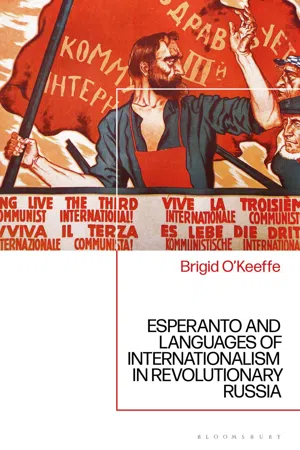
Hoping to unite all of humankind and revolutionize the world, Ludwik Zamenhof launched a new international language called Esperanto from late imperial Russia in 1887. Ordinary men and women in Russia and all over the world soon transformed Esperanto into a global movement. Esperanto and Languages of Internationalism in Revolutionary Russia traces the history and legacy of this effort: from Esperanto's roots in the social turmoil of the pre-revolutionary Pale of Settlement; to its links to socialist internationalism and Comintern bids for world revolution; and, finally, to the demise of the Soviet Esperanto movement in the increasingly xenophobic Stalinist 1930s. In doing so, this book reveals how Esperanto – and global language politics more broadly – shaped revolutionary and early Soviet Russia.
Based on extensive archival materials, Brigid O'Keeffe's book provides the first in-depth exploration of Esperanto at grassroots level and sheds new light on a hitherto overlooked area of Russian history. As such, Esperanto and Languages of Internationalism in Revolutionary Russia will be of immense value to both historians of modern Russia and scholars of internationalism, transnational networks, and sociolinguistics.
- 266 pages
- English
- ePUB (mobile friendly)
- Available on iOS & Android
eBook - ePub
Esperanto and Languages of Internationalism in Revolutionary Russia
About this book
Information
1
A Universal Language for a Globalizing World
In 1887, the first Esperanto primer was published in Warsaw, having cleared tsarist censors for sale throughout the Russian empire. The book, International Language: An Introduction and Full Textbook for Russians, was modestly priced and pseudonymously authored by “Doctor Esperanto” (Doctor Hopeful). Doctor Esperanto was Lazar’ Liudovik Zamenhof (1859–1917), a Jewish subject of the Russian empire. In the introduction to International Language, Zamenhof insisted that Esperanto would tear down the linguistic barriers dividing humanity, allowing the world’s diverse peoples to better understand each other’s values, customs, and worldviews. As a “neutral” and “auxiliary” language, it would make it possible for the world’s “peoples to come together in one family.”1 His international language was the best solution to the modern dilemmas of Babel because it was uncommonly easy to master. “The entire grammar of my language can be learned perfectly in the course of one hour,” Zamenhof boasted.2
In his pursuit of an international language that could solve humankind’s spiritual and practical problems, Zamenhof was not alone. Zamenhof appealed to many of his contemporaries who believed an international language was necessary to overcome the curse of Babel. Fin de siècle Europe exhibited a widely shared craving for an international language that could facilitate commerce, travel, diplomacy, science, and the international exchange of ideas and expertise.3 Zamenhof and his constructed language came of age, after all, in an era of keenly felt globalization and rapid social change. The late nineteenth and early twentieth centuries witnessed a marked “international turn” in how men and women asserted and imagined themselves in the world.4 Among them were Zamenhof and his fellow Esperantists.
While Zamenhof belonged to an era of self-conscious globalization, he also belonged—however unhappily—to the imperial Russian political culture to which he was native. In the first Esperanto primer, Zamenhof tellingly wrote:
Anyone who has attempted to live in a city inhabited by people of different, mutually antagonistic nations (natsii) has no doubt appreciated what an enormous service would be rendered to humanity by an international language that does not interfere in the domestic life of peoples (narodov) and that could, at the very least, serve as the language of government and community life in countries with a population that speaks different languages.5
This was the vision of not just any idealist in the late nineteenth century but of a young Jewish man whose politics were profoundly shaped by his imperial Russian milieu.
Zamenhof’s politics were largely overlooked or downplayed in early accounts of Esperanto and its successes in late nineteenth- and early twentieth-century Europe. The first biographies of Zamenhof, written by admiring Esperantists, tended more toward hagiography than historicism. As such, they emphasized Zamenhof’s personality as an idealist and humanitarian more than they diagnosed his politics or deconstructed the sources of inspiration of his politics.6 Yet scholars seeking to better appreciate Esperanto’s place in world history have recently reconsidered Zamenhof as a political actor—an ideologue as much as an idealist. In particular, they have placed Zamenhof’s Jewishness at the center of their accounts of what motivated an obscure oculist in Warsaw to launch an international auxiliary language in a bid to transform humankind.7
This chapter tells a new history of Esperanto—one that places Esperanto and its Jewish creator squarely in their imperial Russian context. That Zamenhof was a subject of the tsarist empire, and that this fact mattered, has long been acknowledged in the lean literature on Esperanto’s history. Yet it has scarcely been explained why and how Zamenhof’s status as a Jewish subject of the Russian empire mattered. Scholarship on the history of Esperanto has largely presupposed an imperial Russia that was flatly autocratic, oppressive, and especially cruel to its Jews.8 The late Russian empire thus registers in the historiography on Esperanto as a one-dimensional backdrop painted in the muted tones of “authoritarian essentialism.”9 This chapter will explore how and why Esperanto’s ideological vision of a reconciled humanity was born in late imperial Russia’s multiethnic and multiconfessional borderlands and shaped by this autocratic empire’s layered fin de siècle crises.
As late imperial Russia’s tsars and bureaucrats struggled to cope with the challenges of a globalizing and industrializing world, its growing intelligentsia pursued a variety of creative and radical attempts to reimagine the world and Russia’s place within it. Zamenhof joined his fellow intelligentsia elites as they agonized over Russia’s past, present, and future. With Esperanto, Zamenhof contributed his own utopian project to the Russian intelligentsia’s litany of wide-ranging schemes and philosophical visions for a radically liberating future. An international language that all would need to learn in addition to their native tongue(s)—Esperanto—was Zamenhof’s utopian vision for a harmonious empire of humanity, a moral community of global citizens.
Esperanto’s Russian origin story also highlights a specific brand of fin de siècle internationalism that has long been overshadowed historiographically by its competing radical utopian visions in late imperial Russia, such as nihilism, populism, and Russian Marxism. Esperanto was, for many in late imperial Russia and Europe more broadly, an attractive utopian program for all the world’s peoples to unite in a global moral community built on human equality and made possible by an international auxiliary language. Esperanto also offered an exciting means of participating in a rapidly globalizing world and making connections across its national, linguistic, and ideological borders. This chapter explains how the unique transnational encounters and internationalist visions that Esperanto inspired were rooted in the multiethnic, multilingual, and multiconfessional borderlands of an empire in crisis, an empire home to people like Zamenhof who were imagining alternative futures for Russia and the world.
Fathers and Sons
In 1859, Lazar’ (Liudovik) Markovich Zamenhof was born into a Jewish family in the expansive, multiethnic Russian empire. Zamenhof was born in the town of Bialystok, to be precise. This was a fact of enormous consequence. In Zamenhof’s telling, his birthplace fundamentally shaped both his evolving worldview and his drive to create for the world an international auxiliary language uniquely capable of reconciling the fractures dividing humankind. Located on the western edge of the Pale of Settlement, Bialystok was a growing industrial town populated by Poles, Jews, Germans, Lithuanians, Roma, and Ukrainians—by Catholics, Russian Orthodox, and Jews. The Bialystok of Zamenhof’s youth was a bustling town of polyglots in an empire that, in 1859, was on the precipice of decades of profound transformation born of political, cultural, and socioeconomic tumult that shook that empire’s very foundations.
Located just beyond the eastern border of Congress Poland and falling within Russia’s Grodno Province, young Zamenhof’s Bialystok was a rapidly growing regional center within the tsarist empire’s Pale of Settlement. The stunning tempo of Bialystok’s industrial and demographic growth in the nineteenth century owed to its status as a center of the textile industry in imperial Russia’s western borderlands. At the time of Zamenhof’s birth, multiethnic Bialystok was undergoing a striking demographic change. In the span of the nineteenth century, Bialystok’s Jewish population “increased almost thirteen-fold.”10 Much of this population growth owed to the steam engine of Jewish business in the region which accelerated the growth of local capital, stimulated Jewish migration from outlying villages to Bialystok itself, and gave rise, in the late nineteenth century, to Bialystok’s own increasingly self-conscious and vocal Jewish working class. By the late 1860s, Jews owned nearly half of Bialystok’s textile factories. Jewish entrepreneurs also produced and marketed soap, leather, and beer. By century’s end, Bialystok’s Jews constituted a large majority within a city that was outfitted with two synagogues, three Jewish cemeteries, a large Jewish hospital, a Jewish old-age home, and a wide range of other Jewish communal and cultural institutions catering to a variety of religious and political outlooks.11
Zamenhof’s family, however, was not represented in Bialystok’s expanding Jewish business sector. Zamenhof’s father, Mark Zamenhof, was a largely self-taught language teacher and, by all accounts, a stern paterfamilias. In Bialystok, he began his teaching career as a private tutor but later gained a post teaching languages at a Jewish school for girls.12 Eventually, he would publish a German language primer, A Textbook of the German Language for Russian Young People (Warsaw, 1871).13 One Zamenhof biographer has described Mark as a “Russophile” who “had abandoned the observances of Judaism and wished to see Jews assimilated into the Gentile community.”14 Another notes the Russian-language speech that Mark Zamenhof gave in in 1868 on the occasion of the opening of a new synagogue in Bialystok. Offering his gratitude to Alexander II for his just and wise rule, Mark Zamenhof also exhorted his fellow Jews of the tsar’s empire to work toward their own good-faith integration into the imperial social order. “We should no longer distance ourselves from our brothers the Russians, among whom we live” Mark Zamenhof intoned, “but share with them, equally, all the rights of this country, for our happiness and well-being.”15 Reputed Russophile and self-identifying proponent of Jewish Enlightenment (Haskalah), Mark was a Jewish striver who believed his family, coreligionists, and fellow inhabitants of the Pale would do well to prove themselves “useful” to the empire to which they belonged. The Zamenhofs were among many Jewish families in late imperial Russia who, as historian Benjamin Nathans has shown, were looking “beyond the Pale” and seeking integration into a social order that, they hoped, would soon discontinue the empire’s “castelike isolation” of its Jewish subjects.16 Mark’s early career and long-term professional trajectory reflects this commitment to assimilation—an assimilation that in his own life and career he never seems to have divorced from the question of language or the skills of multilingualism.
The Zamenhof family primarily spoke Russian at home, but all—parents and children—were also native speakers of Polish and Yiddish. This was a fact entirely unremarkable for the Zamenhofs’ time as well as for their local and imperial milieus. Bialystok demanded of its inhabitants multilingualism as a basic fact of life. As Esther Schor so aptly puts it, in Zamenhof’s Bialystok, “multilingualism was not the preserve of the educated; it was the way one bought eggs, greeted policemen, prayed, and gossiped.”17 Looking back on his childhood, however, Zamenhof would later more ominously claim that in the Bialystok of his youth, multilingualism served primarily as a mode of hurling insults and sowing mistrust. Bialystok’s “daily life,” he argued, “was poisoned by the bickerings and animosities that arose out of this diversity of tongues.”18
Multilingualism provided the inhabitants of Bialystok, no doubt, with the skills necessary to effectively buy eggs and hurl insults. Bialystokers’ polyglottism certainly also proved useful in an era that for many in the late nineteenth century felt, looked, and sounded ever more expansive, more global. People, goods, and ideas flowed into Bialystok in its bustling “long nineteenth century,” entangling the city and its inhabitants in an array of novel transnational networks and imagined communities. As their horizons widened, many of Bialystok’s inhabitants increasingly felt their lives pinched and constrained in this industrial hub in the borderlands of an empire that, for Jews especially, felt ever more inhospitable. Droves of native Bialystokers in these years also abandoned their hometown for alternative futures elsewhere and their language skills surely helped many of them on their way. Thousands of Bialystok’s Jews migrated in search of new lives elsewhere in the Russian empire or, in the aftermath of the pogroms that rocked the Pale in the tsarist twilight, in Europe, Palestine, or the Americas.19
For their own part, the Zamenhofs departed Bialystok in 1873 when Zamenhof was just thirteen, but they did not move far. The family took up residence in the Jewish quarter of Warsaw, where the striver Mark had secured a post teaching languages.20 The young Zamenhof enrolled in a prestigious gymnasium where he exhibited a love for languages that soon rivaled that of his father. In Bialystok, Zamenhof had studied both German and French in elementary school. In Warsaw, he was able to study Latin and Greek and, later, some English too. Before long, the young Zamenhof’s love for languages began to worry his father.
While still in secondary school, Zamenhof first began scheming to create a universal language for all mankind. In a letter written to a colleague in 1895, Zamenhof explained that his study of Latin and Greek had moved him to near ecstasy. “I dreamt,” he wrote, “that some day I should travel about the world and in fiery words persuade the nations to revive one of these languages for common use. Afterward, I do not remember just how, I arrived at the firm conviction that this was impossible and I commenced to dream of a new, artificial language.” Zamenhof began tinkering with grammar and syntax, suffixes and roots. He obsessively studied and considered the characteristics of the languages in his repertoire: Russian, Polish, Yiddish, German,...
Table of contents
- Cover
- Half-title Page
- Dedication Page
- Title Page
- Contents
- List of Figures
- Acknowledgments
- A Note on the Text
- Introduction
- 1 A Universal Language for a Globalizing World
- 2 Pen Pals, Dreamers, and Globe-Trotters
- 3 Bolshevik Tower of Babel
- 4 Comrades with(out) Borders
- 5 Language Revolutions and Their Discontents
- Epilogue: The Death of Esperanto
- Notes
- Bibliography
- Index
- Copyright Page
Trusted by 375,005 students
Access to over 1.5 million titles for a fair monthly price.
Study more efficiently using our study tools.
Frequently asked questions
Yes, you can cancel anytime from the Subscription tab in your account settings on the Perlego website. Your subscription will stay active until the end of your current billing period. Learn how to cancel your subscription
No, books cannot be downloaded as external files, such as PDFs, for use outside of Perlego. However, you can download books within the Perlego app for offline reading on mobile or tablet. Learn how to download books offline
Perlego offers two plans: Essential and Complete
- Essential is ideal for learners and professionals who enjoy exploring a wide range of subjects. Access the Essential Library with 800,000+ trusted titles and best-sellers across business, personal growth, and the humanities. Includes unlimited reading time and Standard Read Aloud voice.
- Complete: Perfect for advanced learners and researchers needing full, unrestricted access. Unlock 1.5M+ books across hundreds of subjects, including academic and specialized titles. The Complete Plan also includes advanced features like Premium Read Aloud and Research Assistant.
We are an online textbook subscription service, where you can get access to an entire online library for less than the price of a single book per month. With over 1.5 million books across 990+ topics, we’ve got you covered! Learn about our mission
Look out for the read-aloud symbol on your next book to see if you can listen to it. The read-aloud tool reads text aloud for you, highlighting the text as it is being read. You can pause it, speed it up and slow it down. Learn more about Read Aloud
Yes! You can use the Perlego app on both iOS and Android devices to read anytime, anywhere — even offline. Perfect for commutes or when you’re on the go.
Please note we cannot support devices running on iOS 13 and Android 7 or earlier. Learn more about using the app
Please note we cannot support devices running on iOS 13 and Android 7 or earlier. Learn more about using the app
Yes, you can access Esperanto and Languages of Internationalism in Revolutionary Russia by Brigid O'Keeffe in PDF and/or ePUB format, as well as other popular books in Storia & Storia del XX secolo. We have over 1.5 million books available in our catalogue for you to explore.