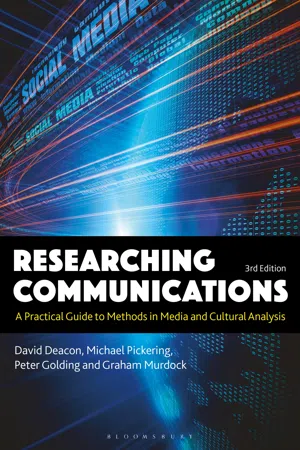
The new edition of the highly respected Researching Communications is a comprehensive and authoritative guide to researching media and communication. Researching Communications, Third Edition is an invaluable guide to performing and analysing research tasks, introducing the major research methods, giving detailed examples of research analysis and practical step-by-step guidance in clear language.
Written by highly regarded experts in the field, the third edition includes new sections on social media analysis, digital research methods and comparative research, as well as updated case studies, international examples and details of recent developments in media and communication studies.
Undergraduate and postgraduate media and communication students will find Researching Communications an invaluable resource at all stages of their course.
eBook - ePub
Researching Communications
A Practical Guide to Methods in Media and Cultural Analysis
- 552 pages
- English
- ePUB (mobile friendly)
- Available on iOS & Android
eBook - ePub
Researching Communications
A Practical Guide to Methods in Media and Cultural Analysis
About this book
Information
1
Approaching research
Communications and contemporary life
Modern communications media have become a major focus for research for the simple reason that they are central to organizing every aspect of contemporary life, from the broad patterning of social institutions and cultural systems, to intimate everyday encounters and people’s personal understandings of the world and their sense of themselves. We cannot fully understand the ways we live now without understanding communications, whether these involve international media forms like blockbuster Hollywood films, or interpersonal communication via online social media. Both the significance and diversity of modern media offer media researchers enormous opportunities to contribute to current knowledge and debate.
Institutions
Communications companies feature prominently among the world’s largest firms and play a major role in economic and political life. Not only do they provide the specialized information and communication links that enable modern enterprises to coordinate production on a global scale and allow financial dealings to continue twenty-four hours a day, they are also pivotal to the orchestration of consumption. In addition to selling an ever-expanding range of their own goods and services, they are the main conduits for the avalanche of general advertising and promotion that oils the wheels of the consumer system as a whole. Their economic importance is matched by their role in the organization of politics. In modern democracies, where political parties must compete for the support of floating voters and social movements continually press to have their views and concerns added to the political agenda, the mass media have become the major public spaces where images are massaged, policies promoted, events made sense of and issues debated. Increasingly as well, those forms of communications known collectively as social media may influence political processes through the use of fake news, clickbait stories or misinformation that goes viral.
Cultural systems
The promotion of products and political platforms is, in turn, part of a much more diverse and broadly based cultural system, in which competing views of the world are expressed through a proliferating range of expressive forms, from graphic arts and street styles to fiction and music. To reach a wider public, these productions, and the diverse ways of thinking, feeling and looking that they express, have for much of the modern period had to engage with the principal mass media of film, television, radio, publishing and the music industry now often labelled as ‘legacy’ media to indicate that they are inherited from past eras of innovation. Although their control over mediated culture has partially undermined by the opportunities for direct address offered by social media platforms, they remain central to contemporary life and to any attempt to explore the patterning of generalized public culture, examining what stands at its centre and what is pushed to the margins. Investigating the way that particular cultural forms organize meaning tell us much about the imaginative spaces we hold in common.
Understandings and identities
That said, an immediate caveat is in order, for as we shall see in later chapters, when we look in detail at how to unpack the meanings carried by media imagery, texts and talk, we find that public communications seldom trade in simple ‘messages’ offering a unitary view of the world. Instead, they offer a range of mental maps which can be entered at different points and navigated in a variety of ways. Nor is it simply the ‘contents’ of media that mobilizes meanings. Through their visual style and the promotion that surrounds them, media machineries – television sets, satellite dishes, smart phones, DSLRs, Echo Dots – speak powerfully to their owners (and to us) about the kinds of people they are and would like to be. The interplay between understandings and identities grounded in people’s everyday lives, and the generalized world views, structures of experience and images of self offered by the public communications system, is both complex and continually being renegotiated.
Patterns of everyday life
Legacy media, social media and their various hybrids play a major role in organizing the routines and rituals of everyday life. While television remains a central presence in domestic and family life, it is not as dominant a communications medium as it used to be, being rivalled today by social media like Twitter or Instagram, or apps enabling the individual consumption of film or music. Listening to breakfast radio or catching up with the latest album by a favourite band are now as common in accompanying people’s daily journey to work as reading the morning newspaper. Media forms and practices change over time, but communications media in general terms remain key to everyday life. In addition, many of the rituals marking important personal moments are bound up with media: photos capture our first halting steps or university graduation; going clubbing or to the cinema is central to courtship, while weddings and family gatherings are now routinely captured in a blizzard of conventional images, selfies and short videos that are often shared instantaneously with those present and with wider audiences via social media platforms.
The relations between communications media and patterns of everyday life have been considerably altered by the advent of digital technologies. These have expanded the range of opportunities for personal and interpersonal representation in the media.
Throughout the book we emphasize the importance of taking a historical perspective on such developments, avoiding being dazzled by the novelty of technological innovations and attempting instead to see how they belong to broader patterns of both change and continuity in the long term. It is nevertheless abundantly clear that digital technologies have transformed every aspect of communication. As Donald Trump’s continual use of Twitter during his presidency of the United States demonstrated, social media allow politicians to by-pass the selections made by journalists and editors working for large national institutions and speak directly to their supporters. These self-representations are not less mediated .The processes of mediation are different, but they are not absent.
It is also clear that interpersonal relationships with existing friends or putative friends and future intimates are being changed by new communication technologies through digital dating sites like Tinder or exchange-of-news-and-views sites like Facebook. But as with all recent innovations we have to ask about the extent of change and transition over time. It is always hazardous to make sweeping pronouncements on social and cultural transformation when we are in the thick of it, still assimilating what it all seems to involve. It may seem that the now commonplace sight of people in a small group failing to converse because they are all immersed in online activities on their mobile phones is comparatively new, but mediated attempts to capture more and more of our attention have historically developed over at least the past century, following the mass propaganda recruitment campaigns of the First World War. Ever since then commercial companies have been vying with each other to harvest more and more of our time and attention.
Undisciplined study
Observing the growing centrality of media to these various dimensions of contemporary life, a number of writers have called for a new discipline of communications studies. How far you support this call depends in part on how you interpret that slippery term ‘discipline’. Clearly, worthwhile research on communications needs to be rigorous rather than impressionistic and haphazard; evidence needs to be collected, analysed and presented systematically. Showing you how to do this is our major aim in this book. But the great strength of communications as a field of study is that it is an interdisciplinary space, where a range of existing academic disciplines meet, bringing their own particular questions, concerns and intellectual traditions with them. Economists, political scientists and sociologists tend to focus on communications as an institutional system and its relations to economic and political life. Psychologists are more likely to be interested in the media’s role in shaping people’s beliefs and identities, while those coming from humanities disciplines, such as history, literary studies and anthropology, are more concerned with the role of communications in cultural systems and everyday life. The cross-fertilization generated by these intellectual encounters is an essential source of intellectual dynamism and renewal, which prevents the study of communications becoming too self-referring.
Drawing a boundary around the analysis of communications in the name of a new discipline has the opposite effect, making it more inward-looking.
Our view is that the study of communications should be undisciplined in this sense, and preserve its role as the primary arena where scholars from very different traditions can come together to puzzle out how best to make sense of the complex connections between communications systems, the organization of contemporary social and cultural life, and our perceptions and understandings of the world around us. To do this, we need to pin down these links and detail how they work. Research is central to this enterprise.
At first sight, the range of available research methods looks like the inside of a mechanic’s toolbox. Most of this book is devoted to telling you which methods can do which jobs, showing you how to use them, making clear what their limitations are and suggesting where they can be used together. But research methods are not just tools of the trade. They are ways of gathering the evidence required by competing definitions of what counts as a legitimate and worthwhile approach to the investigation of social and cultural life. In our view, many of the most interesting questions facing communications research are best tackled by combining different research methods. But this is not a universal view. Many writers insist that only certain methods are appropriate. To understand why, we need to look briefly at the main rival approaches to social and cultural investigation that underpin contemporary research in communication and media studies: positivism, interpretive approaches and critical realism.
The appliance of science: Positivism
Positivism developed in the mid-nineteenth century as practitioners of the emerging social sciences struggled to distance themselves from speculation and personal commentary and establish their credentials as ‘scientists’ on a par with those working in the natural sciences. Their case rested on a number of basic arguments, and although positivism has been modified several times since it was launched, it retains its core features.
Positivists begin by asserting that investigating the social and cultural world is no different, in principle, to investigating the natural world, and that the same basic procedures apply to both. From here, it follows that, as in the natural sciences, the only admissible scientific evidence consists of ‘facts’ established by systematic personal observation. Since people, unlike animals or rocks, can also talk to researchers, positivists add to their methodological armoury the process of asking simple, direct questions, but there is no place for extended encounters or personal involvement in their research practice. On the contrary, collecting usable ‘facts’ requires researchers to be ‘objective’, keeping their distance from their research subjects and not allowing their work to be influenced by their own values or personal judgements. To further bolster objectivity and precision, positivists favour recording relevant ‘facts’ in terms of quantities or numbers that can be processed using statistical techniques. This preference draws its strength from the long-standing assertion that a ‘science’ of anything, including social and cultural life, must be based on empirical data produced by direct observation but it does not necessarily follow from this that all such data has to be converted into numbers – qualitative research can also be empirical.
The general argument in favour of empirical inquiry first developed during the Renaissance, when scientists separated themselves from theology and metaphysics by insisting that what they did was grounded solely in systematic observations of the material world and had no place for airy speculations about the hereafter or worlds beyond the reach of the five senses. Since then, this position has often been used to justify a militant empiricism that rejects any form of theory ‘in favour of what it calls a practical concern with facts’ (Filmer 1972: 43). However, it is important to remember that not all empirical research or research using statistics is empiricist. Empiricism is not a research style associated with particular methods. It is an attitude to the relations between theory and practical inquiry. Not all varieties of positivism are empiricist, but they do all have a particular view of what constitutes a valid theoretical proposition.
Positivists see the overall aim of scientific inquiry as developing generalizations about the relations between social ‘facts’ that establish basic connections of cause and effect. To achieve this, they insist that existing generalizations have to be tested continually against new evidence to see whether the specific predictions (hypotheses) they generate are supported (verified) or disproved (falsified). Testing requires the researcher to isolate the relations they are particularly interested in from other factors that may influence or interfere with them. Positivists argue that this is best done in a laboratory, where the researcher can control conditions. Where experimentation is not possible, for practical or ethical reasons, evidence can be collected by other methods, but confounding factors must be rigorously controlled (statistically) at the analysis stage. Positivists claim that these procedures produce robust predictions that enable social agencies to intervene more effectively to control the causes of social distress. For example, if it could be established beyond reasonable doubt that watching large amounts of screened violence caused teenage boys to behave more aggressively, there would be a strong case for greater censorship of film, video and television. This faith in science’s ‘positive’ role in social engineering was written into positivism’s title and its intellectual project from the outset.
Positivism, then, has strong views on what counts and does not count as legitimate and worthwhile research. These establish deep divisions. One of the most pervasive is between methods that produce quantitative evidence that can be expressed in numbers and those that generate qualitative materials, such as field notes or transcripts of interviews or group discussions. The popularity of qualitative methods in studies of media audiences has prompted the Swedish communications scholar Karl Eric Rosengren to express his profound regret that so many researchers are missing out on ‘the potentially rich harvest bound to come in once the necessary transubstantiation of valuable qualitative insights into quantitative descriptions and explanations based on representative samples . . . has been carried out’ (Rosengren 1996: 140). He is adamant that a true ‘science’ of communication must trade in ‘hard’ numerical facts. Anything else, as Thomas Lindlof notes, is seen as ‘too imprecise, value laden, and particularistic to be of much use in generating general or causal explanations’ (Lindlof 1995: 10). Positivists do use qualitative methods, but only in the preparatory (or pilot) work for a study devoted to producing quantitative data. As the pioneering American communications researcher Robert Merton argued when he was investigating responses to military training films in the Second World War, although talking to soldiers raised interesting questions about their reactions, these speculations had to be ‘tested’ by more rigorous ‘experimental research’ (Merton 1956: 557).
This image of the experiment as the primary route to ‘scientific’ knowledge about social life and human behaviour has been very influential in some key debates within the field of media and communication research. So much so that the distinguished psychologist Hans Eysenck maintained that research employing experimental methods produces the only evidence that can be used to settle the long-running argument as to whether or not there is a direct link between watching violence on film, television and video and behaving aggressively. He concedes that ‘experimental designs are complex and difficult to make fool proof’, and that ‘statistical analysis often has to take care of the many unwanted variables that sneak into the experiment and may confound our data’. But he is adamant that ‘nevertheless, when there is such an impressive amount of agreement [between available] studies . . . we may conclude that there is sufficient evidence in favour of the theory that . . . only the most prejudiced could reject all this evidence and call the case “unproven”’ (Eysenck and Nias 1978: 12).
Even so, a number of researchers do reject the evidence Eysen...
Table of contents
- Cover
- Half-Title
- Dedication
- Title
- Contents
- Preface to the first edition
- Preface to the second edition
- Preface to the third edition
- Acknowledgements
- 1 Approaching research
- 2 Dealing with documentation
- 3 Selecting and sampling
- 4 Asking questions
- 5 Handling numbers
- 6 Counting contents
- 7 Analysing texts
- 8 Unpacking news
- 9 Viewing the image
- 10 Interpreting images
- 11 Being an observer
- 12 Attending to talk
- 13 Taking talk apart
- 14 Making comparisons
- 15 Using computers
- 16 Beyond methodology
- Glossary
- Bibliography
- Index
- Copyright
Trusted by 375,005 students
Access to over 1.5 million titles for a fair monthly price.
Study more efficiently using our study tools.
Frequently asked questions
Yes, you can cancel anytime from the Subscription tab in your account settings on the Perlego website. Your subscription will stay active until the end of your current billing period. Learn how to cancel your subscription
No, books cannot be downloaded as external files, such as PDFs, for use outside of Perlego. However, you can download books within the Perlego app for offline reading on mobile or tablet. Learn how to download books offline
Perlego offers two plans: Essential and Complete
- Essential is ideal for learners and professionals who enjoy exploring a wide range of subjects. Access the Essential Library with 800,000+ trusted titles and best-sellers across business, personal growth, and the humanities. Includes unlimited reading time and Standard Read Aloud voice.
- Complete: Perfect for advanced learners and researchers needing full, unrestricted access. Unlock 1.5M+ books across hundreds of subjects, including academic and specialized titles. The Complete Plan also includes advanced features like Premium Read Aloud and Research Assistant.
We are an online textbook subscription service, where you can get access to an entire online library for less than the price of a single book per month. With over 1.5 million books across 990+ topics, we’ve got you covered! Learn about our mission
Look out for the read-aloud symbol on your next book to see if you can listen to it. The read-aloud tool reads text aloud for you, highlighting the text as it is being read. You can pause it, speed it up and slow it down. Learn more about Read Aloud
Yes! You can use the Perlego app on both iOS and Android devices to read anytime, anywhere — even offline. Perfect for commutes or when you’re on the go.
Please note we cannot support devices running on iOS 13 and Android 7 or earlier. Learn more about using the app
Please note we cannot support devices running on iOS 13 and Android 7 or earlier. Learn more about using the app
Yes, you can access Researching Communications by David Deacon,Michael Pickering,Peter Golding,Graham Murdock in PDF and/or ePUB format, as well as other popular books in Filología & Estudios de comunicación. We have over 1.5 million books available in our catalogue for you to explore.