Also included are 16 case studies on successful organic, biodynamic, and sustainable wineries from the San Francisco North Bay Region, focusing on how what each has done can be replicated.
eBook - ePub
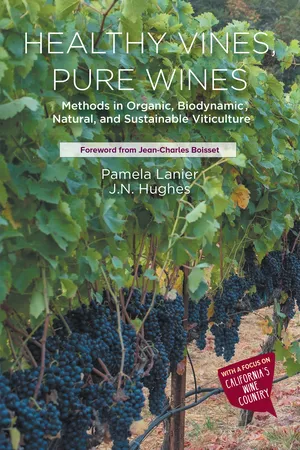
Healthy Vines, Pure Wines
Methods in Organic, Biodynamic®, Natural, and Sustainable Viticulture
- 166 pages
- English
- ePUB (mobile friendly)
- Available on iOS & Android
eBook - ePub
Healthy Vines, Pure Wines
Methods in Organic, Biodynamic®, Natural, and Sustainable Viticulture
About this book
Healthy Vines, Pure Wines serves as a guide, which derives its information from real-world sources to share green practices in sustainable viticulture in a practical way. Including a how-to on treating vineyard issues organically, a look at how climate change is affecting viticulture, and a special focus on women in the field, this handbook maintains a forward focus.
Information
Topic
CommerceSubtopic
AgrobusinessCHAPTER 1
Standards and Certifications
For a bottle of wine to carry a sustainable label, all components of the process must meet the certification requirements, meaning there’s a difference between organic wine and wine made from organic grapes.
California Certified Organic Farmers (CCOF) and United States Department of Agriculture (USDA) Organic:
California Certified Organic Farmers (CCOF) is a USDA-accredited organic certifying agency and trade association, located in Santa Cruz, California. Formed in 1973, CCOF was the first organic certification entity in the United States,1 though it operated only in California until the USDA created its own organic certification.
Due to this decentralized approach, there was a lack of clarity about what organic meant from state to state. A movement grew to develop a national organic standard to help facilitate interstate marketing. In response, Congress passed the Organic Foods Production Act (OFPA) in 1990 to develop a national standard for organic food and fiber production. OFPA mandated that USDA develop and write regulations to explain the law to producers, handlers, and certifiers. After years of work, final rules were written and implemented in fall 2002.2
For wine to be sold as organic, both the growing of the grapes and their conversion to wine must be certified. This includes making sure grapes are grown without synthetic fertilizers and in a manner that protects the environment and preserves the soil. Other agricultural ingredients that go into the wine, such as yeast, also have to be certified organic. Any nonagricultural ingredients must be specifically allowed on the National List of Allowed and Prohibited, and can’t exceed 5 percent of the total product. And while wine naturally produces some sulfur dioxide (sulfites), they can’t be added to organic wine. Sulfites are commonly added to wines to stop the fermentation process, preserve the flavor profile, and keep the wine from oxygenating.
Wines that are sold as “made with organic grapes” have different requirements than organic wine. When a wine is labeled as being made with organic grapes, 100 percent of those grapes used must be certified organic. Yeast and any other agricultural ingredients aren’t required to be organic, but have to be produced without excluded methods (like genetic engineering). As for nonagricultural ingredients, these have to be specifically allowed on the National List. Finally, sulfites may be added to wines that carry the “made with organic grapes” label, up to 100 parts per million.3
Organic certification is generally focused on prohibiting the use of nonsynthetic materials on plants and soil, while sustainable certification includes issues like energy use, waste management, water conservation, and human resources.
The Sonoma County certification program does include a prohibition of certain red listed pesticides and other materials, and a yellow list of discouraged but allowed materials.4

Demeter Biodynamic® Certification
Demeter USA is the only certifier for Biodynamic® farms and products in America. It is part of a worldwide organization, Demeter International, which was first formed in 1928 to advocate Biodynamic® agriculture and to certify Biodynamic® farms. Demeter remains the oldest ecological certification organization in the world, active in 50 countries around the globe.5
Two criteria distinguish it from other forms of organic farming6:
• The use of a complex system of herbal sprays and composting techniques, known as preparations
• The timing of the operations on the land, which is strictly regulated by the movements of the spheres
LODI RULES for Sustainable Winegrowing:
LODI RULES began as a mission in 1992 to educate others and diminish the use of pesticides, eventually turning into a formal certification program with more than 1,000 certified vineyards to date. The LODI RULES program was launched in 2005 and is headquartered just south of Sacramento in one of the few American viticulture areas (AVA) with ancient vines that survived through the Prohibition era.

LODI RULES has six areas of focus: (1) business management, (2) human resource management, (3) ecosystem management, (4) soil management, (5) water management, and (6) pest management; and over 100 sustainability practices that are called Standards, which have been peer reviewed by scientists, academics, and environmental organizations. Annual verification is required.
Today three variations of those rules exist: LODI RULES, CALIFORNIA RULES, and a universal RULES seal. Each seal has the same requirements for certification; seal usage will differ based on where the winery or vineyard is located.
Regenerative Organic Certified (RGO)
Regenerative Organic Certified was established in 2017 by a group of farmers, business leaders, and experts in soil health, animal welfare, and social fairness collectively called the Regenerative Organic Alliance. Their goal is to heal a broken system, repair a damaged planet, and empower farmers and consumers to create a better future through better farming.
By adopting regenerative organic practices on more farms around the world, they hope to create long-term solutions to some of the biggest issues of our time, including the climate crisis, factory farming, and fractured rural economies.
Sustainability Certifications
While organics mainly concerns a focus on products used, sustainability certifications are concerned with water and energy efficiency in the vineyard and winery. They vary greatly because of the environmental needs of differing regions and how organizations have decided to measure efficiency.
California Sustainable Winegrowing Alliance (CSWA) and Certified California Sustainable Vineyard and Winery (CCSW)

CSWA started as the Sustainable Winegrowing Program in 2001. Members of Wine Institute and the California Association of Winegrape Growers (CAWG) created the program to promote vineyards and winery practices that are sensitive to the environment, responsive to the needs and interests of society-at-large, and economically feasible to implement and maintain. CAWG is a public policy advocacy group of wine grape growers, representing more than 60 percent of the total annual grape crush. Together, the Wine Institute and CAWG developed the Code of Sustainable Winegrowing Practices workbook as the basis for the Sustainable Winegrowing Program, providing a tool for vintners and growers to assess their practices and learn how to improve their overall sustainability. Wine Institute and CAWG formed the California Sustainable Winegrowing Alliance to assist in program implementation.
Several of the state’s winegrowing regions and other organizations have sustainable and environmental certification programs, many of which provided the foundation for the statewide California Sustainable Winegrowing Program (CSWA), and all of which play an important role in the ever-expanding tapestry of the California wine community’s efforts to produce high quality wine. California wine grape growers and vintners have multiple factors to consider when choosing the right certification program, and we encourage growers and vintners to consider all options available before choosing.
CCSW has eight years of recognition in the marketplace and was ranked as the most known sustainability certification program by 457 US wine trade in a recent trade survey (December 2016, Wine Opinions). CSWA expects that recognition to grow, as the program’s growth continues to increase every year. In addition, CCSW is included in the domestic and international communications efforts of CSWA and Wine Institute, which has export marketing programs in 25 countries. The further the distance from California, the more important it becomes for wine regions and AVAs to identify as being under the California umbrella.
While CSWA advocates for the adoption of sustainable practices regardless of vineyards’ and wineries’ decision to pursue certification, CCSW can add credibility to sustainability claims. The new CCSW logo for wine labels indicates that both the winery is certified and 85 percent or more of the grapes are from certified vineyards. CSWA accepts Lodi Rules and SIP-Certified in the 85 percent rule for certified grapes because the programs also cover the 3 E’s of sustainability and include comparable required practices, transparent standards, continuous improvement, and annual third-party audits.7
Napa Green
According to their website, Napa Green Land is currently an umbrella program that recognizes growers with validated environmental compliance and verified Farm Plans as meeting our standards for watershed stewardship. These vineyard owners and managers develop custom, whole-property Farm Plans to:
• Prevent erosion and sediment runoff
• Reduce and eliminate potentially harmful inputs
• Conserve water resources through efficient irrigation and frost protection
• Protect and restore riparian habitat
• Contribute to a healthy and thriving Napa River watershed
Napa Green also certifies wineries, with a separate labe...
Table of contents
- Cover
- Half-Title Page
- Title Page
- Copyright
- Dedication
- Description
- Contents
- Acknowledgments
- Foreword by Jean-Charles Boisset
- Introduction
- Chapter 1 Standards and Certifications
- Chapter 2 Profiles in Sustainable Viticulture: “Amigo Bob” Cantisano
- Chapter 3 Farming Techniques and Practices
- Chapter 4 Organically Treating Common Vineyard Issues
- Chapter 5 Climate Change Changes Wine
- Chapter 6 Women, Regenerative Agriculture, and Natural Wine
- Chapter 7 Organic, Biodynamic®, and Sustainable Wineries and Vineyards of California’s North Bay Wine Country
- Chapter 8 Boisset Collection: Raymond Vineyards and Deloach Vineyards
- Chapter 9 An Interview With Sam and Phil Coturri; Organic Leaders
- Chapter 10 Making Wine at Home
- Chapter 11 Petaluma Gap AVA: Establishing a New American Viticultural Area
- Glossary & Terms
- Further Exploration and Learning
- Works Cited
- About the Authors
- About the Contributors
- Index
- Backcover
Trusted by 375,005 students
Access to over 1.5 million titles for a fair monthly price.
Study more efficiently using our study tools.
Frequently asked questions
Yes, you can cancel anytime from the Subscription tab in your account settings on the Perlego website. Your subscription will stay active until the end of your current billing period. Learn how to cancel your subscription
No, books cannot be downloaded as external files, such as PDFs, for use outside of Perlego. However, you can download books within the Perlego app for offline reading on mobile or tablet. Learn how to download books offline
Perlego offers two plans: Essential and Complete
- Essential is ideal for learners and professionals who enjoy exploring a wide range of subjects. Access the Essential Library with 800,000+ trusted titles and best-sellers across business, personal growth, and the humanities. Includes unlimited reading time and Standard Read Aloud voice.
- Complete: Perfect for advanced learners and researchers needing full, unrestricted access. Unlock 1.5M+ books across hundreds of subjects, including academic and specialized titles. The Complete Plan also includes advanced features like Premium Read Aloud and Research Assistant.
We are an online textbook subscription service, where you can get access to an entire online library for less than the price of a single book per month. With over 1.5 million books across 990+ topics, we’ve got you covered! Learn about our mission
Look out for the read-aloud symbol on your next book to see if you can listen to it. The read-aloud tool reads text aloud for you, highlighting the text as it is being read. You can pause it, speed it up and slow it down. Learn more about Read Aloud
Yes! You can use the Perlego app on both iOS and Android devices to read anytime, anywhere — even offline. Perfect for commutes or when you’re on the go.
Please note we cannot support devices running on iOS 13 and Android 7 or earlier. Learn more about using the app
Please note we cannot support devices running on iOS 13 and Android 7 or earlier. Learn more about using the app
Yes, you can access Healthy Vines, Pure Wines by Pamela Lanier,Jessica Nicole Hughes in PDF and/or ePUB format, as well as other popular books in Commerce & Agrobusiness. We have over 1.5 million books available in our catalogue for you to explore.