Environment Impact Assessment
eBook - ePub

Environment Impact Assessment

Precept & Practice

  1. 352 pages
  2. English
  3. ePUB (mobile friendly)
  4. Available on iOS & Android
eBook - ePub

About this book

Environment Impact Assessment: Precept & Practice deals with theoretical, practical, managerial and legal issues in multidisciplinary holism to suit Indian environmental planning and governance. Environment Impact Assessment is not only considered a tool for sustainable development but a promissory augury of creation of equitable regime of for ecosystem governance. The book is laced with polemical issues in dexterous detail to cater erudite demand of environmental planners besides fulfilling the void of curriculum and pedagogic requirements of technical universities, environmental management and legal studies. The book offers diversity of thoughts across discipline on Environment Impact Assessment discourse in rounded perspective having immense potential for textual and reference utilities. The treatment of subject is not only discursive but paradigmatic to eradicate contemporary crisis in Environment Impact Assessment regime. It combines theoretical postulate with deeper empiricism and penetrative case studies to make an intriguing subject of Environment Impact Assessment with greater ease and lucidity.

Note: T&F does not sell or distribute the Hardback in India, Pakistan, Nepal, Bhutan, Bangladesh and Sri Lanka.
Frequently asked questions

Yes, you can cancel anytime from the Subscription tab in your account settings on the Perlego website. Your subscription will stay active until the end of your current billing period. Learn how to cancel your subscription.
No, books cannot be downloaded as external files, such as PDFs, for use outside of Perlego. However, you can download books within the Perlego app for offline reading on mobile or tablet. Learn more here.
Perlego offers two plans: Essential and Complete
  • Essential is ideal for learners and professionals who enjoy exploring a wide range of subjects. Access the Essential Library with 800,000+ trusted titles and best-sellers across business, personal growth, and the humanities. Includes unlimited reading time and Standard Read Aloud voice.
  • Complete: Perfect for advanced learners and researchers needing full, unrestricted access. Unlock 1.4M+ books across hundreds of subjects, including academic and specialized titles. The Complete Plan also includes advanced features like Premium Read Aloud and Research Assistant.
Both plans are available with monthly, semester, or annual billing cycles.
We are an online textbook subscription service, where you can get access to an entire online library for less than the price of a single book per month. With over 1 million books across 1000+ topics, we’ve got you covered! Learn more here.
Look out for the read-aloud symbol on your next book to see if you can listen to it. The read-aloud tool reads text aloud for you, highlighting the text as it is being read. You can pause it, speed it up and slow it down. Learn more here.
Yes! You can use the Perlego app on both iOS or Android devices to read anytime, anywhere — even offline. Perfect for commutes or when you’re on the go.
Please note we cannot support devices running on iOS 13 and Android 7 or earlier. Learn more about using the app.
Yes, you can access Environment Impact Assessment by K. M. Baharul Islam, Zafar Mahfooz Nomani, K. M. Baharul Islam,Zafar Mahfooz Nomani in PDF and/or ePUB format, as well as other popular books in Biological Sciences & Ecology. We have over one million books available in our catalogue for you to explore.

Information

Publisher
CRC Press
Year
2021
Print ISBN
9781032055824
eBook ISBN
9781000425901

Chapter 1
Genuine Savings Rates in India: An Indicator of Measuring Environmental Sustainability
*

M. Balasubramanian
* This paper has presented international Conference on ā€œEnvironment, Technology and Sustainable Development: Promises and Challenges in the 21st Century, held on 2nd to 4th March, 2014 organized by ABV-Indian Institute of Information
Abstract: GDP’s current role poses a number of problems. A major issue is that it interprets every expense as positive and does not distinguish welfare enhancing activity from welfare-reducing activity. Nations, need indicators that measure progress towards achieving their goals – economic, social, and environmental. The traditional measures of investment and saving are relied upon measures based on income. The natural environment is omitted from the accounting algorithm and thus, depreciated physical capital is included, whereas, depletion of environmental resource was excluded. The World Bank attempted to make the inclusion of natural and human capital into the saving measurement, and has developed a measure known as ā€œgenuine saving’ which comprises physical, human and natural capital. This paper has calculation of genuine saving rates in India and policy implications of the measures. The paper suggests that Indian approach is needed to appropriately address sustainability issues and to incorporate natural capital in national accounting.
Keywords: Gross Domestic Product, Welfare-Reducing Activity, Genuine Savings Rates, Natural and Human Capital, Environmental Sustainability

1.1 INTRODUCTION

In conventional national income accounts, net savings is obtained by deducing only depreciation of physical capital from gross saving1. It is well understood that GNP and GDP offer an incomplete answer to the sustainability question as they omit non-marketed public goods such as environmental quality (Nordhaus, 2000). The genuine savings measure proposed by World Bank (1999). Achieving sustainable development necessarily entails creating and maintaining wealth. Given the centrally of savings and investment in economic theory, it is surprising that the effects of depleting natural resources and degrading the environment have not, until recently, been considered in measurements of national savings (Hamilton and Clemens 1999). The true rate of saving in nation after due account is taken of the depletion of natural resources and the damages caused by pollution. The new estimates of genuine saving feature broader coverage of natural resources, improved data and methods of calculation, and significant enhancement in the treatment of human resources (World Bank 1997). Pearce and Atkinson (1993) introduced a measure of sustainable development based on a net saving criterion and Hamilton (1994) has called this measure genuine savings and provided an extended framework for a more consistent treatment of natural asset loss. Genuine savings is derived as follows. A measure of gross domestic product and ā€œgreenā€ net national product (NNP) in an economy with natural resources and environmental assets is (see Hartwick, 1993; Maler, 1991; Hamilton, 1994; Atkinson et al.1997). The main objective of the paper is analyse genuine saving calculation in India. The plan of the paper is as follows. In section 1.1 details discussion of genuine saving. In section 2 review of literature. Section 3 extends the theory and methodology of the paper. In section 4 use data for the period 1970–2008 to study the genuine saving calculation. Section 5 results and discussion and conclusion and policy implication presented in final section.
1 Pearce and Atkinson (1993), Hamilton (1994, 1997, 1998), Weitzman (1996), Hartwick (1997), World Bank (1997, 2006), Atkinson et al (1998), Dasgupta and Maler (2000), Hamilton and Clemens (1999), Arrow et al (2003), Neumayer (2004, 2006)

1.1.1 Genuine Savings

Genuine saving provides a much border indicator of sustainability by valuing changes in natural resources, environmental quality, and human capital, in addition to the traditional measure of changes in produced assets provided by net saving (World Bank 2006).
Genuine saving is useful to policy makers not only as an indicator of sustainability, but as a means of presenting resource and environmental issues within a framework familiar to finance and development planning ministers. It underlines the need to boost domestic savings, and hence, the need for sound macroeconomic policies and it highlights the fiscal aspects of environment and resource management, since collecting resource royalties and charging pollution taxes are basic ways to both raise development finance and ensure efficient use of the environment. (World Bank, 2006).
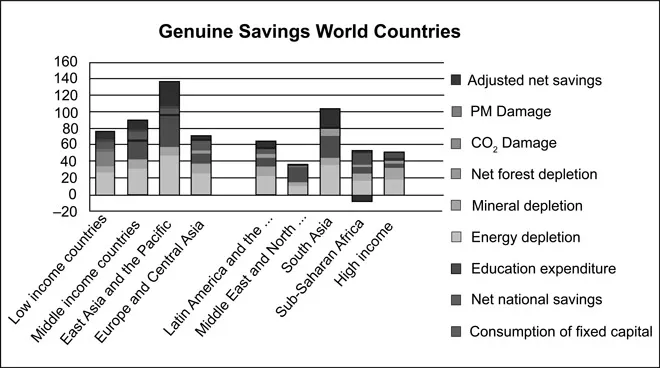
Genuine savings measure seems useful as it calls for such good things as net investment in physical capital, investment in education, and subtraction from GDP of net value of natural resource depletion and the net value of environmental damage. Genuine savings indicator which is one of the best known methods to express different aspects of sustainable development in monetary terms. It is computed from the figure for net domestic savings (assumed to comprise net additions to, or investment in, human capital minus depletion of energy, mineral, and forest resources, and damage from CO2 emission). The notion of genuine saving is presented briefly and informally in Hamilton (1994) and Perace, Hamilton and Atkinson (1996). Genuine savings have some conceptual issue and data limitations are also discussed by the World Bank2 Fig 1.1 Show genuine saving of world counties.
2 See Friend (2000), Hamilton Clemens (1999), World Bank (1997, 1999), Neumayer (2004, 2006, 2007), Brown et al (2003)
Fig.1 .1: Genuine saving World Countries
Fig. 1.1: Genuine saving World Countries
Source: Author’s calculation
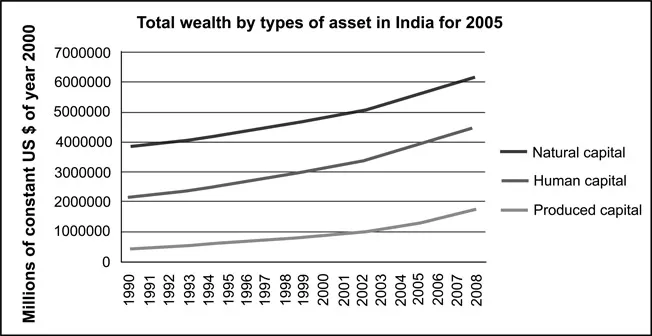
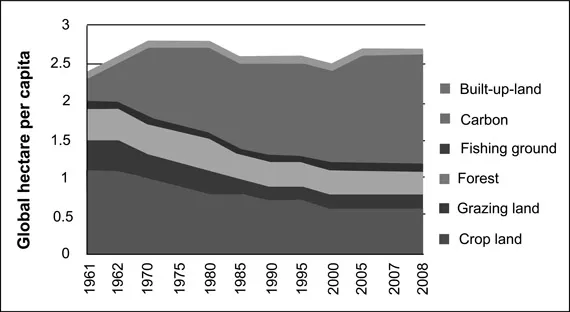
An interest in the relationship among national income, wealth and welfare has revived in the recent years, driven in large part of concern about the long-run consequences of natural resource depletion and environmental degradation (Dasgupta 2003). Pearce and Atkinson (1993) provided one of the earliest suggestions for an indicator of weak sustainability: an adjusted national savings measure that accounts for the depletion of natural resources and the environment. The underplaying concept of sustainability is ā€œweakā€ because it does not take account of any thresholds in critical natural asset or limits to sustainability of natural and produced asset. Hamilton (1996) developed welfare measures to accounts for living and non-living resources, resource discoveries and different varieties of pollutants in a similar extended national accounting framework – the corresponding saving measures, equivalent to that of Pearce and Atkinson (1993). Figure 1.2 and 1.3 respectively global percapita ecological footprint3 by components and total wealth by types of asset in India for 2005.
3 Ecological in 1997. constitute an accounting quantifying footprint and biocapacity of nations began footprint the annual framework supply is Global network initiated footprint of, and demand for National accounts program in 2003, with the most key ecosystem two by means of edition recent issued in 2001. NFAs services measures Ecological Footprint: a measure of the demand populations constitute annual an accounting supply framework quantifying the of, and demand and activities given place the biosphere a in year, given on for key the technology ecosystem services two by means of prevailing and resources management of that year. measures Ecological Footprint: a measure of the demand populations and Biocapacity: a measure of the amount of biologically productive land and activities place on the biosphere sea area available to the in a given year, given the prevailing technology and resources provide ecosystem services that management of that year. humanity consumes-our-ecological budget or nature’s regenerative Biocapacity: a measure of the amount of biologically productive land capacity. Indi a’s ecological foot print presented Table 4. and sea area available to provide the ecosystem services that humanity consumes-our-ecological budget or nature’s regenerative capacity. India’s ecological foot print presented Table 4.
Fig 1.2: Global percapita Ecological Footprint, by component, 1961–2008
Fig. 1.2: Global percapita Ecological Footprint, by component, 1961–2008
Source: Author’s calculation
Fig.1.3: Total wealth by types of asset in India for 2005
Fig. 1.3: Total wealth by types of asset in India for 2005
Source: Author’s calculation

1.2 LITERATURE

An extended net or genuine saving has a central place in any portfolio of indicates purporting to measure the sustainability of development to be firmly appears now (UNECE 2007; Stiglitz, Sen and Fitoussi 2009; World Bank 2010). Pearce and Atkinson (1993) were among the...

Table of contents

  1. Cover
  2. Half Title
  3. Title Page
  4. Copyright Page
  5. Preface
  6. Contents
  7. Section I: Environment Impact Assessment, Sustainability & Security
  8. Section II: Environment Impact Assessment & Technological Innovations
  9. Section III: Environment Impact Assessment Climate Change & Information Management
  10. Section IV: Environment Impact Assessment & Indian Laws & Policies
  11. Section V: Environment Impact Assessment & Sectoral Planning