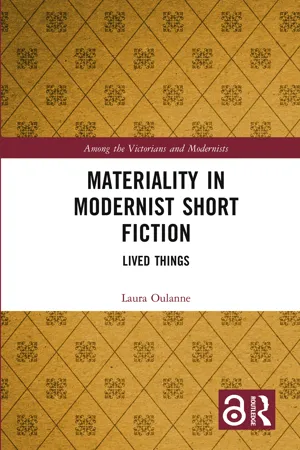
Materiality in Modernist Short Fiction provides a fresh approach to reading material things in modern fiction, accounting for the interplay of the material and the cultural. This volume investigates how Djuna Barnes, Katherine Mansfield, and Jean Rhys use the short story form to evoke the material world as both living and lived, and how the spaces they create for challenging gendered social norms can also be nonanthropocentric spaces for encounters between the human and the nonhuman. Using the unique knowledge created by literary works to spark new conversations between phenomenology, cognitive studies, and new materialisms, complemented with a feminist perspective, this book explores how literature can touch the basic experience of being in, feeling and making sense of a material world that is itself alive and active. From a sensitive reading of how three women used the material world to make their readers see, feel, and question the norms shaping our experience, this volume draws a theory of reading affective materiality that illuminates modernism and the short story form but also reaches beyond them.
- 172 pages
- English
- ePUB (mobile friendly)
- Available on iOS & Android
eBook - ePub
About this book
Information
1 Introduction
A man, dressed in an evening suit and a top hat, is crawling through the undergrowth around a country house.1 Two children are sitting on a landing, looking down at preparations being made for a party, and thinking that they are observing plants and furniture moving on their own. A woman from Martinique stands in a shabby London flat, holding her best dress in her arms and crying. These scenes in short stories by Djuna Barnes (1892–1982), Katherine Mansfield (1888–1923), and Jean Rhys (1890–1979) are not necessarily their most important turning points or defining moments. Regardless, they convey a powerful sense of a meaningful experience that might stick with a reader as an image or a feeling, even after forgetting the names of characters or the general plotline of the story.
All these moments feature human characters interacting with things, that is, material, inanimate entities: clothes, natural debris, and furniture. The initial motivation behind this book is the insight that things have an important role to play in such affective moments in the short fiction of Barnes, Mansfield, and Rhys, so much so that to view them merely as background and props for the action of the stories is to overlook their possible importance. I will suggest that modernist fiction in general calls for a reading more aware of the presence of things and materiality, and further, that all narrative fiction might open up for such awareness. Material things help to shape characters’ identities, provide indirect symbolic allusions, and convey information about historical time—all this is the familiar stuff of literary studies. However, this list of tasks does not completely account for their importance in fiction in general, or in these particular stories. First, material things can and need to be seen as agents in their own right, changing the course of the narratives, and affecting their characters as well as their readers; second, human beings interact and intermingle with the world of things through their lived bodies, and this fictional sense experience often translates into the most memorable instances of the stories for the reader. Sometimes even the idea that material things surround characters or fictional worlds might be a product of habitual human-centered thinking: it could equally well be said that characters surround or gather around things.
It has become an acknowledged necessity that even scholars in the humanities find new ways of recognizing the nonhuman players in this world. We are reminded of this by urgent ecological crises as well as posthumanist, new materialist, and ecocritical approaches to art and culture. Furthermore, emerging paradigms in cognitive sciences and philosophy of mind suggest that the interaction between our bodies and the material environments we inhabit is essential for the emergence of our experience, emotions, cognition, and even language. Importantly, this vein of thinking has also emerged within narrative studies. Human beings are bound not only to what phenomenologists call the “lived body” but also to the material world in which this subjectively felt, acting body is situated, among other, nonhuman bodies. Therefore, the title of this book suggests that the experience of being-in-the-world as a lived body in lived space is accompanied and partly defined by “lived” and lively things occupying this space and that this aspect of material things becomes highlighted in modernist short fiction.
While living with lived things, we remain cultural beings embedded in and shaped by our social environments, their norms, affordances, and restrictions that treat our lived bodies differently based on gendered categories, for instance. These cultural meanings unavoidably extend to the world of things as well—particularly the world of fictional things. Cultural and symbolic meanings, as noted above, also tend to dominate how these things are read. My book sets out to build a bridge between these ways of regarding the material world in narrative fiction. I propose an anti-anthropocentric approach to reading modern fiction that takes into account the materiality and affectivity of its fictional worlds and refrains from reducing them to human-centered categories of thinking, while asking how we make sense of fictional things, as human readers who engage with social and cultural meanings as well as experiences of the material world. More specifically, I suggest that Djuna Barnes, Katherine Mansfield, and Jean Rhys use the short story form to evoke the material world as material, that is, felt, lived, and sensed, and thereby to create potential spaces for challenging gendered social norms of, among other things, fetishism, family, life narratives, and empathy. By showing how the texts do this, I hope to demonstrate that this kind of reading not only changes how we can interpret specific modernist short stories but also opens up new pathways to see connections between the material, the formal, and the cultural in any narrative fiction.
The book is structured around the interconnected themes of power, agency, affectivity, and meaning. It asks how short stories by Barnes, Mansfield, and Rhys create a fictional “feel” for materialities and how this is conductive to the creation of experiential knowledge, meanings, and values. What kind of power and agency do material things have in the stories and how do they differ from human agents? What is their role in affective encounters and relations in the fictional worlds of the texts and how do they contribute to the potential evocation of readerly emotions? How do material things participate in the production of meaning and the processes of sense-making and interpretation involved in reading them? To provide the attention that the things in the fictional works seem to demand for themselves, I combine phenomenological and cognitive approaches to literature and reading with anti-anthropocentric thinking of the ways human culture and experience are entangled in different nonhuman materialities. These approaches are in line with the feminist understanding that informs this book, recognizing that the experience of materialities is always already a gendered phenomenon and that attention to such experience in fiction also reveals how the writers depict what it is like to be in the material world as a gendered subject, and most importantly, create spaces to reimagine both human-centered and gendered norms and categories. In the remainder of this introductory chapter, I will provide a brief overview of the starting points for my approach to lived things as material-cultural, affective agents in fiction and equally briefly chart and contextualize the texts and authors that will be read in the latter chapters.
Reading Things, Senses, and Meanings
“Things” might be the topic of the broadest study imaginable. This book is about something more specifict than anything oreverything, as hinted at by the inclusion of “lived” as well as the word “materiality” in its title. The things in the scenes referred to at the beginning of this introduction all share certain qualities: they are material items usually conceived of as inanimate that can be used or interacted with by human beings. Their materiality is something readers can be assumed to be familiar with as a simple result of living in the world. We carry clothes about our person, and they can be so close that we may not always experience them as things, but rather as extensions of our lived bodies; we attach certain meanings and categories to natural and artificial things; we have learned to hold books and look at works of art in a specific way. The things evoked in the passages also have more or less recognizable borders, according to which readers engaging with them imaginatively will separate them from the environment, as they have learned to do with the things encountered in everyday life.
My choice to write about “things,” not, for instance, “objects,” reflects the aim to highlight both the very materiality and the potential agency of things, instead of their position in a binary logic of subjects and objects. The material things in the texts may be the grammatical objects of sentences, which also imply a grammatical subject. However, these linguistic relations do not completely define what the things do in the fictional world and what they do to the readers of fiction. Things exist and occupy space with their materiality, regardless of who is looking at them or doing something to them and regardless of the meanings that encircle them. In addition, not all materialities that are present in Barnes’s, Mansfield’s, and Rhys’s fiction fit so easily under the definition of a “thing,” which implies more or less clear borders separating them from the environment. These include the undergrowth through which the man in a top hat is crawling, or other environments that we are invited to imagine, however vaguely, to make up the spaces of the rented room or the children’s house preparing for the party. Furthermore, the human bodies of the fictional characters are among the material existents in the stories, and as the analyses will show, the borderline between a human and a thing-body is not always clear-cut. Yet, for us humans, the world tends to be given as things, even if their boundaries sometimes overlap.
Things and materialities have taken center stage in some approaches to literature and culture that have emerged within the past 20 years. The initiator of “thing theory,” Bill Brown, suggests that researchers should pay attention to the “thingness” of things and our relations to them as they appear in art and literature (Brown 2003, 2004, 2016). One point of departure for Brown’s thinking is in Martin Heidegger’s writings about the thing (das Ding) as a part of the lifeworld, whose being always remains unattainable for humans when they approach their world by way of objects and tools, yet is somehow graspable in moments when an object refuses to work (like a broken tool or a dirty window) (Heidegger 1984, 73; Heidegger 1971; Brown 2016, 28). Ultimately, Heidegger’s thinking about “the thing” is much more complex and develops throughout his writings, while the tension between things as unattainable and obstinate or resisting, and the human attempt to understand something of their ways of being, is crucial for Brown’s use of the concept. Brown also draws on “actor-network theory,” Bruno Latour’s seminal attempt to recognize the diversity of agencies (or “actants,” a term borrowed from structuralist literary studies; see Greimas 1987) taking part in societies, including nonhuman ones (Latour 2005). Thing theory has led literary scholars to discuss, for instance, the narrative and political impact of 18th century stories narrated by things such as clothes, coins, and coaches (Lamb 2004) and the recalcitrance and obsolescence of things in American fiction (Tischleder 2014).
This book shares thing theory’s sense of distinction between objects and things and the general project of paying attention to the world of things, yet I find that this is not a sufficient approach for studying the way humans and things are intermingled in modernist short stories. The notion of “thing” is useful because it reflects the human tendency to see the world as divided into individual things, as opposed to the crude physical level of general materiality. Yet I wish to focus on is materiality in general and look at things with the added denominator of “lived.” Instead of only looking for the essence of things or thingness an sich as disclosed by the fictional work, the aim is to grasp more flexible, fluid, and potentially elusive relationships, in which the common denominator of materiality encompasses people, things, and environments alike. Instead of emphasizing the otherness of things, or their withdrawal into themselves (cf. also Harman 2002, 4), the literary texts at the heart of this research point toward a need to study how a human being-in-the-world is entangled in and defined by the presence of materiality and things. Material things may resist our actions when they cease to work for us as tools and objects, or as symbolic entities to guide the interpretation of a story. However, things also take active part in human lives, from the ways our bodies interact with and are permeated by chemical matter of the “environment” to the way appliances, means of transportation, and furniture direct our movements, postures, and relationships.
New materialisms, which are perhaps no longer so “new” but still developing, have emerged as part of a “material turn” in the humanities, a reaction to directions in postmodern thought resting on the primacy of language and social forms in constructing meanings, identities, and even bodies. This is also where the “new” materialisms differ from “old” materialism, whose origins can be attributed to Marx and which implies a focus on modes of production and economic systems, keeping the human at its center and the subject/object divide more or less intact, while new materialists work to challenge it. Such perspective, however, does not mean disregarding language and culture. Rather, the attention to nonhuman materialities, and the material makings of the human, can complement the study of culture, language, and human experience, and vice versa; new materialist thinking builds on the insight that “our material lives are always culturally mediated, but they are not only cultural” (Coole and Frost 2010, 27). The “material” of new materialism is not a lifeless lump of unattainable reality on which meanings are inscribed by linguistic and cultural practices: matter and bodies, too, produce meanings and actions (Coole and Frost 2010, 6; Bennett 2010, 1–4).
Fictional things need not be personified or magically animated to appear as lively and active, and to have an effect on us. Their seemingly mute and unattainable being is already permeated by life and agency of its...
Table of contents
- Cover
- Half Title
- Series Page
- Title Page
- Copyright Page
- Contents
- List of Figures
- Acknowledgments
- List of Abbreviations
- 1 Introduction
- 2 Powerful Things
- 3 Lively Things
- 4 Touching Things
- 5 Making Sense of Things
- 6 Conclusion: Reading Affective Materiality
- Index
Trusted by 375,005 students
Access to over 1.5 million titles for a fair monthly price.
Study more efficiently using our study tools.
Frequently asked questions
Yes, you can cancel anytime from the Subscription tab in your account settings on the Perlego website. Your subscription will stay active until the end of your current billing period. Learn how to cancel your subscription
No, books cannot be downloaded as external files, such as PDFs, for use outside of Perlego. However, you can download books within the Perlego app for offline reading on mobile or tablet. Learn how to download books offline
Perlego offers two plans: Essential and Complete
- Essential is ideal for learners and professionals who enjoy exploring a wide range of subjects. Access the Essential Library with 800,000+ trusted titles and best-sellers across business, personal growth, and the humanities. Includes unlimited reading time and Standard Read Aloud voice.
- Complete: Perfect for advanced learners and researchers needing full, unrestricted access. Unlock 1.5M+ books across hundreds of subjects, including academic and specialized titles. The Complete Plan also includes advanced features like Premium Read Aloud and Research Assistant.
We are an online textbook subscription service, where you can get access to an entire online library for less than the price of a single book per month. With over 1.5 million books across 990+ topics, we’ve got you covered! Learn about our mission
Look out for the read-aloud symbol on your next book to see if you can listen to it. The read-aloud tool reads text aloud for you, highlighting the text as it is being read. You can pause it, speed it up and slow it down. Learn more about Read Aloud
Yes! You can use the Perlego app on both iOS and Android devices to read anytime, anywhere — even offline. Perfect for commutes or when you’re on the go.
Please note we cannot support devices running on iOS 13 and Android 7 or earlier. Learn more about using the app
Please note we cannot support devices running on iOS 13 and Android 7 or earlier. Learn more about using the app
Yes, you can access Materiality in Modernist Short Fiction by Laura Oulanne in PDF and/or ePUB format, as well as other popular books in Literature & North American Literary Collections. We have over 1.5 million books available in our catalogue for you to explore.