eBook - ePub
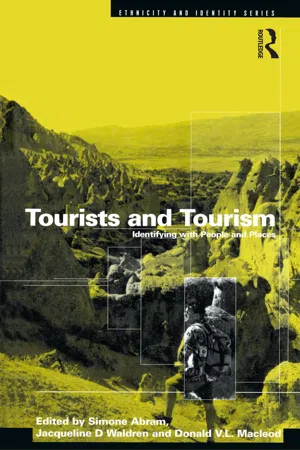
Tourists and Tourism
Identifying with People and Places
- 260 pages
- English
- ePUB (mobile friendly)
- Available on iOS & Android
eBook - ePub
About this book
The fact that tourism is a major global industry forecast to continue its dramatic growth well into the twenty-first century is often cited as a rationale for its analysis. However, while the connection between individual locations and the world's global markets is an obvious product of tourism, the heart of the tourist experience is the construction of identity: the relation of the traveller to resident populations; the participants' views of themselves and others; tourists' search for authenticity and their testing of boundaries.This book significantly furthers current debates on tourism by asking important and vexing questions about the nature of the tourist experience: 'folk museums' that forget many of the 'folk' who live in the areas represented; the environments and events that are shaped to meet the 'imagined dreams' of tourist spectators; the categorization of visitors and returnees who take up residence and participate in the construction of 'local' identities; the evolving meanings associated with indigenous culture, tradition, heritage, representation, reality and authenticity. In renegotiating the definitions of tourism for the new millennium, this book represents a major contribution to an emerging and highly topical area of study.
Information
1
Island Involvement and the Evolving Tourist
Introduction
This chapter examines tourism as a process, rather than its social and economic structures. Structure, however, has been at the forefront of the anthropology of tourism. In MacCannell’s book, The Tourist (1976), it is suggested that the structural paradigm in anthropology is best suited to handle the subject of tourism. Following in the footsteps of Durkheim and Levi-Strauss, he suggests that ‘tourist attractions are an unplanned typology of structure that provides direct access to the modern consciousness or “world view”, … tourist attractions are precisely analogous to the religious symbolism of primitive people’ (1976:2). Many other authors, while not ascribing a structuralist paradigm to their work, begin their enquiries by attempting to define ‘tourism’. This not only boxes in the parameters of their studies, but also presupposes a very limited role, with minimal flexibility for the tourists themselves. In one article, Cohen warns us of the dangers of stereotyping the tourist. He provides a number of examples in which a tourist might deviate from being a ‘voluntary, temporary traveller, travelling in the expectation of pleasure from the novelty and change experienced on a relatively long and non-recurrent round-trip’ (1974:533). By so doing, Cohen allows for a degree of flexibility in our structural, definitional typologies; but they remain with us just the same.
When tourism researchers show an interest in socio-cultural change, it is usually for that of the receiving community, and takes the form of an impact study (cf. Milman and Pizam 1988; Dogan 1989; Wilkinson 1989). The tourists themselves, as Nunez and many others have suggested, are ‘less likely to borrow from their hosts than their hosts are from them’ (1978:208); hence ‘etic’ definitions of ‘tourists’ are felt to encompass all tourist identities. Tourists and the industry of ‘tourism’ that they represent have been seen as contributors to and carriers of a host of changes and ‘pressures exerted from the centre’ (Cohen 1987: 16) which corrode ‘traditional’ ways of life in remote areas, and are held responsible for the ‘destruction of savagery and nature’ (MacCannell 1992: 18). The tourist has not been seen as one who may be more than just briefly changed by his experience, but as one who consistently effects change.
A corollary to the more traditional gaze at tourist impact is represented in the recent attention given to the construction of ‘place’ through tourism (cf. Gold and Gold 1995; Urry 1995). This, however, is more about the ways in which the past and future of a locale are shaped for an imagined, stereotyped, and sometimes demonized tourist ‘clientele’ than it is about the felt identity shifts that take place within the ‘touring’ individuals whose relationships with other people and locales alter through time. Studies of ‘space’ and ‘place’ can only benefit from a closer examination of tourist experiences and identities. This chapter sets out to show how these identities are not always so static and impenetrable by beginning, not with an ascribed academic definition of the study group, but with the terms and definitions expressed by residents of a small, rural, island community. In a volume of the Annals of Tourism Research, entitled ‘The Evolution of Tourism’ (Butler and Wall 1985), the authors carefully illustrate the continuity and change of touristic styles and the very structure of the tourist industry through time. This chapter is also concerned with an evolution through time, not at the industry level, but at the level of the individual tourist. It is, therefore, a study of tourist identity.
Issues of structure continue to inform a strong dualistic impulse in the anthropology of tourism. That ‘hosts’ and ‘guests’, for instance, always divide themselves into discrete units that are vastly different from one another is questionable, especially in studies of rural tourism in the UK. According to Smith, ‘even in complex societies in which economic disparities may be mitigated, the tendency to view visitors as “outsiders” is evident’ (1978: 7). And yet, as Urry points out, ‘some places only exist because of visitors … such as the Lake District… [and] visitors are in a sense as much local as are “real” locals’ (1995: 166). The semantic wrestling that we do with identity categories (for example the visitor-local vs the real-local) shows us that our typologies need further unpacking than we have allowed in our tourism studies thus far. The movement that an individual’s body and identity undergoes (from home in Glasgow to summer home in the Hebrides, for instance), as well as the fluidity found within named identity categories (for example ‘incomer’, ‘guest’, ‘islander’, ‘local’, etc.) are examined in this chapter.
To do this, material is drawn from three years of anthropological fieldwork (1984–7) on a small island in the Inner Hebrides of Scotland, as well as from oral history and written historical accounts about the island. I suggest that, in this small island context at least, tourism may be seen as one modern element in a larger process of shifting identities, whereby incomers may become islanders. This chapter will, therefore, emphasize process over structure, and will begin with individuals rather than with the industry of tourism per se. For those interested in how tourists affect the host community, this case study will perhaps provide an example of the ultimate ‘impact’, for it shows how tourists over time may possibly become part of and thus create the host community. The ethnographic, processual perspective adopted here gives added complexity to recent models of ‘the tourist’ experience.
Ethnography
I conducted field research on a small Inner Hebridean island off the west coast of Scotland, twelve miles long and three miles wide. From the sea, as the boat approaches from the south-east, all beaches and beauty spots are hidden from view, and the tourist sees only a long, flat, grey and generally uninviting rock. It takes three and a half hours on the Caledonian Macbrayne ferry to get to the island from the nearest mainland port, and during the period of my residence there, this ferry travelled only three times a week in the winter and four times a week in the summer season. Because of the infrequency of transport connections and the crack-of-dawn departure of the ferry, a trip to the island from the London area took around twenty-four hours. To all intents and purposes the island could be seen as a ‘remote area’ (Ardener 1987). Between 1984 and 1987, its resident winter population averaged 150, sixteen of whom were children between twelve and sixteen years old who attended high school and resided during term in school hostels on the mainland.
The island’s economy was, in the mid-1980s, based primarily on stock farming of sheep and cattle, and all the grazing land and fields outside the village were divided between seven owners. Other full-time and part-time occupations included lobster fishing, running basic services (such as the shops and the pier), and tourism. A characteristic of the island economy was that in order to make a living during all seasons, occupational pluralism was extensively practised. A fisherman might also work on the pier on boat days, drive the ‘school run’, and lead the coastguard. A woman working in the shop might also knit sweaters on commission and take in people for bed and breakfast. Of the winter population, about 75 per cent of the adults of working age were people who were not born on the island.
Relatively few visitors came to the island between October and May. Public places such as the pier on boat days, the two shops, and the one hotel pub were dominated during the winter by small but dedicated gatherings of people who shared local gossip, news about livestock and weather forecasts, and details about a myriad of evening social events in which they were involved. In the pier shed a little semicircle of these residents waited for the boat to bring food supplies and mail; in the shops groups assembled to wait for their bread and milk orders; and in the pub, a single arc of beer and whisky drinkers lined the counter and shared in a large and often quite expensive series of ‘rounds’.
The summer season was marked by an explosion of the population and a total shift in the atmosphere and social function of these public places. The groups either dispersed altogether or were divided and then expanded by new faces. Rounds in the pub, for instance, became directed at smaller groups of family and close friends or neighbours. As the population swelled in the summer to at least two or three times its winter size, residents recognised and reached out to include many of the new arrivals. A study of identity which avoids detailed attention to the part-time cast of characters that pass through the place would be only half a study. So: who were these summer visitors? When a summer ferry arrived, a single stream of people carried their bags and cameras down the passenger ramp, and vehicles packed solid with people and supplies drove off the car ramp. An island-born resident once joked that the whole island sinks a few inches during this time. The mass of visitors were carefully distinguished by the resident population as follows:
1. ‘Day-trippers’ were holiday-makers who took an advertised excursion trip on the Cal-Mac ferry and disembarked with only a light bag and camera to explore. Most of these visitors leisurely walked the quarter mile to the village, stopping at the gift shop. From there they either had a pub lunch in the hotel, or they set off walking on one of the two roads leading out of the village, and then turned back in time to catch the return ferry to the mainland, approximately three hours after their arrival.
2. ‘Yachties’, as the name implies, arrived not on the ferry but in their own boats. These yachts were moored in the village bay for anything from a few hours to an entire week. If it has been said that the term ‘tourist’ may in many places be locally imbued with derogatory meaning, the term ‘yachtie’ was just that much worse. Locals sometimes made snide remarks about these people, who were instantly recognised by their boating attire and yellow ‘wellies’. Perhaps this was a class-related prejudice, for one cannot instantly place a tourist off the ferry in any income bracket, but the yachties always appeared to be in a higher one. Also, people felt that ‘yachties’ only saw the island as another place where they could comfortably moor for the night, and that most were uninterested in the island per se. They also had a reputation for not spending much money on the island except at the hotel pub.
3. The term ‘tourist’ covered all other holiday-makers who did not own a home on the island, did not have kin there, or were not themselves originally from the island. It included people who stumbled upon the island in their search for remoteness, peace and wilderness, who would stay in either the hotel, the guest-house, rented cottages, bed-and-breakfast houses, tents, dormobiles, or caravans. Sometimes ‘tourists’ learned of the place through friends, and often stayed as house-guests on the island, although those who stayed with local families were usually just called ‘visitors’. ‘Tourists’ who enjoyed their visit, whether it was for two days or many weeks, often indicated that they appreciated the lack of a strong tourist infrastructure there. Some brought their own cars, others hired bicycles, mopeds or a ride in the guest-house jeep to get to see as much of the island as they could and to visit some of the best sandy beaches. Some travelled by foot or occasionally by hitching rides. Most tourists came from England, Wales, or mainland Scotland; but there were a few international tourists from the Continent, America, and Australia, for example. As the tourists departed on the boat at the end of their stay, many would probably never be seen again, and they would plan their next holiday in Amsterdam, Majorca or another Hebridean island. Urry suggests that ‘contemporary tourists are collectors of gazes The initial gaze is what counts and people appear to have less and less interest in repeat visits’ (1995: 138). And yet this is not true for all, and the question of why repeat visits are practised by some people in some places needs to be addressed. On the island discussed here, some tourists would find something particularly enchanting about the place and would plan to return, and their faces and names would become well known in time, locally.
4. Another species in the summer population were the ‘Summer-home people’, also aptly called the ‘Summer Swallows’. They came to ‘roost’ on the island during the summer, in homes they bought or built up from ruins. Most were professionals, such as musicians, writers, teachers, and business people, who could afford to leave their jobs for a considerable part of the year. Some of these had summered on the island for over thirty years. Many summer-home people who had rebuilt ruins did not (as Erik Cohen and others have noted of some tourists) wish to share life as it was really lived-they were perfectly aware that most islanders lived in council houses with central heating and all the modern amenities - but wished instead to live life as they believed it should be lived, or imagined that it once was lived, an example of the ‘countryside aesthetic’ that Harrison suggests developed in the nineteenth century amongst the professional middle class (Harrison cited in Urry 1995: 213). Hence their tendency to be found living in beautiful rustic stone cottages, with open fireplaces, exposed lintels and beams, neat stone crevices, hanging ancient tools and glass floats, wood-burning stoves, and outside toilets may contribute another material example of the cultural process Trevor-Roper (1983) has described as the invention of Highland culture and tradition. When one realises that more than 20 per cent of all lived-in dwellings on the island were summer homes, it becomes clear how easily their rather similar rustic remains could leave a strong pseudo-tradition behind for future archaeologists.
Of all the categories described so far, the summer-home people were more involved in the local community than the rest. They stopped in the street and talked to residents, or visited some of them in their homes, they sometimes made crafts to sell in the gift-shop, they attended local fund-raising events, such as dances and sales, and they entered their baking and artwork in the annual agricultural show. They sometimes illustrated their emotional commitment to the place by naming their children and/or pets after island characters and place-names. Full-time residents often commented about how Summer Swallows, despite their apparent zeal for the place, did not always contribute as much to the local economy as did day-trippers and short-term tourists, for they often cut costs by arriving with their vehicles laden with large food and fuel supplies, only purchasing perishables like milk and vegetables in the store.
‘Summer Swallows’ are a commonly found species in indigenous rural tourism in the UK. The sense of continuity and familiarity with places and people is what appeals to such holiday-makers. Consider the following excerpts from an article in The Scotsman, called ‘Short-changed by the Tourist Trade’, about a nameless Scottish island:
When the ferry arrives in the summer, exotic cars are disgorged, loaded to the roof and beyond with every conceivable requirement for a fortnight’s stay, even down to the family deep freeze on a trailer. They drive off to their crumbling holiday homes, bought for a song by London standards, but a fortune by highland ones, and used just two or three weeks in the year, while young islanders scramble for tumbledown...
Table of contents
- Cover
- Half Title
- Title Page
- Copyright Page
- Contents
- Acknowledgements
- Notes on Contributors
- Introduction: Tourists and Tourism - Identifying with People and Places
- 1 Island Involvement and the Evolving Tourist
- 2 Performing for Tourists in Rural France
- 3 We Are Not Tourists - We Live Here
- 4 More than the Beatles: Popular Music, Tourism and Urban Regeneration
- 5 Whose New Orleans? Music’s Place in the Packaging of New Orleans for Tourism
- 6 The Ideal Village: Interactions through Tourism in Central Anatolia
- 7 ‘Alternative’ Tourists on a Canary Island
- 8 Mas’ Identity: Tourism and Global and Local Aspects of Trinidad Carnival
- 9 Representations of Nepal
- 10 The South-east Asian ‘Living Museum’ and its Antecedents
- 11 Packaging the Wild: Tourism Development in Alaska
- Index
Trusted by 375,005 students
Access to over 1.5 million titles for a fair monthly price.
Study more efficiently using our study tools.
Frequently asked questions
Yes, you can cancel anytime from the Subscription tab in your account settings on the Perlego website. Your subscription will stay active until the end of your current billing period. Learn how to cancel your subscription
No, books cannot be downloaded as external files, such as PDFs, for use outside of Perlego. However, you can download books within the Perlego app for offline reading on mobile or tablet. Learn how to download books offline
Perlego offers two plans: Essential and Complete
- Essential is ideal for learners and professionals who enjoy exploring a wide range of subjects. Access the Essential Library with 800,000+ trusted titles and best-sellers across business, personal growth, and the humanities. Includes unlimited reading time and Standard Read Aloud voice.
- Complete: Perfect for advanced learners and researchers needing full, unrestricted access. Unlock 1.5M+ books across hundreds of subjects, including academic and specialized titles. The Complete Plan also includes advanced features like Premium Read Aloud and Research Assistant.
We are an online textbook subscription service, where you can get access to an entire online library for less than the price of a single book per month. With over 1.5 million books across 990+ topics, we’ve got you covered! Learn about our mission
Look out for the read-aloud symbol on your next book to see if you can listen to it. The read-aloud tool reads text aloud for you, highlighting the text as it is being read. You can pause it, speed it up and slow it down. Learn more about Read Aloud
Yes! You can use the Perlego app on both iOS and Android devices to read anytime, anywhere — even offline. Perfect for commutes or when you’re on the go.
Please note we cannot support devices running on iOS 13 and Android 7 or earlier. Learn more about using the app
Please note we cannot support devices running on iOS 13 and Android 7 or earlier. Learn more about using the app
Yes, you can access Tourists and Tourism by Simone Abram,Don Macleod,Jackie D. Waldren in PDF and/or ePUB format, as well as other popular books in Social Sciences & Hospitality, Travel & Tourism Industry. We have over 1.5 million books available in our catalogue for you to explore.