In November 1993 voters in Cincinnati, Ohio passed Issue 3, an amendment to the City Charter eliminating gay, lesbian, and bisexual persons' legal protection against discrimination and prohibiting their recognition as a group or class. This Christian right initiative emerged largely in response to the inclusion of "sexual orientation" in the city's newly enacted Human Rights Ordinance just one year earlier. Using qualitative data, Kimberly Dugan captures the dynamics and interdependence of the gay, lesbian, and bisexual movement and the Christian right as they engaged in conflict over Issue 3 by focusing on cultural factors relevant to movement mobilization, strategies, and success.
eBook - ePub
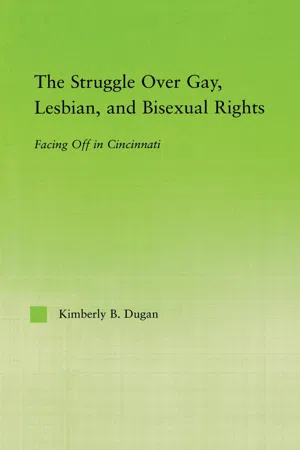
The Struggle Over Gay, Lesbian, and Bisexual Rights
Facing off in Cincinnati
- 160 pages
- English
- ePUB (mobile friendly)
- Available on iOS & Android
eBook - ePub
About this book
Information
Chapter One
Facing Off Over Gay Rights
In November 1993 voters in Cincinnati, Ohio passed Issue 3, an amendment to the City Charter eliminating gay, lesbian, and bisexual persons' legal protection against discrimination and prohibiting their recognition as a group or class. This anti-gay initiative emerged as a Christian Right response to a newly enacted gay rights law. Just one year prior to the passage of Issue 3, the majority of Cincinnati's City Council voted for a Human Rights Ordinance (HRO) that included "sexual orientation" as a protected category. The Human Rights Ordinance was a tremendous success for the gay, lesbian, and bisexual movement who long labored for recognition and protection against discrimination. But the victory celebration was short-lived. In rapid fashion, the Christian Right launched its Issue 3 campaign and emerged as a powerful political force in the "Queen City."
Cincinnati, Ohio has long been known for its conservativism. The city has a unique history filled with Christian and-"obscenity" and "pro-family" activism and successes, along with a surprising smattering of recent gay rights gains. The anti-gay Issue 3 was more than just another attack on progressive politics. It was an all-encompassing ballot initiative to amend the Cincinnati Charter to prevent the city from:
Enacting, adopting, enforcing or administering any ordinance, regulation, rule or policy which provides that homosexual, lesbian, or bisexual orientation, status, conduct, or relationship constitutes, entitles, or otherwise provides a person with the basis to have any claim of minority or protected status, quota preference or other preferential treatment.1
Sixty-two percent of Cincinnati voters voted in favor of this initiative.
The movement to pass Issue 3 was a direct response by the Christian Right to the achievements of the gay, lesbian, and bisexual movement. For the two years leading up to the Issue 3 campaign, the gay rights movement had scored major victories. In 1991 Cincinnati joined Akron, Columbus, and Yellow Springs, Ohio when the City Council put into law protections for gay city workers (Green 1991). Cincinnati's City Council responded favorably to the lobbying efforts of a coalition of local groups including Stonewall Cincinnati, (the leading gay rights organization in the city), the Greater Cincinnati Gay and Lesbian Coalition, and Gay and Lesbian March Activists (GLMA) (Rose 1990; Stonewall Cincinnati 2004). This Equal Employment Opportunities policy was the first significant victory for gay rights activists in Cincinnati (Stonewall Cincinnati 2004).
Riding on the momentum of their recent success, this coalition of gay rights organizations lobbied the Cincinnati City Council intensely for a progay Human Rights Ordinance for the city. In 1992 the Council voted 7-2 for the Human Rights Ordinance (Rose 1990). The first of its kind in the city, the Human Rights Ordinance protected Cincinnatians from discrimination in housing, employment, and public accommodations on the basis of, among other commonly protected categories, sexual orientation.2 The Ordinance did not provide any form of affirmative action extensions (e.g. in employment) on the basis of the categories therein, nor did it require compliance from religious organizations or associations.3
Gay, lesbian, and bisexual activists, along with members of other protected classes,4 fought long and hard to win this anti-discrimination legislation. It was not the first time the city was asked to decide on such protections. In 1978 the Ordinance failed to get the Council support needed to become law due to "roadblocks" including how the policy was written (Rose 1990). Now, more than a decade later, Cincinnati's gay, lesbian, and bisexual movement experienced the sweet smell of success. In a short time period, the City Council passed two important pieces of legislation in favor of gays and lesbians. One could only imagine what would come next.
The Issue 3 counterattack could have been predicted given the Christian Right's local history of action and accomplishment. Beginning in the 1980s, a newly created anti-pornography organization, Citizens for Community Values (CCV), along with vigilant pornography foe, then Sheriff Simon Lets,5 launched a massive anti-pornography campaign throughout the city. Together these forces rid the city of the sale of much pornographic print and video materials and closed local strip clubs.6 While CCV was created as an anti-pornography organization, its mission is stated far more broadly:
To unite the community in the promotion of traditional Judeo-Christian values which strengthen the moral character of the community and seek to change attitudes and behaviors that are destructive to those values.7
The anti-pornography agenda made national headlines when in 1990 the Cincinnati Contemporary Arts Center displayed a Robert Mapplethorpe photograph exhibit. The exhibit set off a swell of protests over six of the photographs that were explicitly homoerotic. Again led by Citizens for Community Values and partnered with local law enforcement, pornography opponents successfully forced the closing of the art exhibit and the arrest of the museum director on "pandering and obscenity" charges.8 The director ultimately was acquitted but the city became the focus of controversy and even ridicule from some, resulting in the new label "Censornatti."9 The successes of CCV and their conservative allies provided for an infrastructure and ready network of supporters in the region.
By 1992, homosexuality, not pornography, was the foe. The seeds for the Issue 3 initiative were planted by a short-lived group called "New Wave 2000."10 However, it was not until the Executive Directive of CCV formed a new organization dedicated specifically to eliminating gay rights that the antigay campaign begin to take shape. With the approval of CCV's Board of Directors, the Executive Director formed Take Back Cincinnati to lead the petition drive for Issue 3. Take Back Cincinnati's mission was "to promote debate for the purpose of educating and motivating voters for the November election so 'We, the People,' can voice our opinion at the ballot box."11 After a few months of activism, Take Back Cincinnati collected enough signatures to put Issue 3 to a popular vote.12
Once Issue 3 was officially approved for the November ballot, the Executive Director of CCV created yet another, separate organization, Equal Rights Not Special Rights (ERNSR), which ran the actual Issue 3 campaign. Take Back Cincinnati disappeared and ERNSR emerged anew under different leadership. The new chairman of ERNSR was the owner of a local Christian radio station as well as a number of other stations.13 Despite the change in leadership, the head of CCV remained highly involved as a spokesperson and an unofficial leader of the campaign.
The gay, lesbian, and bisexual movement had to regroup quickly. As the leading gay rights organization, Stonewall Cincinnati was instrumental in forming Equality Cincinnati as the Issue 3 opposition's campaign organization. Stonewall Cincinnati was not officially involved in the campaign. However, members of Stonewall's Board of Directors and at least one staff member served the campaign. By September 1993, just two months before the election, Equality Cincinnati (the Political Action Committee) and its sister organization Equality Foundation (the financial arm of the campaign) were in full operation. Not only were human resources drawn from Stonewall Cincinnati, but "Equality," as they were locally known, also used their office space and equipment. Despite this clear crossover between the campaign organization and Stonewall, Equality Cincinnati was a separate entity with a unique mission and some new leadership.
The actual campaign lasted two to three months. In this short time, both Equality Cincinnati and ERNSR spent a combined total of approximately $700,000 to polarize the city over Issue 3. The Christian Right under the local guise of ERNSR, was victorious. Issue 3 passed with nearly two-thirds of Cincinnati voters behind it.
Social movements, such as the gay, lesbian, and bisexual movement and the Christian Right, have long been recognized for their contributions to social and political change. However, movements for social change do not operate in isolation; they exist within a larger political and cultural environment that may be favorable or unfavorable to their goals and tactics (Zald and Useem 1987; Meyer and Staggenborg 1996; Gamson and Meyer 1996; Bernstein 1997; 1996). By exploring the case of Cincinnati's Issue 3, I examine and expand upon existing theory regarding the ways in which cultural opportunities, collective identity, and their opponent movement affect movement strategies and claims. Given the alternating movement victories and the heavily contested nature of gay rights in Cincinnati, the battle over Issue 3 provided a fascinating study of the operation of opposing movements.
Qualitative data that I collected allows me to explore the Christian Right and the gay, lesbian, and bisexual movements and the cultural influences on each movement. This study tests and expands upon existing theoretical notions of the dynamics and interplay between opposing movements. Analyses of social movements must account for the influence of a contending movement. To that end, this book examines how culture provided significant social and political opportunities to each movement, how collective identity influenced movement strategies, and how each movement framed their claims and messages around the campaign. Interviews with members of both movements as well as other well-placed observers and supporters, newspapers and other media, and organizational documents offered a comprehensive analysis of culture and the dynamics between opposing movements.
Cincinnati's Issue 3 ballot initiative took place in a larger historical context of right-wing and gay rights activism in the twentieth century. After tracing these movements historically, I discuss contemporary activism. I then outline the theoretical frameworks and methodological considerations of the study. This chapter ends with a brief description of the chapters that follow.
HISTORY OF THE OPPOSING MOVEMENTS
Origins of the Gay, Lesbian, and Bisexual Movement
The gay, lesbian, and bisexual movement consists of those individuals and organizations advocating for the personal and legal rights and freedoms of gays, lesbians, bisexual, and transgendered persons.14 The Stonewall Riots are widely considered to be the birthplace of the contemporary gay and lesbian rights movement (D'Emilio 1983; Adam 1987; Cruikshank 1992; Duberman 1993).15 In 1969 police raided the Greenwich Village gay bar, the Stonewall Inn—such raids were common to gay and lesbian bars all across the country (D'Emilio 1983; Adam 1987:76; see also Duberman 1993; Epstein 1999; Boyd 2003). Although vice raids had become a feature of gay life in the 1960s and earlier, Friday night, the 27th of June 1969 has since stood as a symbol to gay, lesbian, bisexual, and transgendered people of the spark that prompted the modern gay liberation movement (D'Emilio 1983; Adam 1987). On that night, the police encountered substantial physical resistance from bar patrons and outsiders marshaled by "drag queens, dykes, street people, and bar boys" (Adam 1987:75) followed by a weekend of rioting in Greenwich Village.
Prior to "Stonewall," the "homophile" movement had been active for years (see Epstein 1999; Boyd 2003). However, the events that weekend in June shifted the movement into a new phase that was significantly more visible and extensive.
What once stood as a "small, thinly spread reform effort suddenly grew into a large, grassroots movement for liberation" (D'Emilio 1983:239). D'Emilio wrote, "Stonewall thus marked a critical divide in the politics of consciousness of homosexuals and lesbians" (239). The number of gay and lesbian political groups and organizations grew from about fifty at the time of Stonewall to more than eight hundred by 1973 (Button, Rienzo, and Wald 1997:25) and Stonewall signified a new political ideology and agenda for gays and lesbians.
The following decade was ripe with gay and lesbian movement victories.16 For instance, one landmark success was the American Psychiatric Association 1973 decision to remove "homosexuality" as a disorder from its diagnostic manual. Because of the efforts of the liberation movement same-sex sexuality was no longer considered a sickness by the medical establishment. During that time, the gay and lesbian movement was also victorious in a number of locations in its push for inclusion of sexual orientation in human rights ordinances and other policies (Button, Rienzo, and Wald 1997).
However, the 1970s were also a time of challenges for the movement (Adam 1987:100). There was an "ease with which gay and lesbian aspirations were assimilated, contained, and overcome by the societies in which they originated" (Adam 1987:100-101). In the late 1970s, the gay and lesbian movement would "fall prey" to what Adam referred to as "a reorganized enemy [of] conservative forces in the United States [which] formed the New Right" (Adam 1987:101).
Origins of the Christian Right
The Christian Right is defined as a "broad coalition of profamily organizations and individuals who have come together to struggle for a conservative Christian vision in the political realm" (Herman 1997:9). The Christian Right,17 with its anti-gay rights focus emerged alongside of and with the "technical assistance and encouragement from the secular right" (Diamond 1995:165). Some scholars conflate the "New" with the "Christian" Right, as both were mobilized in the 1970s, overlapped in membership, and shared some of the same concerns (Petchesky 1981). The New Right is said to have arisen early that decade out of the former, more materialist right-wing that dominated for decades (Offe 1985; see also Petchesky 1981; Inglehart 1987; Flanagan 1987). Unlike their older, conservative predecessors who focused on capital, the welfare state, militarism, and security, the New Right became concerned with issues of identity (Offe 1985; see also Adam 1987). Petchesky argued that the "new-ness" of this right-wing force was in its "tendency to locate sexual, reproductive, and family issues at the center of its political program" (1981:207).
Although the New Right is largely considered an altered, more moralistic version of the older counterpart, some scholars further delineate between these contemporary forces and that of the Christian Right. Indeed, as Sara Diamond notes, "the secular New Right represented a new phase in fusionism's blend of anticommunist militarism, moral traditionalism, and economic libertarianism" (1995:102). Furthermore, she argued that "as moral issues rose to the top of the national agenda, and because evangelicals constituted a large segment of the population, it was no wonder that New Right leaders sought to foster the new Christian Right" (162; see also Diamond 1989). Scholars began to draw a line between the "relatively secular economic right" and such "social conservatives" as the Christian Right with their anti-gay focus (Herman 1997: 9-10; see also Klatch 1987).
The 1977 landmark anti-gay crusade signified this right-wing shift into engaging in the politics over gay rights. Led by Christian fundamentalist Anita Bryant and her organization, Save our Children, the Christian Right successfully moved voters to repeal a recently enacted Dade County, Florida law protecting gays and lesbians from discrimination (Adam 1987; Button, Rienzo, and Wald 1997; see also Epstein 1999). In 1978 gay rights laws in St. Paul, Minnesota, Eugene, Oregon, and Wichita, Kansas met with similar fates at the hands of these conservative forces (Button, Rienzo, and Wald 1997). Save Our Children took their energy and resources to California in 1978 to support the State's anti-gay "Proposition 6" promoted by State Representative John Briggs. Had it passed, this initiative would have banned openly gay or lesbian people from teaching in California's public schools (Diamond 1995: 171; see also Adam 1987). Although the gay, lesbian, and bisexual movement and Christian Right emerged from different historical impetuses, they confronted one another in cities across the United States— including Cincinnati, Ohio.
THE CONTEMPORARY MOVEMENTS
The gay and lesbian movement continued to grow and gain in both cultural visibility and legislative clout throughout the 1980s. The AIDS epidemic played a significant role in thrusting gay concerns18 into the public eye. Organizations such as ACT UP and Queer Nation formed around AIDS and other gay-related issues, gays and lesbians "came out" across the country, openly lesbian and gay candidates ran for and were elected to public offices,...
Table of contents
- Cover
- Series Page
- Title Page
- Copyright Page
- Contents
- Acknowledgments
- Chapter One Facing Off Over Gay Rights
- Chapter Two Cultural Opportunities and Issue 3 Mobilization
- Chapter Three Collective Identity and the Issue 3 Movements' Strategies
- Chapter Four The Framing of Issue 3
- Chapter Five Frame Resonance and the Challenger's Imperative to Counter
- Chapter Six Conclusions on an Anti-Gay Rights Test Case
- Notes
- Bibliography
- Index
Trusted by 375,005 students
Access to over 1.5 million titles for a fair monthly price.
Study more efficiently using our study tools.
Frequently asked questions
Yes, you can cancel anytime from the Subscription tab in your account settings on the Perlego website. Your subscription will stay active until the end of your current billing period. Learn how to cancel your subscription
No, books cannot be downloaded as external files, such as PDFs, for use outside of Perlego. However, you can download books within the Perlego app for offline reading on mobile or tablet. Learn how to download books offline
Perlego offers two plans: Essential and Complete
- Essential is ideal for learners and professionals who enjoy exploring a wide range of subjects. Access the Essential Library with 800,000+ trusted titles and best-sellers across business, personal growth, and the humanities. Includes unlimited reading time and Standard Read Aloud voice.
- Complete: Perfect for advanced learners and researchers needing full, unrestricted access. Unlock 1.5M+ books across hundreds of subjects, including academic and specialized titles. The Complete Plan also includes advanced features like Premium Read Aloud and Research Assistant.
We are an online textbook subscription service, where you can get access to an entire online library for less than the price of a single book per month. With over 1.5 million books across 990+ topics, we’ve got you covered! Learn about our mission
Look out for the read-aloud symbol on your next book to see if you can listen to it. The read-aloud tool reads text aloud for you, highlighting the text as it is being read. You can pause it, speed it up and slow it down. Learn more about Read Aloud
Yes! You can use the Perlego app on both iOS and Android devices to read anytime, anywhere — even offline. Perfect for commutes or when you’re on the go.
Please note we cannot support devices running on iOS 13 and Android 7 or earlier. Learn more about using the app
Please note we cannot support devices running on iOS 13 and Android 7 or earlier. Learn more about using the app
Yes, you can access The Struggle Over Gay, Lesbian, and Bisexual Rights by Kimberly B. Dugan in PDF and/or ePUB format, as well as other popular books in Social Sciences & LGBT Studies. We have over 1.5 million books available in our catalogue for you to explore.