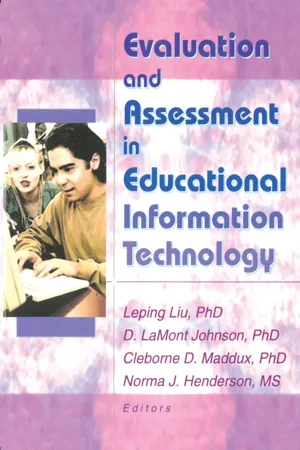
Evaluation and Assessment in Educational Information Technology
eBook - ePub

Evaluation and Assessment in Educational Information Technology

  1. 240 pages
  2. English
  3. ePUB (mobile friendly)
  4. Available on iOS & Android
eBook - ePub

Evaluation and Assessment in Educational Information Technology

About this book

Choose the right hardware and software for your school! This unique book is the first systematic work on evaluating and assessing educational information technology. Here you?ll find specific strategies, best practices, and techniques to help you choose the educational technology that is most appropriate for your institution. Evaluation and Assessment in Educational Information Technology will show you how to measure the effects of information technology on teaching and learning, help you determine the extent of technological integration into the curriculum that is best for your school, and point you toward the most effective ways to teach students and faculty to use new technology. Evaluation and Assessment in Educational Information Technology presents:

  • a summary of the last ten years of assessment instrument development
  • seven well-validated instruments that gauge attitudes, beliefs, skills, competencies, and technology integration proficiencies
  • two content analysis instruments for analyzing teacher-student interaction patterns in a distance learning setting
  • an examination of the best uses of computerized testing--as opposed to conventional tests, as used in local settings, to meet daily instructional needs, in online delivery programs, in public domain software, and available commercial and shareware options
  • successful pedagogical and assessment strategies for use in online settings
  • a four-dimensional model to assess student learning in instructional technology courses
  • three models for assessing the significance of information technology in education from a teacher?s perspective
  • an incisive look at Michigan?s newly formed Consortium of Outstanding Achievement in Teaching with Technology (COATT)
  • ways to use electronic portfolios for teaching/learning performance assessment
  • and much more!

Frequently asked questions

Yes, you can cancel anytime from the Subscription tab in your account settings on the Perlego website. Your subscription will stay active until the end of your current billing period. Learn how to cancel your subscription.
No, books cannot be downloaded as external files, such as PDFs, for use outside of Perlego. However, you can download books within the Perlego app for offline reading on mobile or tablet. Learn more here.
Perlego offers two plans: Essential and Complete
  • Essential is ideal for learners and professionals who enjoy exploring a wide range of subjects. Access the Essential Library with 800,000+ trusted titles and best-sellers across business, personal growth, and the humanities. Includes unlimited reading time and Standard Read Aloud voice.
  • Complete: Perfect for advanced learners and researchers needing full, unrestricted access. Unlock 1.4M+ books across hundreds of subjects, including academic and specialized titles. The Complete Plan also includes advanced features like Premium Read Aloud and Research Assistant.
Both plans are available with monthly, semester, or annual billing cycles.
We are an online textbook subscription service, where you can get access to an entire online library for less than the price of a single book per month. With over 1 million books across 1000+ topics, we’ve got you covered! Learn more here.
Look out for the read-aloud symbol on your next book to see if you can listen to it. The read-aloud tool reads text aloud for you, highlighting the text as it is being read. You can pause it, speed it up and slow it down. Learn more here.
Yes! You can use the Perlego app on both iOS or Android devices to read anytime, anywhere — even offline. Perfect for commutes or when you’re on the go.
Please note we cannot support devices running on iOS 13 and Android 7 or earlier. Learn more about using the app.
Yes, you can access Evaluation and Assessment in Educational Information Technology by D Lamont Johnson,Cleborne D Maddux,Leping Liu,Norma Henderson in PDF and/or ePUB format, as well as other popular books in Business & IT Industry. We have over one million books available in our catalogue for you to explore.

Information

Publisher
CRC Press
Year
2021
Print ISBN
9780789019394
eBook ISBN
9781000447941
Edition
1
Subtopic
IT Industry

Evaluation and Assessment in Educational Information Technology

Contents

EDITORIAL
Assessing Learning in the New Age of Information Technology in Education
Leping Liu D. LaMont Johnson Clebome D. Maddux Norma J. Henderson
INSTRUMENTS AND TESTING
Instruments for Assessing the Impact of Technology in Education
Rhonda Christensen Gerald Knezek
Using Interaction Content Analysis Instruments to Assess Distance Learning
Baruch Ojfir Yossi Lev Yael Lev Lngrid Barth
Computer Testing in Education: Emerging Trends
Anna C. McFadden George E. Marsh II Barrie Jo Price
CURRENT TRENDS AND PRACTICES
Effective Practices in Distance Education
Carmen L. Gonzales Laura Sujo de Montes
Assessing Student Learning in Instructional Technology: Dimensions of a Learning Model
Leping Liu D. LaMont Johnson
New Directions in the Evaluation of the Effectiveness of Educational Technology
Walter F. Heinecke Natalie B. Milman Lisa A. Washington Laura Blasi
Another Perspective on Assessing the Significance of Information Technology in Education
Jarkko Alajääski Jyrki Suomala
Evaluation of a Faculty Development Model for Technology Use in Higher Education for Late Adopters
Jessica Kahn Robert Pred
Technology Training for Teacher Education in Jamaica: A Case for Needs Assessment
Moses Peart Caryl J. Sheffield
COATT: A State-Wide Initiative to Evaluate and Improve Teacher Technology Education
Thomas Fox McManus Michael T. Charles Reuben A. Rubio Ellen S. Hoffman James S. Lenze
Technology 2000: Using Electronic Portfolios for the Performance Assessment of Teaching and Learning
Dennis M. Holt Paula McAllister Erin Claxton Ingram
Assessing Technology Based Instruction in Biology and Geography
Eila Jeronen
Index

EDITORIAL

Assessing Learning in the New Age of Information Technology in Education

Leping Liu D. LaMont Johnson Cleborne D. Maddux Norma J. Henderson
This collection of articles is devoted to issues and trends in assessment relating to information technology in education. We believe an examination of such issues and trends is important because of the increased emphasis information technology in education is receiving at national, state, and local levels. The emphasis on using information technology in teaching and learning cuts across ail levels of education from pre-school to higher education. Consequently, in an age of ever-increasing demand for accountability, those who advocate using technology in education are being asked to demonstrate results using valid and relevant assessment procedures. The bottom line is that those of us who advocate for integrating information technology into teaching and learning promise more efficient and effective education. Questions are being asked now and will be asked more forcefully in the near future regarding our ability to deliver on this promise. This collection of articles addresses ways and means of demonstrating our success.
LEPING LIU is Assistant Professor, Department of Reading, Special Education and Instructional Technology, College of Education, Towson University, Towson, MD 21252 (E-mail: [email protected]).
D. LAMONT JOHNSON is Professor, Department of Counseling and Educational Psychology, University of Nevada, Reno, NV 89557 (E-mail: [email protected]). CLEBORNE D. MADDUX is Professor, Department of Counseling and Educational Psychology, University of Nevada, Reno, NV 89557 (E-mail: [email protected]). NORMA J. HENDERSON is doctoral candidate, Department of Counseling and Educational Psychology, University of Nevada, Reno, NV 89557 (E-mail: [email protected]).
[Haworth co-indexing entry note]: "Assessing Learning in the New Age of Information Technology in Education." Liu et al. Co-published simultaneously in Computers in the Schools (The Haworth Press, Inc.) Vol. 18, No. 2/3, 2001, pp. 1-3; and: Evaluation and Assessment in Educational Information Technology (ed: Leping Liu et al.) The Haworth Press, Inc., 2001, pp. 1-3. Single or multiple copies of this article are available for a fee from The Haworth Document Delivery Service [l-800-HAWORTH, 9:00 a.m. 5:00 p.m. (EST). E-mail address: [email protected]].
In 1988, Computers in the Schools devoted a theme issue to assessing the impact of information technology (Maddux, 1988). A lot has changed since that issue was published. The technology has certainly changed, the way we use the technology has changed, and we propose that the methods for evaluating our efforts have changed. Therefore, we believe this volume provides a timely reexamination of this important topic.
Since 1988, the number of master's and doctoral programs focusing on information technology in education has increased dramatically. This trend is one sign of the steady maturation of the field of information technology in education. As the field matures, the need for appropriate assessment methods becomes more urgent. As faculty members, administrators, and classroom teachers deal with meeting this need, three assumptions are emerging:
  1. Instruction on learning to use, and learning to apply, information technology in education differs significantly from instruction in other curricular areas (Grin & van de Graaf, 1996; Hargreaves, 1997).
  2. As the technology has changed, and the applications have changed, courses dealing with information technology in education have changed, thereby creating a need to reevaluate assessment methods for these courses (Johnson & Liu, 2001; Liu & Cheeks, 2001).
  3. In most well-developed graduate programs emphasizing information technology in education, assessment is a ...

Table of contents

  1. Cover
  2. Half Title
  3. Title Page
  4. Copyright Page
  5. Contents
  6. Index