A vivid biography of the nineteenth-century society couple who helped turn a tropical wilderness into a Gilded Age paradise.
Palm Beach's sunny and idyllic shores had humble beginnings as a wilderness of sawgrass and swamps only braved by the hardiest of souls. Two such adventurers were Fred and Byrd "Birdie" Spilman Dewey, who pioneered in central Florida before discovering the tropical beauty of Palm Beach in 1887.
Though their story was all but lost, this dynamic couple was vital in transforming the region from a rough backcountry into a paradise poised for progress. Authors Ginger Pedersen and Janet DeVries trace the remarkable history of the Deweys in South Florida from their beginnings on the isolated frontier to entertaining the likes of the Flaglers, Vanderbilts, Phippses, Cluetts, Clarkes, and other Palm Beach elite. Using Birdie's autobiographical writings from her bestselling books to fill in the gaps, Pedersen and DeVries narrate a chapter in Florida's history that has remained untold until now.
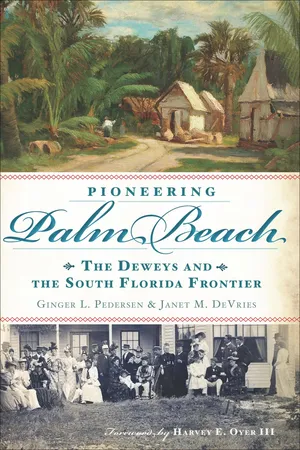
eBook - ePub
Pioneering Palm Beach
The Deweys and the South Florida Frontier
- 163 pages
- English
- ePUB (mobile friendly)
- Available on iOS & Android
eBook - ePub
Pioneering Palm Beach
The Deweys and the South Florida Frontier
About this book
Trusted by 375,005 students
Access to over 1.5 million titles for a fair monthly price.
Study more efficiently using our study tools.
Information
The Blessed Isle
The Deweys began to look for a new Lake Worth Country homestead, one closer to Palm Beach. She wrote, “Although there was a degree of pleasure heretofore unknown in our quiet days at The Hermitage, just our two selves and our lovely kits, we never once changed our plans of making another, less isolated home. We looked up and down the West Shore of the Sound, pricing the various pieces of land which were available, and weighing the advantages and disadvantages of each.”
The “West Shore” referred to the area that today is West Palm Beach, which did not exist in 1890, when the Deweys secured their land on the shores of Lake Worth. The isolation that she experienced at the Hermitage was something that she did not want to experience again. Waterfront property along Lake Worth was what most people wanted as the lake acted as a “highway” for the settlers. The west shore ideally received the southeast tradewinds that prevail most of the year, as the lake water cools the ocean breezes. The newspapers of the time did not refer to town names such as Palm Beach; events occurred on the “East Side” or the “West Side” of Lake Worth.
The land they purchased was a portion of a government lot along Lake Worth. The lots along the water south of present-day West Palm Beach were homesteaded by members of the Lanehart/Lainhart family in 1876. George Lainhart homesteaded lot one, while older cousin Benjamin Lanehart (they spelled their names differently) homesteaded Lots 2 through 5; Benjamin’s property totaled 130 acres. Benjamin built his palmetto shack about where Olive Avenue and Flamingo Drive in West Palm Beach are today. He cleared some land and grew sweet potatoes and pumpkin, and the homestead was granted by the federal government on August 1, 1883.

BEN LANEHART’S PALMETTO SHACK. Ben Lanehart, one of the earliest pioneers on the west side of Lake Worth, stands outside his palmetto shack. Fellow pioneer Abner Wilder is standing in the doorway. Courtesy Historical Society of Palm Beach County.
Lanehart began to sell his land in parcels. In 1888, George Bristol bought a five-acre portion of Lot 3 and built a house on the natural ledge near the shoreline. The lot was about 220 feet wide and 900 feet long. He had built a long dock out into Lake Worth, so larger boats were able to dock at the property. At that time, the word “dock” was not used to refer to what is called a dock today; rather it was called a wharf.
Of the five acres, the west three acres had been cleared, and two of those acres had been planted with pineapples. The land surrounding the house that Bristol built was covered with oak and sand pine trees, or what was called “spruce pine” at the time. One feature that attracted the Deweys to the property was that the deed had riparian rights, which meant they owned the waterfront rights. “Thus we became the happy possessors of The Blessed Isle,” she wrote. “It was not really an island, but, like The Hermitage, it was across the water from everything, and the only way to go anywhere, was by boat. We looked across to the settlement, and, on clear days, could signal to the other side. Out on the wharf, we had a fine view up and down the Sound, of points running out from both shores, and of islands of various shapes and sizes, covered with palms and other growth.”

WHARF AT THE BLESSED ISLE. The Blessed Isle’s long wharf extended far into Lake Worth, allowing larger vessels to dock at the Dewey home. Private collection.
The Deweys paid $600 for the five acres and the small house on the property, and they signed the deal on January 23, 1890. The meaning of the name “Blessed Isle” was yet another mystery to be solved. She provided a clue at the end of her second book, The Blessed Isle and Its Happy Families, as to the origin of the name, by mentioning the “Elysian Fields.” In Greek mythology, the Elysian Fields were a form of heaven for heroes and for the brave. The Islands of the Blessed was an island paradise heaven on the western side of the Okeanos River reserved for heroes of the Greek myths. Such a place was a “winterless paradise.” Plutarch, the Greek historian of ancient times, wrote, “[W]here the air was never extreme, which for rain had a little silver dew, which of itself and without labor, bore all pleasant fruits to their happy dwellers, till it seemed to him that these could be no other than the Fortunate Islands, the Elysian Fields.” Birdie was a student of Greek mythology, and the analogy of the Blessed Isles to the Lake Worth Country was perfect, so she named the estate the Blessed Isle.
The move from the Hermitage to the Blessed Isle began. As she always had to have chickens, Fred put up a fowl house with wire netting to keep out the wildlife that loved nothing better than fresh chicken and eggs. Birdie began to pack their belongings at the Hermitage, and it was not without bittersweet feelings: “The Hermitage had been so completely our home—so really our own creation, evolved from wildest nature, that it was harder to give up than was any other we had ever left. We had found it an unbroken forest, tied together with wild vines and undergrowth, and we had made it a home blest with a charm of real comfort and beauty.”
Fred secured a sloop and hired a few men to help pack their possessions and take the wagon down to the water so their things could be loaded aboard the sloop. Even though the Blessed Isle was about two miles south, there were no roads or trails to take. Last to be packed up were the two cats, which would have scampered into hiding at the sight of strangers. All was loaded on the wagon, and it began its way down the hill, chickens clucking and cats crying out of fear. Birdie walked behind, carrying her most prized possession: a Greek goddess statue she named “Meditation.” By twilight, they had reached the sloop, and it was loaded with all the goods, while the cats and fowl had to be towed behind the sloop in a small skiff. As darkness fell, the strong south wind caused them to tack back and forth along the sound for the two-mile ride southward.
As they approached the Blessed Isle, the skipper realized that the low tide and strong winds would not allow the heavily laden craft to dock safely at the wharf. Instead, they anchored the sloop near the channel, got aboard the skiff with cats and chickens and rowed to the Blessed Isle. The cats were freed from their crate and quickly scampered into the underbrush. The men retrieved the food basket, a kerosene stove and a few bedding items from the sloop, as it was nearing midnight. Birdie put together a quick stew for the cold and hungry men.
At daybreak, the men brought the rest of the possessions ashore, and all had gone well. Last to be offloaded were her books; being the heaviest, they had been loaded on the sloop’s bottom. The books were loaded on the skiff, and it was making its way toward the wharf when the unthinkable happened: a wave overturned the skiff. “My heart seemed to turn with it, as I saw the boxes of books spill into the waves, sink, then bob up around the boat,” she wrote. Books were her most prized possessions, some of which “we wouldn’t take a farm for.” The books were quickly retrieved and unpacked, left to dry in the sun and dry sand, but the damage had been done: “Their bloated, discolored appearance is still a constant reminder of our difficult and adventurous move to The Blessed Isle.”
The Blessed Isle’s location finally allowed the connections to civilization that Birdie needed. Even with Fred absent, she could take her work under the pine and oak trees near the house and see boats passing by, waving to the passengers. Fred could also just dock the skiff or sailboat and be home without the long trek that he had at the Hermitage. The two cats and Birdie settled into this new home, and were a wonderful greeting party for Fred each day as he docked on his return from work in Palm Beach.

TROPICAL SUN MASTHEAD. Guy Metcalf founded and published the Tropical Sun, the area’s first newspaper. Originally published in Juno, the newspaper moved its offices to West Palm Beach in 1895. Birdie Dewey wrote articles as a correspondent for the Tropical Sun. Private collection.
Development was beginning to take hold in the fledging community. The first newspaper, the Tropical Sun, was published at the small settlement of Juno (at Lake Worth’s northern end), located at the terminus of the Celestial Railroad that ran the 7.5 miles between Jupiter and Juno. The paper published its inaugural issue in March 1891, and Birdie became the first newspaper columnist in South Florida. Her column “The Sitting Room,” written under Birdie’s pen name “Aunt Judith,” featured an advice section, household tips, recipes and original fiction and poems. Ruby Andrews Myers also contributed to the column. Birdie wrote the column until September 1891, and Myers continued it until 1892.
The house that stood on the property needed its own name, too. Most of the homes in the emerging Palm Beach had names, so the Dewey home would be no different. She stated, “There was a small new house so constructed so that additional rooms might easily be added.” It is not known how large that original house was, but what would become the Dewey house was a large two-story wooden structure. An article from the September 30, 1891 Tropical Sun mentioned that Fred was receiving a large load of lumber so that he could “add quite largely to his house.” If the estate was the Blessed Isle, what were they to call the house? This time, they chose an Italian expression popular at the time as the house’s moniker. The Italian expression is Se non è vero, è ben trovato, which means, according to the Merriam-Webster dictionary, “Even if it is not true, it is well conceived.” So, “ben trovato” became an expression of the Victorian era meaning “well invented,” and the house was named Ben Trovato, the first of three Dewey houses to carry the name. The renovations continued into 1892, with the Tropical Sun reporting that “Mr. Dewey is making quite extensive improvements at Ben Trovato, adding quite largely to his house, and painting and furnishing the part built last season.”
The three known pictures of Ben Trovato taken at the time the Deweys owned it show a striking house that combined several architectural styles of the day, including elements of lake style, shingle style and even some Victorian/Queen Anne elements with the octagonal feature that was most likely added in 1891–92. In an interview, Roger Cope, an architect familiar with early Florida homes, stated that the house could be classified as “Federal” style with tropical elements. He surmised that the octagonal feature housed a formal sitting room on the first floor and a master bedroom on the second. The only photographs of the house’s interior are a few in the book The Blessed Isle of the porches that were located on the west side of the house. Interviews conducted in 2012 with two people who were in the house long after the Deweys owned it both spoke of its magnificent spiral staircase.
About this time, Fred became a political leader in the community, holding several different positions. In April 1889, he was appointed county commissioner for Palm Beach by the Florida Senate, and in 1890, he was elected Dade County tax assessor and appointed tax collector. It is important to note that today’s Miami-Dade County is much smaller geographically than Dade County was in the 1890s. Formed in 1836, Dade County stretched from Bahia Honda Key north to the St. Lucie River, about the size of the state of Massachusetts. Today’s Palm Beach County was carved out of the northern end of Dade County in 1909. The county seat had been located in many towns, and in 1888, Dade County residents voted to move the county seat from Miami to Juno, at Lake Worth’s northern end. At Juno, workers constructed a courthouse and jail, and publisher Guy Metcalf moved his Indian River newspaper to Juno and renamed it the Tropical Sun. There was no easy way to reach faraway Miami other than by sailing or walking the beach, something that took several days.
Being tax assessor and collector meant that Fred had to visit every household in Dade County, figure the land’s worth and what the tax assessment would be and then actually collect the monies. Birdie wrote, “In a spacious country, where there is not one single mile of road and no steamboats, this is far from being an easy task, and the time consumed made it a real hardship.” When Fred was between tax assessing and collecting trips, Fred and Birdie worked together on the massive tax books. In that era of no computers or calculators, the only technology to which they had access was an “adder,” a clockwork mechanism that could be used to add single columns of figures. “As we neared the end of making the set of tax-books, we were both full of eager thrills to see if they would come out even.” Once the tax book was finished, two copies had to be made by hand. The authors searched for a copy of the tax book, but all three copies have been lost to time.

BEN TROVATO FROM THE WHARF. The front of Ben Trovato faced Lake Worth. Nestled in the pine woods, the two-story house featured a unique octagonal room on the north end. Courtesy Historical Society of Palm Beach County.
The 1890 tax collecting trip was uniquely recorded and documented because several passengers had agreed to accompany Fred on his tax collection route. The events were eloquently captured by Emma Gilpin, the wife of commodities trader John R. Gilpin. From Pennsylvania, the Gilpins explored many parts of Florida and finally found the paradise they sought in Palm Beach. Emma Gilpin was a gifted writer and kept journals and wrote beautiful letters to relatives back home. These treasures of South Florida history were saved by family members and donated to History Miami Museum and the Historical Society of Palm Beach County.
Fred arranged for George Potter’s sloop the Heron for the trip. George served as captain and Ben Potter as first mate, and the expedition included Fred, the Gilpins (with son Vincent) and Elizabeth Marsh, described as “an energetic lady from Chicago.” Marsh’s role on the trip differs in the Gilpin account of the events and what Birdie recorded. Birdie knew that the trip would take a month or more, so she had arranged to have “a spinster of mature age” to stay with her, and this woman was to come over on the Heron. That spinster was undoubtedly Marsh, who was a “Miss” in the Gilpin account, and an older woman. Birdie wrote, “At the last minute this lady caught the enthusiasm of the cruisers and instead of having her ‘big box, little box and band-box’ handed out on the wharf of The Blessed Isle, she commanded that they be left in the boat’s cabin, where she decided to stay and join the cruising party.” Birdie stated that the other passengers were somewhat dismayed by having another on board in such cramped quarters; she quoted Fred as being “floored.” In the Gilpin account, Emma stated that Marsh had planned the trip. Which one is accurate cannot be determined. The Heron measured thirty-eight feet long and had a fifteen-foot cabin. There were no “facilities” on board, so the friendly group of seven became very familiar with one another.
The Heron struggled to get out of the inlet, running aground a few times. Finally at sea, they had a restless night on the rough seas. Fred caught some kingfish, which Ben Potter cooked on a kerosene stove. With coffee, the group enjoyed an expedition breakfast, but the rough seas did not let the food stay down long. In ten hours, with a strong northeast breeze, they had reached Biscayne Bay and sailed to Lemon City, which at that time was much larger and more im...
Table of contents
- Front Cover
- Half Title
- Title Page
- Copyright
- Dedication
- Contents
- Foreword
- Acknowledgements
- Introduction
- The Spilmans and the Taylors
- “One Awful Night in My Tenth Year”
- Westward to the Land of Lincoln
- “Begin to Talk Florida”
- The Dreamer of Dreams
- “Night in a Long White-Draped Room”
- The Lake Worth Country
- The Hermitage
- The Blessed Isle
- The King Arrives in the Jungle
- The Great Freeze and the Orphaned Town
- A New Century and New Challenges
- The Bird Whisperer and the Journey Home
- Bibliography
- About the Authors
Frequently asked questions
Yes, you can cancel anytime from the Subscription tab in your account settings on the Perlego website. Your subscription will stay active until the end of your current billing period. Learn how to cancel your subscription
No, books cannot be downloaded as external files, such as PDFs, for use outside of Perlego. However, you can download books within the Perlego app for offline reading on mobile or tablet. Learn how to download books offline
We are an online textbook subscription service, where you can get access to an entire online library for less than the price of a single book per month. With over 1.5 million books across 990+ topics, we’ve got you covered! Learn about our mission
Look out for the read-aloud symbol on your next book to see if you can listen to it. The read-aloud tool reads text aloud for you, highlighting the text as it is being read. You can pause it, speed it up and slow it down. Learn more about Read Aloud
Yes! You can use the Perlego app on both iOS and Android devices to read anytime, anywhere — even offline. Perfect for commutes or when you’re on the go.
Please note we cannot support devices running on iOS 13 and Android 7 or earlier. Learn more about using the app
Please note we cannot support devices running on iOS 13 and Android 7 or earlier. Learn more about using the app
Yes, you can access Pioneering Palm Beach by Ginger Lee Pedersen,Janet M DeVries,Janet M. DeVries in PDF and/or ePUB format, as well as other popular books in History & North American History. We have over 1.5 million books available in our catalogue for you to explore.