A look at the memorable chain of restaurants and hotels and its place in New Mexico's history.
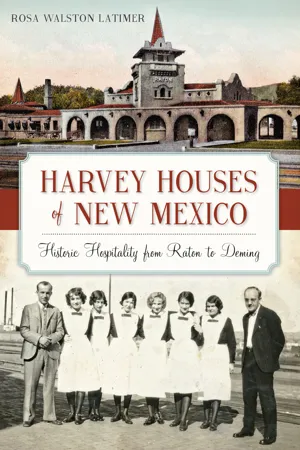
The Santa Fe Line and the famous Fred Harvey restaurants forever changed New Mexico and the Southwest, bringing commerce, culture, and opportunity to a desolate frontier. The first Harvey Girls ever hired staffed the Raton location. In a departure from the ubiquitous black and white uniform immortalized by Judy Garland in 1946's
The
Harvey Girls, many of New Mexico's Harvey Girls wore colorful dresses reflective of local culture. In Albuquerque, the Harvey-managed Alvarado Hotel doubled as a museum for carefully curated native art. Join author Rosa Walston Latimer and discover New Mexico's unique history of hospitality the "Fred Harvey way."
eBook - ePub
Harvey Houses of New Mexico
Historic Hospitality from Raton to Deming
- 147 pages
- English
- ePUB (mobile friendly)
- Available on iOS & Android
eBook - ePub
About this book
Information
Chapter 1
FRED HARVEY IN NEW MEXICO
The land of desert and stars, modern and ancient cultures, forest green and rocky tan.
—Hospitality Magazine: A Magazine For and About the Men and Women of Fred Harvey
—Hospitality Magazine: A Magazine For and About the Men and Women of Fred Harvey
Fred Harvey’s narrative in the United States began when the Englishman immigrated in 1850 at the age of fifteen. Harvey learned the restaurant business working as a pot scrubber and busboy in New York. Later, he owned a café in St. Louis, Missouri, that catered to wealthy businessmen who expected fast service and good food served in tasteful surroundings. However, the effects of the Civil War and a dishonest partner brought an end to his first restaurant venture. Harvey then found employment with the railroad as a freight agent, solicitor and mail clerk and traveled many miles by rail. This experience provided firsthand knowledge of how difficult it was to get decent food while traveling by train. This insider information would serve him very well.
Mr. Harvey knew the Santa Fe Railroad was expanding and needed to develop a robust passenger business to finance the growth. With his knowledge of the restaurant business, he believed he could help accomplish this. When Harvey met with Santa Fe officials in 1876, the entrepreneur was confident he could personally change the miserable reputation of railway dining and increase passenger service. On a handshake with the president of the Santa Fe Railroad, an agreement was reached, and the first restaurant chain in the United States was launched.
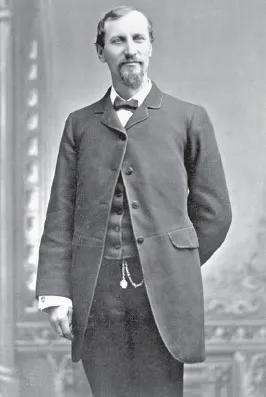
Fred Harvey, founder of Harvey House restaurants, newsstands and hotels. Harvey is credited for bringing a high standard of hospitality to towns along the Santa Fe Railroad. Courtesy of kansasmemory.org, Kansas State Historical Society.
As Fred Harvey’s chain of trackside restaurants grew, when a location was deemed appropriate for a Harvey establishment, the Santa Fe would design and build space in or adjacent to the new depot building for the kitchen, food storage, a lunch counter and usually a dining room, as well as living quarters for Harvey employees. This space, built especially for Fred Harvey’s business venture, was called a Harvey House. Mr. Harvey was also afforded the use of Santa Fe trains to deliver laundry, food products and employees along the line at no charge.
Originally Harvey Houses were established along the railroad at intervals of approximately one hundred miles, providing dining opportunities for passengers when the train stopped to refuel the steam engine. Other sites were determined by the location of Santa Fe division points where large numbers of railroad employees needed a place to eat.
In New Mexico, the Fred Harvey story is more than a tale of first-class eating establishments along the Santa Fe Railroad. When Fred Harvey made his sales pitch to the president of the Santa Fe, he proposed restaurants with such stellar food and service that people would ride the train just so they could eat at a Harvey House. That vision motivated the building of luxury hotels with amenities that catered to tourists giving them a destination with Harvey House restaurants, luxury accommodations, lush patios for rest and relaxation and a cultural experience.
The development of tourism by the Fred Harvey company was an intelligent business decision that had a lasting impact on New Mexico. The emphasis on tourism in the state continues. In 2014, the New Mexico governor’s office reported a third consecutive year of tourism growth, with 32.2 million people traveling to the state in 2013.
The Fred Harvey company valued consistent food quality as much as quality of service. Only the best, freshly prepared food was offered at a Harvey House, and travelers soon realized they could trust the Fred Harvey name all along the Santa Fe line.
Harvey House managers were required to send tabulated reports at the end of each day. The purpose of these reports was not to assess possible ways of reducing expenses but to ensure that the Harvey standard was maintained. Santa Fe magazine explained that the reports made certain “the slices of ham in the Harvey sandwiches are as thick as ever and the same thickness everywhere and that the coffee is as strong as it should be.” In Harvey Houses, whole pies were cut into four servings instead of the usual six or eight in other restaurants. The daily reports reflected the inventory of food used in relation to the number of customers served, indicating that portions were up to Harvey standards. Many Harvey Houses operated in the red for years. Fred Harvey’s business philosophy was simple. He believed that profits would come in the long run if excellent service was provided and maintained.
Fred Harvey died in 1901 at the age of sixty-five. That year, he owned and operated approximately fifteen hotels, forty-seven restaurants, thirty dining cars and a San Francisco Bay ferry. The eulogy delivered at his funeral foretold the way Fred Harvey would always be remembered. “Fred Harvey is dead, but his spirit still lives. The standard of excellence he set can never go back. He has been a civilizer and benefactor. He has added to the physical, mental and spiritual welfare of millions. Fred Harvey simply kept faith with the public. He gave pretty nearly a perfect service.”
After his death, Harvey’s sons, Ford and Byron, continued to operate the substantial family business, and the company name remained “Fred Harvey.” For years, employees continued to say they worked for Fred Harvey.
Business at Harvey Houses began to decline during the Depression years and continued to falter even as the nation recovered economically. The increase of dining cars (usually staffed and operated by the same Fred Harvey company) made it unnecessary for passengers to leave the train to eat, and diesel engines were replacing steam locomotives, eliminating the need for frequent fuel stops. In addition, the automobile was becoming a popular and affordable way to travel. Many Harvey Houses closed; however, when troops were mobilized during World War II, thousands traveled by passenger train, and Fred Harvey’s restaurants were reopened to provide meals to these U.S. armed forces. Former Harvey Girls and other employees returned to work in the Harvey Houses that had been closed, and in locations still open, such as the Alvarado in Albuquerque, additional staff was hired to handle the increased business.
In reality, the thousands of troops traveling by train added greatly to the Harvey House customer base during the time when civilian train travel was waning, bringing profits back to some sites that had been closed for several years. The results of a smart, extensive marketing effort, coupled with the enduring Harvey reputation and an increase in patrons, were positive for the company. According to intercompany memos, Fred Harvey served over forty-one million meals and brought in a gross income of over $37 million in 1945, the largest in the company’s seventy-year history.
Harvey Girls
There is a difference between eating and dining. Fred Harvey brought dining to New Mexico accompanied by an appreciation for the land and culture of the West. He also brought Harvey Girls.
Originally, Harvey attempted to staff Harvey Houses with local, all-male employees. This led to many problems, not the least of which was an unwillingness or inability to meet the high Fred Harvey standards. A pivotal event in Raton, New Mexico, brought a change that proved to be extremely successful. Following an incident at the Raton Harvey House that left the all-male staff unable to work the next morning, an enraged Fred Harvey fired everyone and hired a new manager who suggested replacing the unruly men with attractive young women. Harvey agreed, and ads began to appear in the northeast and midwest similar to this:
Wanted—Young women, 18–30 years of age, of good character, attractive, and intelligent, as waitresses in Harvey Eating Houses on the Santa Fe Railroad in the West. Good wages, with room and meals furnished. Experience not necessary. Write Fred Harvey, Union Depot, Kansas City, Missouri.
In the early years, all young women who answered the ad traveled to Kansas City for a rigorous personal interview. For a number of years, Alice Steel conducted many of these interviews. Alice is remembered fondly by some Harvey Girls as being sympathetic and understanding; however, others found her to be stern and somewhat harsh. In either case, this initial interview looms large in the memory of many Harvey Girls. Alice’s impression of a young lady determined whether the black-and-white uniform was in her future. Later, interviews were also conducted in Chicago, and as the West became more populated and trusted Harvey managers were in place, more local women were hired.
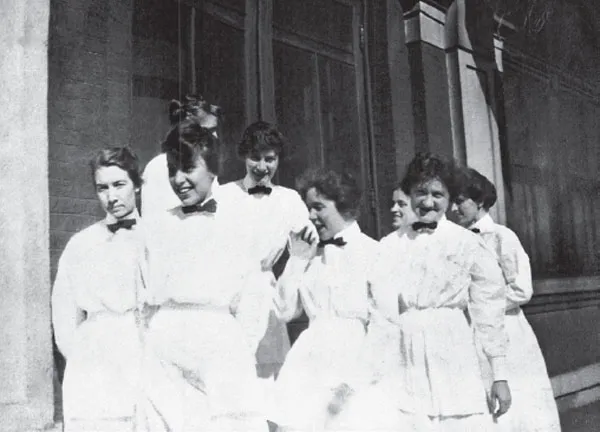
New Mexico Harvey Girl Bertha Peterson (second from right) with unidentified Harvey Girls. Courtesy of Carrie Cygan.
Regardless of the hiring process, once on the job, Harvey Girls were held to strict standards. Harvey’s precise rules about dressing modestly, wearing little or no makeup and conducting oneself in a respectable manner served the purpose of reassuring young ladies that they would be in good company, working and living with like-minded women. Their reputations would be protected even far from home where they would often be judged without benefit of a family’s good reputation.
Harvey Girls personalized the Fred Harvey standards and, in many cases, brought their eastern and midwestern sensibilities to a job that previously was not held in high esteem. Harvey’s rules were a dominant part of any Harvey Girl’s experience and served to standardize service in Harvey Houses. The expectation that Harvey Girls conduct themselves in a ladylike manner at all times changed the public perception of waitresses.
The ambitious, venturesome young women who had successful interviews were given a train pass to their new jobs and often left immediately. Most began their Harvey Girl career at a smaller Harvey House such as Rincon or Vaughn, New Mexico. In the early years, all Harvey Girls were single and were required to sign a contract stipulating they would not marry during the first six months of employment. Eventually, married women were hired, and in unusual circumstances, a widow with a child was permitted to live and work at a New Mexico Harvey House.
Much has been written about the many couples who met across the counter in a Harvey House and eventually married. However, most Harvey Girls were very particular about who they allowed to “court” them and even more picky when it came time to choose a husband. A former Harvey Girl recalled her engagement to a Santa Fe engineer. The couple had the Harvey House manager’s approval, and the relationship seemed headed to the altar until the prospective groom grew a mustache. The young woman didn’t like kissing a man with facial hair, and she told her fiancé she wouldn’t marry him unless he shaved. He didn’t, and she didn’t marry him.
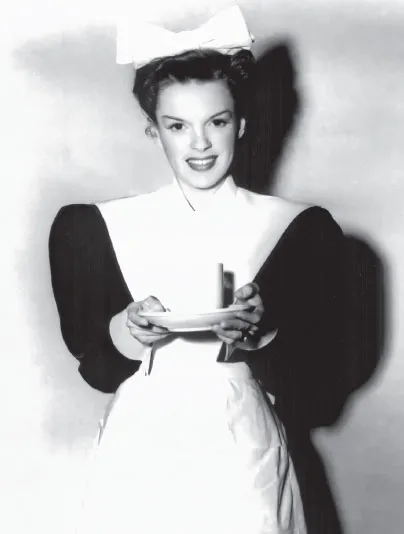
Publicity photograph for the 1946 movie The Harvey Girls, featuring Judy Garland. Author’s collection.
Many people became familiar with Harvey Girls through the 1946 MGM movie The Harvey Girls. The movie, set in a fictitious New Mexico town, featured top movie stars of the time—Judy Garland, Ray Bolger and Angela Lansbury—and can still be seen occasionally on the Turner Classic Movies channel. The song “On the Atchison, Topeka and the Santa Fe,” sung by Garland, won an Academy Award for songwriter Johnnie Mercer. The movie was filmed on a movie set in California, and the set design was modeled from the exterior and dining room of the Castaneda, a Harvey hotel in Las Vegas, New Mexico. According to movie trivia, the balcony featured in one of the movie’s musical numbers is a replica of Castaneda’s street-side, second-floor balcony. Apparently, during the time Harvey Girls were working at Castaneda, there was a saloon directly across the street. In the movie, the Alhambra saloon was across the dirt street from the fictitious New Mexico Harvey House.
Southwest Indian Detours
As train passenger service improved, traveling to New Mexico became much more comfortable and accessible. Those who lived in other parts of the United States began to travel west for vacations. Many credit the Fred Harvey company with developing commercial cultural tourism. Fred Harvey Indian Detours complemented the established Harvey hotels and restaurants and became the bedrock for tourism in the Southwest.
The imaginative Indian Detours gave train passengers a reason to interrupt their train trip and take excursions by car (known as Harveycars) or Indian Detour buses to local attractions, including Indian pueblos and Spanish mission ruins. Young women, called Couriers, were trained in the history of the area and served as tour guides. Perhaps not as well remembered as Harvey Girls, the Couriers were an important part of the success of the Indian Detours. A review of the Indian Detours in the New York Times magazine described one Courier: “Our guide tells the tale, a pretty young college girl in high boots and a 10-gallon hat, with enough Indian jewelry to open a curio shop.” These uniforms added to the charm of the Detours, but the attractive young women were expected to be in every way as prepared for their job as the Harvey Girls were. The Harveycar motor cruises allowed visitors, traveling in enormous cars with sixteen cylinders, to experience the many cultures of the Southwest. Fred Harvey advertising invited tourists to take “roads to yesterday” and travel “back through the centuries.”
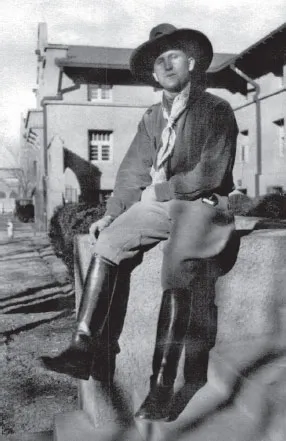
A New Mexico Indian Detour driver. The Harvey tours provided sightseeing trips to living pueblos and archaeological sites throughout the Southwest. Courtesy Belen Harvey House Museum Photo Archives.
Marketing for the Indian Detours touted the unknown paths of the Indians “worn inches deep in solid rock by moccasined feet; the ways of the sandaled padres and steel-clad soldiers of Spain; the trails of the fur-capped mountain men; and the broad tracks blazed by those in buckskin and deepened under the dust clouds of plodding pack trains and covered wagons.” Who wouldn’t want to leave the constraints of train travel to experience this? Many took advantage of this “southwestern motor service designed for the most discriminating traveler.”
According to company records, the Detours served 150,000 square miles in southwestern Colorado, New Mexico and Arizona. The good reputation of Fred Harvey was the primary marketing strategy: “The interest of the railroad, and the management of the Harvey company, assure efficiency in personnel, the finest of equipment and that type of finely individual services so long a source of pride with the parent organizations.”
Detour itineraries were often mixed with horseback riding and camping. The Detours are evidence of the continued business acumen of the Fred Harvey company. (Enjoy a sample of a 1920 Indian Detour via a fifteen-minute film posted on YouTube by the Office of Image Archaeology.)
Indian Department and Museum
Herman Schweize...
Table of contents
- Front Cover
- Title Page
- Copyright
- Dedication
- Contents
- Foreword, by Maurine McMillan
- Acknowledgements
- Introduction
- 1. Fred Harvey in New Mexico
- 2. Stay Awhile: Destination Harvey Hotels
- 3. Short Stops: Trackside Hotels
- 4. Good Eats: Harvey House Restaurants
- 5. News and Smokes: Harvey Newsstand
- 6. Long Ago: Early Harvey Houses
- 7. Fred’s Friends: Keeping the History Alive
- 8. Harvey House Kitchens: Original Recipes
- Bibliography
- About the Author
Trusted by 375,005 students
Access to over 1.5 million titles for a fair monthly price.
Study more efficiently using our study tools.
Frequently asked questions
Yes, you can cancel anytime from the Subscription tab in your account settings on the Perlego website. Your subscription will stay active until the end of your current billing period. Learn how to cancel your subscription
No, books cannot be downloaded as external files, such as PDFs, for use outside of Perlego. However, you can download books within the Perlego app for offline reading on mobile or tablet. Learn how to download books offline
Perlego offers two plans: Essential and Complete
- Essential is ideal for learners and professionals who enjoy exploring a wide range of subjects. Access the Essential Library with 800,000+ trusted titles and best-sellers across business, personal growth, and the humanities. Includes unlimited reading time and Standard Read Aloud voice.
- Complete: Perfect for advanced learners and researchers needing full, unrestricted access. Unlock 1.5M+ books across hundreds of subjects, including academic and specialized titles. The Complete Plan also includes advanced features like Premium Read Aloud and Research Assistant.
We are an online textbook subscription service, where you can get access to an entire online library for less than the price of a single book per month. With over 1.5 million books across 990+ topics, we’ve got you covered! Learn about our mission
Look out for the read-aloud symbol on your next book to see if you can listen to it. The read-aloud tool reads text aloud for you, highlighting the text as it is being read. You can pause it, speed it up and slow it down. Learn more about Read Aloud
Yes! You can use the Perlego app on both iOS and Android devices to read anytime, anywhere — even offline. Perfect for commutes or when you’re on the go.
Please note we cannot support devices running on iOS 13 and Android 7 or earlier. Learn more about using the app
Please note we cannot support devices running on iOS 13 and Android 7 or earlier. Learn more about using the app
Yes, you can access Harvey Houses of New Mexico by Rosa Walston Latimer in PDF and/or ePUB format, as well as other popular books in Business & Business History. We have over 1.5 million books available in our catalogue for you to explore.