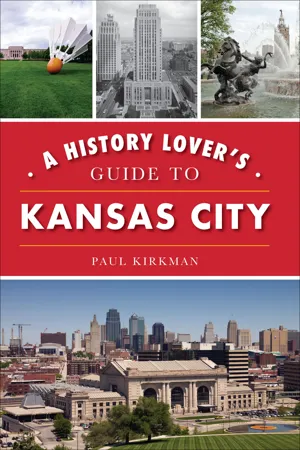
Discover the sights, sounds, and rich history of Kansas City—from ancient burial mounds to a world-class jazz museum.
Kansas City is often seen as a "cow town" with great barbecue and steaks. But it's also a city with more boulevards than Paris and more working fountains than Rome. There are burial mounds that date back more than two thousand years. The National World War I Museum and Memorial, opened in 1926, stands more than two hundred feet tall. Leila's Hair Museum has a collection that brings tourists from all over the nation. The Kansas City Jazz Museum features a historic district and world-class museum that document a time when dance halls, cabarets, speakeasies, and even honky-tonks and juke joints fostered the development of a new musical style. Join Missouri historian Paul Kirkman as he cuts a trail past the stockyards and takes you on a tour into the heart of America—Kansas City.
Includes photos and information on Kansas City landmarks
- 144 pages
- English
- ePUB (mobile friendly)
- Available on iOS & Android
eBook - ePub
A History Lover's Guide to Kansas City
About this book
Information
1
BEND IN THE RIVER
CHEZ LES CANNES
In simple terms, it was a bend in the Missouri River that created Kansas City. Situated at the edge of an ancient inland sea, carved out by water flowing across the northern plains and shoved into place by massive glaciers, the Missouri River, the second-longest river on the North American continent, takes a sharp turn toward the east at the mouth of the Kaw along its long path toward the Mississippi River. A natural rock ledge made the juncture an easy place to land a boat or canoe, and the rich soil deposited in the surrounding floodplain ensured that abundant plant and animal life existed there. A large number of caves and springs added shelter and fresh water to the mix. The combination made the site a natural crossroads for hunters and trappers, and it eventually became the perfect place for a more permanent settlement. Stone axes that were found here date back twelve thousand years; a Native American settlement called Nebo Hill, at a site northeast of Kansas City, dates back to 3000 BCE; and as many as thirty Native American sites, including burial mounds, have been found in the area. The area’s natives belong to a tribe called the Hopewell (the name came from the Hopewell farm in Ross County, Ohio, where a group of burial mounds was found), which date from around 100 BCE to 700 CE. In the following centuries, there continued to be Native American settlements in the area, but the cultures and tribes became more diverse. With the introduction of the horse and the adoption of bows and arrows, the earlier mound-building cultures were supplanted by the cultures of the plains. The Hopewell sites tended to be the homes of smaller groups, with villages rarely larger than a few dozen residents.
The first Europeans who recorded their travels to the area were Spanish, but the earliest description of the juncture of the Kansas and Missouri Rivers was written by French explorer Étienne de Veniard, Sieur de Bourgmont, in 1714. Regular trade routes and fairs had already been established among the area’s Native American groups long before the arrival of European explorers, but, at opposite ends of those routes, both the French and Spanish had begun building trading posts and forts to protect their interests and develop commerce. Among these early forts were Fort Orleans (built in 1723), which was located some eighty miles east of the Kawsmouth, and Fort de Cavagnial (built in 1744), which was located near modern-day Fort Leavenworth (north of Kansas City).
Many European and American explorers passed through and noted the bend in the river where Kansas City would rise. In the late eighteenth century, Daniel Morgan Boone (son of Daniel Boone) spent time trapping and hunting in the area along the Blue River (a tributary of the Missouri). In June 1804, Captain Meriwether Lewis and Lieutenant William Clark, on their voyage of discovery, made camp in the area and explored it. Clark noted in his journal that they had reached the mouth of the Kaw on June 26, 1804, and that the area that is now known as Quality Hill in Kansas City, Missouri, was a promising location for a fort.
When Francois Chouteau (nephew of Rene Auguste Chouteau, who, along with Pierre Laclede, is credited with the founding St. Louis) chose to build a home and trading post at the river’s bend and move there with his wife, Bereniece, in 1821, the foundations of Kansas City were laid. The Chouteau family had previously been in business with John Jacob Astor’s American Fur Company, and, starting with Rene Auguste, had several generations of successful traders. Francois Chouteau had obtained exclusive trading rights with the tribes in the Missouri River Valley from the U.S. government. He, along with his family and employees, set up trading posts in what would become known as Bonner Springs, Turner, Argentine, Shawnee, Topeka and Lawrence on the Kansas side, and Randolph and Kansas City on the Missouri side.
Francois Chouteau brought thirty-five men to the Kawsmouth area to work in his operation, and many of them either brought families or started them with Native American women, including several members of the Blackfoot and Shawnee tribes. By the early 1830s, at least one hundred French Catholic families had settled in the area; a small catholic church was eventually built, and Father Benedict Roux came to minister to the faithful there. The Chouteau Trading Post was the center of the settlement’s activity. All of the settlement’s families were involved in the fur trade and most lived in the West Bottoms, near the mouth of the Kaw River. This community became known as the “French Bottoms,” and the Native Americans called it “Chouteau’s Town.”
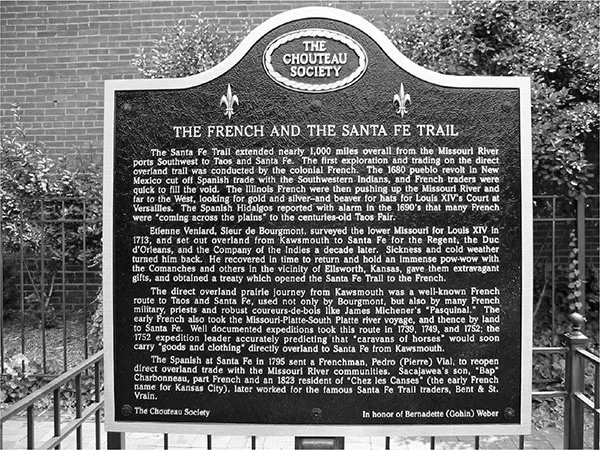
Chouteau Society marker. A tour of the original French settlement, with eleven place markers, is available through the Jackson County (Missouri) Historical Society. Courtesy of David W. Jackson, orderlypackrat.com.
The community grew slowly, at first, in isolation, while the great armies and navies that served political and financial alliances competed to secure control of the center of the continent. After the War of 1812, France had little hope of competing with the British and Spanish in North America, and the other nations were forced to accept that the United States would be at least an equal partner in determining the future of the continent. But in Missouri, the French trappers, traders and missionaries were the first to establish settlements. Although the Louisiana Purchase had given the United States a legal claim to the territory, it was another thirty years before the majority of people living in the Kansas City area were actually American citizens.
The Missouri River was the lifeblood of the early settlers in Chouteau’s community. Boats laden with furs gathered from around the western territories disembarked from Chouteau’s landing and traveled across Missouri, to St. Louis. Trade with Mexico, along the Santa Fe Trail, built up nearby Independence, as the trade goods that had come up the Missouri River from the East were unloaded just north of the town, at Wayne’s Landing. The supplies were then transferred to the hundreds of wagons that continually traversed the trail, bringing back silver, gold and incredible profits to the traders who were brave enough to make the trip. Francois Chouteau died in 1838, while he was on his way back to the Kansas City area from one such trip. Keel boats and, later, steamboats plied the river, hauling tons of cargo that had no other roads to travel on. At the time, the railroads had not made it far enough west, and the trails that had been cut through the Missouri woods had practically been grown over behind the men cutting them.
The community at the Missouri River’s bend prospered, and the location was ideal—except when it wasn’t, when the snowmelt from the mountains and plains hundreds of miles upstream and the summer rains would swell the river far beyond its banks. The first flood to hit the French community occurred in 1826, and it swept away the six buildings that comprised Chouteau’s Trading Post on the north bank of the Missouri River. The area’s next major flood occurred in 1844, and only one brick warehouse was left standing. The community never fully recovered, and the American settlers who followed struggled with the same forces of nature. The Flood of 1903 descended on a city of 160,000 people, leaving 20 dead and over 20,000 homeless. The river destroyed homes and businesses and 16 of the 17 railroad bridges in town; the stockyards and Union Depot were underwater, pulling all rail traffic to a hault. Today’s Union Station was built on higher ground, at Twenty-Fifth Street and Grand Avenue, in 1914, as a response to the concern that the river would once again submerge the vital rail hub. Despite the many efforts to limit the threat that the river poses, major floods inundated the city in 1951, 1993 and 1995. The safety of the bluffs and high ground south of the river beckoned the early settlers and set the tone of growth over the ensuing years. Kansas City has always needed the river, but it cannot control it; the river reminds the city, periodically, that it is not really in charge.
There were other factors that drove the development of Kansas City. The Indian Removal Acts of the early nineteenth century had the unintended consequence of changing the economic trajectory of the small river town. In 1808, Colonel William Clark, along with a contingent of soldiers led by Nathan Boone (son of Daniel Boone), traveled overland to a spot east of the river’s bend to build a fort overlooking the Missouri River. Fort Clark (later known as Fort Sibley and Fort Osage) was built to promote trade with the Osage, protect Americans heading west and counter the British and French influences over the area’s Native American population. That same year, Pierre Chouteau negotiated a treaty with the Osage, in which they ceded seven-eighths of Missouri River and nearly half of the state of Arkansas to the United States. In the trade, the Osage were paid $1,500 and given various goods and services through Fort Clark. By 1825, the Kansa had also ceded millions of acres of territory, and by 1827, Fort Leavenworth was built to protect travelers on the Santa Fe Trail.
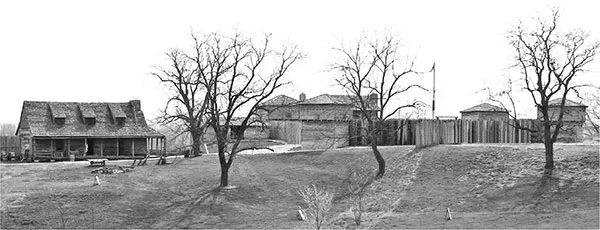
Fort Osage National Historic Landmark, Fort Osage. Courtesy of Wikimedia Commons.
The combination of new lands opening up in the West and constant conflict between settlers and Native Americans in the East fueled the push for a solution to separate the two groups. In 1825, the Missouri Shawnee were the first of many tribes to be relocated to the Kansas Territory. In 1830, the Delaware were given land along the Kansas River, and in quick succession, the Ottawa, Kickapoo, Otoe, Sac and Fox tribes were moved (willingly or not) to eastern Kansas. The government’s payments to the tribes were spent in the trading posts around the Kansas City area and brought wealth to the several trail towns near the river’s bend. The fledgling communities’ populations grew and changed rapidly in those early days.
In The Oregon Trail, Francis Parkman related his impressions of Independence and Westport in 1846:
Being at leisure one day, I rode over to Independence. The town was crowded. A multitude of shops had sprung up to furnish the emigrants and Santa Fe traders with necessaries for their journey; and there was an incessant hammering and banging from a dozen blacksmiths’ sheds, where the heavy wagons were being repaired, and the horses and oxen shod. The streets were thronged with men, horses and mules.
Yet, a few miles closer to the Kansas Territory:
Westport was full of Indians, whose little shaggy ponies were tied by dozens along the houses and fences. Sacs and Foxes, with shaved heads and painted faces, Shawanoes and Delawares, fluttering in calico frocks, and turbans, Wyandottes dressed like white men, and a few wretched Kansas wrapped in old blankets, were strolling about the streets, or lounging in and out of the shops and houses.
These little communities continued to benefit from the abundant opportunities provided by the area; however, they were still subject to forces that they couldn’t really control—from politics to the river. In spite of the challenges, they were undeterred, and homes and businesses began to take hold along the banks of the Missouri River.
RENNER-VILLAGE AT RENNER-BRENNER PARK
2901 Northwest Vivion Road
Riverside, Missouri 64150
816-741-4172
www.rennerbrennersitepark.com
www.riversidemo.com
For thousands of years, the land along Line Creek, above its juncture with the Missouri River, was inhabited by various groups of Native Americans from the Nebo Hill people and the Black Sand culture to the mound-building Hopewell and various woodland and plains tribes. Burial mounds, pottery, stone implements and thousands of other artifacts have been found in and ...
Table of contents
- Front Cover
- Title Page
- Copyright
- Contents
- Acknowledgements
- Introduction
- Chapter 1. Bend in the River: Chez Les Cannes
- Chapter 2. Trappers, Traders and Outfitters
- Chapter 3. Builders and Dreamers
- Chapter 4. Bleeding Kansas (City)
- Chapter 5. Back to Business
- Chapter 6. Looking Forward
- Chapter 7. Tom’s Town
- Chapter 8. The Senator from Pendergast
- Chapter 9. The Future of Our Past
- About the Author
Trusted by 375,005 students
Access to over 1.5 million titles for a fair monthly price.
Study more efficiently using our study tools.
Frequently asked questions
Yes, you can cancel anytime from the Subscription tab in your account settings on the Perlego website. Your subscription will stay active until the end of your current billing period. Learn how to cancel your subscription
No, books cannot be downloaded as external files, such as PDFs, for use outside of Perlego. However, you can download books within the Perlego app for offline reading on mobile or tablet. Learn how to download books offline
Perlego offers two plans: Essential and Complete
- Essential is ideal for learners and professionals who enjoy exploring a wide range of subjects. Access the Essential Library with 800,000+ trusted titles and best-sellers across business, personal growth, and the humanities. Includes unlimited reading time and Standard Read Aloud voice.
- Complete: Perfect for advanced learners and researchers needing full, unrestricted access. Unlock 1.5M+ books across hundreds of subjects, including academic and specialized titles. The Complete Plan also includes advanced features like Premium Read Aloud and Research Assistant.
We are an online textbook subscription service, where you can get access to an entire online library for less than the price of a single book per month. With over 1.5 million books across 990+ topics, we’ve got you covered! Learn about our mission
Look out for the read-aloud symbol on your next book to see if you can listen to it. The read-aloud tool reads text aloud for you, highlighting the text as it is being read. You can pause it, speed it up and slow it down. Learn more about Read Aloud
Yes! You can use the Perlego app on both iOS and Android devices to read anytime, anywhere — even offline. Perfect for commutes or when you’re on the go.
Please note we cannot support devices running on iOS 13 and Android 7 or earlier. Learn more about using the app
Please note we cannot support devices running on iOS 13 and Android 7 or earlier. Learn more about using the app
Yes, you can access A History Lover's Guide to Kansas City by Paul Kirkman in PDF and/or ePUB format, as well as other popular books in History & North American History. We have over 1.5 million books available in our catalogue for you to explore.