
eBook - ePub
Taking the Heat
How Climate Change Is Affecting Your Mind, Body, and Spirit and What You Can Do About It
- 256 pages
- English
- ePUB (mobile friendly)
- Available on iOS & Android
eBook - ePub
Taking the Heat
How Climate Change Is Affecting Your Mind, Body, and Spirit and What You Can Do About It
About this book
From meteorologist and Peabody Award–winning journalist Bonnie Schneider, an innovative look at how climate change is already threatening our mental and physical health and practical tips for you to tackle these challenges head on.
The impacts of climate change have become dire. Rising temperatures, volatile weather, and poor air quality affect our physical and mental health in dangerous new ways. From increasing the risk of infectious disease to amplifying emotional stress and anxiety—even the healthiest among us are at risk. Bonnie Schneider has tracked environmentally-linked physiological impacts throughout her career as a TV journalist, meteorologist, and the founder of Weather & Wellness©—a platform that explores the connection between weather, climate change, and health. In Taking the Heat, Schneider provides crucial advice from science experts and medical professionals to help you:
-Cope with the mental anguish of “eco-anxiety” and other climate change fears for our planet’s future, particularly expressed by millennials and Gen-Z
-Identify health hazards caused by extreme heat and air pollution that disproportionally affect low-income and minority communities
-Uncover the science behind longer and stronger allergy seasons and learn new ways to reduce your risk of adverse allergic reactions
-Detect the increased threat of dangerous pathogens lurking in unexpected places and why we may face future pandemics
-Understand how seasonal fluctuations of sunlight, heat, and humidity can not only factor into feelings of depression and anxiety but also can trigger flare-ups for certain auto-immune diseases
-Discover how meditation and mindfulness practices can ease the psychological stress that often occurs in the aftermath of devastating natural disasters
-Explore how the Earth’s rising temperatures may rob you of restorative sleep and impair mental sharpness
-Learn why increased levels of CO2 in the atmosphere may reduce the availability of what you choose to eat; learn sustainable solutions—from food to fitness
- And more!
Anchored in the latest scientific research and filled with relatable first-person stories, this book is the one guide you need to navigate the future of your own health—mind, body, and spirit, in a rapidly changing environment.
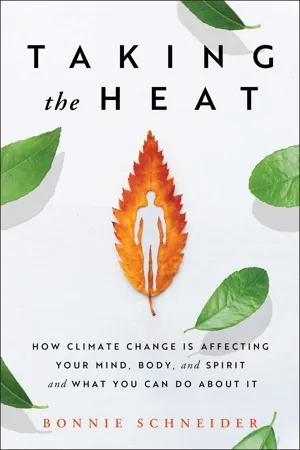
The impacts of climate change have become dire. Rising temperatures, volatile weather, and poor air quality affect our physical and mental health in dangerous new ways. From increasing the risk of infectious disease to amplifying emotional stress and anxiety—even the healthiest among us are at risk. Bonnie Schneider has tracked environmentally-linked physiological impacts throughout her career as a TV journalist, meteorologist, and the founder of Weather & Wellness©—a platform that explores the connection between weather, climate change, and health. In Taking the Heat, Schneider provides crucial advice from science experts and medical professionals to help you:
-Cope with the mental anguish of “eco-anxiety” and other climate change fears for our planet’s future, particularly expressed by millennials and Gen-Z
-Identify health hazards caused by extreme heat and air pollution that disproportionally affect low-income and minority communities
-Uncover the science behind longer and stronger allergy seasons and learn new ways to reduce your risk of adverse allergic reactions
-Detect the increased threat of dangerous pathogens lurking in unexpected places and why we may face future pandemics
-Understand how seasonal fluctuations of sunlight, heat, and humidity can not only factor into feelings of depression and anxiety but also can trigger flare-ups for certain auto-immune diseases
-Discover how meditation and mindfulness practices can ease the psychological stress that often occurs in the aftermath of devastating natural disasters
-Explore how the Earth’s rising temperatures may rob you of restorative sleep and impair mental sharpness
-Learn why increased levels of CO2 in the atmosphere may reduce the availability of what you choose to eat; learn sustainable solutions—from food to fitness
- And more!
Anchored in the latest scientific research and filled with relatable first-person stories, this book is the one guide you need to navigate the future of your own health—mind, body, and spirit, in a rapidly changing environment.
Frequently asked questions
Yes, you can cancel anytime from the Subscription tab in your account settings on the Perlego website. Your subscription will stay active until the end of your current billing period. Learn how to cancel your subscription.
No, books cannot be downloaded as external files, such as PDFs, for use outside of Perlego. However, you can download books within the Perlego app for offline reading on mobile or tablet. Learn more here.
Perlego offers two plans: Essential and Complete
- Essential is ideal for learners and professionals who enjoy exploring a wide range of subjects. Access the Essential Library with 800,000+ trusted titles and best-sellers across business, personal growth, and the humanities. Includes unlimited reading time and Standard Read Aloud voice.
- Complete: Perfect for advanced learners and researchers needing full, unrestricted access. Unlock 1.4M+ books across hundreds of subjects, including academic and specialized titles. The Complete Plan also includes advanced features like Premium Read Aloud and Research Assistant.
We are an online textbook subscription service, where you can get access to an entire online library for less than the price of a single book per month. With over 1 million books across 1000+ topics, weāve got you covered! Learn more here.
Look out for the read-aloud symbol on your next book to see if you can listen to it. The read-aloud tool reads text aloud for you, highlighting the text as it is being read. You can pause it, speed it up and slow it down. Learn more here.
Yes! You can use the Perlego app on both iOS or Android devices to read anytime, anywhere ā even offline. Perfect for commutes or when youāre on the go.
Please note we cannot support devices running on iOS 13 and Android 7 or earlier. Learn more about using the app.
Yes, you can access Taking the Heat by Bonnie Schneider in PDF and/or ePUB format, as well as other popular books in Biological Sciences & Global Warming & Climate Change. We have over one million books available in our catalogue for you to explore.
Information
1. ECO-ANXIETY
When the Oxford English Dictionary named climate emergency as its 2019 āWord of the Year,ā it was among a short list of other worthy contendersāincluding a relatively new term, eco-anxiety.
Defined as the fear of climate change and its impact on future life on this planet, eco-anxiety, especially for children and Generation Z (those ages eighteen to twenty-five), is a genuine source of mental anguish. In its milder forms, eco-anxiety might manifest as disappointment and frustration. But in the most severe cases, climate fears can overwhelm people to the point of unrelenting insomnia, difficulty maintaining daily functioning and self-destructive behaviors like substance abuse or self-harm.1
Parents are increasingly seeking advice on how to allay their childrenās fears about rising seas, melting ice caps, and destructive storms. In just the past few years, eco-anxiety has become a driving force in the global conversation about climate changeāeven prompting universities to create courses on how to handle āclimate grief.ā
Mental health experts believe there are ways to cope with eco-anxiety. This starts with validating climate concerns, easing unmanageable levels of anxiety, and discovering new outlets for proactive endeavors to improve our planetās health.
Thoughts of Environmental Doom
āI watched this entire hillside of giant evergreens fall, one by one,ā twenty-year-old college student Barbara āBeeā Elliott said, recalling the barren site littered with overturned trees. āI felt as though it was ripping my own heart out from the soil as they fell because of our inconsiderate and dominating development.ā
The University of Washington Bothell undergraduate says her climate concerns escalated when she watched a land development project get underway near her apartment complex. As construction workers dug into the earth, laying concrete and asphalt, tall trees were knocked down in the process. Bee witnessed firsthand what she considered to be a āhurtful desecration of the natural environment.ā
As the project moved to its final phases, Beeās disappointment gave way to frustration. She felt no one was considering the needs of the trees. Thatās when she decided to do something. Bee wanted to alert people in the area as to what was happening all around them.
āI sawed off an inch of a tree stump still standing, sanded it down, and painted a crying eye being pulled open on the stump,ā Bee said. āThis was to illustrate that these evergreens wanted us humans to wake up and open our eyes!ā
Bee shared this experience the same year that one of the loudest and most influential voices for Generation Z, Greta Thunberg, spoke to world leaders at the United Nations Climate Action Summit in September 2019. The Swedish climate activist had previously revealed her feelings of eco-anxiety to the world: āWhen I was about eight years old, I first heard about something called āclimate changeā or āglobal warming.ā ā2 Greta said she couldnāt understand why adults werenāt doing more to stop climate change.
Gretaās message resonates with Gen Z. āI think Greta comes from a real place of concern that a lot of kids are feeling right now,ā twenty-three-year-old Maisy Roher said. The recent New York University graduate shared her own struggle with eco-anxiety in an interview with Vice. āI guess the despair started when I was eighteen, and I began learning about how much the Earth was changing, and Iād have full-blown panic attacks about the Arctic sea ice melting and the polar bears starving.ā3
Over the past few years, mental health professionals worldwide say theyāve seen an uptick of patientsāfrom young adults to parents of small childrenāseeking help for eco-anxiety. āWeāre hearing more and more about this,ā said San Franciscoābased psychiatrist Dr. Robin Cooper, MD, whoās been in private practice for thirty-eight years. Dr. Cooper is a cofounder and steering committee member of the international Climate Psychiatry Alliance, a group of psychiatrists dedicated to educating the profession and the public about the mental health impacts of climate change.
Symptoms are often similar to clinical anxiety, Dr. Cooper said. āEco-anxiety is a shorthand term for many extremely powerful and at times overwhelming feelings: fear, anxiety, distress, anger, sadness, and depression, which can merge into a sense of hopelessness.ā
The Mental Health Classification
Eco-anxiety, psychiatrists say, is not an āofficial diagnosis,ā meaning itās not classified as a mental illness or psychological disorder. The term is used to describe the focus of the patientās distress. Whether climate change is experienced indirectly or directly, it can translate into impaired mental health, resulting in depression and anxiety.4
In March 2018, a Yale University poll pointed to a rise in climate anxiety. Compared to a similar survey in 2014, nearly double the respondents (21 percent) reported being āvery worried about the effects of global warming.ā5 A more recent poll by the American Psychiatric Association (APA) found that young people were more likely to be concerned about climate changeās impact on mental health than older adults: 67 percent of Gen Zers (eighteen to twenty-five years old) and 63 percent of Millennials (twenty-four to thirty-nine years old) responded that they were āsomewhat or very concerned about the impact of climate change on their mental health,ā compared to 42 percent of Baby Boomers (fifty-six to seventy-four years old) and 58 percent of Gen Xers (forty to fifty-five years old).6
In a 2019 interview with Medscape, Dr. Lise Van Susteren said she would like the American Psychiatric Association (APA) to establish a subspecialty in climate psychiatry. This potential area of concentration would feature specialists who were trained in climate issues and could treat patients with eco-anxiety, and also offer targeted counseling to assist communities facing natural disasters.7
Pollution in Paradise
Twenty-one-year-old Katie Hearther grew up in a place many consider pure paradise: Hawaii. But even the most beautiful tropical destinations can be soiled by the effects of ocean pollution. Katie volunteered to help clean up the litter on Kahuku Beach with other teens while she was in high school. The experience was life changing.
Located on the Big Islandās southern tip, Kahuku Beach was once a pristine spot of Oahu. Now, though, the shoreline is infamous for another reason: its massive accumulation of plastic trash and marine debris. As Thrillist reports, despite occasional sea turtle and monk seal sightings, āocean currents and strong winds push plastic garbage and fishing industry waste onto the beach and into the rocky shelves.ā8
Katie described Kahuku as her personal ground zero. Up close, conditions at the beach were worse than she imagined. She painstakingly sifted sand with nets to remove tiny pieces of plastic. Each scoop was filled with so many particles that progress was slow and frustrating. Despite her time, focus, and energy, she only managed to clear a small area of the beach. She felt like her efforts didnāt matter. āThis snowballed into my every waking thought,ā Katie said. āThere were terrible things happening to the ocean, and I felt powerless to stop it.ā
Katie, who also suffered from general anxiety, says she could not shake intrusive thoughts of the planetās perilous state.
āIt can be extremely paralyzing,ā she said. āOn the best days, itās like a quiet buzz in the background of my life. On the worst days, it is difficult to get out of bed because the weight of the global issue that is climate change is just so heavy. I canāt articulate how every day is a battle to figure out how I can possibly be happy when no one cares that the world is on fire.ā
Katie says this fear influences her lifestyle choices and long-term thinking. She decided to dedicate her college studies to marine science, hoping to move things forward in a positive direction. She does everything she can to minimize her carbon footprint. But Katie feels these actions are not enough, as they will only have what she calls a āminuscule impact.ā
āIāve already decided Iāll never have children of my own,ā she confided. āI donāt discuss these feelings often⦠but thatās my reality.ā
That may sound drastic, but some recent studies point to climate change concerns influencing young peopleās choices in family planning. One study found that 38 percent of Americans between the ages of eighteen and twenty-nine believe climate change can factor in to a coupleās decision to have children.9 And a 2018 New York Times poll found that 33 percent of young adults say theyāre expecting to have fewer children than their ideal because theyāre worried about climate change.10
In an online interview with the Sierra Club, therapist Ann Davidman said that when the topic is explored further, additional underlying anxieties can be revealed. āItās easier and more socially acceptable to say āclimateā than āIām really ambivalent about having children.ā⦠We often get judged and shamed for not knowing.ā11
Nightmares of āClimate Collapseā
Bee and Katie share several commonalities: theyāre both students at the University of Washington Bothell, and they each have friends and acquaintances who have categorized their views as alarmist or overdramatic. Katie said people often tended to be dismissive when she opened up and expresseed her thoughts about climate change. āThereās a misconception that climate change is an issue of the future, instead of a global problem thatās happening now,ā she said.
Toxic wildfire smoke, a future planet with no trees, and ātotal climate collapseā are fears that kept Bee Elliott up at night. Originally from Southern California, Bee said it was hard to express these feelings with friends, as some didnāt take them seriously.
Katie and Bee found like minds in each other and support on campus. An innovative new college course offered an outlet for students like them to vent their climate concerns and help them discover new, productive ways to cope with their eco-anxiety.
Professor for Change
Natural disasters that would normally affect someone perhaps once in a lifetime impacted a University of Washington professor and her family several times in a matter of only a couple of years. For climate educator Dr. Jennifer Atkinson, watching this sequence of unfortunate extreme weather events unfold was transformational.
It started in 2016 when wildfire outbreaks engulfed the communities surrounding her motherās home outside of Paso Robles, California. Then another fire in October 2017 brought flames frighteningly closeāwithin a quarter mile of the family home. Only a slight shift in the wind at the last moment spared the dwelling. The neighborsā homes were not so lucky.
This 2017 fire was part of one of the most destructive outbreaks that season, known in Northern California as āWildfire Firestorm,ā a group of 250 wildfires that burned for weeks.12
Just a couple of months later, Dr. Atkinson returned to California for the holidays. She visited her family in Santa Barbara just as another massive fire was breaking out. Ripping across Ventura and Santa Barbara Counties, the Thomas Fire burned almost three hundred thousand acres before being fully contained, making it the largest wildfire in modern California history at the time.13
Dr. Atkinson recalled there was ash everywhere. Her young nieces and nephew wore face masks to go to school that December. āI remember walking out of The Nutcracker with themāthis iconic symbol of the winter...
Table of contents
- Cover
- Title Page
- Foreword
- Introduction
- Chapter 1: Eco-Anxiety
- Chapter 2: Natural Disasters, Trauma, and Gratitude
- Chapter 3: Cities of Heat
- Chapter 4: Viruses and Infectious Diseasesāfrom Corona to Lyme
- Chapter 5: The New Allergy Season
- Chapter 6: Shining Light on Winter Blues
- Chapter 7: Weathering Autoimmune Flare-ups
- Chapter 8: Heat, Sleep, and Memory
- Chapter 9: Food Choices and Carbon Footprints
- Chapter 10: Sustainable Fitness
- Conclusion
- Acknowledgments
- About the Author
- Notes
- Copyright