This unique book offers compelling stories to help you encounter life with mindfulness and find new vigor on your teaching path. Author Richard Brady, founder of the Mindfulness in Education Network, shares his experiences in a variety of areas, including motivation, agency and freedom, creativity, nurturing presence and community, and more. Following each story, you'll find reflections and contemplations that invite connection with your own experiences and ultimately with action. The book can be used by educators of all levels and subject areas, for personal use and for in-service and pre-service education.
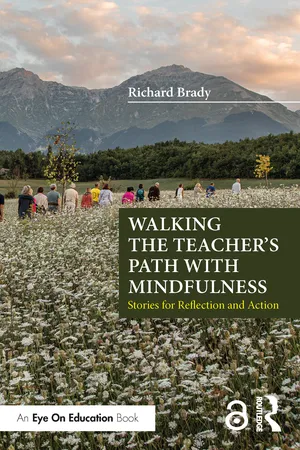
eBook - ePub
Walking the Teacher's Path with Mindfulness
Stories for Reflection and Action
- 142 pages
- English
- ePUB (mobile friendly)
- Available on iOS & Android
eBook - ePub
About this book
Information
Topic
EducationSubtopic
Personal SuccessPART I
Catching Fire
Don’t ask what the world needs. Ask what makes you come alive and go out and do it. Because what the world needs is people who have come alive.—Howard Thurman1
Catching fire—motivation—is complex and mysterious. What I’ve learned about it has come from reflecting on my own learning experience, those of my students, experiences with teaching—my own and others’, and wisdom shared directly with me and drawn from books. Fires begin to burn only when conditions are sufficient, and countless ingredients contribute to the fuel. In the following stories these include particular teachers, situations, environments, activities, groups, books, and challenges. The fuel mixture must be appropriate for the learner and the learner must be primed for ignition for combustion to occur. An old maxim suggests that, “When the learner is ready, the teacher will appear.” But even when the fire kindled is but a small one or dies out when conditions change, embers can remain and reignite years later.
What makes our students come alive? In 1980 I’d been teaching high school math at Sidwell Friends School in Washington, DC for seven years when I was presented with an unusual opportunity to examine this question. Almon was a sophomore. He wasn’t a student of mine, but I’d been having conversations with him since he brought his box of childhood toys to school and placed it in the hall in front of his locker.
One day Almon bemoaned his current experience with mathematics:
“Before last year I attended St. Albans and never enjoyed math. Last year I lived in Boston and attended Commonwealth School. My math teacher there got me really excited about math. Now I’ve come to Sidwell, and I no longer enjoy it.”
“Almon,” I replied, “were you excited about math at Commonwealth or were you excited about your teacher? If it was math you were excited about, my guess is you’d still be excited about it this year regardless of the teacher.”
Almon was skeptical.
John Holt, author of How Children Fail2 and one of my education heroes, had taught at Commonwealth, which held up one rule: No roller skating in the halls. In other words, Don’t be a damn fool. I’d always wanted to visit there. I asked Almon the name of his teacher. On our next professional development day I paid a visit to Commonwealth. Just as I suspected—Almon’s teacher projected his exuberance about math and kept his class on the edge of their seats with his inspired rhetoric and well-timed questions. Here at the front of the class was the charismatic teacher I was not.
As a student, I never experienced a teacher like Almon’s. I had excellent high school math teachers, but my total engagement in their classes was primarily motivated by my own interest in math, supported by their clear explanations and the challenging assigned and extra credit problems they gave us. English was a different story.
I grew up with little interest in literature or writing. Raised in a family where emotional expression wasn’t the lingua franca, my understanding of books and my self-expression were limited. Fortunately, in eleventh grade reading opened a door, exposing me to a vast range of emotions and to families that didn’t look like mine. I discovered new dimensions of life. My soft-spoken English teacher, Mr. Landers, helped me investigate American literature in a fresh way, to connect it with my own experience. Junior year at Winnetka, Illinois’ New Trier High School included writing the dreaded Junior Theme, an analysis of the works of an author selected by the student. Leaning on Mr. Landers’ advice, I choose Thomas Wolfe. Thomas Wolfe: A Theme was the most important paper I wrote in all my school years. In Eugene Gant, the protagonist of Wolfe’s first novel Look Homeward Angel,3 I found a character who spoke for me. For the first time, I found myself intensely interested in developing and communicating my own thoughts. My feeling of self-worth increased in response to Mr. Landers’ encouragement and approval and infused my writing. I was exploring myself.
With Mr. Landers’ urging I moved up to honors English for senior year. In Mr. Boyle’s world literature class, my classmates were mostly members of New Trier’s literary and arts set, well versed in literary analysis and writing. None of us were prepared for Mr. Boyle. The year started with impossible, out-of-the-blue spelling and abbreviation tests. Were they, like the slap of a Zen master, intended to humble the better students? I had no idea, but I was more curious than anxious. In contrast to Mr. Landers, Mr. Boyle was far more critical of my work. Did I know how to read? I soon discovered that I didn’t know how to delve beneath the surface. Focusing my latent analytical skills on my own ideas was slow going, but my experience with Mr. Landers gave me confidence in their worth. Without that, I’m not sure I would have mustered the strength to survive Mr. Boyle’s critiques.
For the fall semester Mr. Boyle gave me a ‘C’, my worst grade in all of high school. Grades were important to my parents. Making a fuss about our success, they rewarded my brother and me for good report cards. They didn’t ask about my grade in Mr. Boyle’s class. They assumed I did not and could not deserve a ‘C’.
“Mr. Boyle is probably prejudiced. You should ask for a transfer,” my mother said, trying to minimize the suffering she assumed I felt.
I was angry, a rare state. For me, the ‘C’ had a different significance. I knew I deserved it. I still had a lot to learn from Mr. Boyle. With a fresh sense of personal power, I asked my parents to stay out of it.
During the second semester, I wrote a five-page paper for Mr. Boyle on “Petition,”4 W.H. Auden’s 100-word poem beseeching God to intervene in a world gone awry. Removed though I felt from a higher power, I was drawn to the idea of prayer as an avenue of radical change. I also wrote a paper upholding the Athenian jurors’ verdict of Socrates as guilty. Putting myself in the jurors’ shoes, I argued that Socrates, through teaching the youth, threatened society. I got so involved in writing my opus that there was no way I could finish it on time. Since the paper was already late, I decided to take the time to thoroughly complete it. Writing a paper that I wanted to write was a new experience. I loved it!
At the end of second semester, I received an ‘A’ from Mr. Boyle—satisfying but unneeded. I already felt grateful. Reading and writing had begun to come alive for me. I was developing an understanding of literature, complementing the new understanding of myself developed in Mr. Landers’ English class the previous year. Both of these jewels I carried tenderly as I continued on my path. My newfound interest in literature became a part of me.
Reflections and Contemplations
As the Thurman quote advises, ask what makes you come alive.
Visualize a time when you came alive.
What ingredients—people, place, situation, feelings, hopes—helped make this possible?
When have you seen one of your students come alive?
What conditions helped promote this?
Student-Led Learning
Sometimes the teacher and the subject matter prove insufficient to kindle a fire. In the early 1990s an afternoon ninth/tenth grade algebra class was giving me fits. The students didn’t seem to be able to settle down. They finished only half the work my morning group completed. This was very unusual for Sidwell, where students placed a high value on success. My first impulse was to blame their difficulties on a clique of immature ninth-graders.
I wasn’t hesitant to ask friends for advice about personal problems. However, I was an experienced teacher. I should not have been having difficulty handling a class. I should know what to do. I was too proud to ask a colleague for help. By December I was at my wits’ end. When an opportunity for assistance presented itself, I reached out gratefully for help for the first time. I shared my problem with Marci, a visiting educational consultant.
Marci asked whether I was sure of my suspicions about the immature students.
“I’m not,” I answered.
“Why don’t you ask the class what the problem is?”
“I never thought of doing that,” I replied.
I conducted an anonymous survey. The results were surprising. Students responded that they were tired because the class met right after lunch. Reporting this “finding” to the class, I told them I’d do some research over winter break and see if I could find a remedy.
I spent part of my break at a small meditation center in nearby West Virginia. Rahula, one of the teachers there, was a yoga practitioner. When I asked his advice, Rahula told me about qi (a Chinese word pronounced “chi,” meaning life force energy) and showed me an exercise that brings qi up from the feet.
Stand on your toes with your hands over your head. Breathe out as you bend down and touch the floor. Then breathe in and slowly straighten, raising your hands back up over your head. Repeat this exercise nine more times, remaining on your toes.
With Rahula’s remedy, I returned to my challenging after-lunch class. Gathering the students in a circle, I led them in the exercise. We all reported feeling invigorated. The lesson that followed went ...
Table of contents
- Cover
- Half Title
- Series Page
- Title Page
- Copyright Page
- Dedication
- Table of Contents
- Meet the Author
- Foreword
- A Letter to Readers
- Acknowledgements
- Introduction
- Part I: Catching Fire
- Part II: Living Without Boundaries
- Part III: Seeing with the Heart
- Part IV: Walking My Path
- Postscript
- Resources
- Permissions
Trusted by 375,005 students
Access to over 1.5 million titles for a fair monthly price.
Study more efficiently using our study tools.
Frequently asked questions
Yes, you can cancel anytime from the Subscription tab in your account settings on the Perlego website. Your subscription will stay active until the end of your current billing period. Learn how to cancel your subscription
No, books cannot be downloaded as external files, such as PDFs, for use outside of Perlego. However, you can download books within the Perlego app for offline reading on mobile or tablet. Learn how to download books offline
Perlego offers two plans: Essential and Complete
- Essential is ideal for learners and professionals who enjoy exploring a wide range of subjects. Access the Essential Library with 800,000+ trusted titles and best-sellers across business, personal growth, and the humanities. Includes unlimited reading time and Standard Read Aloud voice.
- Complete: Perfect for advanced learners and researchers needing full, unrestricted access. Unlock 1.5M+ books across hundreds of subjects, including academic and specialized titles. The Complete Plan also includes advanced features like Premium Read Aloud and Research Assistant.
We are an online textbook subscription service, where you can get access to an entire online library for less than the price of a single book per month. With over 1.5 million books across 990+ topics, we’ve got you covered! Learn about our mission
Look out for the read-aloud symbol on your next book to see if you can listen to it. The read-aloud tool reads text aloud for you, highlighting the text as it is being read. You can pause it, speed it up and slow it down. Learn more about Read Aloud
Yes! You can use the Perlego app on both iOS and Android devices to read anytime, anywhere — even offline. Perfect for commutes or when you’re on the go.
Please note we cannot support devices running on iOS 13 and Android 7 or earlier. Learn more about using the app
Please note we cannot support devices running on iOS 13 and Android 7 or earlier. Learn more about using the app
Yes, you can access Walking the Teacher's Path with Mindfulness by Richard Brady in PDF and/or ePUB format, as well as other popular books in Education & Personal Success. We have over 1.5 million books available in our catalogue for you to explore.