eBook - ePub
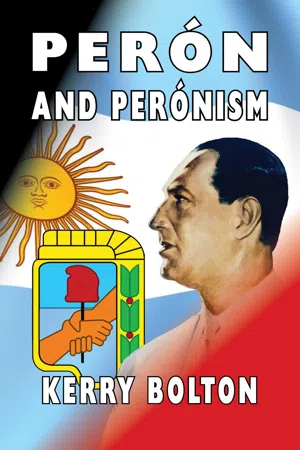
Peron and Peronism
Information
Third Position: Beyond Capitalism and Communism
During the Cold War, when states were being cajoled and scared into supporting one or another of the antagonists, Perón reiterated that Justicialism is as much opposed to capitalism as to communism, and beyond that is opposed to the imposition of great power hegemony. Already in 1950 Perón had described his doctrine as a ‘Third Position’ in a speech to parliament.1
Unlike other Latin American anti-communists, whose answer to communism was merely counter violence, Perón understood that an idea could only be defeated by a superior idea. Communism had merely been a reaction to capitalism; its mirror image, and both are anti-human. Both ‘insectify’ humanity; that is, both aim to reduce man to the level of a drone, rather than towards a higher – ultimately spiritual – meaning.
The rejection by Perónism of capitalism and Marxism, and of the ‘Western bloc’ headed by the USA, and the Eastern, headed by the USSR, which he saw as imperialism working in unison to run the world, placed Argentina in a ‘third position’ in the world of power politics.
Jill Hedges points out that this ‘third position’ was the forerunner of what would become the ‘Third World’.2 Salbuchi writes that the socio-economic doctrine of Justicialism was the basis of this ‘third position’ applied to the diplomatic and geopolitical realms: ‘All these and many other government policies, measures and doctrines later went under the name of “Third Position”, i.e., non-alignment with neither of the superpowers: U.S.-U.K. nor the USSR. PsyWar tactics later downgraded this concept to “Third World”, which became synonymous with poverty and destitution’.3
In 1969 Perón, in referring to the division of the world between the USA and the USSR described Justicialism as a ‘Third Position’ that rejected both:
For a quarter of a century, the Justicialist Revolution in Argentina promoted a popular transformative movement without bloodshed that, responding to its evolution, has given birth to a ‘third position’ that is equally distant ideologically from the dominant imperialisms and from the system they tried to impose throughout the world. The international synarchy, that harbours the imperialist interests in both zones, has promoted a modus vivendi that in the name of ‘coexistence’, opposes any other evolution that is not within the ideologies or systems imposed by them. So, the reaction of both imperialisms is characterised by violent domination, whether it is economic, military, or both at the same time, as we have been given evidence for in Latin America, in the zone of the Russian satellite states, or more specifically in Santo Domingo and Czechoslovakia.4
Having regained leadership of Argentina after 18 years of exile, Perón reiterated Argentina’s ‘third position’ vis-à-vis world politics in a message to the Fourth Conference of Non-Aligned Countries in 1973:
As far as foreign policy is concerned, the terms of our actions are clear and precise. We argue, from the very moment of the birth of Perónism, as basic principles and objectives in the international [realm], the following:
- The overall defence of national sovereignty across our land and especially over Argentine Antarctica, the Falkland Islands and its independent islands.
- Exercise of the Policy of Social Justice, Economic Independence and Sovereignty, as premises to ensure every people in the world their own happiness, by conducting their own justice and their own freedom.
- The Third Position as a universal solution to dogmatic Marxism and demoliberalism international capitalism, leading to the annulment of the entire imperialist domination in the world.5
Speaking to the General Confederation of Labour in 1973, as part of a weekly discourse to workers at CGT headquarters, Perón outlined the character of the Justicialist revolution vis-à-vis the world situation and the super-powers. At this time, it is evident that much of what Perón was saying was an attempt to clarify Justicialist doctrine after his exile had seen a bitter and even bloody rivalry develop between Left and Right factions of Perónism. In this lecture he avers to the conflict between the labour movement leadership, and the Leftist faction that he – interestingly – calls ‘Trots’; that is, Trotskyites.
Today I would like to address an issue that is especially important for the moment we live. It is this apparent controversy that seems to have occurred in some sectors of Perónism, the fight that apparently has been raised between union bureaucracy on the one hand, and the Trots, on the other.6
After Perón’s exile in 1955, when there was a long era of repression of everything and everyone associated with Perón, many of the young generation became Perónists based on the legends of their parents and grandparents, and engaged in guerrilla warfare. Perón’s view, in exile, was that the various factions within Justicialism would be reconciled on his return to Argentina. What transpired was a bloody conflict between Perónist factions, marked by the shoot-out at Ezeiza airport between Leftist and Rightist factions awaiting Perón’s return. The factions were not reconciled; the ultra-Left intensified its guerrilla warfare, prompting the army to overthrow Isabel Perón in 1976.7
Perón referred to the wide variety of views within the Justicialist movement, stating that: ‘I have always handled the Perónist movement with greater tolerance in that sense, because I think that those who join and live in a mass movement such as the Perónist should have absolute freedom to think, to feel and to act for the benefit of the same movement’.8 Perón identified three currents within the movement, which we might term ultra-Leftist, ‘conservative’, and those who are truly Perónists insofar as they have transcended the old dichotomy:
Certainly, in all revolutionary movements there are three kinds of approaches: first, that of the hurried, who believe that everything is going slowly, not doing anything, because they do not break things or people are not being killed. Another sector is made up of latecomers, those who do not want anything done, and then do everything possible so that this revolution is not made. Between these two extremes there is a balanced approach not to go further or stay longer, but to do everything possible for the benefit of the masses, who are the most deserving.9
It is relevant to note that Justicialist administrations since the death of Perón have been accused of veering one way or another: Menem to the so-called ‘right’,10 and what is termed the ‘Left’ of the Kirchner administrations.
Perón defined ‘revolution’ as structural change according to the social development of humanity, drawing from the ancient Greek conception of affecting change harmoniously, and without recourse to methods that make the ‘cure worse than the disease’. Again, it is a reference to the crypto-Trotskyite advocates of permanent revolution who were undermining the Perónist revolution in the name of Perón:
Revolution is likely to be as old as the world, because the world has never been static, but has always been in constant evolution, and revolutions are always part of that evolution. Perhaps the inventors of organised revolution have been the Greeks, who gave us the Greek demos of the Plato Revolution. They, perhaps, were the inventors of organised revolution, but the Greece of that time, before launching the revolution, placed at the forefront of all its universities a phrase that indicates what the revolution should be. They said: ‘Everything in its extent and harmoniously’. That is the revolution: the changes made to your needs harmoniously, not so that the remedy is worse than the disease.
When talking about revolution, some believe that force is made with bombs and bullets. Revolution, in its true sense, is the structural changes needed according to the evolution of humanity, which is controlling all changes to be made.11
Perón stated that man is really only a passive agent of revolution or social evolution insofar as it proceeds according to organic historical laws, or ‘historical fatalism’:
Man often believes he is the one that produces the evolution. In this, as in many other things, man is a little messenger. Because evolution is what he has to accept and to which he must adapt. Consequently, all that man can do is to agree with this development that he does not dominate; it is the work of nature and historical fatalism. He is only an agent that creates a system to serve that evolution and is placed within it. It means that the revolution that we speak of is not a cause but an effect of these developments.12
Perón proceeds with his own historical dialectic. He states that man creates social and political systems according to the requirements thrown up by the dialectical, or ‘fatal’ laws of history. This is the same as stating that political, economic, philosophical and other systems emerge according to what the Germans coined as the zeitgeist; literally the ‘spirit of the age’. Hence, that is why Perón states that man can only be a messenger of that spirit. He can only work within that ‘spirit of the age’, no matter how he might rant against it. That is why despite Marx’s attempt to establish a historical dialectic that would overthrow capitalism, his own ideology was merely a reflection, like capitalism, of the same zeitgeist of the 19th century: namely, economics. Hence, Perón places Marxism within the same context as capitalism, and states that Marxism is just another ‘capitalist system’:
Therefore, synthetically [dialectally] considering history, we see in the corresponding medieval feudal system that the Middle Ages is a product of the evolution of mankind. The feudal system is what man created to be able to walk within that system.
Then comes the stage of medieval nationalism, i.e. the formation of nationalities. And there are the demoliberal-born capitalist system and the communist system, because both are born in the eighteenth century and developed in this century and part of the nineteenth century. One is individualistic capitalism, and the other is state capitalism. In the background are two capitalist systems.
However, these systems have served the nineteenth and early twentieth centuries, and today are already both outmoded. Not either one but both. And I’ll say why they are outmoded, why they have been overcome by evolution: The demoliberal-capitalist system is outdated, because it was created to serve the stage of nationalities, which now is ending, to give birth to the [historical-dialectical] stage of continentalism. Today men are already grouped by continents and not by nations, and that [demoliberal] system was created for t...
Table of contents
- Table of Contents
- Peron and Peronism
- Introduction
- Juan Domingo Perón: A Biographical Sketch
- The Emergence of Justicialism
- Third Position: Beyond Capitalism and Communism
- Fundación Eva Perón
- The Struggle Against International Finance
- The Second Perónist Period
- The 1955 Coup against Perón
- Achievements of the Perónist State
- The New Justicialist Constitution
- Capital and Capitalism
- Justicialism And Latin America
- ‘International Synarchy’
- Third World: Third Position
- The Third Perónist Period
- After Perón
- Conclusion
Trusted by 375,005 students
Access to over 1.5 million titles for a fair monthly price.
Study more efficiently using our study tools.
Frequently asked questions
Yes, you can cancel anytime from the Subscription tab in your account settings on the Perlego website. Your subscription will stay active until the end of your current billing period. Learn how to cancel your subscription
No, books cannot be downloaded as external files, such as PDFs, for use outside of Perlego. However, you can download books within the Perlego app for offline reading on mobile or tablet. Learn how to download books offline
Perlego offers two plans: Essential and Complete
- Essential is ideal for learners and professionals who enjoy exploring a wide range of subjects. Access the Essential Library with 800,000+ trusted titles and best-sellers across business, personal growth, and the humanities. Includes unlimited reading time and Standard Read Aloud voice.
- Complete: Perfect for advanced learners and researchers needing full, unrestricted access. Unlock 1.5M+ books across hundreds of subjects, including academic and specialized titles. The Complete Plan also includes advanced features like Premium Read Aloud and Research Assistant.
We are an online textbook subscription service, where you can get access to an entire online library for less than the price of a single book per month. With over 1.5 million books across 990+ topics, we’ve got you covered! Learn about our mission
Look out for the read-aloud symbol on your next book to see if you can listen to it. The read-aloud tool reads text aloud for you, highlighting the text as it is being read. You can pause it, speed it up and slow it down. Learn more about Read Aloud
Yes! You can use the Perlego app on both iOS and Android devices to read anytime, anywhere — even offline. Perfect for commutes or when you’re on the go.
Please note we cannot support devices running on iOS 13 and Android 7 or earlier. Learn more about using the app
Please note we cannot support devices running on iOS 13 and Android 7 or earlier. Learn more about using the app
Yes, you can access Peron and Peronism by Kerry Bolton in PDF and/or ePUB format, as well as other popular books in History & Political Biographies. We have over 1.5 million books available in our catalogue for you to explore.